Politics
Daisy Morales Named FNN News 2022 State Legislator of the Year
Published
4 years agoon
ORLANDO, Fla. (FNN) – Florida National News (FNN) has named State Representative Daisy Morales (D-Orlando) Florida National News State Legislator of the Year for her unwavering commitment to the disability community in Florida and nationwide.
There are 120 members of the Florida House of Representatives, and 40 members of the Florida Senate which make up the Florida State Legislature. In November 2022, Republicans increased majority from 78-42 to 85-35 with control over the Florida House. As the minority party, Democratic legislators have an uphill battle in getting legislation passed through committees, on the House floor and signed into law by a Republican governor.
This year, the Florida National News highlights a House Democratic freshman state legislator with a proven track record of getting sponsored legislation passed and signed into law who has advanced the rights, dignity, equal opportunities, and choices for Floridians with intellectual and developmental disabilities during the 2022 Legislative Session.
2022 State Legislator of the Year
There are many ways to measure a lawmaker’s success. FNN News kept it simple: the Legislator of the Year is one who accomplishes both parts of their job: pass laws (in other words, draft bills that pass both Chambers of the Legislature and get signed into law by the governor) and balance the state budget. Given how difficult it is for a Democrat lawmaker to get bills passed and signed into law, the more sponsored bill signed into law that are under their belt, the better.
During the 2022 Legislative Session, Representative Morales sponsored bipartisan legislation that was signed into law by Governor Ron DeSantis that had significant impact for disabled homeowners (HB 13), disabled veterans (HB 45), and the Down Syndrome community (HB 213).
In 2020, Representative Morales was elected to the Florida House of Representatives and served on the Education & Employment Committee, Post-Secondary Education & Lifelong Learning Subcommittee, Agriculture & Natural Resources Appropriations Subcommittee, Congressional Redistricting Subcommittee, and the Finance & Facilities Subcommittee. She also served on the Select Subcommittee for the Seminole Gaming Compact during her two-year term. During that time, the freshman state lawmaker made history in the Florida House by sponsoring and co-sponsoring over 100 bipartisan bills that were signed into law–more than any other freshman state representative during the 2020-2022 term.
Here’s a breakdown of Morales’ three sponsored bills in detail and the bills’ beneficiaries.
1. Disabled Veterans
Educational Opportunities for Disabled Veterans (HB 45)
Representative Morales sponsored House Bill 45, Educational Opportunities for Disabled Veterans, legislation which provides disabled veterans receiving certain federal educational assistance more benefits. They are eligible to receive a waiver for tuition and fees at certain institutions; the legislation provides calculation for the waiver amount; requires the amount awarded by the state to be contingent on application of specified federal benefits; requires institutions to submit an annual report to the Board of Governors and State Board of Education; and requires boards to adopt regulations and rules.
Florida lawmakers passed HB 45 earlier this year. The law provides an educational benefit to disabled veterans, allowing those who qualify as residents to attend state universities or career centers, and if they’re not qualified for the 100% eligibility tier federally, remaining tuition fees can be waived.
This law was so pivotal, it’s on a path to becoming a national model.
![]()
Democratic State Rep. Daisy Morales met virtually with Louisiana Republican State Rep. Beau Beaullieu (above right) about introducing legislation on educational opportunities for disabled veterans in the Pelican State.
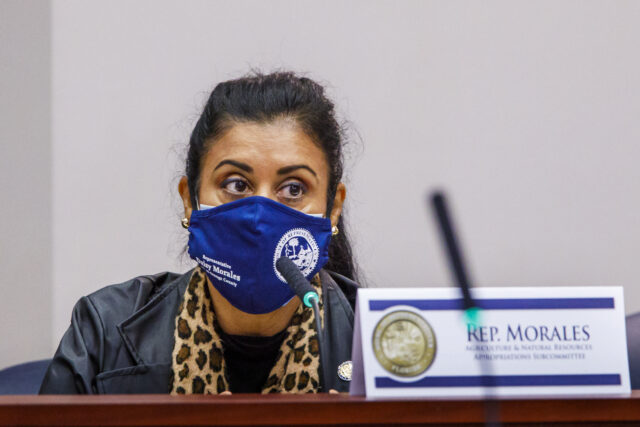
Morales hopes Florida could become a national model on veteran education.
“It’s great to work as partners to help disabled veterans who have sacrificed so much for our country with educational opportunities to eliminate challenges they face when they have given so much for our country and allow them to support their families,” Morales said when the bill was signed into law. “My office will work closely with other State Legislators looking to pass legislation for educational tuition assistance.”
2. Disabled Homeowners
In July of 2021, Rep. Morales and State Representative Michael Gottlieb (D-Broward) filed HB 13 – Property Tax Exemptions For Widows, Widowers, Blind Persons, or Persons Totally and Permanently Disabled, a 2022 bill increasing the homestead exemption for the widowed and disabled.
HB 13 proposes a 10x property tax exemption increase for residents who are widows, widowers, blind persons, or persons totally and permanently disabled from $500 to $5,000. The exemption would apply to tax years beginning on or after January 2023.
HB 13 was eventually amended into HB 7071, the largest tax relief bill in Florida’s history, offering $1.2 billion in tax relief to Floridians in the form of several tax holidays in addition to the 10x tax exemption increase for disabled homeowners.
3. Down Syndrome Community
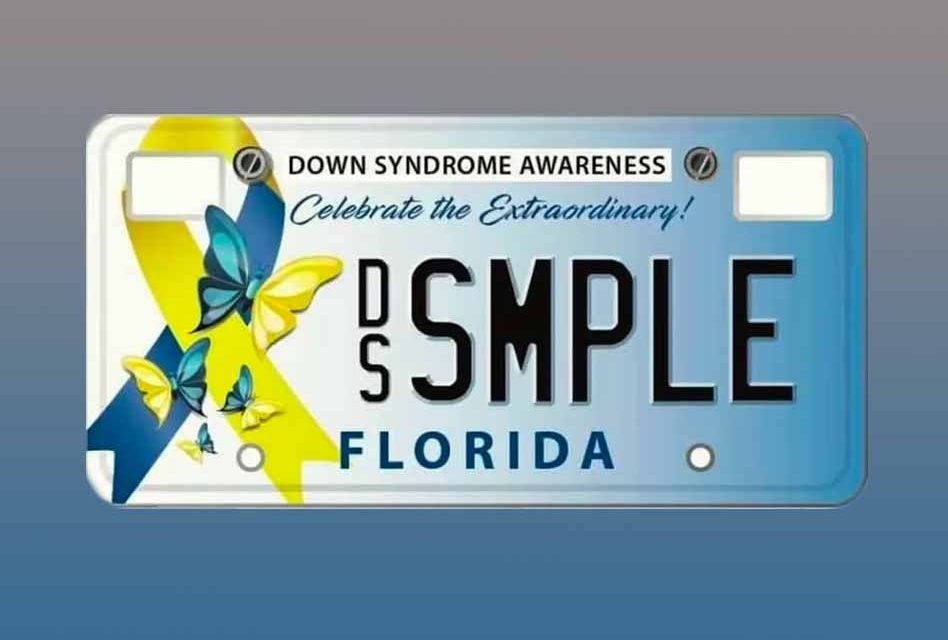
In December of 2021, Rep. Morales drafted HB 213 – Specialty License Plates, proposing the sale of Down Syndrome specialty license plates, and breaking down where the proceeds would go:
- Fifty percent would be used to build and maintain HOLLAND, an affordable housing project for independent living for persons with Down Syndrome and other intellectual disabilities.
- Fifteen percent would be dedicated to World Changer scholarships provided by Our City Beautiful, a non-profit organization, for Florida residents 18 years of age or older with Down Syndrome who wish to further their education at Florida postsecondary educational institutions.
- Thirty-five percent would be used for grants to other nonprofit organizations within this state to support housing, educational scholarships, and employment assistance programs for persons with Down Syndrome and other intellectual disabilities.
The Senate companion bill, CS/CS/SB 364, which included Rep. Morales’ bill as well as bills for several other specialty license plates, was signed into law.
Leadership and Commitment to Advocacy
As a former vice chair of the Orange County Disability Advisory Board and longtime caretaker for her adult sister with Down Syndrome, Rep. Morales used her real life experiences to author and support legislation benefitting Floridians with disabilities once she got to Tallahassee. In addition to the three key disability-related bills she sponsored, she also co-sponsored HB 15 – Children with Developmental Delays, HB 173 – Care of Student with Epilepsy or Seizure Disorders, HB 235 – Restraint of Students with Disabilities in Public Schools, and HB 475 – Alzheimer’s Disease and Related Forms of Dementia Education and Public Awareness.
Morales also brought that commitment to District 48.
FILE – (l-r) Orlando District 2 Commissioner Tony Ortiz and State Representative Daisy Morales at the Engelwood Neighborhood Center. File photo: Willie David/Florida National News.
With April being Autism Awareness Month, Morales teamed up with District 2 Orlando City Commissioner Tony Ortiz to host an Autism Awareness Day event at the Engelwood Neighborhood Center, located on South Semoran Blvd. The event featured vendors who serve the Autism community: attorneys, health care companies, small business owners, and even the arts community, all coming together to raise awareness of the services available in Central Florida for residents with autistic family members.
Rep. Morales proved herself a common sense champion over the past two years with a passion for helping one of Florida’s most vulnerable communities. The disabled community is the biggest winner of Rep. Morales’ legislative agenda during her time in the Florida House of Representatives.
That’s why Florida National News is proud to name Daisy Morales State Legislator of the Year for 2022.
“I’m honored to be recognized by Florida National News for this,” Morales said. “I also appreciate this media outlet for consistently reporting on the work my office was doing throughout my term. I fight to ensure the disability community is heard, because they need a voice in Tallahassee. As the sibling and caretaker of someone with Down Syndrome, I understand what the disability community needs and wanted to use the authority entrusted to me by the voters to give them what they need.”
You may like

Trump Calls for “Permanent Pause” on Migration from Poorer Nations After D.C. Shooting

Elon Musk Waves ‘Chainsaw of Bureaucracy’ at Conservative Conference, Vows to Cut Through Federal Government

Honoring the Legacy of Senator Geraldine Thompson: A Champion of Voting Rights, Education, and African American History
Florida
Democratic Leaders Condemned Susan Valdés’ GOP Switch; Orange Democrats Later Appear Alongside Her
Published
5 days agoon
August 30, 2026TALLAHASSEE, Fla. (FNN) — Florida Democratic leaders sharply condemned state Rep. Susan Valdés after she left the Democratic Party and joined the Republican Party in December 2024. A later photograph shows prominent Orange County Democrats appearing alongside the Tampa-area Republican lawmaker at a Florida Capitol gathering.
Among those identified at the gathering are Samuel Vilchez Santiago, a former Orange County Democratic Party chair and the 2026 Democratic nominee for Florida House District 43; Democratic state Rep. Johanna López of Orlando; and Joel Montilla, a former candidate for Orange County Commission District 5.
The photograph shows Valdés and other attendees in a legislative office with a Puerto Rican Bar Association of Florida banner displayed behind them.
Their appearance does not establish an endorsement of Valdés or support for her decision to become a Republican. But the photograph provides a notable contrast to the Democratic backlash that followed her party switch.
Valdés Leaves Democrats for GOP
Valdés switched from Democrat to Republican on Dec. 9, 2024, weeks after winning reelection to the Florida House as a Democrat.
Her decision came shortly after an unsuccessful bid to chair the Hillsborough County Democratic Party.
In announcing the switch, Valdés criticized her former party and Democratic House leadership, saying she was tired of Democrats being a party of protesting rather than progress. She also said she wanted to focus on delivering results for her constituents.
Democratic Leaders Condemn Valdés
Valdés’ departure drew immediate criticism from Democratic leaders.
Then-House Democratic Leader Fentrice Driskell characterized the move as a “bait-and-switch” after voters had reelected Valdés as a Democrat.
Florida Democratic Party Chair Nikki Fried called the decision “hypocritical and self-serving,” while Democratic state Sen. Carlos Guillermo Smith of Orlando characterized the switch as “political opportunism.”
The criticism centered heavily on timing: Valdés won another term as a Democrat and then changed parties before beginning that term.
Orange Democrats Later Appear With Valdés
Against that backdrop, the later appearance of Orange County Democrats alongside Valdés presents a political contrast.
Vilchez Santiago previously chaired the Orange County Democratic Party and is now the Democratic nominee for House District 43. López is a Democratic state representative from Orange County. Montilla ran for the nonpartisan Orange County Commission District 5 seat in 2024.
Their presence with Valdés does not establish political support. Democrats and Republicans routinely participate together in legislative, professional and community events.
Vilchez Santiago Appears With Republican as Campaign Funding Draws Scrutiny
The photograph adds another dimension to the political narrative surrounding Vilchez Santiago.
Republican associations and questions of Democratic Party loyalty became issues during the 2026 House District 43 Democratic primary. Against that backdrop, Vilchez Santiago’s own appearances with Republicans — along with any documented campaign contributions from Republican or Republican-aligned donors — can be examined under the same standard.
Campaign-finance records can establish who contributed to his campaign, how much and when. However, receiving contributions from Republican donors is different from saying a campaign was “funded by Republicans.” Such a broader characterization requires evidence establishing the source and significance of that financial support.
Vilchez Santiago’s former position as Orange County Democratic Party chair makes the political contrast more pronounced: the Democratic nominee is pictured alongside a Republican legislator whom Democratic leaders publicly condemned after she left their party.
Same Standard for Political Associations
The central issue is consistency.
A photograph with a Republican does not automatically constitute an endorsement. Neither does attending a bipartisan event or receiving a lawful contribution from an individual Republican.
If political associations with Republicans are considered relevant when evaluating one Democrat’s party loyalty, similar associations involving other Democratic candidates should be evaluated using the same evidentiary standard.
The photograph establishes an appearance. Campaign-finance reports establish contributions. Neither, standing alone, establishes an endorsement, coordination or political alliance.
From Condemnation to Capitol Gathering
Valdés was not simply another Republican legislator at the Capitol. She won reelection as a Democrat before joining the Republican Party and drawing sharp condemnation from Democratic leaders.
The later photograph therefore presents a notable political contrast: Orange County Democratic political figures appearing alongside a Republican lawmaker whose departure from their party Democratic leaders had publicly condemned.
Whether those appearances represented political support requires additional evidence.
Florida
[COURTS & LAW] Paula Stark Court Record Could Impact Daisy Morales, James Bush III Defamation Lawsuits Against FHDCC
Published
1 week agoon
August 28, 2026Stark’s Leon County Election Fight, Bush’s $1 Million Default Battle in Miami-Dade and Morales’ Orange County Defamation Lawsuit Could Put FHDCC’s Legal Status Under Scrutiny in Three Florida Courts
ORLANDO, Fla. (FNN) — Three Florida court cases. Three counties. One political committee — and an unresolved legal question that could affect two pending defamation lawsuits.
Court records obtained and reviewed by Florida National News show the Florida House Democratic Campaign Committee (FHDCC) sought permission to become a Party Defendant in Republican state Rep. Paula Stark’s Leon County election lawsuit in June 2026.
Less than a month later, FHDCC took a different procedural position in former Democratic state Rep. James Bush III’s Miami-Dade defamation lawsuit, arguing that it is an unincorporated political organization that lacks the capacity to be sued in its own name.
That position is supported by a sworn affidavit submitted by State Rep. Christine Hunschofsky, chair of FHDCC, describing her authority over committee funds and legal matters and stating the committee’s position that it cannot be sued as a political committee.
Now, former Democratic state Rep. Daisy Morales has named FHDCC as a defendant in a separate defamation lawsuit in Orange County.
The cases involve different parties, claims and legal issues. FHDCC’s attempt to intervene in Stark’s case does not establish that the committee has capacity to be sued in Bush or Morales.
But the developing record presents a significant question: FHDCC affirmatively asked one Florida circuit court to allow it to become a Party Defendant, then later argued in another that its organizational structure prevents it from being sued in its own name.
FHDCC Asked to Become a Party Defendant in Stark Case
Stark, a Republican state representative from St. Cloud, sued after election officials determined she failed to qualify for reelection to House District 47.
Her case, Paula Stark v. Cord Byrd, et al., Case No. 2026-CA-1311, was filed in the Second Judicial Circuit in Leon County before Circuit Judge Joshua M. Hawkes.
On June 25, 2026, attorney Mark Herron filed a motion on behalf of FHDCC and Democratic House District 47 candidates Jorge Figueroa and Anthony Nieves.
The filing was expressly titled “Motion to Intervene as a Party Defendants in Pending Election Case” and asked Hawkes to permit FHDCC, Figueroa and Nieves to intervene as Party Defendants under Florida Rule of Civil Procedure 1.230.
FHDCC also described itself in the motion as an affiliated party committee established under Section 103.092, Florida Statutes, to support Democratic candidates for the Florida House.
The committee asserted that the outcome of Stark’s lawsuit would affect the resources FHDCC would expend in the House District 47 election.
Herron signed the filing as “Attorney for the Florida House Democratic Campaign Committee.”
Herron also serves as FHDCC treasurer. His dual role could become relevant if the Bush or Morales defamation lawsuits reach discovery concerning the committee’s organization, finances or decision-making. Any potential testimony would depend on Herron’s firsthand knowledge and applicable attorney-client and other legal protections.
Hawkes Denied FHDCC Intervention
FHDCC did not succeed in becoming a party to Stark’s case.
In his July 8 Order on Petition for Mandamus, Hawkes explained that he denied FHDCC intervention because the committee’s asserted interest amounted to “just a financial stake.”
Hawkes instead allowed Figueroa and Nieves to intervene because their candidacies and political positions were directly affected by whether the primary would remain closed. The written order consequently identifies Figueroa and Nieves — not FHDCC — as intervenors.
That distinction is critical.
The Stark record establishes that FHDCC asked to become a Party Defendant. It does not establish that the court accepted FHDCC in that capacity. Hawkes expressly denied the committee’s request.
Hawkes ultimately denied Stark’s request for ballot relief. In his analysis, he also referenced an argument advanced by “counsel for Intervenors.”
The Stark litigation was subsequently closed.
Why Stark Matters
Hawkes did not decide whether FHDCC has legal capacity to sue or be sued.
He rejected FHDCC’s intervention because its asserted interest in the election dispute was insufficient.
But the underlying motion remains significant because it establishes that FHDCC, through counsel, affirmatively invoked a Florida court’s jurisdiction and asked to participate as a Party Defendant.
That record could become relevant if FHDCC maintains in other courts that its organizational structure prevents it from being sued in its own name.
Bush’s $1 Million Default Battle in Miami-Dade
While Stark’s election litigation was unfolding in Leon County, FHDCC was facing a different legal battle in Miami-Dade.
Former Democratic state Rep. James Bush III filed a defamation lawsuit in August 2025 against Edge Communications, LLC, Strong Community, FHDCC and state Rep. Ashley Gantt.
The case, James Bush III v. Edge Communications, LLC, et al., Case No. 2025-015569-CA-01, was assigned to Section CA31 of the Eleventh Judicial Circuit and Circuit Judge Migna Sanchez-Llorens, according to the court’s Case Management Order.
The order, signed Oct. 11, 2025, established July 8, 2026, as the deadline for summary judgment and dispositive motions, resolution of certain pretrial matters and mediation. It projected an Oct. 6, 2026 trial date.
On July 8 — the same day Hawkes issued his Stark ruling in Leon County — clerk defaults were entered against FHDCC and other defendants in Bush’s lawsuit, according to filings previously reviewed by FNN.
FHDCC moved to set aside its default on July 15.
Bush then filed a Motion for Final Default Judgment on July 29 seeking $1 million, plus costs, against the defaulted defendants.
The distinction is important: Bush is seeking a $1 million final default judgment. The court has not entered a $1 million judgment based on the records reviewed for this report.
FHDCC Argues It Cannot Be Sued in Its Own Name
FHDCC’s response to the Miami-Dade default creates the central comparison with the Stark record.
In its Motion to Set Aside Default, FHDCC argued that it is a 527 political unincorporated organization that lacks capacity to be sued in its own name.
The committee cited Larkin v. Buranosky, a 2008 Florida appellate decision involving unincorporated political organizations.
That remains FHDCC’s legal position, not a determination by the Miami-Dade court.
But the timing creates a significant comparison:
June 25 — Leon County: FHDCC asks to enter litigation as a Party Defendant.
July 8 — Leon County: Hawkes denies FHDCC intervention.
July 15 — Miami-Dade County: FHDCC argues that its organizational status prevents it from being sued in its own name.
Those positions are not automatically contradictory. Intervention and capacity to be sued are distinct legal questions, and Hawkes did not decide whether FHDCC possessed capacity to sue or be sued.
But the records could invite scrutiny of how FHDCC characterizes its legal identity and litigation authority in different proceedings.
FHDCC Chair Hunschofsky Submits Sworn Affidavit
The Miami-Dade dispute took on added significance when State Rep. Christine Hunschofsky, chair of the Florida House Democratic Campaign Committee, submitted a sworn affidavit supporting FHDCC’s effort to set aside the default.
Hunschofsky described FHDCC as a Florida registered political committee affiliated with the Florida Democratic Party but not controlled by it.
She also described her authority within the organization, stating that she is responsible for the allocation of FHDCC funds and for legal actions against the committee and its defense.
Hunschofsky further stated that FHDCC is an unincorporated entity and that the committee understands it “cannot be sued as a political committee.”
She said that after learning Bush had obtained a default, she immediately instructed attorney Juan-Carlos Planas to seek to set aside the default and have the case dismissed based on FHDCC’s position that it cannot be sued under Florida law.
The affidavit represents sworn statements by FHDCC’s chair concerning the committee’s structure and her responsibilities. Her assertion concerning whether FHDCC can be sued is the committee’s legal position; it does not establish that Sanchez-Llorens has accepted that interpretation.
Morales Defamation Lawsuit Brings Question to Orange County
The third case brings the issue to Orange County.
On Aug. 14, former Democratic state Rep. Daisy Morales filed a defamation lawsuit against FHDCC and Democratic House District 43 nominee Samuel Vilchez Santiago.
The case, Daisy Morales v. Samuel Vilchez Santiago and Florida House Democratic Campaign Committee, Case No. 482026CA008697A001OX, is pending in the Ninth Judicial Circuit before Circuit Judge Michael Deen.
Morales asserts claims for defamation/libel and defamation by implication arising from political mailers distributed during the Democratic primary campaign.
Among the disputed statements was a representation that Morales endorsed Republican candidates and was expelled from the Orange County Democratic Party.
Morales alleges the statements were false and defamatory.
Those allegations remain pending. Neither Vilchez Santiago nor FHDCC has been found liable for defamation.
Vilchez Santiago defeated Morales in the Aug. 18 Democratic primary, but the election result does not resolve the civil lawsuit.
Could Stark and Bush Affect Morales?
The Stark intervention record makes the potential Orange County issue clearer.
If FHDCC raises the same capacity defense against Morales that it raised against Bush, the Orange County court could be asked to consider a broader record concerning the committee’s legal identity and structure.
That record could include FHDCC’s request to become a Party Defendant in Stark; Herron’s representation of the committee; Hawkes’ denial of FHDCC intervention; FHDCC’s Miami-Dade capacity argument; Hunschofsky’s sworn affidavit; and state records governing the committee’s organization and operations.
None of that evidence establishes the merits of Morales’ defamation claims.
But it could become relevant to a threshold question:
Is FHDCC itself a proper defendant?
And if Florida law ultimately says it is not, another question follows:
Who is the proper party for allegedly actionable conduct undertaken through the committee?
Three Courts, Different Consequences
The issue carries different consequences in each court.
Leon County: FHDCC affirmatively sought Party Defendant status, but Hawkes denied its intervention. Stark’s case is closed, and nothing in the Bush or Morales litigation currently changes that outcome.
Miami-Dade County: The consequences are immediate. Bush is seeking a $1 million final default judgment while FHDCC is attempting to set aside its default and arguing that it cannot be sued in its own name.
Orange County: The issue is prospective. If FHDCC raises the same capacity defense against Morales, Deen could be asked to examine the developing Stark and Bush records in determining whether FHDCC is a proper defendant.
One Political Committee, Three Florida Courts
The court records do not establish wrongdoing by FHDCC, Herron, Hunschofsky or their attorneys. Nor do they establish the merits of the Bush or Morales defamation claims.
What they do establish is an unusual litigation record involving the same political committee across three Florida circuit courts.
In Leon County, FHDCC asked to become a Party Defendant — and Hawkes denied the request.
In Miami-Dade County, FHDCC is fighting a clerk’s default and Bush’s request for a $1 million final default judgment while arguing that it cannot be sued in its own name.
In Orange County, FHDCC is now a named defendant in Morales’ defamation lawsuit.
The cases could ultimately put a fundamental question under scrutiny:
What is the Florida House Democratic Campaign Committee’s legal status — and if FHDCC cannot be sued in its own name, who may be held legally accountable for actionable conduct undertaken through the committee if that conduct is ultimately proven?
Florida
FIU Becomes First Florida University to Launch CORE Emergency Management Partnership
Published
1 week agoon
August 26, 2026MIAMI, Fla. (FNN) — Florida officials announced the launch of the Coalition for Operational Readiness in Education, or CORE, Program at Florida International University, beginning an initiative designed to strengthen the state’s emergency management workforce through partnerships with colleges, universities and technical and trade schools.
The program will connect higher education institutions with the Florida Division of Emergency Management and other state agencies to provide students with specialized education and training in emergency management.
CORE is also expected to provide opportunities for students to earn industry-recognized certificates and establish pathways to jobs with emergency management offices and private-sector industry partners across Florida.
FIU First to Launch CORE
Florida International University in Miami is the first institution where CORE is being rolled out.
State officials said 11 institutions have committed to participating, with the long-term goal of expanding the initiative to every college, university, technical school and trade school in Florida.
The statewide expansion would create a pipeline of students trained for careers involving disaster preparedness, emergency response and recovery.
Building Florida’s Emergency Management Workforce
Florida’s exposure to hurricanes and other natural disasters has made emergency preparedness and response a major state priority.
Officials said maintaining Florida’s emergency management capabilities requires developing the next generation of professionals who will work before, during and after disasters and other emergencies.
The CORE partnerships are designed to connect classroom education with professional training, certifications and employment opportunities.
Education-to-Employment Pipeline
The program is intended to create a more direct pathway from education to careers in emergency management.
Through partnerships involving state agencies, educational institutions and industry organizations, students could gain specialized training while developing credentials recognized by employers.
The initiative could also help state and local emergency management agencies develop a larger pool of trained candidates as Florida’s population and emergency-response needs continue to grow.
Statewide Expansion Planned
While the program begins at FIU, officials said the broader objective is statewide.
The goal is to eventually establish CORE partnerships throughout Florida’s higher education and workforce-training system, including universities, colleges, technical schools and trade schools.
Florida officials also envision CORE becoming a workforce-development model that other states could replicate.
Key Takeaways
- Program: Coalition for Operational Readiness in Education (CORE)
- Initial launch: Florida International University in Miami
- State partner: Florida Division of Emergency Management and other state agencies
- Participating institutions: 11 institutions have committed so far
- Training: Specialized emergency management education and workforce preparation
- Credentials: Industry-recognized certificates
- Career component: Pathways to emergency management agencies and industry employers
- Long-term goal: Expand CORE to colleges, universities, technical schools and trade schools throughout Florida
- National objective: Develop a Florida workforce model that could be replicated in other states
Trending
Florida5 days agoDemocratic Leaders Condemned Susan Valdés’ GOP Switch; Orange Democrats Later Appear Alongside Her
Entertainment3 days agoTom Cruise Announces ‘Days of Thunder’ 2 With Anne Hathaway, Surprises NASCAR Fans at Daytona
Sports5 days agoRyan Preece Captures Checkered Flag in Dramatic Coke Zero Sugar 400 Victory at Daytona
Entertainment9 hours agoLee Brice, Kane Brown, Brantley Gilbert, Brandon Lake and Stephen Wilson Jr. to Headline Audacy’s Stars and Strings in South Florida