

North Florida News
DeSantis eases voting rules in counties devastated by Ian


Florida
Byron Donalds Secures Endorsement From Gainesville Democrat Cynthia Moore Chestnut, Spotlighting Cross-Party Politics

Longtime Democratic leader backs Republican nominee as state Sen. LaVon Bracy Davis pushes back, renewing debate over the impact of cross-party endorsements in Florida politics
GAINESVILLE, Fla. (FNN) — Republican gubernatorial nominee Byron Donalds has secured the endorsement of Gainesville City Commissioner Cynthia Moore Chestnut, a longtime Democrat and former state lawmaker, drawing criticism from fellow Democrats and putting Florida’s history of cross-party political support in the spotlight.
Proud to have the endorsement of Cynthia Moore Chestnut, a longtime public servant who has represented her community at the city, county, and state levels.
I’m honored to have her support as our movement continues to grow across Florida! pic.twitter.com/r0oARJB15o
— Byron Donalds (@ByronDonalds) September 3, 2026
Chestnut announced her support for Donalds on Thursday and followed with a lengthy explanation defending her decision. She said she remains a Democrat but does not believe party affiliation should dictate her vote.
“My endorsement of Byron Donalds is not a betrayal of my values; it is a declaration that Black voters are not political property,” Chestnut wrote.
Chestnut, a former Florida House member, Alachua County commissioner and Democratic Party leader, said she wants to see Florida elect a Black governor in her lifetime.
That gives the endorsement additional historical significance. Donalds, who won the Republican nomination in Florida’s Aug. 18 primary, is seeking to become Florida’s first Black governor, according to The Associated Press.
The endorsement is also notable because Chestnut previously supported Democratic gubernatorial nominee David Jolly before shifting her support to his Republican opponent. Current reporting confirms Chestnut’s endorsement and her subsequent defense of the decision.
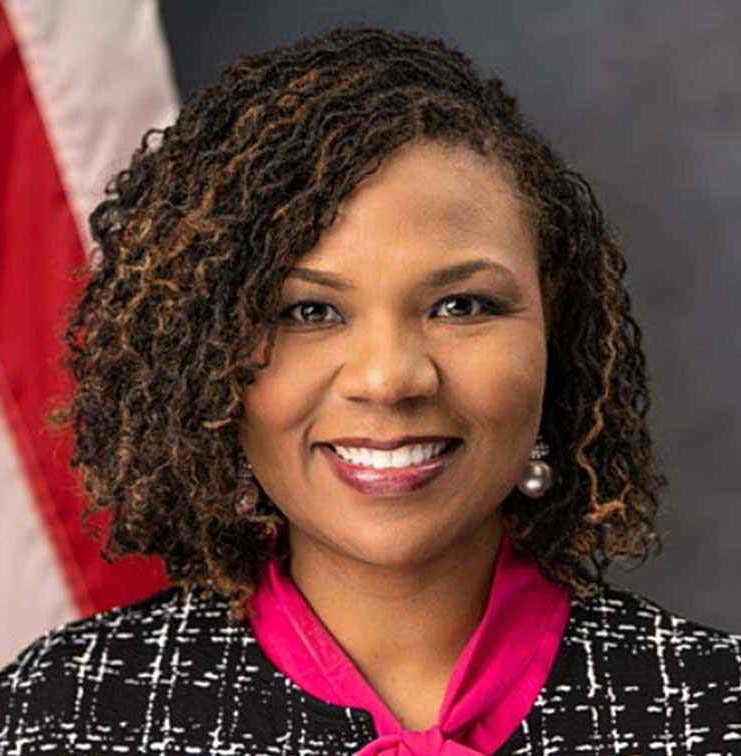
Florida Democratic state Sen. LaVon Bracy Davis, who represents Central Florida in the Florida Senate.
State Sen. LaVon Bracy Davis Pushes Back on Donalds Endorsement
Democratic state Sen. LaVon Bracy Davis of Ocoee responded with an extensive public statement saying she was “deeply disappointed” by Chestnut’s decision.
Bracy Davis focused much of her criticism on Donalds’ record on voting rights, including his opposition to federal voting-rights legislation and to the proposed Harry T. and Harriette V. Moore Florida Voting Rights Act, which Bracy Davis sponsors.
“I want to see a Black governor of Florida in my lifetime too,” Bracy Davis wrote, while arguing that representation should not be separated from a candidate’s voting record and policy positions.
The disagreement presents competing views of political independence. Chestnut argues that Black voters should not be treated as the political property of either party. Bracy Davis argues that representation should be weighed against a candidate’s record and policies.

Byron Donalds’ Jim Crow Remarks Resurface
Bracy Davis also invoked Donalds’ controversial 2024 comments about Black families during the Jim Crow era.
Donalds said at a Philadelphia event that “during Jim Crow, the Black family was together” while discussing marriage and family structure. Democrats sharply criticized the remarks, while Donalds rejected interpretations that he was praising segregation.
The distinction is important: Donalds did not explicitly say Black Americans were better off under Jim Crow.
Cynthia Moore Chestnut Points to FAMU and Black Representation
Chestnut also cited Donalds’ connection to Florida A&M University and the importance she places on Black representation.
Donalds attended FAMU before transferring to Florida State University, where he earned his bachelor’s degree.
Chestnut, a FAMU graduate, said she respects Donalds’ support for historically Black colleges and universities and also cited shared cultural connections through his Jamaican and Panamanian family background.
Bracy Davis countered that attending an HBCU should not substitute for examining a candidate’s political record.
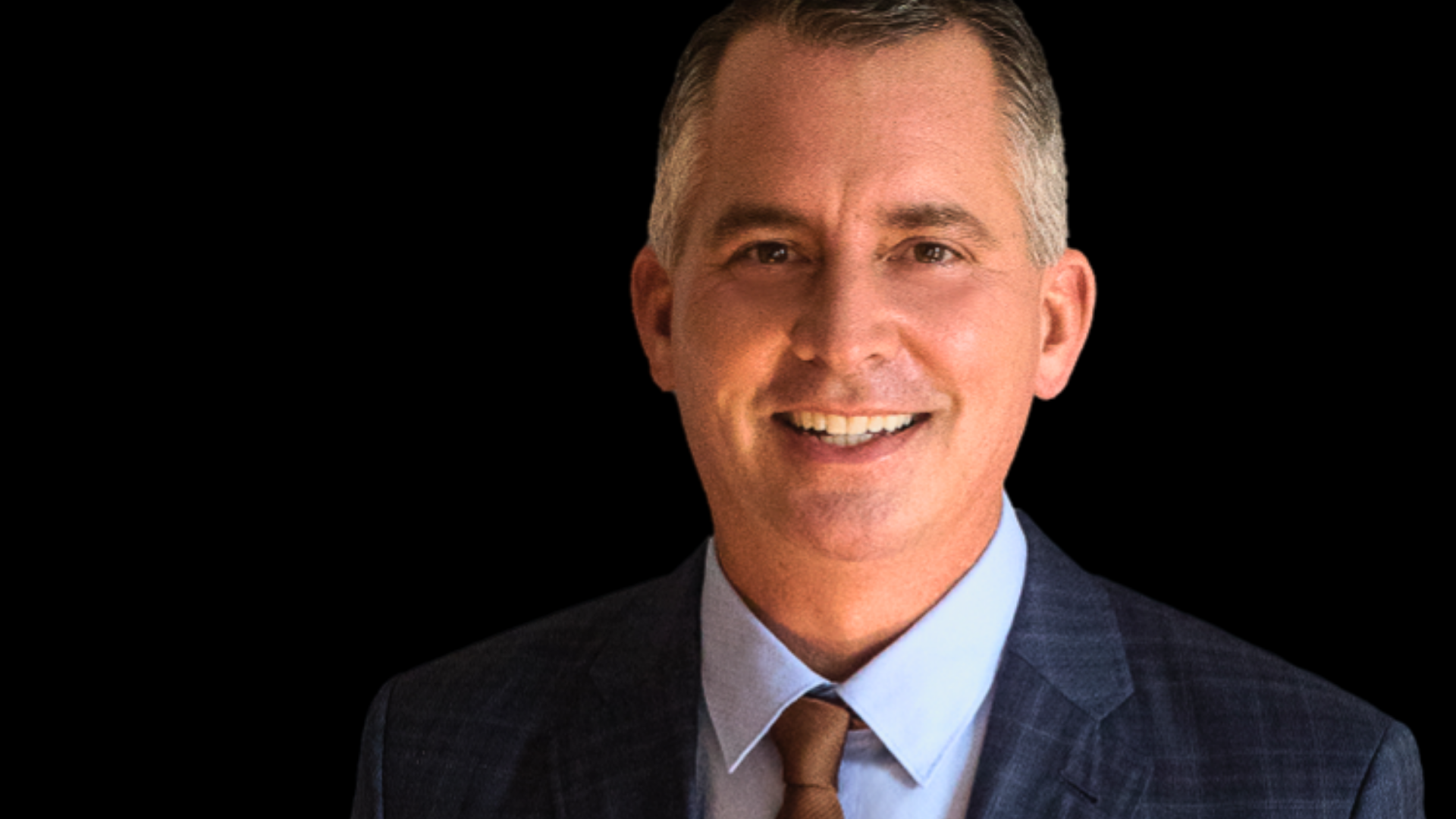
David Jolly, a former Republican congressman who became a Democrat in 2025, is the Democratic nominee for governor of Florida in 2026. Source David Jolly
David Jolly Was a Republican Before Becoming a Democrat in 2025
Party affiliation adds another dimension to the controversy.
Democratic gubernatorial nominee David Jolly represented Florida in Congress as a Republican from 2014 to 2017. He left the Republican Party in 2018 and became an independent.
Jolly remained unaffiliated for several years before registering as a Democrat in April 2025, as he considered entering the 2026 governor’s race.
He subsequently entered the race and won the Democratic nomination in the Aug. 18 primary. AP described the contest as Donalds, the Republican nominee, against Jolly, a former Republican congressman running as the Democratic nominee.
The circumstances differ from Chestnut’s decision: Jolly formally changed parties; Chestnut says she remains a Democrat while supporting the Republican nominee.
The history nevertheless creates an unusual political contrast: a longtime Democrat is supporting Donalds over a Democratic nominee who previously represented Florida in Congress as a Republican.

Byron Donalds Adds $1 Million From Orlando-Based Morgan & Morgan
Chestnut’s endorsement comes as Donalds continues attracting substantial financial support heading into the general election.
A Florida National News review of Florida Division of Elections campaign-finance records found that Morgan & Morgan contributed $1 million to Friends of Byron Donalds PAC on Aug. 26, 2026.
The contribution appears in the committee’s 2026 G1A report and identifies the contributor as “Morgan & Morgan,” with an address at 20 N. Orange Ave., 16th Floor, Orlando.
The same report shows 18 contributions totaling approximately $1.93 million, meaning the Morgan & Morgan contribution accounted for more than half of the money listed in that group of contributions.
Morgan & Morgan was founded by Orlando attorney John Morgan, who has a long history of political involvement and support for Democratic candidates and causes, although his political activity has crossed party lines.
The distinction is important: Florida’s filing identifies Morgan & Morgan — not John Morgan personally — as the contributor of the $1 million.
For Donalds, the developments represent two different forms of support as the general election takes shape: a seven-figure contribution from a prominent Orlando law firm and a cross-party endorsement from a Democratic elected official with decades of experience in Florida politics.
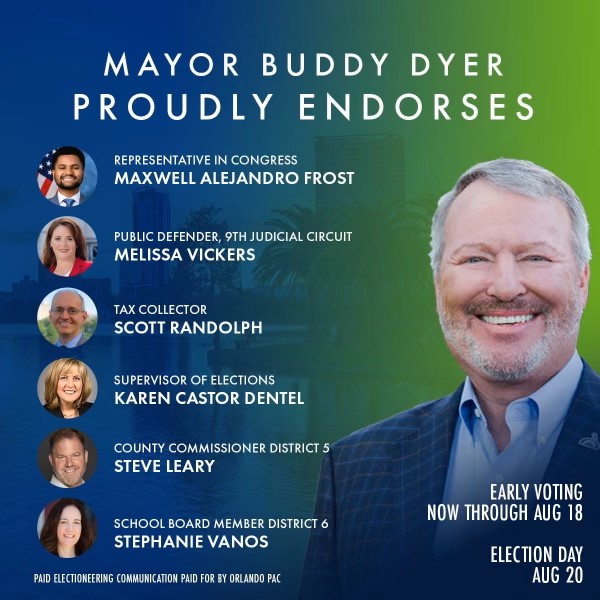
Democratic Orlando Mayor Buddy Dyer included Republican Steve Leary among his endorsed candidates for the 2024 election. The Orlando PAC mailer promoted Leary for Orange County Commission District 5 alongside several Democratic candidates. Source Winter Park Voice
Buddy Dyer, Gary Siplin and Victoria Siplin Show Cross-Party Support Is Not New
Chestnut’s decision has generated attention, but Democratic elected officials supporting Republican candidates is not unprecedented in Central Florida.
During the 2024 Orange County Commission District 5 race, Democratic Orlando Mayor Buddy Dyer endorsed Republican former Winter Park Mayor Steve Leary.

Political Rivals: Samuel Vilchez Santiago lost the 2020 Florida House District 48 Democratic primary to Daisy Morales, who went on to win the seat. During Morales’ 2022 reelection campaign, Vilchez Santiago supported Rita Harris, who defeated Morales in the Democratic primary. Vilchez Santiago later chaired the Orange County Democratic Party during the 2024 dispute over Morales’ party status. In their 2026 House District 43 rematch, the dispute resurfaced in news coverage and FHDCC attack mailers alleging Morales endorsed Republicans and was expelled from the local party. The mailers identified the Florida House Democratic Campaign Committee as the payer and Vilchez Santiago as approving them. Morales disputes the allegations and has challenged them through litigation and an election complaint.
Samuel Vilchez Santiago, then-chairman of the Orange County Democratic Executive Committee, told Winter Park Voice that the organization “sent out texts and mailers alerting voters that Leary is a Republican, not a Democrat.” Vilchez Santiago said those communications were not issued in response to Dyer’s endorsement, but were intended to educate voters.
However, former Democratic state Sen. Gary Siplin and Orange County Commissioner Victoria Siplin, also a Democrat, supported Leary as well.
Those endorsements occurred in an officially nonpartisan county election, an important distinction from the partisan governor’s race, although the candidates’ political affiliations were publicly known.
The examples nevertheless demonstrate that prominent Central Florida Democrats have previously crossed party lines to support Republican candidates.
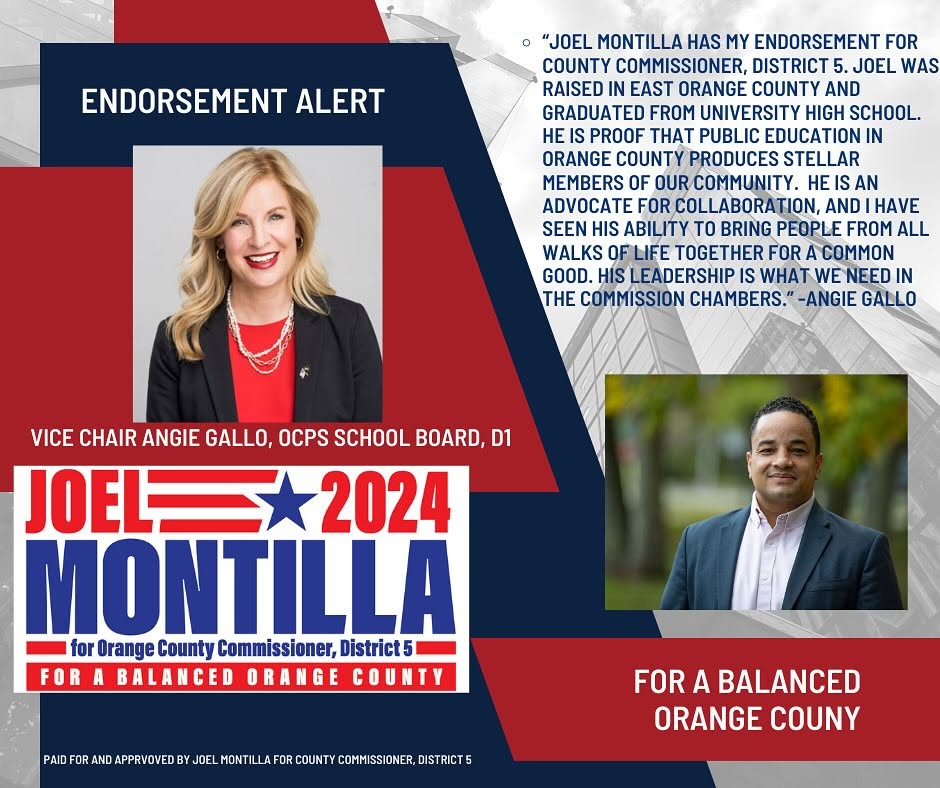
Then-Orange County School Board Vice Chair Angie Gallo publicly endorses Joel Montilla for Orange County Commission District 5 in a campaign graphic paid for and approved by Montilla’s campaign. Source: Joel Montilla Campaign
ANGIE GALLO ENDORSED JOEL MONTILLA AND SERVED AS HIS CAMPAIGN MANAGER
Another potentially relevant figure from the 2024 Orange County Commission District 5 campaign is Angie Gallo, then an Orange County School Board member.
A Joel Montilla campaign press release dated Oct. 24, 2023, identifies “Angie Gallo — Campaign Manager” in the campaign’s contact information. The campaign subsequently publicized Gallo’s endorsement of Montilla.
The documentary record therefore identifies Gallo as both Montilla’s campaign manager and a public supporter.
The Orange County Commission race was officially nonpartisan, although Montilla’s Republican affiliation was publicly known.
Gallo’s party-registration history, however, requires an important distinction. Published reports citing election records indicate she left the Republican Party in 2023, was registered No Party Affiliation during the 2023–24 Montilla campaign, and registered as a Democrat in 2025.
Her potential relevance is narrower: as Montilla’s documented campaign manager, Gallo could be a potential fact witness concerning how the campaign identified formal endorsers, host-committee participants and other supporters — including whether the campaign considered Morales an endorser.
FNN has not established that Gallo was contacted to verify the disputed endorsement allegation or that she will become a witness. Her inclusion is based on her documented campaign role, not an allegation of wrongdoing.
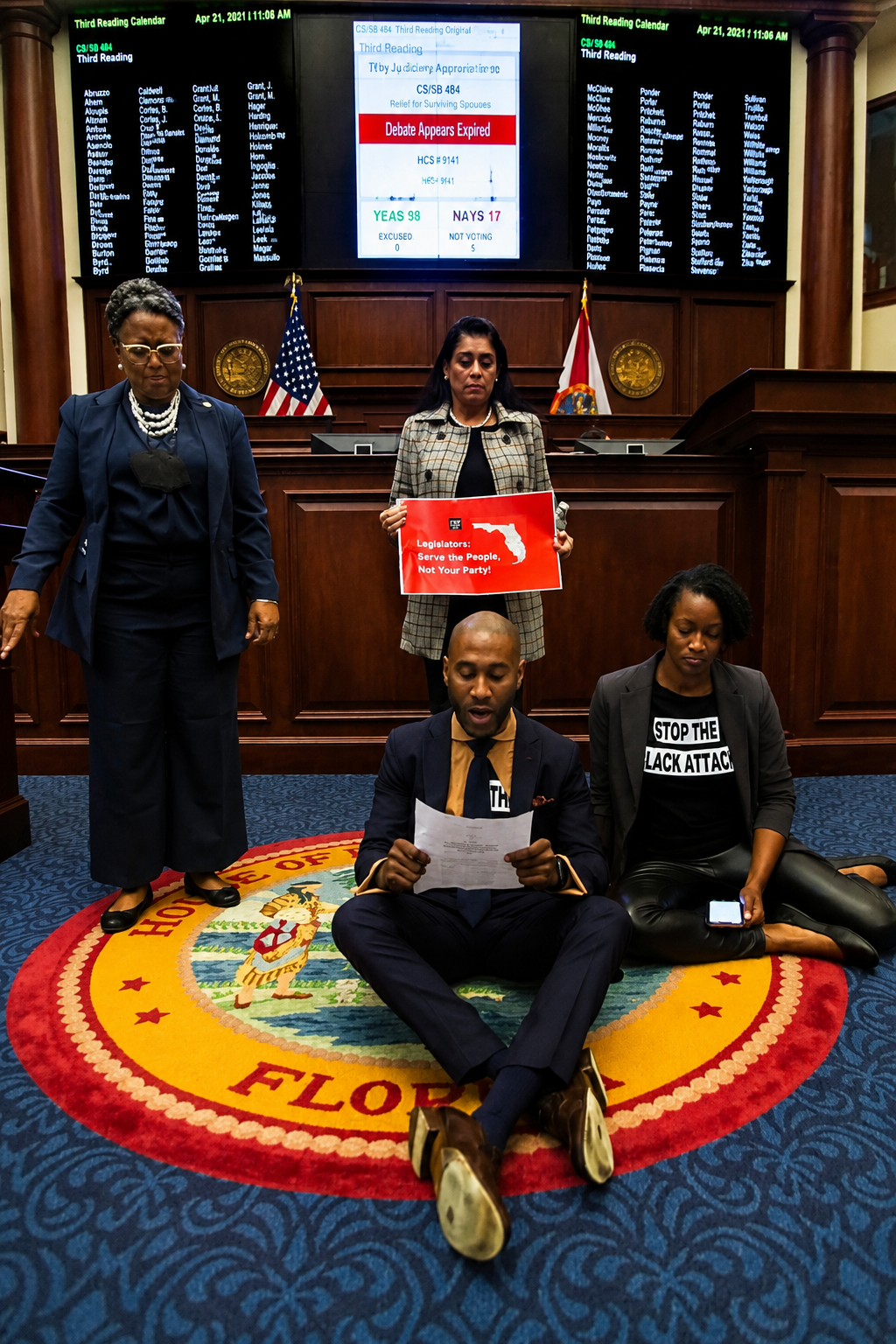
Rep. Yvonne Hayes Hinson, D-Gainesville, Rep. Daisy Morales, D-Orlando, Rep. Tray McCurdy, D-Orlando (in front) and Rep. Angie Nixon, D-Jacksonville, protest on the Florida Seal as debate is halted in the House of Representatives Thursday, April 21, 2022, at the Capitol in Tallahassee, Fla. The session was halted by the protest, but continued after a brief recess. Phil Sears AP
Former Democratic State Rep. Daisy Morales Adds Context to Party-Loyalty Debate
Former Orlando state Rep. Daisy Morales, a Puerto Rican Democrat, provides another Central Florida example relevant to the debate over party loyalty and political independence.
In 2022, Morales, a Puerto Rican lawmaker known for working across party lines, represented a Central Florida district with a significant Puerto Rican population.
On April 21, 2022, Morales joined Black Democratic lawmakers protesting a congressional redistricting map backed by Republican Gov. Ron DeSantis on the Florida House floor.
The demonstration received state and national attention.
The Miami Herald reported that several Black Democrats disrupted debate and that Democratic lawmakers sang “We Shall Overcome,” temporarily forcing the House into recess.
The Herald identified Morales alongside Democratic Reps. Yvonne Hinson, Travaris McCurdy and Angie Nixon in its reporting and accompanying photograph.
Morales carried a sign declaring:
“Legislators serve the people. Not your party.”
The Herald reported that McCurdy, Nixon and Rep. Felicia Robinson sat in the center aisle while more than a dozen Democratic colleagues gathered around them in solidarity. The Republican-controlled House later approved the congressional map 68-38 along party lines.
The demonstration also received national coverage.
NBC News, in reporting preserved through syndication, identified Morales as the Hispanic representative participating in the demonstration and subsequently issued a correction after initially identifying another lawmaker.
The episode placed Morales alongside Black Democratic lawmakers in one of the Legislature’s most visible protests of the 2022 congressional redistricting fight.
FNN also reported on the demonstration at the time, describing Democratic lawmakers as temporarily shutting down House proceedings while protesting the congressional map.
Two years later, Morales became involved in an Orange County Democratic Party dispute over an alleged loyalty-oath violation connected to the 2024 Orange County Commission District 5 election.
Morales disputes that she endorsed Republican Joel Montilla, maintaining that her involvement was limited to joining his campaign-launch host committee. Montilla has separately told FNN — and later confirmed to Florida Politics — that Morales did not endorse his campaign.
That creates a factual distinction between Morales’ and Gallo’s documented involvement with the Montilla campaign: Morales is identified in campaign material as a host-committee participant and denies making an endorsement, while Montilla’s campaign documentation identifies Gallo as his campaign manager and the campaign subsequently publicized her endorsement.
The comparison has an important limitation. Gallo was registered No Party Affiliation during the 2023–24 Montilla campaign, while Morales was a member of the Orange County Democratic Executive Committee, according to Vilchez Santiago’s account.
The available record therefore does not establish that Morales and Gallo were subject to the same Democratic Party membership requirements, loyalty provisions or disciplinary authority.
Gallo’s potential relevance is instead primarily factual: as Montilla’s campaign manager, she may have firsthand knowledge concerning how the campaign distinguished formal endorsements from host-committee participation.
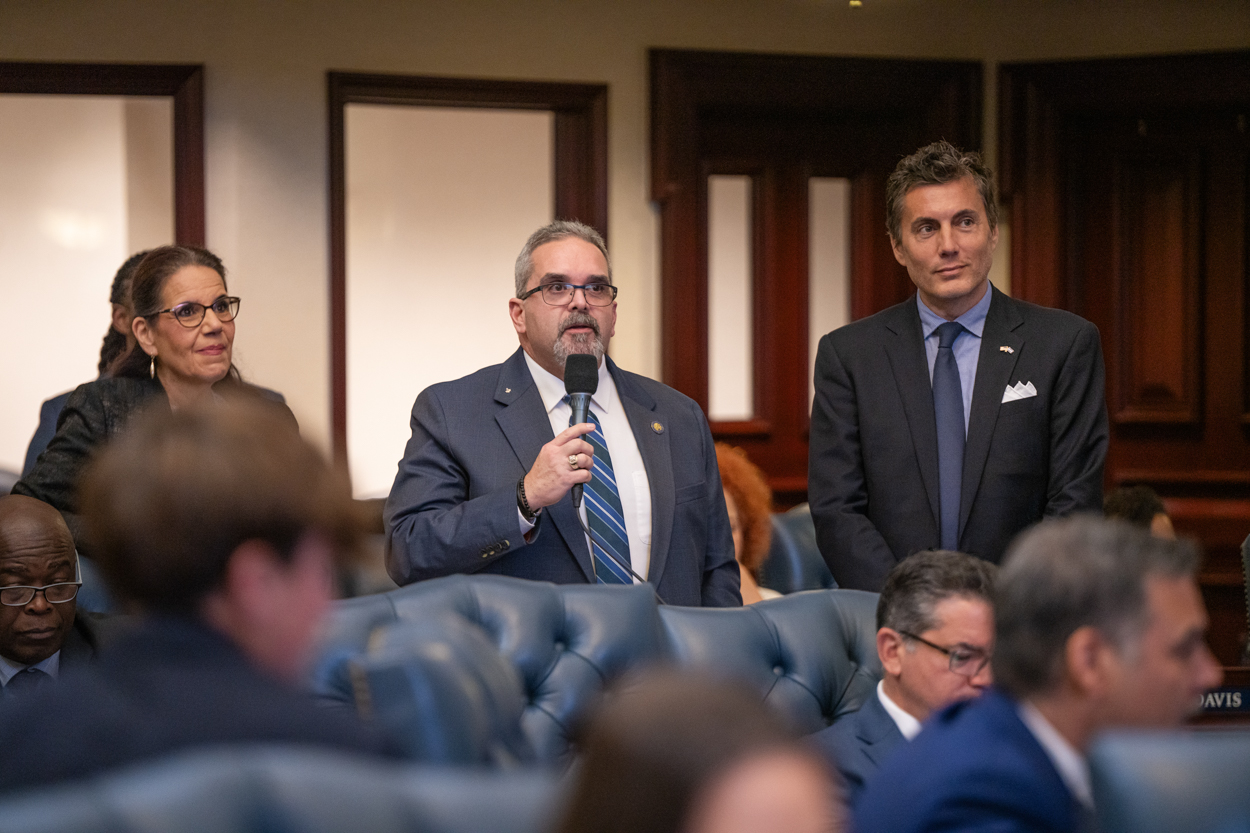
Democratic state Rep. Jose Alvarez, center, speaks on the Florida House floor alongside Democratic state Rep. Susan Valdés, left, and Republican state Rep. Fabián Basabe, right. Source: Florida House
State Rep. Jose Alvarez Crossed Party Lines, Then Withdrew His Support
Cross-party support has also occurred in partisan legislative politics.
Democratic state Rep. Jose Alvarez of Kissimmee endorsed Republican state Rep. Fabián Basabe for reelection in 2025, saying his decision reflected his experience working with Basabe rather than their different party affiliations.
Alvarez later rescinded the endorsement in July 2026 and called for Basabe to resign following a civil jury verdict involving two former House employees.
The episode nevertheless provides another recent example of a Central Florida Democrat publicly supporting a Republican candidate.
CROSS-PARTY SUPPORT AND DEMOCRATIC PARTY DISCIPLINE ARE DIFFERENT QUESTIONS
The examples involving Cynthia Moore Chestnut, Buddy Dyer, the Siplins, Daisy Morales and José Alvarez highlight an important distinction between cross-party political support and internal party discipline.
Being a registered Democrat or a Democratic elected official does not necessarily mean someone is subject to the same county party loyalty oath, bylaws or disciplinary procedures. Any comparison requires examining the individual’s party status, committee membership, applicable rules and conduct at the relevant time.
That distinction is part of the dispute involving former state Rep. Daisy Morales, who filed a defamation lawsuit and sought Florida Elections Commission review of campaign claims that she endorsed Republicans and was expelled from the Orange County Democratic Party. Those allegations remain disputed.
Angie Gallo presents a different issue. She was registered No Party Affiliation during the 2023–24 Joel Montilla campain. Her potential relevance arises instead from her documented role as Montilla’s campaign manager and possible firsthand knowledge concerning how his campaign identified endorsers and host-committee participants.
Accordingly, examples of cross-party political support can provide broader political context, but they do not by themselves establish selective enforcement or prove that different individuals were subject to identical Democratic Party rules.
CYNTHIA MOORE CHESTNUT SAYS SHE REMAINS A DEMOCRAT
Chestnut has made clear that her endorsement of Republican gubernatorial nominee Byron Donalds does not represent, in her view, a departure from the Democratic Party.
“This endorsement does not mean I have stopped being a Democrat,” Chestnut wrote.
Chestnut framed her decision as an exercise of political independence and emphasized her desire to see Florida elect a Black governor.
Democratic state Sen. LaVon Bracy Davis publicly criticized the endorsement, pointing to disagreements with Donalds’ political record and arguing that Democratic and Black voters should consider those differences.
Their disagreement illustrates a broader debate over party loyalty, representation, policy and political identity without establishing how internal party rules would apply to either situation.
CHESTNUT ENDORSEMENT ADDS A CROSS-PARTY ELEMENT TO THE GENERAL ELECTION
Chestnut’s endorsement represents a documented instance of a longtime Democratic political figure supporting the Republican nominee for governor.
Donalds won the Republican nomination Aug. 18 and is seeking to become Florida’s first Black governor. The Associated Press also placed his nomination within a historically notable group of Black major-party gubernatorial nominees running around the country in 2026.
Democrats nominated former U.S. Rep. David Jolly, who previously served in Congress as a Republican, later became an independent and subsequently joined the Democratic Party.
Chestnut has emphasized the historic dimension of Donalds’ candidacy in explaining her endorsement while maintaining that she remains a Democrat.
Whether additional Democratic officials make similar endorsements before the November election remains unknown.
The episode nevertheless provides a contemporary example of the distinction at the center of the broader discussion: cross-party political support is a documented political act, while whether that conduct violates an internal party rule depends on the particular person’s party position, applicable rules and circumstances.
________________________________________
CORRECTION/CLARIFICATION: Previous FNN reporting incorrectly identified Orange County School Board member Angie Gallo as a Democrat while discussing her role as campaign manager for Joel Montilla’s 2023–24 Orange County Commission campaign. Published reports indicate Gallo left the Republican Party in 2023, registered NPA, and became a registered Democrat in 2025. Her potential relevance as a fact witness concerning the Montilla campaign remains unchanged. FNN has updated its reporting accordingly.


 Florida4 days ago
Donalds, Jolly Court Black Voters In Governor’s Race. How Much Are They Spending With Black-Owned Media?
 Central Florida News3 days ago
Broadcaster Ray Cruz Santiago Criticizes Samuel Vilchez Santiago With Communist Graphics, Puerto Rican Identity Claims
 Central Florida News4 days ago
Festival of Trees Marks 40 Years With Holiday Displays, Santa Breakfasts and Parties
 Entertainment4 days ago
“4000 Days,” “Frampton” Set for Naples International Film Festival Oct. 24–25
 Business4 days ago
GOAA Highlights Airport Improvements, Approves New Small Business Policies


