

US NATIONAL NEWS
Oaths and pledges have been routine for political officials. That’s changing in a polarized America


COLUMBUS, Ohio (AP) — The resignation letter was short and direct.
“I can no longer be under an oath to uphold the New Constitution of Ohio,” wrote Sabrina Warner in her letter announcing she was stepping down from the state’s Republican central committee.
It was just days after Ohio voters resoundingly approved an amendment last November to the state constitution ensuring access to abortion and other forms of reproductive health care. For many, the vote was a victory after the U.S. Supreme Court overturned a constitutional right to abortion in 2022.
For Warner, a staunch abortion opponent, it meant she could no longer stand by the Ohio Constitution she had proudly sworn an oath to uphold just over a year before.
Throughout modern American history, elected officials have sworn oaths to uphold constitutions and said the Pledge of Allegiance without much controversy. In a handful of cases recently, these routine practices have fallen victim to the same political divisions that have left the country deeply polarized.
Disagreements over abortion rights, gun control and treatment of racial minorities are some of the issues that have caused several political leaders to say they cannot take an oath or recite the pledge.
Some Republicans, including Missouri Secretary of State Jay Ashcroft, a candidate for governor, point to amendments enshrining abortion rights in state constitutions. Ohio’s protections passed last fall, and advocates are proposing an initiative for the Missouri ballot this year.
Warner signed off her resignation letter, effective two days after Ohio’s vote, with a biblical reference to “the cowardly, the vile, the murderers” and more being “consigned to the fiery lake of burning sulfur.” She did not return messages seeking comment.

In Tennessee this month, Democratic Rep. Justin Jones declined to lead the pledge during a legislative session. He gained national attention after being one of two Black lawmakers whom Republicans briefly expelled from the state House last year after he and two other Democrats participated in a demonstration advocating for gun control from the House floor, outraging GOP members because it violated the chamber’s rules.
Tennessee House members are tapped to find a minister to lead a prayer before the start of a session and then to lead the chamber in the pledge to the American flag. Just before he was to do so, Jones submitted a handwritten note to the House clerk that read, “I prefer not to lead the pledge of allegiance.”
His refusal came as he has criticized his Republican colleagues for being racist and focusing on what he said are the wrong issues, such as targeting the LGBTQ+ community rather than addressing gun control nearly a year after six people, including three children, were killed in a school shooting in Nashville.
While another Democratic lawmaker, an Army veteran, led the pledge without commenting on Jones’ refusal, Republicans quickly expressed their outrage at Jones’ decision. GOP Rep. Jeremy Faison called Jones’ refusal to say the Pledge of Allegiance a “disgrace.”

“In my opinion, he should resign. That is an embarrassment to veterans and to people who have come before us,” Faison said.
Jones, responding later to the Republican criticism, said he “couldn’t bring myself to join their performative patriotism as they continue to support an insurrectionist for president and undermine liberty and justice for all.”
Jones’ stance recalled a similar one in 2001, when then-Tennessee Rep. Henri Brooks said she was chastised by Republican leaders for refusing to join her fellow lawmakers in the pledge. Brooks, who is Black, told media outlets at the time that she hadn’t recited the pledge since being in the third grade and declined to do so because the American flag represented the colonies that enslaved her ancestors.
Earlier this year, former President Donald Trump refused to sign a loyalty oath in Illinois, a pledge that has been in place since the McCarthy era.
The part Trump left unsigned confirms that candidates “do not directly or indirectly teach or advocate the overthrow of the government” of the United States or the state or “any unlawful change in the form of the governments thereof by force or any unlawful means.” Trump, who signed the voluntary oath during his presidential runs in 2016 and 2020, has yet to say why he didn’t sign it this time.
He has faced a number of state lawsuits seeking to bar him from the ballot related to his role in the Jan. 6, 2021, attack on the U.S. Capitol, an issue that is currently before the U.S. Supreme Court.
His spokesman, Steven Cheung, did not return an email seeking comment but told news outlets in a statement in January: “President Trump will once again take the oath of office on January 20th, 2025, and will swear ‘to faithfully execute the office of president of the United States and will to the best of my ability preserve, protect and defend the Constitution of the United States.’”
Unlike with the Pledge of Allegiance, declining to take an oath of office often carries the higher price of being unable to hold an elected position.
In Missouri, Ashcroft drew attention in October when he said that he would refuse to take the oath of office as governor if voters protect a right to abortion in the state Constitution.
“Any time a statewide official is sworn in, we swear an oath to uphold the Constitution of the United States and of the state of Missouri,” he told reporters after an abortion-related court hearing. “If I cannot do that, then I would have to leave my position. I cannot swear an oath and then refuse to do what I’d said I would do.”
The issue also has roiled Republicans in the Missouri Senate. State Sen. Rick Brattin, head of the state’s chapter of the Freedom Caucus, said if voters in November approve a proposed ballot initiative to enshrine abortion rights in the state Constitution, “You would have to swear an oath to protect and to defend the death of the unborn.”
Similar concerns were expressed at the federal level in the landmark Dobbs case, which overturned Roe v. Wade.
The Foundation to Abolish Abortion argued that the high court’s decision in the case would play a crucial role in how much people respected the Constitution. “American public officials are oath-bound to follow the Court insofar as the Court follows the Constitution, but not farther,” the group and other abortion opponents wrote in a friend of the court brief.
Chris Redfern said the Republican concerns over adding abortion rights to a state constitution is a marked contrast to how Democrats handled a previous flashpoint. He was elected chair of the Ohio Democratic Party in 2005 after voters inserted a ban on same-sex marriage in the state Constitution. He said he doesn’t recall any of the amendment’s opponents considering forgoing their oaths or resigning over it.
“In the old days, before the Tea Party and then Trump, there was a seriousness about the Constitution and taking the oath on swearing-in day,” said Redfern, a former state lawmaker. “Especially with the polarization that Donald Trump has brought on, I don’t think that there’s a respect for these kinds of instruments. There’s certainly no adherence, but I don’t believe that legislators really care all that much. They do know that they have to be sworn in to get paid every couple of weeks.”

Entertainment
Kym Whitley, Yvette Nicole Brown to Headline First Ladies Health Initiative Brain Health Luncheon

Entertainment
Chaka Khan, Q Parker to Lead Living Legends Foundation’s 35th Anniversary Gala in Atlanta

Milestone celebration will recognize the executives, radio personalities, entrepreneurs and cultural leaders who helped shape Black music and entertainment
ATLANTA, Ga. (FNN) — Ten-time Grammy Award winner Chaka Khan will serve as honorary ambassador and Grammy-winning singer and founding 112 member Q Parker as honorary gala chair for the Living Legends Foundation’s 35th Anniversary Awards Dinner & Gala, the organization announced.
The milestone celebration is scheduled for Friday, Oct. 2, in Atlanta and will bring together artists, music executives, radio personalities, creatives, entrepreneurs and cultural leaders to recognize the people whose work has helped shape Black music, media and entertainment.
For Khan, the role marks a return to an organization that recognized her more than three decades ago. She was among the artists honored by the Living Legends Foundation in 1992.
“When you cross a bridge, you don’t think about all the hands that built it. Some of the most important contributions are the ones we never see,” Khan said in the announcement. “Thank you, Living Legends Foundation, for seeing that every story matters and for honoring those hands and hearts that helped build the way for all of us.”
Chaka Khan Returns for Milestone Anniversary
Living Legends Foundation Chairman David C. Linton said Khan’s connection to the organization makes her participation especially significant during its 35th anniversary.
“Having Chaka Khan serve as our Honorary Ambassador during this milestone year is incredibly meaningful,” Linton said. “Chaka’s history with the Foundation reaches back to our earliest years, and her extraordinary career represents the excellence, longevity and cultural impact we have worked to celebrate for 35 years.”
Khan’s appearance also comes as she prepares for another chapter in her recording career. According to the foundation’s announcement, her new album, “Chakzilla,” is scheduled for release Sept. 18. The project, described as her first full-length album in seven years, includes collaborations with Sia, Snoop Dogg and Lenny Kravitz.
The combination of Khan’s new music and her honorary role highlights one of the gala’s central themes: connecting the legacy of Black music with the people continuing to move the industry forward.
Q Parker to Serve as Honorary Gala Chair
Joining Khan is Q Parker, a founding member of Grammy-winning R&B group 112. Parker will serve as honorary gala chair and help promote the foundation’s work recognizing and supporting music industry professionals.
“Black music has given me a career, a community, and an opportunity to use my gifts to impact people around the world, so serving as Honorary Chair for the Living Legends Foundation’s 35th anniversary is truly an honor,” Parker said.
Parker said the industry’s success extends far beyond the artists audiences see on stage.
“This organization understands that our industry is bigger than the names we see on the marquee,” Parker said. “There are countless people behind the scenes who have dedicated their lives to moving our culture forward.”
Parker recently released the single “Stare,” from his forthcoming album, “Evolution of Romance, Volume Two,” expected this fall, according to the announcement.
Honoring the People Behind Black Music and Culture
Founded in 1991, the Living Legends Foundation has built its mission around recognizing professionals whose work has helped bring Black music and culture to audiences around the world.
Beyond its annual honors, the nonprofit provides support to music industry professionals with confirmed needs and invests in future generations through mentorship, scholarships and other assistance.
The anniversary gala will continue that mission by placing executives, broadcasters, advocates, entrepreneurs and other behind-the-scenes leaders alongside some of the most recognizable figures in entertainment.
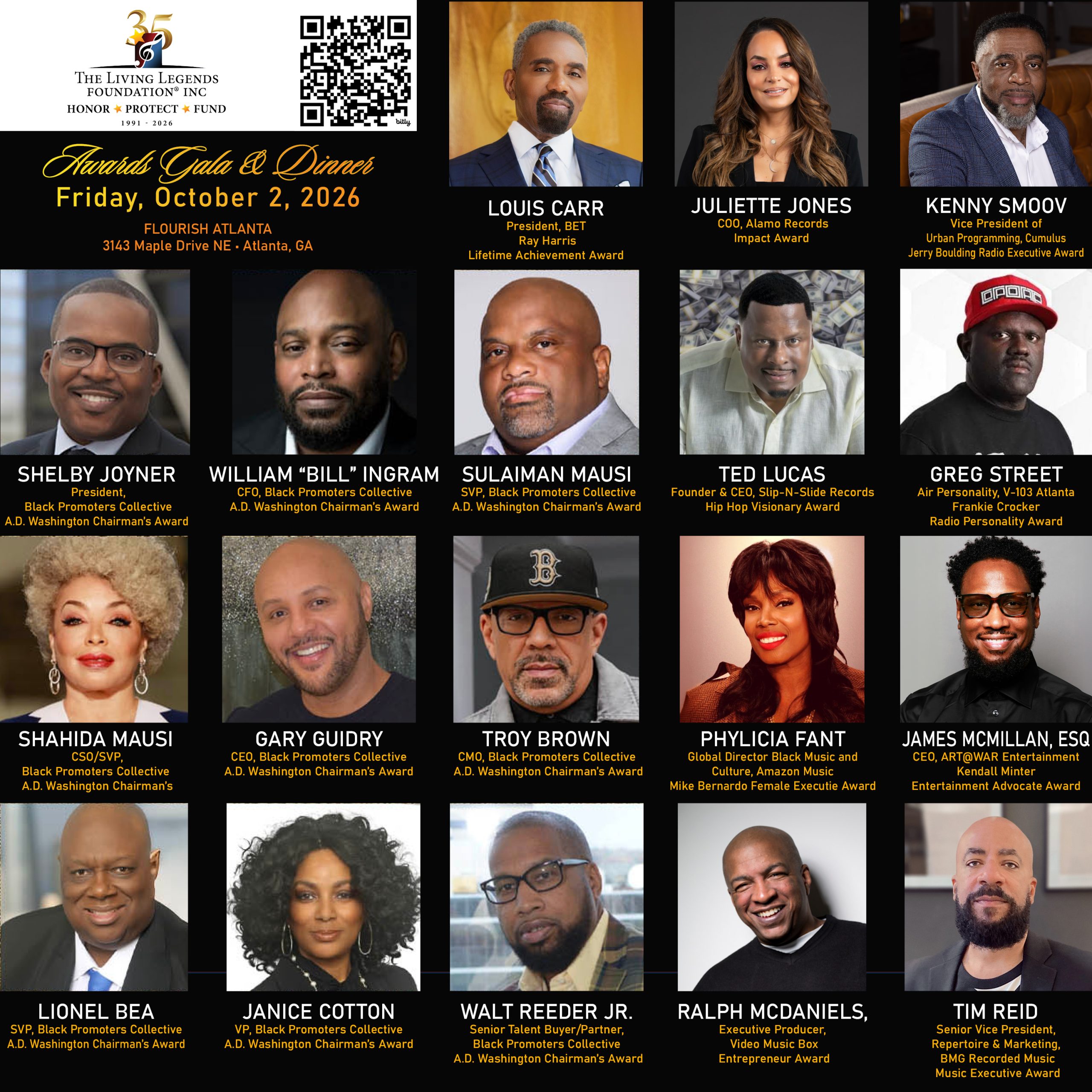
2026 Living Legends Foundation Honorees
This year’s honorees include:
- Ray Harris Lifetime Achievement Award: Louis Carr, president of BET
- A.D. Washington Chairman’s Award: Black Promoters Collective
- Jerry Boulding Radio Executive Award: Kenny Smoov, vice president of urban programming, Cumulus
- Frankie Crocker Radio Personality Award: Greg Street, air personality, V-103 Atlanta
- Impact Player Award: Juliette Jones, COO, Alamo Records
- Music Executive Award: Tim Reid, senior vice president, repertoire and marketing, BMG Recorded Music
- Mike Bernardo Female Executive Award: Phylicia Fant, global director, Black Music + Culture, Amazon Music
- Kendall Minter Entertainment Advocate Award: James McMillan, Esq., CEO, ART@WAR Entertainment
- Hip-Hop Visionary Award: Ted Lucas, founder and CEO, Slip-N-Slide Records
- Entrepreneur Award: Ralph McDaniels, executive producer, “Video Music Box”
Why the 35th Anniversary Matters
The anniversary reflects more than three decades of recognizing people whose contributions to Black music and entertainment have not always received the same public attention as the artists they helped build, promote and sustain.
That history is reflected in Khan’s return. After being recognized by the foundation in its early years, she will now help honor another generation of industry leaders.
The 35th Anniversary Awards Dinner & Gala will continue the Living Legends Foundation’s tradition of celebrating achievement, leadership, innovation and service while preserving the stories of the people who helped build the business and culture surrounding Black music.
Business
DOJ, DOT and DHS Launch Nationwide Crackdown on CDL Fraud, Trucking Schools and Unqualified Drivers


