Connect with us

Opinion

[Opinion] The Power in Orange County, FL Politics…I See It Differently.

Published

on

ORANGE COUNTY (FNN NEWS) - Randy Ross ranks Orange County's power players to set the record straight. Image: Orlando Weekly.

ORLANDO, Fla. (FNN NEWS) – Recently, an Orlando publication published their top 12 most powerful people in Orange County and Orlando politics. And when I reviewed the list there seemed to be more than a number of names out of order and many missing. So, while certainly subjective in nature, I have decided to create my own list (“just a guy with a Facebook page”) that I think more closely mirrors the power in Orange County politics.

Let’s first begin with what I believe quantifies power and influence in politics. It comes down to responsibility and influence. And for some reason some of the heavy hitters that truly have the most responsibility in our county are often underestimated. Whether it’s being mayor of one of the largest counties in Florida or overseeing a $170 billion-dollar property appraiser and assessment process, don’t get it twisted, often those in elected office have far more power than the recently published list acknowledged.

Let’s start by posting the Orlando publication’s relatively weak and misguided list of the most powerful politicians in their published order:

1. Mayor Buddy Dyer
2. Attorney John Morgan
3. Attorney Frank Kruppenbacher
4. Attorney Mayanne Downs
5. Mayor Teresa Jacobs
6. Marcos Marchena
7. Kelly Cohen
8. Sheriff Jerry Demings
9. Chief John Mina
10. Senator Bill Nelson
11. Commissioner Patty Sheehan
12. Congresswoman Val Demings


Below you will find “Randy’s TOP 25 Powerful People in Orlando/Orange County Politics,” followed by the ones to watch. I will highlight a few.

1. Orange County Mayor Teresa Jacobs. Hands down the most powerful role and responsibility in our county. How a city attorney ranked above her escapes me. I originally met Mayor Jacobs in 2000 and I can honestly say she’s the same down-to-earth person I always believed she was. Last year, through her compassion and leadership, she finally got the respect I felt she always deserved from the LGBTQ community despite it being a tragedy that opened that door. While I support term limits, watching her term out in 2018 will be a difficult thing to see. We can only hope that Mayor Jacobs is looking at options to continue her time in public service.

2. City of Orlando Mayor Buddy Dyer. Certainly the Orlando City Mayor has a substantial responsibility, but to suggest it’s more encompassing than that of our County Mayor is subjective privilege, not fact. I do predict we’ll see the Mayor announce his leaving for office to become the President of The University of Central Florida…anyone wanting to hedge a bet?

3. Orange County Property Appraiser Rick Singh. One to watch? I don’t think so. In addition to running what could best be described as one of the most effective property appraiser offices in Florida, Singh has taken his office to places most wouldn’t even dream. In addition to saving citizens millions through critical evaluations, he manages nearly 50 billion more dollars of assessments than his predecessor. I also believe we’ll see him soon jump into the Orange County Mayor’s race. But you didn’t hear that from me… I’m not one to gossip.

4. Attorney and Medical Marijuana Activist John Morgan. Not only has he taken the medical marijuana initiative to reality with millions of dollars, he has been a fundraising guru for Democratic Presidential candidates for years. While I don’t believe he’ll ultimately run for Governor, I do believe he has clearly established himself as a political leader in Orange County.

5. Orange County Tax Collector Scott Randolph. I’ve been somewhat critical of Randolph in the past, but you only need to have to renew your license or interact with his office to recognize he has taken the Orange County Tax Collector’s office to the next level with technology and convenience.

6. Orange County Sheriff Jerry Demings

7. Attorney and Political Power-Broker Frank Kruppenbacher

8. City of Orlando Police Chief John Mina

9. Orange County Supervisor of Elections Bill Cowles

10. Orange County Clerk of Courts Tiffany Moore Russell. Time and time again I hear nothing but praise for how Russell is running the Clerk of Courts office.

11. Orange County Comptroller Phil Diamond

12. Orange County Commissioner, Former Florida State House Representative and Apopka Mayoral Candidate Bryan Nelson

13. City of Orlando District 4 Commissioner Patty Sheehan

14. Orange County School Board (District 6) Member Nancy Robinson

15. City of Orlando District 5 Commissioner Regina Hill. Hill represents one of the most integral areas of our City requiring more thoughtful planning for growth than most may be willing to acknowledge. While Lake Nona and Medical City are substantial, Hill’s district truly is the heart of Downtown Orlando, making decisions in and surrounding it impactful and trendsetting.

16. Town of Windermere Mayor Gary Bruhn. Mayor Bruhn is everywhere and possesses loads of clout with his fellow mayors. My guess is he’s perfectly happy being the Mayor of Windermere even if he gets the subtle urge here and there to look at other offices.

17. Orange County School Board (District 3) Linda Kobert

18. Orange County Public School Board Chair and Rumored Orange County Mayoral Candidate Bill Sublette

19. Florida Senator Bill Nelson

20. Congresswoman Stephanie Murphy

21. Congresswoman Val Demings

22. Orange County Commissioner and possibly Orange County Mayoral Candidate Pete Clarke. Everyone likes “Pete,” but will that be enough to compete in a heavy Democrat town even in a nonpartisan race? We shall see.

23. Hotelier Harris Rosen

24. Timeshare Mogul David Siegel

25. Consultant and Trump Florida Hispanic Spokeswoman Bertica Cabrera-Morris. As one person suggested to me, Bertica has the ability to touch many things in our community and her brilliance is that most will never know she was there. She embodies class and hard-knocks passion for the clients she represents.


ONES TO WATCH (IN NO PARTICULAR ORDER)

1. Belle Isle Mayor Lydia Pisano. Pisano is one of the most misunderstood elected officials I’ve met. In fact, maybe too perfect. But be on the look out–my money is she will seek County Commission District 3 in 2018. Only time will tell.

2. Orange County Republican Party Vice Chairman Chadwick Hardee

3. Florida State House District 44 Candidate Bobby Olszewski

4. Florida State House District 49 Representative Carlos G. Smith

5. Orange Soil & Water Conservation District Supervisor Eric Rollings

6. Former Orange County Clerk of Courts Eddie Fernandez. Fernandez surely must be eyeing various races looking for the right fit. And when he identifies one, he’ll be all in 150 percent.

7. Florida State House District 44 Candidate John Newstreet

8. Political Consultant and Edgewood Commissioner John Dowless

9. Florida State House District 50 Representative Rene Plasencia

10. Planned Parenthood External Affairs Director and Florida State House District 47 Candidate Anna Eskamani

11. Orange County Republican Executive Committeeman and Candidate for Florida Agriculture Commissioner Paul Paulson. Paul is scouting the state right now, putting signs up for his bid for Agriculture Commissioner in cow pastures and roadsides only road warriors can find. He’s viable and not afraid of putting his own money where his mouth is. That combination will prove, I believe, a positive combination.

12. Orange County Young Republicans President Nicholas Primrose

13. Orange County Democratic Chairman Wes Hodge

14. Philanthropist Christopher Comins. Now retired, developer and philanthropist Chris Comins, I predict, will be a person we’re going to hear more about in 2018 and 2020.

15. Florida State House District 30 Representative Bob Cortes

16. Florida Senator David Simmons

17. East Orlando Post Founder Jacob Engels

18. Orange/Osceola State Attorney Aramis Ayala. While I think her State Attorney role is on life support, she’s set herself up for something, by accident I believe, far greater for those that do not support the death penalty.

19. Ericka Dunlap, Candidate for City of Orlando District 5 Commissioner. As Dunlap, a former Miss America, sets her sight on this seat, if she doesn’t win, she has certainly set a path for a future as a possible spokesperson for the University of Central Florida or Government Affairs for a Fortunate 500 company.

20. Florida Senator Andy Gardner


So there you have it. It’s just my opinion. But the power in Orange County politics isn’t sitting with names people haven’t heard of necessarily. Give the credit where it’s due: to the people in those elected positions responsible for everything from our property assessments to our safety. Give credit to those that truly have impact. To me, that’s the power!

What does your list look like?

Continue Reading
Click to comment

Leave a Reply

Your email address will not be published. Required fields are marked *

Entertainment

Bad Bunny’s Halftime Show Was a Master Class in American Culture

Published

on

Bad Bunny appears on stage during the Super Bowl LX Pregame & Apple Music Super Bowl LIX Halftime Show Press Conference on Feb. 5, 2026, in San Francisco (Kevin Mazur/Getty Images for Roc Nation)

A reminder that diversity is not a threat — it is America’s strength.

By The Honorable Rick Singh
Former Orange County Property Appraiser

Bad Bunny’s halftime performance reminded us of something every American needs to hear right now:

We may come from different places, but we share far more in common than we sometimes realize. Our greatest strength has always been our willingness to embrace diversity — not fear it.

As an elected official, I delivered many speeches over the years. But one of the most meaningful moments of my public service was speaking to newly sworn American citizens — individuals who had taken their oath of citizenship just minutes before I addressed them.

I can tell you this: they were some of the proudest Americans I have ever encountered — men and women from every corner of the world, united by one oath and one dream.

For many, English was a second language. For some, this was the first country they had ever traveled to. But the pride in their eyes was unmistakable.

Watching them always brought me back to my own story.

I still remember arriving in America as a 10-year-old after spending my first decade of life in tropical Guyana — and experiencing so many things for the first time: winter in New York City without a coat, running water, electricity, trains, cars, and even an escalator, which absolutely terrified me.

I shared those experiences with them. I also shared my mother’s journey — her strength and sacrifice — which inspired me and reminded me of what so many immigrant families endure with quiet courage.

And I reminded those new Americans of something important:

Be proud of your culture.
Be proud of your food.
Be proud of your faith.
Be proud of your music.

Not only be proud of it — share it.

Share it with your American neighbors and friends, because that’s how we foster harmony and understanding.

When we share our traditions, we don’t just celebrate who we are — we educate. We break down stereotypes. We replace fear with familiarity. And we turn strangers into neighbors.

That is how we grow closer. That is how we build community.

And that brings me back to Bad Bunny.

His performance spoke powerfully to the idea of diversity — and to the universal language that connects all people: music. In many ways, it was world culture presented on one of America’s biggest stages.

It was also a master class in Puerto Rican culture — which I must remind some people is American culture.

Like so much of Latin America and the Caribbean, it also carried a deeper story: slavery and the legacy of indentured laborers, including those brought from India, who cut sugar cane and planted crops that fueled global empires.

When I saw the sugar cane fields in the performance visuals, I was reminded of where I was born — Guyana — where I spent my first ten years of life. My parents were humble sugar cane farmers.

The coconut stand selling fresh coconuts reminded me of Bourda Market in Georgetown.

And the vibrant Latin music took me right back to my childhood in the Bronx — hearing legends like El Gran Combo de Puerto Rico, Tito Puente, Eddie Palmieri, and Iris Chacón playing from apartment windows or speakers on fire escapes.

Different cultures.
Different rhythms.
Different drums from different lands.

But one shared spirit.

That’s America.

And when we embrace that truth, we don’t become weaker — we become stronger.

Because the reality is simple:

Together, we are all American.

Across Latin America and the Caribbean — regardless of language, flag, or heritage — we share lived experiences shaped by common history: agricultural roots, multi-generational homes, the neighborhood bodega or corner shop, struggle and resilience, rhythm and resistance, elders playing dominoes, and families gathering around food and music.

It’s not geography.
It’s identity.

It’s music.

In the end, Bad Bunny delivered something meaningful — not just for Puerto Ricans, but for every immigrant and every family with a story like mine.

His performance wasn’t just music and spectacle. It was a reflection of who we are, where we come from, and what we’ve overcome.

It reminded millions that being American isn’t about looking a certain way or speaking a certain language. It’s about owning your story, celebrating your roots, and contributing that richness to the shared tapestry of this country.

Boricua love, baby — you’ve got to love it.

Continue Reading

Opinion

Commentary: Civility as Moral Power: What Gandhi Gave King — and What King Gave America and the World

Published

on

Dr. Martin Luther King Jr. did not merely change laws. He changed the moral tone of a nation.

At a time when America was convulsed by racism, violence, and injustice, Dr. King chose a path many dismissed as weak or naïve: civility, nonviolence, and disciplined love. History proved otherwise. In King’s hands, civility was neither politeness nor passivity. It was moral power.

That power did not arise in isolation. King drew deeply from the life and philosophy of Mahatma Gandhi. While studying theology and social ethics, he encountered Gandhi’s doctrine of satyagraha — the “force of truth.” What struck King most was Gandhi’s insistence that injustice must be resisted, but never with methods that corrupt the soul or mirror the cruelty of the oppressor. King later called Gandhi “the guiding light of our technique of nonviolent social change.”

From India’s struggle against British colonialism to America’s fight against segregation, the moral logic was the same: suffering willingly endured, without hatred or retaliation, can awaken the conscience of a nation. Nonviolence was not weakness; it was moral jiu-jitsu — exposing injustice by refusing to cooperate with it, while refusing to become it.

For King, civility did not mean silence in the face of injustice. In his Letter from Birmingham Jail, he made clear that unjust laws must be broken — openly, lovingly, and with a willingness to accept the penalty. Like Gandhi, King rejected both cowardly submission and violent revolt. His method of nonviolent civil disobedience was precise and intentional: it disrupted injustice while preserving the moral legitimacy of the movement.

This moral lineage from Gandhi to King remains one of the most remarkable transmissions of ethical philosophy in modern history. Different cultures. Different continents. One moral grammar. Both men believed that love is a social force, not merely a private virtue; that hatred multiplies hatred; and that the means we use to pursue justice shape the society we ultimately create.

When children were attacked by fire hoses in Birmingham and peaceful marchers were beaten on the Edmund Pettus Bridge, it was not rage that moved the conscience of the nation. It was the devastating contrast between the dignity of the protesters and the brutality of their oppressors. Civility gave the movement credibility. Nonviolence gave it legitimacy. Moral discipline gave it victory.

Neither Gandhi nor King was “nice” in the shallow sense. Both condemned injustice relentlessly. Both disrupted the comfort of the powerful. Yet neither surrendered to cruelty or dehumanization. They understood a hard truth: a movement that loses its soul cannot save a society.

Today, in an age of outrage, humiliation, and political tribalism, their shared example speaks with renewed urgency. We cancel rather than persuade. We humiliate rather than debate. We dehumanize rather than disagree — and we call it authenticity.

Gandhi and King would have rejected this moral downgrade.

They would remind us:
That cruelty is not courage.
That rage is not righteousness.
That humiliation is not justice.

Gandhi lit the torch. King carried it across an ocean. Now it rests in our hands.

To honor them is not merely to quote them once a year. It is to practice what they practiced: to resist injustice without surrendering our humanity, to speak with moral clarity without moral cruelty, and to pursue change without poisoning the future with hatred.

Their revolution was not only political.

It was moral.

And it remains ours.


Hon. Rick Singh is a former Orange County property appraiser and a civic leader in Central Florida. He writes on ethics, public service, and democratic culture.

Continue Reading

Opinion

OPINION: Puerto Rican Political Power in Florida Faces Decline Post-2024 Losses

Published

on

The 2024 elections marked a troubling turning point for Puerto Rican political representation in Florida. What was once a growing force of influence in state and national politics now faces a steep decline, raising alarms about the future of Puerto Rican voices in government.

In 2016, our community achieved historic milestones: Darren Soto became the first Puerto Rican from Florida elected to the U.S. Congress, Victor Torres won a seat in the Florida Senate, and four Puerto Ricans—John Cortes, Amy Mercado, René Plasencia, and Bob Cortes—held seats in the Florida State House. This wave of representation was a proud moment for Puerto Ricans, a sign that our voices were finally being heard at the highest levels.

2016 Representation Snapshot:

  • 1 U.S. Representative Seat
  • 1 Florida State Senate Seat
  • 4 Florida State House Seats

Fast forward to 2025, and the numbers tell a much different story:

  • 1 U.S. Representative Seat (Darren Soto)
  • 0 Florida State Senate Seats
  • 2 Florida State House Seats (Johanna López and Susan Plasencia)

The losses in 2024 have decimated our influence in state government. The Florida State Senate, once home to a Puerto Rican voice, is now silent. The reduction in House seats has further diminished our ability to shape policy and advocate for our community.

This is a moment for reflection and action. As a former Puerto Rican Florida State Representative, I understand the hard work it takes to elevate our community’s concerns and ensure they are heard. But these latest setbacks demonstrate that we cannot afford complacency.

We must:

  1. Prioritize leadership development by identifying and mentoring the next generation of Puerto Rican leaders.
  2. Strengthen voter engagement efforts to increase turnout and political awareness within our community.
  3. Build coalitions across Florida to amplify our collective voice and work toward shared goals.
  4. Focus on unity, setting aside partisan divides to protect and grow Puerto Rican representation.

Puerto Ricans in Florida contribute significantly to the state’s economy, culture, and community development. Yet, without strong political representation, our ability to advocate for critical issues—such as disaster recovery, housing, healthcare, and education—is severely hampered.

The time to act is now. If we fail to address this decline, the consequences for Puerto Rican communities across Florida could be dire. Let us remember that our representation is not just about holding titles but about driving meaningful change for the people we serve. Together, we can rebuild and ensure that Puerto Rican political power not only survives but thrives for future generations.

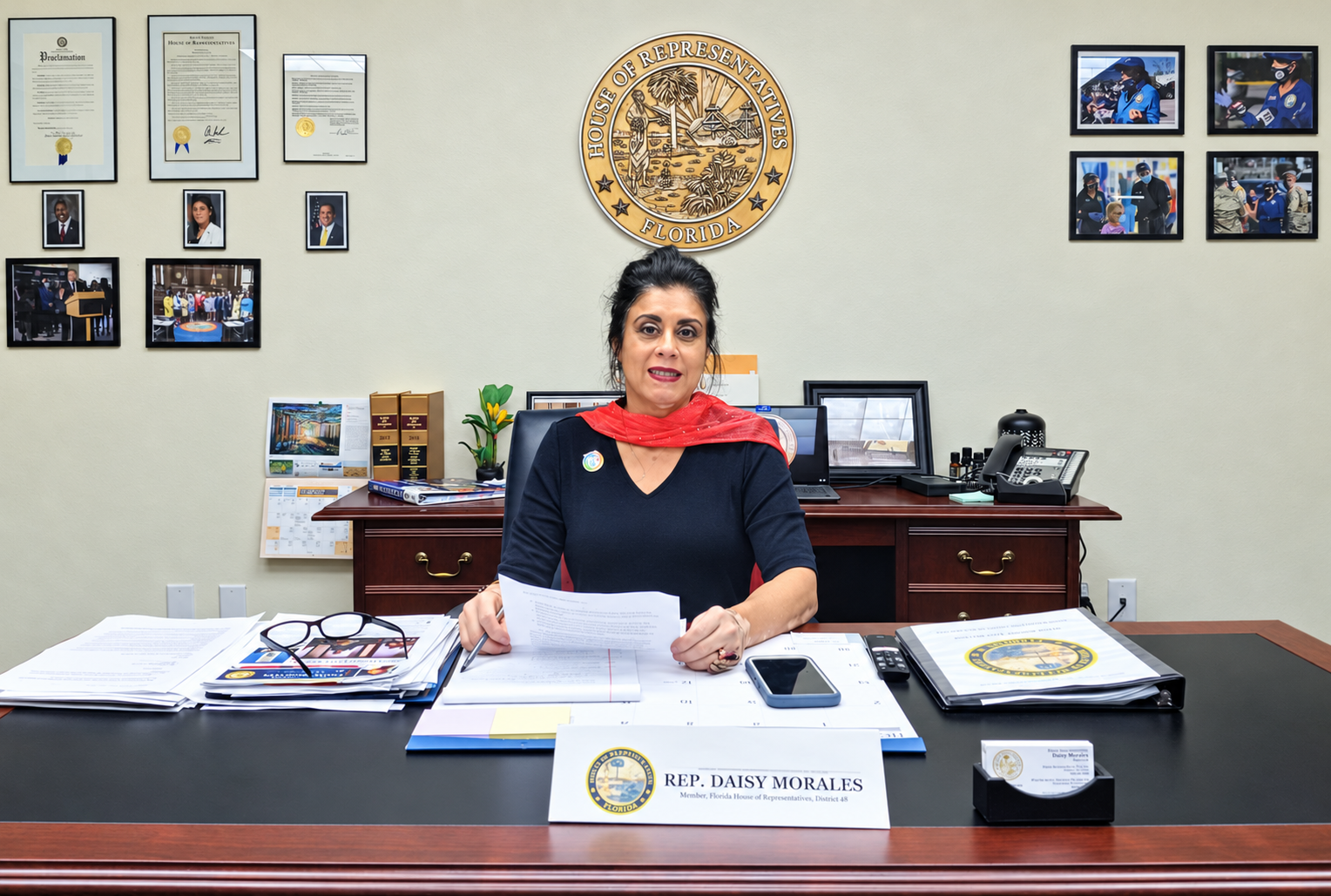
Daisy Morales
Former Florida State Representative
Advocate for Puerto Rican Leadership and Progress
_______________________________________________________________

To contribute to Florida National News, you can submit Letters to the Editor (up to 200 words) or My Voice columns (approximately 500 words) by emailing them to letters@FloridaNationalNews.com. Please include your address for verification purposes only. If submitting a My Voice column, also attach a photo and a 1-2 line bio about yourself.

Submissions are considered for publication based on space availability. All contributions may be edited for content, clarity, and length and may also be republished across any platform within the FNN News Network.

We value your voice and look forward to hearing from you!

Continue Reading
Advertisement
Advertisement Ticket Time Machine ad
Advertisement Orlando Regional REALTOR Association logo
Advertisement Parts Pass App
Advertisement Hispanic Chamber of Commerce of Metro Orlando
Advertisement
Advertisement African American Chamber of Commerce of Central Florida
Advertisement FNN News en Español
Advertisement Indian American Chamber of Commerce logo
Advertisement Florida Sports Channel

FNN Newsletter

Trending