Connect with us

Florida

Byron Donalds Secures Endorsement From Gainesville Democrat Cynthia Moore Chestnut, Spotlighting Cross-Party Politics

Published

on

Longtime Democratic leader backs Republican nominee as state Sen. LaVon Bracy Davis pushes back, renewing debate over the impact of cross-party endorsements in Florida politics

GAINESVILLE, Fla. (FNN) — Republican gubernatorial nominee Byron Donalds has secured the endorsement of Gainesville City Commissioner Cynthia Moore Chestnut, a longtime Democrat and former state lawmaker, drawing criticism from fellow Democrats and putting Florida’s history of cross-party political support in the spotlight.


Chestnut announced her support for Donalds on Thursday and followed with a lengthy explanation defending her decision. She said she remains a Democrat but does not believe party affiliation should dictate her vote.

“My endorsement of Byron Donalds is not a betrayal of my values; it is a declaration that Black voters are not political property,” Chestnut wrote.

Chestnut, a former Florida House member, Alachua County commissioner and Democratic Party leader, said she wants to see Florida elect a Black governor in her lifetime.

That gives the endorsement additional historical significance. Donalds, who won the Republican nomination in Florida’s Aug. 18 primary, is seeking to become Florida’s first Black governor, according to The Associated Press.

The endorsement is also notable because Chestnut previously supported Democratic gubernatorial nominee David Jolly before shifting her support to his Republican opponent. Current reporting confirms Chestnut’s endorsement and her subsequent defense of the decision.
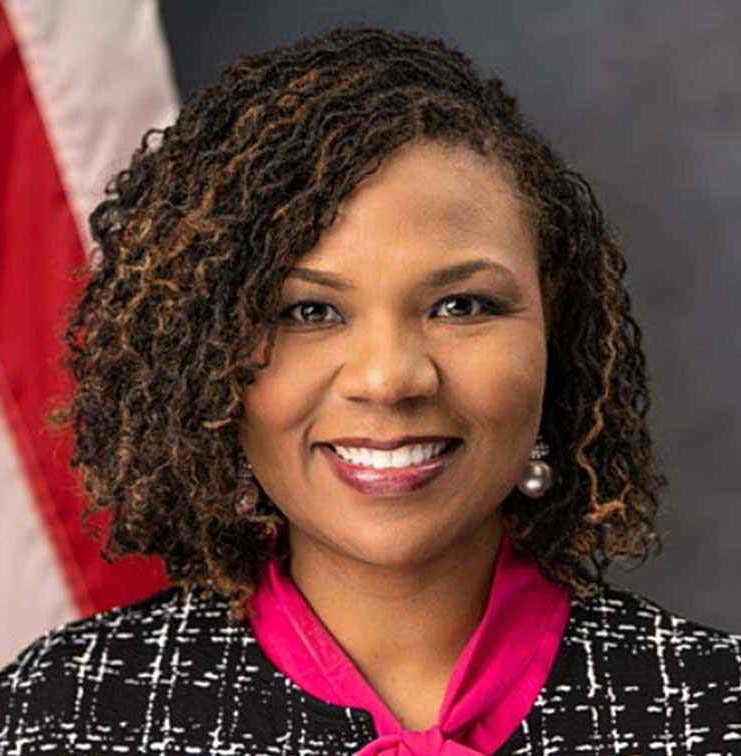
 

Florida Democratic state Sen. LaVon Bracy Davis, who represents Central Florida in the Florida Senate.

State Sen. LaVon Bracy Davis Pushes Back on Donalds Endorsement

Democratic state Sen. LaVon Bracy Davis of Ocoee responded with an extensive public statement saying she was “deeply disappointed” by Chestnut’s decision.

Bracy Davis focused much of her criticism on Donalds’ record on voting rights, including his opposition to federal voting-rights legislation and to the proposed Harry T. and Harriette V. Moore Florida Voting Rights Act, which Bracy Davis sponsors.

“I want to see a Black governor of Florida in my lifetime too,” Bracy Davis wrote, while arguing that representation should not be separated from a candidate’s voting record and policy positions.

The disagreement presents competing views of political independence. Chestnut argues that Black voters should not be treated as the political property of either party. Bracy Davis argues that representation should be weighed against a candidate’s record and policies.

Byron Donalds’ Jim Crow Remarks Resurface

Bracy Davis also invoked Donalds’ controversial 2024 comments about Black families during the Jim Crow era.

Donalds said at a Philadelphia event that “during Jim Crow, the Black family was together” while discussing marriage and family structure. Democrats sharply criticized the remarks, while Donalds rejected interpretations that he was praising segregation.

The distinction is important: Donalds did not explicitly say Black Americans were better off under Jim Crow.

Cynthia Moore Chestnut Points to FAMU and Black Representation

Chestnut also cited Donalds’ connection to Florida A&M University and the importance she places on Black representation.

Donalds attended FAMU before transferring to Florida State University, where he earned his bachelor’s degree.

Chestnut, a FAMU graduate, said she respects Donalds’ support for historically Black colleges and universities and also cited shared cultural connections through his Jamaican and Panamanian family background.

Bracy Davis countered that attending an HBCU should not substitute for examining a candidate’s political record.
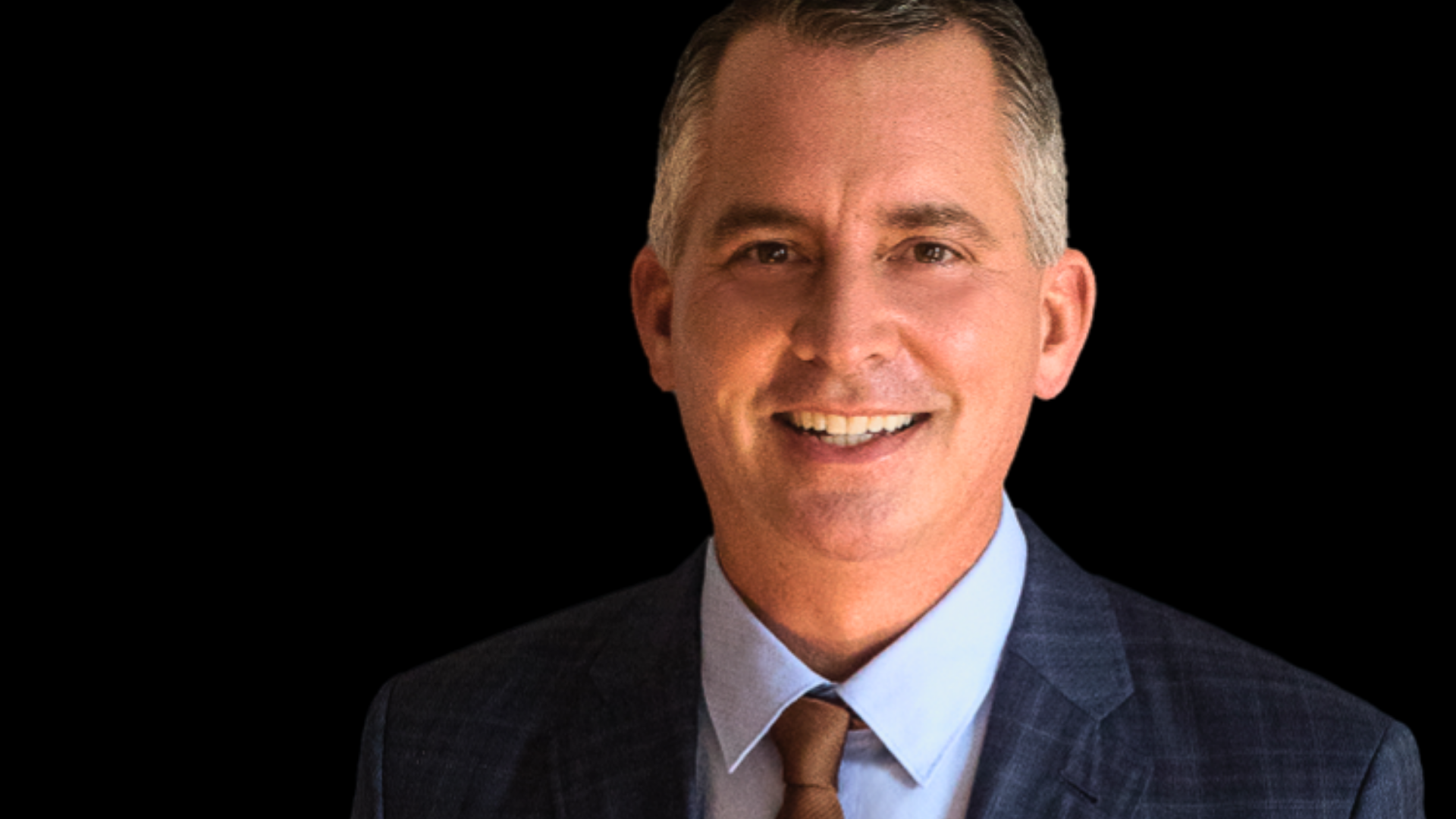


David Jolly, the 2026 Democratic nominee for Florida governor, previously represented Florida in Congress as a Republican from 2014 to 2017. He left the Republican Party in 2018, became politically unaffiliated and registered as a Democrat in 2025. Jolly faces Republican nominee Byron Donalds in the general election.

David Jolly, a former Republican congressman who became a Democrat in 2025, is the Democratic nominee for governor of Florida in 2026. Source David Jolly

David Jolly Was a Republican Before Becoming a Democrat in 2025

Party affiliation adds another dimension to the controversy.

Democratic gubernatorial nominee David Jolly represented Florida in Congress as a Republican from 2014 to 2017. He left the Republican Party in 2018 and became an independent.

Jolly remained unaffiliated for several years before registering as a Democrat in April 2025, as he considered entering the 2026 governor’s race.

He subsequently entered the race and won the Democratic nomination in the Aug. 18 primary. AP described the contest as Donalds, the Republican nominee, against Jolly, a former Republican congressman running as the Democratic nominee.

The circumstances differ from Chestnut’s decision: Jolly formally changed parties; Chestnut says she remains a Democrat while supporting the Republican nominee.

The history nevertheless creates an unusual political contrast: a longtime Democrat is supporting Donalds over a Democratic nominee who previously represented Florida in Congress as a Republican.

Byron Donalds Adds $1 Million From Orlando-Based Morgan & Morgan

Chestnut’s endorsement comes as Donalds continues attracting substantial financial support heading into the general election.

A Florida National News review of Florida Division of Elections campaign-finance records found that Morgan & Morgan contributed $1 million to Friends of Byron Donalds PAC on Aug. 26, 2026.

The contribution appears in the committee’s 2026 G1A report and identifies the contributor as “Morgan & Morgan,” with an address at 20 N. Orange Ave., 16th Floor, Orlando.

The same report shows 18 contributions totaling approximately $1.93 million, meaning the Morgan & Morgan contribution accounted for more than half of the money listed in that group of contributions.

Morgan & Morgan was founded by Orlando attorney John Morgan, who has a long history of political involvement and support for Democratic candidates and causes, although his political activity has crossed party lines.

The distinction is important: Florida’s filing identifies Morgan & Morgan — not John Morgan personally — as the contributor of the $1 million.

For Donalds, the developments represent two different forms of support as the general election takes shape: a seven-figure contribution from a prominent Orlando law firm and a cross-party endorsement from a Democratic elected official with decades of experience in Florida politics.
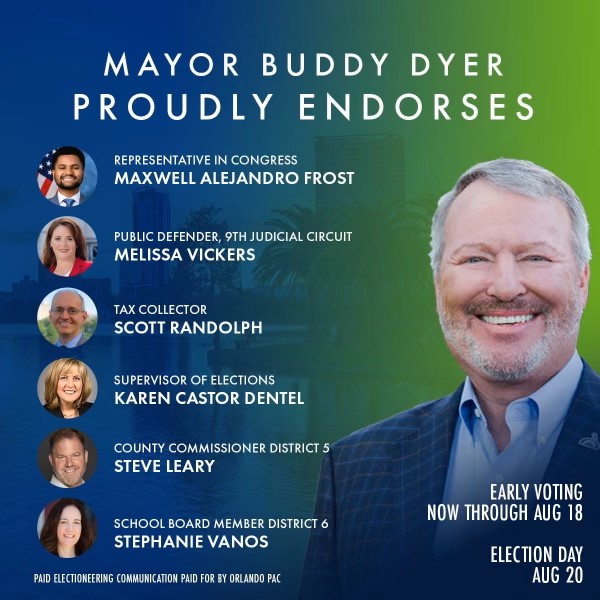
A 2024 election mailer from Orlando PAC features Democratic Orlando Mayor Buddy Dyer’s endorsements, including Republican former Winter Park Mayor Steve Leary for Orange County Commission District 5. The slate also included Maxwell Alejandro Frost, Melissa Vickers, Scott Randolph, Karen Castor Dentel and Stephanie Vanos. The mailer illustrates cross-party support in an officially nonpartisan county race and is relevant to the broader debate over Democratic officials endorsing Republican candidates in Central Florida.

Democratic Orlando Mayor Buddy Dyer included Republican Steve Leary among his endorsed candidates for the 2024 election. The Orlando PAC mailer promoted Leary for Orange County Commission District 5 alongside several Democratic candidates. Source Winter Park Voice

Buddy Dyer, Gary Siplin and Victoria Siplin Show Cross-Party Support Is Not New

Chestnut’s decision has generated attention, but Democratic elected officials supporting Republican candidates is not unprecedented in Central Florida.

During the 2024 Orange County Commission District 5 race, Democratic Orlando Mayor Buddy Dyer endorsed Republican former Winter Park Mayor Steve Leary.

Political Rivals: Samuel Vilchez Santiago lost the 2020 Florida House District 48 Democratic primary to Daisy Morales, who went on to win the seat. During Morales’ 2022 reelection campaign, Vilchez Santiago supported Rita Harris, who defeated Morales in the Democratic primary. Vilchez Santiago later chaired the Orange County Democratic Party during the 2024 dispute over Morales’ party status. In their 2026 House District 43 rematch, the dispute resurfaced in news coverage and FHDCC attack mailers alleging Morales endorsed Republicans and was expelled from the local party. The mailers identified the Florida House Democratic Campaign Committee as the payer and Vilchez Santiago as approving them. Morales disputes the allegations and has challenged them through litigation and an election complaint.


Samuel Vilchez Santiago, then-chairman of the Orange County Democratic Executive Committee, told Winter Park Voice that the organization “sent out texts and mailers alerting voters that Leary is a Republican, not a Democrat.” Vilchez Santiago said those communications were not issued in response to Dyer’s endorsement, but were intended to educate voters.

However, former Democratic state Sen. Gary Siplin and Orange County Commissioner Victoria Siplin, also a Democrat, supported Leary as well.

Those endorsements occurred in an officially nonpartisan county election, an important distinction from the partisan governor’s race, although the candidates’ political affiliations were publicly known.

The examples nevertheless demonstrate that prominent Central Florida Democrats have previously crossed party lines to support Republican candidates.
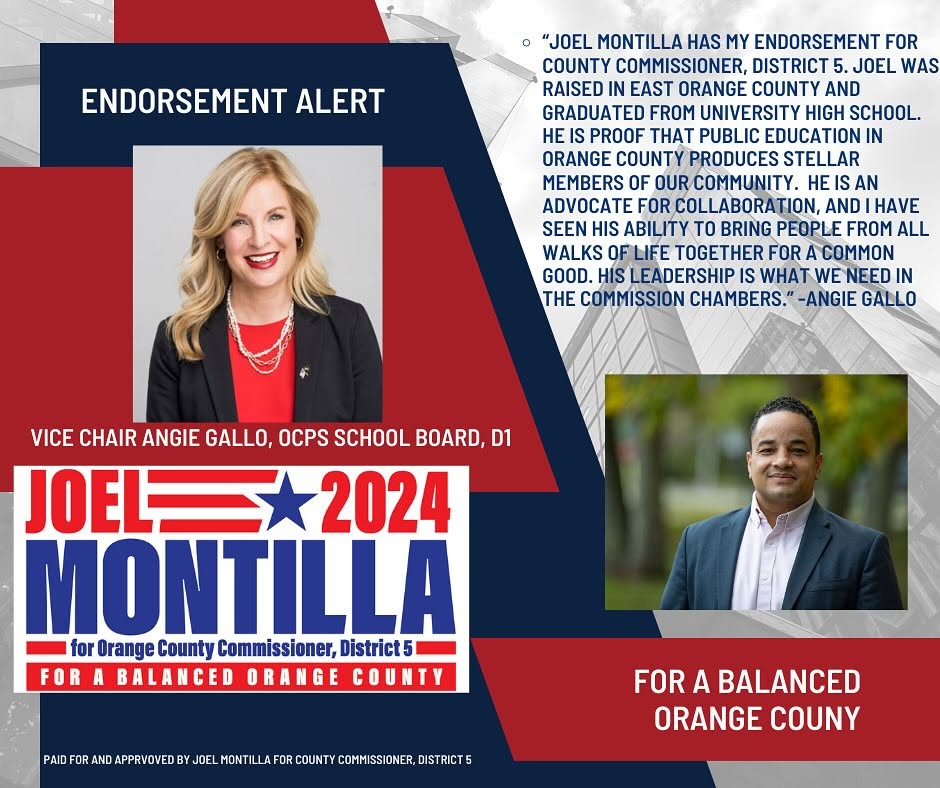
Then-Orange County School Board Vice Chair Angie Gallo publicly endorses Joel Montilla for Orange County Commission District 5 in a campaign graphic paid for and approved by Montilla’s campaign. Source: Joel Montilla Campaign

ANGIE GALLO ENDORSED JOEL MONTILLA AND SERVED AS HIS CAMPAIGN MANAGER

Another potentially relevant figure from the 2024 Orange County Commission District 5 campaign is Angie Gallo, then an Orange County School Board member.

A Joel Montilla campaign press release dated Oct. 24, 2023, identifies “Angie Gallo — Campaign Manager” in the campaign’s contact information. The campaign subsequently publicized Gallo’s endorsement of Montilla.

The documentary record therefore identifies Gallo as both Montilla’s campaign manager and a public supporter.

The Orange County Commission race was officially nonpartisan, although Montilla’s Republican affiliation was publicly known.

Gallo’s party-registration history, however, requires an important distinction. Published reports citing election records indicate she left the Republican Party in 2023, was registered No Party Affiliation during the 2023–24 Montilla campaign, and registered as a Democrat in 2025.

Her potential relevance is narrower: as Montilla’s documented campaign manager, Gallo could be a potential fact witness concerning how the campaign identified formal endorsers, host-committee participants and other supporters — including whether the campaign considered Morales an endorser.

FNN has not established that Gallo was contacted to verify the disputed endorsement allegation or that she will become a witness. Her inclusion is based on her documented campaign role, not an allegation of wrongdoing.
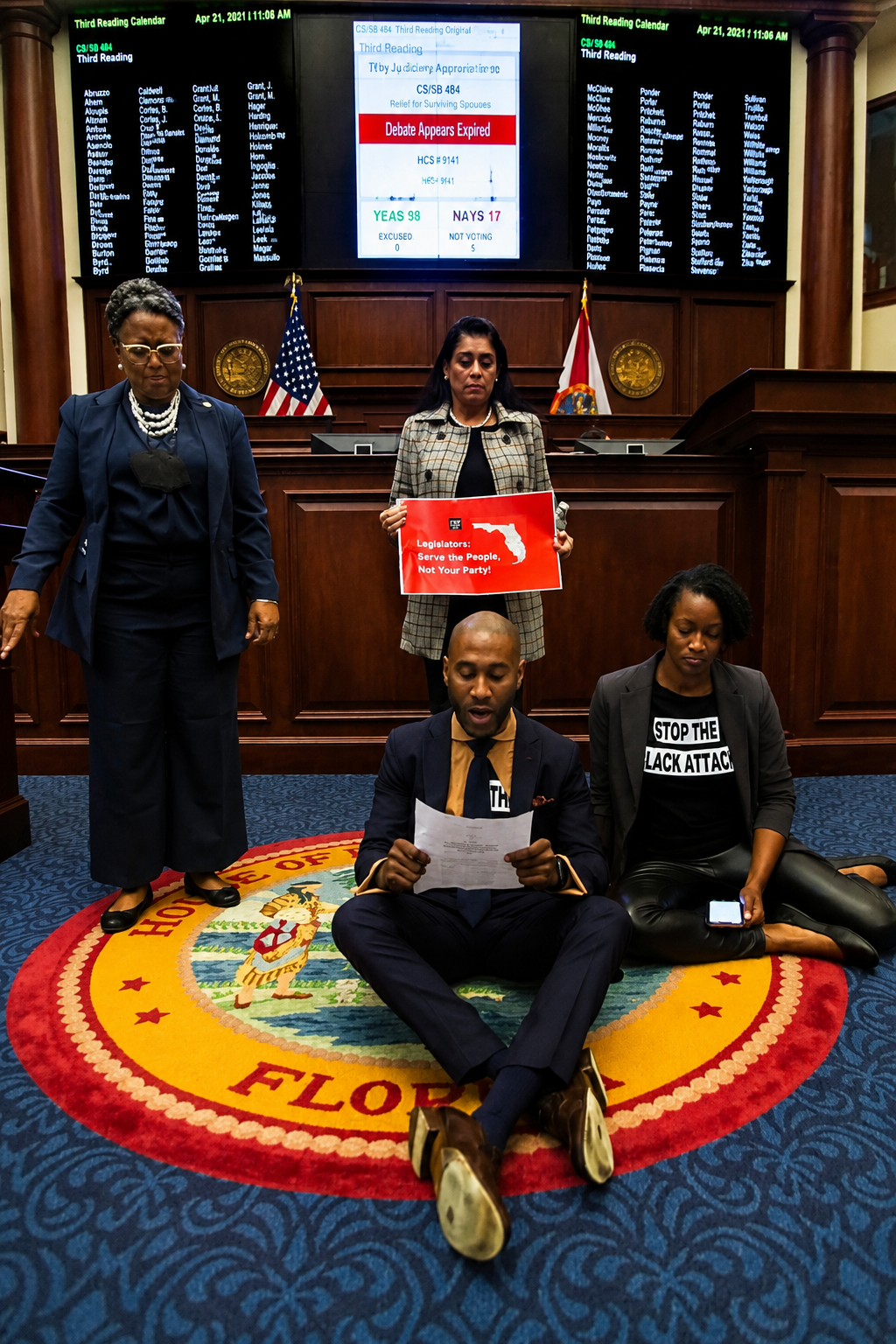
Rep. Yvonne Hayes Hinson, D-Gainesville, Rep. Daisy Morales, D-Orlando, Rep. Tray McCurdy, D-Orlando (in front) and Rep. Angie Nixon, D-Jacksonville, protest on the Florida Seal as debate is halted in the House of Representatives Thursday, April 21, 2022, at the Capitol in Tallahassee, Fla. The session was halted by the protest, but continued after a brief recess. Phil Sears AP

Former Democratic State Rep. Daisy Morales Adds Context to Party-Loyalty Debate

Former Orlando state Rep. Daisy Morales, a Puerto Rican Democrat, provides another Central Florida example relevant to the debate over party loyalty and political independence.

In 2022, Morales, a Puerto Rican lawmaker known for working across party lines, represented a Central Florida district with a significant Puerto Rican population.

On April 21, 2022, Morales joined Black Democratic lawmakers protesting a congressional redistricting map backed by Republican Gov. Ron DeSantis on the Florida House floor.

The demonstration received state and national attention.

The Miami Herald reported that several Black Democrats disrupted debate and that Democratic lawmakers sang “We Shall Overcome,” temporarily forcing the House into recess.

The Herald identified Morales alongside Democratic Reps. Yvonne Hinson, Travaris McCurdy and Angie Nixon in its reporting and accompanying photograph.

Morales carried a sign declaring:

“Legislators serve the people. Not your party.”

The Herald reported that McCurdy, Nixon and Rep. Felicia Robinson sat in the center aisle while more than a dozen Democratic colleagues gathered around them in solidarity. The Republican-controlled House later approved the congressional map 68-38 along party lines.

The demonstration also received national coverage.

NBC News, in reporting preserved through syndication, identified Morales as the Hispanic representative participating in the demonstration and subsequently issued a correction after initially identifying another lawmaker.

The episode placed Morales alongside Black Democratic lawmakers in one of the Legislature’s most visible protests of the 2022 congressional redistricting fight.

FNN also reported on the demonstration at the time, describing Democratic lawmakers as temporarily shutting down House proceedings while protesting the congressional map.

Two years later, Morales became involved in an Orange County Democratic Party dispute over an alleged loyalty-oath violation connected to the 2024 Orange County Commission District 5 election.

Morales disputes that she endorsed Republican Joel Montilla, maintaining that her involvement was limited to joining his campaign-launch host committee. Montilla has separately told FNN — and later confirmed to Florida Politics — that Morales did not endorse his campaign.

That creates a factual distinction between Morales’ and Gallo’s documented involvement with the Montilla campaign: Morales is identified in campaign material as a host-committee participant and denies making an endorsement, while Montilla’s campaign documentation identifies Gallo as his campaign manager and the campaign subsequently publicized her endorsement.

The comparison has an important limitation. Gallo was registered No Party Affiliation during the 2023–24 Montilla campaign, while Morales was a member of the Orange County Democratic Executive Committee, according to Vilchez Santiago’s account.

The available record therefore does not establish that Morales and Gallo were subject to the same Democratic Party membership requirements, loyalty provisions or disciplinary authority.

Gallo’s potential relevance is instead primarily factual: as Montilla’s campaign manager, she may have firsthand knowledge concerning how the campaign distinguished formal endorsements from host-committee participation.
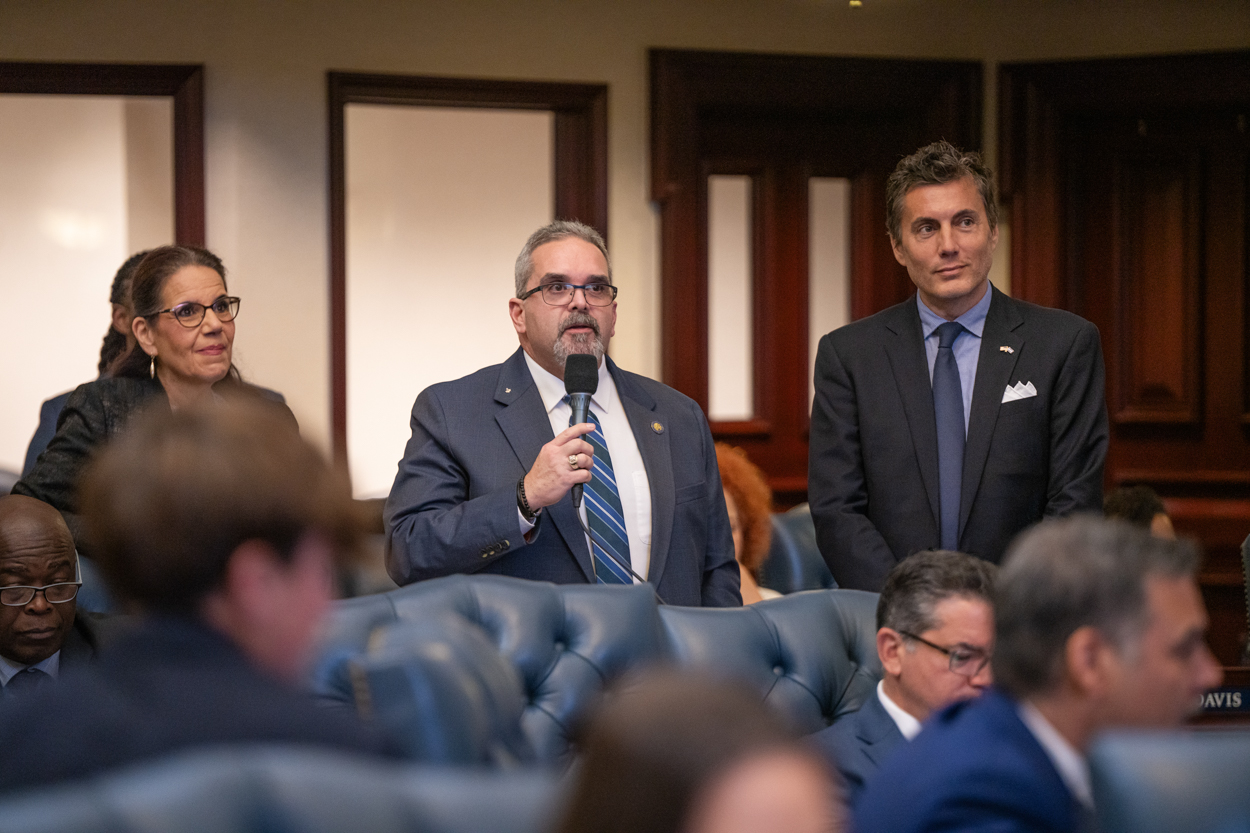
Democratic state Rep. Jose Alvarez, center, speaks on the Florida House floor alongside Democratic state Rep. Susan Valdés, left, and Republican state Rep. Fabián Basabe, right. Source: Florida House

State Rep. Jose Alvarez Crossed Party Lines, Then Withdrew His Support

Cross-party support has also occurred in partisan legislative politics.

Democratic state Rep. Jose Alvarez of Kissimmee endorsed Republican state Rep. Fabián Basabe for reelection in 2025, saying his decision reflected his experience working with Basabe rather than their different party affiliations.

Alvarez later rescinded the endorsement in July 2026 and called for Basabe to resign following a civil jury verdict involving two former House employees.

The episode nevertheless provides another recent example of a Central Florida Democrat publicly supporting a Republican candidate.

CROSS-PARTY SUPPORT AND DEMOCRATIC PARTY DISCIPLINE ARE DIFFERENT QUESTIONS

The examples involving Cynthia Moore Chestnut, Buddy Dyer, the Siplins, Daisy Morales and José Alvarez highlight an important distinction between cross-party political support and internal party discipline.

Being a registered Democrat or a Democratic elected official does not necessarily mean someone is subject to the same county party loyalty oath, bylaws or disciplinary procedures. Any comparison requires examining the individual’s party status, committee membership, applicable rules and conduct at the relevant time.

That distinction is part of the dispute involving former state Rep. Daisy Morales, who filed a defamation lawsuit and sought Florida Elections Commission review of campaign claims that she endorsed Republicans and was expelled from the Orange County Democratic Party. Those allegations remain disputed.

Angie Gallo presents a different issue. She was registered No Party Affiliation during the 2023–24 Joel Montilla campain. Her potential relevance arises instead from her documented role as Montilla’s campaign manager and possible firsthand knowledge concerning how his campaign identified endorsers and host-committee participants.

Accordingly, examples of cross-party political support can provide broader political context, but they do not by themselves establish selective enforcement or prove that different individuals were subject to identical Democratic Party rules.

CYNTHIA MOORE CHESTNUT SAYS SHE REMAINS A DEMOCRAT

Chestnut has made clear that her endorsement of Republican gubernatorial nominee Byron Donalds does not represent, in her view, a departure from the Democratic Party.

“This endorsement does not mean I have stopped being a Democrat,” Chestnut wrote.

Chestnut framed her decision as an exercise of political independence and emphasized her desire to see Florida elect a Black governor.

Democratic state Sen. LaVon Bracy Davis publicly criticized the endorsement, pointing to disagreements with Donalds’ political record and arguing that Democratic and Black voters should consider those differences.

Their disagreement illustrates a broader debate over party loyalty, representation, policy and political identity without establishing how internal party rules would apply to either situation.

CHESTNUT ENDORSEMENT ADDS A CROSS-PARTY ELEMENT TO THE GENERAL ELECTION

Chestnut’s endorsement represents a documented instance of a longtime Democratic political figure supporting the Republican nominee for governor.

Donalds won the Republican nomination Aug. 18 and is seeking to become Florida’s first Black governor. The Associated Press also placed his nomination within a historically notable group of Black major-party gubernatorial nominees running around the country in 2026.

Democrats nominated former U.S. Rep. David Jolly, who previously served in Congress as a Republican, later became an independent and subsequently joined the Democratic Party.

Chestnut has emphasized the historic dimension of Donalds’ candidacy in explaining her endorsement while maintaining that she remains a Democrat.

Whether additional Democratic officials make similar endorsements before the November election remains unknown.

The episode nevertheless provides a contemporary example of the distinction at the center of the broader discussion: cross-party political support is a documented political act, while whether that conduct violates an internal party rule depends on the particular person’s party position, applicable rules and circumstances.


________________________________________

CORRECTION/CLARIFICATION: Previous FNN reporting incorrectly identified Orange County School Board member Angie Gallo as a Democrat while discussing her role as campaign manager for Joel Montilla’s 2023–24 Orange County Commission campaign. Published reports indicate Gallo left the Republican Party in 2023, registered NPA, and became a registered Democrat in 2025. Her potential relevance as a fact witness concerning the Montilla campaign remains unchanged. FNN has updated its reporting accordingly.

Crimes and Courts

Florida Gaming Control Commission Seizes 163 Illegal Slot Machines, $247K in St. Petersburg

Published

on

Florida Gaming Control Commission

State gaming agents and partner law enforcement agencies targeted two St. Petersburg businesses, seizing more than $247,000 in cash and issuing notices to appear to three people.

ST. PETERSBURG, Fla. (FNN) — The Florida Gaming Control Commission seized 163 alleged illegal slot machines and $247,285 in cash during searches of two St. Petersburg businesses as part of an enforcement action dubbed “Operation Final Spin,” according to the agency.

The Sept. 10 operation was conducted with the Pinellas County Sheriff’s Office, Florida Highway Patrol and Florida Department of Business and Professional Regulation’s Division of Alcoholic Beverages and Tobacco, according to an FGCC news release.

The searches targeted Action Arcade, 6541 54th Ave. N., and The Zoo Sports Club and Grille, 5111 66th St. N.

FGCC is responsible for regulating authorized gambling and enforcing Florida’s criminal gambling prohibitions. Its stated enforcement priorities include investigating illegal arcades, slot-machine businesses and the distribution of illegal gambling devices.

163 Machines Seized at Two Locations

According to FGCC, agents seized 90 machines and $142,020 from Action Arcade.

Two people were issued notices to appear, with each accused of one count of possession of slot machines and one count of keeping a gambling house, the agency said.

At The Zoo Sports Club and Grille, agents seized another 73 machines and $105,265, according to FGCC. One person was issued a notice to appear on allegations of possession of slot machines and acting as an agent or employee of a gambling house.

The allegations are charges, and the individuals are presumed innocent unless proven guilty.

State Rep. Berny Jacques Joins Enforcement Action

Florida Gaming Control Commission Vice Chair Tina Repp and state Rep. Berny Jacques participated in the enforcement action, according to the commission.

“These machines are designed to take advantage of people, and far too often that means senior citizens living on fixed incomes who can least afford to lose what they have,” Jacques said in the agency’s release.

Jacques thanked FGCC and participating law enforcement agencies and said the operation was intended to protect vulnerable residents.

Repp said the operation was part of a broader statewide enforcement effort.

“Operation Final Spin and the more than 200 illegal arcades we have shut down before this should make it clear that our goal is to disrupt and dismantle illegal gaming across the state of Florida,” Repp said.

The claim that more than 200 illegal arcades have previously been shut down is attributed to Repp and FGCC.

Where Slot Machines Are Legal in Florida

Florida tightly restricts where slot machines can legally operate. FGCC says slot-machine gaming is authorized at eight licensed pari-mutuel facilities in Miami-Dade and Broward counties and at certain tribal gaming facilities. The agency says offering slot-machine gaming at an unlicensed establishment, including bars, restaurants and adult arcades, violates state law.

FGCC also warns that illegal gambling businesses operate outside regulatory safeguards governing licensed slot machines, including requirements related to game integrity and minimum payout percentages.

Florida’s gambling laws and regulations are primarily contained in Chapters 550, 551 and 849 of the Florida Statutes.

Reporting Suspected Illegal Gambling

People who suspect illegal gambling activity can submit information through the Florida Gaming Control Commission’s reporting system or call 850-880-3433.

Additional information about authorized gambling locations is available through the FGCC Gaming Locations directory.

Continue Reading

Florida

Republicans for Jolly Launches as GOP Supporters Back Democrat David Jolly for Florida Governor

Published

on

Former Republican gubernatorial candidate Bobby Williams, left, speaks during the launch of Republicans for Jolly at Williams Park in St. Petersburg on Sept. 14, 2026, as Democratic gubernatorial nominee David Jolly looks on. The coalition was formed to organize Republican and independent support for the Jolly-Graham ticket. Photo courtesy: David Jolly for Governor.

Former Republican gubernatorial candidate Bobby Williams joins GOP officials and voters supporting Jolly as the Democratic nominee seeks crossover support ahead of November

ST. PETERSBURG, Fla. (FNN)— A coalition of Florida Republicans supporting Democratic gubernatorial nominee David Jolly launched “Republicans for Jolly” on Monday in St. Petersburg, with former Republican gubernatorial candidate Bobby Williams among those publicly backing Jolly in the 2026 governor’s race.

According to the Jolly campaign, the coalition will work with the Jolly-Graham campaign to organize events, conduct outreach and engage Republicans and independent voters who are willing to cross party lines in the Nov. 3 general election.

The campaign launched the effort under the message “Principles Over Party,” arguing that voters should place governing principles ahead of party affiliation. The coalition has also launched an online organizing effort through the Republicans for Jolly campaign page.

Bobby Williams Backs Jolly

Williams, who sought the Republican nomination for governor earlier this year, appeared at the St. Petersburg announcement and said his support for Jolly was based on the candidate rather than party affiliation.

“My message hasn’t changed; it’s back to ‘We the People’ instead of ‘We the Lobbyists’ and ‘We the Big Corporations,’” Williams said, according to the campaign. “It’s person over party.”

Williams added: “What person is going to best represent Floridians? … We want someone who is going to fight for Floridians.”

The event was held at Williams Park, where Ronald Reagan campaigned during his successful 1980 presidential campaign.

Republican Leaders Join Coalition

The organization is co-chaired by Greg Wilson, who served as a deputy assistant secretary in the U.S. Treasury Department during the Reagan and George H.W. Bush administrations, and George Kruse, a Republican Manatee County commissioner.

“David is a man of character, competency, and ethical values,” Wilson said in the campaign release. “His policy positions pass a common-sense test and are achievable even in a divided state government.”

Kruse said the coalition believes Republicans should consider candidates based on their governing principles rather than solely their party registration.

“In this election, we believe that tested and trusted principles, rooted in local control, affordability, and basic common sense, are on the ballot in Florida,” Kruse said.

Those assessments represent the views of Wilson, Kruse and the coalition supporting Jolly.

Jolly Courts Republicans and Independents

Jolly represented Florida in Congress as a Republican before leaving the GOP and becoming an independent. He later joined the Democratic Party and is now the party’s 2026 nominee for governor.

His previous Republican affiliation has become part of his campaign’s effort to attract voters outside the Democratic Party.

“This campaign has room for all Floridians, regardless of their political background,” Jolly said. “If you want a candidate who will work hard to improve housing, healthcare, and education, and stop data centers, I’d be honored to earn your vote.”

According to Jolly’s campaign, his “principles over party” platform emphasizes local control, private-sector leadership, personal freedom and government intervention in areas where he believes markets are failing to produce adequate results. The campaign identifies housing, property insurance, health care, education and affordability among its major policy areas.

Jolly has described his approach as accepting policy ideas from either side of the political spectrum based on whether he believes they will work, rather than their partisan origins.

Republicans Respond to Jolly’s Crossover Effort

The effort comes as Jolly faces Republican gubernatorial nominee Byron Donalds in the general election.

Republicans have disputed Jolly’s characterization of himself and his agenda. Following the coalition announcement, Donalds campaign communications director Gates McGavick criticized Jolly’s policy positions and characterized his agenda as liberal.

Jolly, meanwhile, rejected several claims being made about his positions by the Donalds campaign during questions following the St. Petersburg announcement.

The competing statements underscore the broader campaign fight over Jolly’s political identity: his campaign is highlighting his Republican background and crossover supporters, while Republican opponents are emphasizing his current affiliation and positions as the Democratic nominee.

Cross-Party Support Emerges on Both Sides

The Republicans for Jolly announcement also comes amid crossover endorsements elsewhere in the governor’s race.

Independent reporting noted that the announcement followed Gainesville City Commissioner Cynthia Chestnut, a Democrat, publicly supporting Donalds, providing an example of cross-party support moving in the opposite direction.

For Jolly, the new coalition creates an organized vehicle for Republican supporters to participate directly in his campaign through voter outreach, events and public testimonials.

“We’re just building a bigger table,” Jolly said during the St. Petersburg event, according to reporting on the announcement.

Continue Reading

Florida

FNN ANALYSIS: After 2024 Defections, Florida Democrats Face 2026 Election Test: Can They Rebuild as Republicans Expand Their Advantage?

Published

on

Wide view of the Florida House of Representatives chamber in Tallahassee with lawmakers seated at their desks during a legislative session.
Members of the Florida House of Representatives conduct legislative business inside the House chamber at the Florida Capitol in Tallahassee. The chamber is at the center of Florida’s changing political landscape as Republicans hold a supermajority and Democrats seek to rebuild their legislative representation ahead of the 2026 general election. Photo: Florida House of Representatives

Republicans built a legislative supermajority through elections before two House Democrats switched parties and the Senate Democratic leader became unaffiliated. Now Democrats are trying to rebuild amid a GOP voter-registration advantage exceeding 1.54 million — and signs that some Republican-held districts remain competitive.

By Florida National News

TALLAHASSEE, Fla. (FNN) — Six years ago, Florida Democrats held enough seats in the state House to prevent Republicans from reaching a two-thirds supermajority.

Today, the political landscape looks dramatically different.

Republicans emerged from the 2020 election with 78 of the Florida House’s 120 seats, two short of the 80 required for a two-thirds majority. Democrats held 42.

By the end of the 2024 election, Republicans had 85 seats and Democrats 35. Then two newly reelected Democratic representatives — Susan Valdés of Tampa and Hillary Cassel of Broward County — switched to the Republican Party, expanding the GOP advantage to 87-33.

Four months later, another high-profile departure came in the Senate. Democratic Leader Jason Pizzo left his party and became unaffiliated.

Those defections attracted significant attention, but they can obscure the larger story of Florida’s political transformation.

Party switching did not create Republican control of Tallahassee. Elections did.

The subsequent defections widened an advantage Republicans had already established at the ballot box.

Now, with the Nov. 3, 2026, general election approaching, Democrats face a more complicated test than simply winning several competitive races. They are attempting to rebuild legislative representation while confronting a Republican voter-registration advantage of more than 1.54 million active voters.

At the same time, Democratic victories in several 2026 legislative contests suggest the statewide numbers do not necessarily determine what happens district by district.

That creates three questions heading into November: Can Democrats win back legislative seats? Can Republicans protect the districts underlying their supermajority? And can both parties retain the lawmakers voters elect under their banners?

From 42 House Democrats to Republican Supermajority

The clearest starting point is 2020.

Republicans won 78 House seats, compared with 42 for Democrats. With 80 seats needed for a two-thirds majority, Democrats retained enough representation to keep Republicans below that threshold.

Former Democratic Reps. Daisy Morales of Orange County and James Bush III of Miami-Dade County were among the lawmakers elected as part of that 42-member Democratic delegation.

The balance changed decisively two years later.

Republicans expanded their House majority to 85 seats in the 2022 election, crossing the two-thirds threshold. The 2024 election again produced an 85-35 Republican advantage.

That chronology is important because it separates two different political developments.

Republicans gained the supermajority through elections. The Democratic defections came afterward.

The distinction also provides a clearer measurement of Democratic decline: from 42 House seats after the 2020 election to 35 after the 2024 election — a net reduction of seven seats before either Valdés or Cassel changed parties.

Two House Democrats Switch Parties

The first post-election departure came quickly.

On Dec. 9, 2024, Valdés announced she was leaving the Democratic Party and joining the Republican Party, just weeks after voters reelected her as a Democrat.

Her switch moved the House from 85 Republicans and 35 Democrats to 86-34.

Less than three weeks later, Cassel followed.

On Dec. 27, Cassel announced she also was leaving the Democratic Party for the GOP.

The House moved to 87 Republicans and 33 Democrats.

Florida Democratic Party Chair Nikki Fried criticized Cassel’s decision at the time while acknowledging the difficult political environment facing Democrats.

The significance went beyond losing two caucus members.

A direct switch from Democrat to Republican changes the partisan margin by two: Democrats lose one seat while Republicans simultaneously gain one.

The two defections therefore transformed an 85-35 House into an 87-33 chamber without another general election being held.

Senate Democratic Leader Becomes Unaffiliated

The next departure was politically significant but fundamentally different.

On April 24, 2025, Pizzo announced he was leaving the Democratic Party while serving as Senate Democratic leader. His voter registration became No Party Affiliation the following day.

He did not become a Republican.

That distinction matters when measuring party switching. Valdés and Cassel directly increased the Republican House caucus. Pizzo’s departure did not add a Republican senator.

It nevertheless cost Democrats a sitting senator and their caucus leader. Sen. Lori Berman subsequently became Senate Democratic leader.

An FNN review of these high-profile departures from 2020 through 2026 therefore identifies three sitting Democratic state lawmakers leaving the party:

Valdés: Democrat → Republican

Cassel: Democrat → Republican

Pizzo: Democrat → No Party Affiliation

FNN’s review did not identify a comparable sitting Republican Florida legislator who switched directly to the Democratic Party during the same period.

But the numbers reinforce the larger point: the movement of individual lawmakers accelerated a political shift that had already occurred through elections.

The Bigger Transformation Is Outside the Capitol

The change in Florida’s voter-registration balance has been even more dramatic than the movement inside the Legislature.

In 2020, Florida reported 5,315,954 active registered Democrats and 5,218,739 Republicans.

Democrats held an advantage of 97,215 voters.

As of July 31, 2026, Florida reported:

Party affiliationActive voters
Republican5,607,836
Democratic4,066,503
No Party Affiliation3,327,656
Minor parties497,679
Total13,499,674

Republicans now lead Democrats by 1,541,333 active registered voters, according to the Florida Division of Elections.

Measured from the Democratic advantage in 2020 to the Republican advantage in July 2026, the Republican-Democratic registration margin shifted by approximately 1.64 million voters.

That is one of the most important numbers for understanding Florida politics entering the 2026 general election.

But it also requires careful interpretation.

A decline in active Democratic registration cannot automatically be described as more than a million Democrats becoming Republicans.

Voter rolls change for multiple reasons, including deaths, people moving into or out of Florida, new registrations, inactive classifications, list maintenance and voters changing party affiliation.

The more defensible conclusion is narrower but still consequential:

Florida moved from a slight Democratic registration advantage in 2020 to a Republican advantage exceeding 1.5 million active voters by mid-2026.

That is a structural change extending far beyond a handful of lawmakers changing parties.

More Than 3.3 Million Voters Belong to Neither Major Party

There is another number that complicates any attempt to translate registration totals directly into election outcomes.

Florida had more than 3.32 million active voters registered with no party affiliation as of July 31.

That electorate is larger than the population of many states.

Those voters do not form a single ideological bloc, and their existence does not erase the GOP registration advantage. But they reinforce why statewide party registration alone cannot determine the outcome of individual legislative races.

Florida legislative elections are decided district by district.

Candidate quality, fundraising, turnout, district boundaries, local demographics, campaign organization and voter enthusiasm can produce outcomes that differ from statewide trends.

That distinction has become especially relevant in 2026.

Democrats Have Shown They Can Still Flip Republican-Held Seats

For Democrats, the strongest counterargument to the state’s broader Republican trend has come from actual election results.

Democrat Emily Gregory flipped House District 87 in a March 2026 special election, defeating Republican Jon Maples.

The result drew attention because Republican Mike Caruso had carried the district by roughly 19 percentage points in 2024.

Democrat Brian Nathan also flipped Senate District 14, defeating Republican Josie Tomkow by just over 400 votes.

Those results demonstrated that at least some Republican-held legislative districts remain competitive under the right electoral conditions.

Florida Democrats have also expanded year-round organizing and made breaking the Republican legislative supermajority a central objective of the 2026 cycle.

But special elections come with an important warning.

They typically involve smaller and sometimes substantially different electorates than November general elections.

Republicans have pointed to House District 35 as evidence of that difference. Democrat Tom Keen won the Orlando-area seat in a January 2024 special election, only for Republicans to reclaim it during the November general election.

The 2026 Democratic flips therefore provide evidence of competitiveness, not proof of a statewide reversal.

November will provide the larger test.

Republicans Have a Structural Advantage — But Still Must Defend It

The challenge facing Republicans is different.

They do not need to rebuild a legislative majority. They already possess one.

They enter the election with a House supermajority and a statewide registration advantage that would have been difficult to envision when Democrats still led voter registration in 2020.

The question is whether those structural advantages continue translating into legislative victories across Florida.

A statewide registration lead does not make every Republican-held district equally secure.

The Gregory and Nathan victories demonstrate that Democrats can still win Republican-held territory, particularly when turnout, candidate performance and district conditions align.

For Republicans, November therefore becomes a test of durability.

Can the party maintain the legislative gains it accumulated over multiple election cycles while defending districts Democrats now view as opportunities?

The Democratic Challenge Is Now Twofold: Win Seats and Keep Them

For Democrats, the experience following the 2024 election introduces another issue that cannot be measured solely on election night.

Political parties invest substantial resources recruiting candidates, raising money, organizing voters and winning legislative seats.

But caucus strength ultimately depends on keeping those lawmakers after they take office.

The Valdés and Cassel switches demonstrated how quickly that calculation can change.

Democrats won 35 House seats in November 2024. Weeks later, they had 33 members because two lawmakers elected as Democrats joined Republicans.

Pizzo’s departure presented a different version of the same organizational problem: Democrats lost their Senate leader even though he did not join the Republican Party.

That creates two separate measurements for Democratic rebuilding:

Electoral growth: Can Democrats increase the number of legislative seats they win?

Caucus stability: Can they retain the lawmakers elected as Democrats?

Winning without retention can limit rebuilding. Retention without winning additional districts leaves the party’s minority position largely unchanged.

Democrats need both if their objective is to reduce Republican legislative dominance.

Former Lawmakers Add Another Dimension to the Rebuilding Debate

The 2026 cycle also raises questions about how a minority party decides where to invest limited political resources.

Morales and Bush were members of the 42-seat Democratic House delegation elected in 2020. Both later left the Legislature and subsequently sought returns through Democratic primaries.

Their races, districts and political circumstances are different and should be evaluated separately.

But their candidacies illustrate a broader strategic issue facing any party attempting to rebuild:

How should resources be divided among defending incumbents, supporting challengers in opposition-held districts, recruiting newcomers and considering former lawmakers seeking a return to office?

There is no single formula.

A former legislator may bring name recognition, fundraising relationships and legislative experience. A newcomer may offer stronger district appeal or represent a changing electorate. An incumbent may require significant resources simply to prevent the party from losing another seat.

The effectiveness of those decisions ultimately can be measured by outcomes.

Does the party gain seats?

Does it protect vulnerable seats?

Does it expand into territory previously controlled by the opposition?

And does it retain the lawmakers it helped elect?

Those questions become particularly important when one party is operating from a substantial numerical disadvantage.

What Has Actually Changed Since 2024?

For Democrats, there are identifiable changes since the immediate aftermath of the 2024 election.

The Florida Democratic Party retained Nikki Fried as chair in 2025, expanded its year-round organizing operation and increased regional staffing ahead of the 2026 cycle.

The party has continued its Take Back Local initiative aimed at municipal and local races while placing greater emphasis on legislative contests.

And Democrats have produced tangible 2026 victories, including Republican-held legislative seats.

Those developments provide evidence of organizational activity and some electoral progress.

They have not, however, erased the larger structural imbalance.

Republicans still hold the legislative supermajority.

Republicans still lead statewide active voter registration by more than 1.54 million.

Democrats still must gain substantially more legislative ground before control of either chamber becomes competitive.

The most accurate description of the Democratic position heading toward November is therefore neither collapse nor comeback.

It is a rebuilding test whose results remain unresolved.

Why It Matters to Florida Voters

The significance extends beyond the internal fortunes of either political party.

A legislative supermajority can affect the balance of power in Tallahassee because it gives the majority party sufficient numbers to take actions that require more than a simple majority.

The size of the minority caucus also affects committee representation, legislative negotiations, the ability to sustain or challenge certain procedural actions and the overall political leverage available to the opposition.

That makes legislative competition relevant even when control of a chamber is not immediately in doubt.

For Democratic voters, 2026 provides a measurable test of whether the party can translate organizing and special-election victories into broader legislative gains.

For Republican voters, it tests whether the political coalition that produced the GOP’s current advantage remains durable in a general election.

For NPA and minor-party voters, it underscores the potential importance of voters outside either major party in competitive districts.

And for Florida voters generally, it provides a way to distinguish political narratives from measurable results.

The Numbers to Watch on Nov. 3

The 2026 general election is scheduled for Nov. 3. Florida’s voter-registration deadline is Oct. 5, with mandatory statewide early voting scheduled for Oct. 24-31.

Rather than judging Florida’s political direction from one race, three measurements will provide a clearer picture.

First: Legislative seats.
Do Democrats finish the election with more House and Senate seats than they entered with, or do Republicans maintain or expand their advantage?

Second: Republican registration advantage versus district results.
Does the GOP’s statewide registration lead translate consistently into legislative victories, or do Democrats continue outperforming the statewide environment in selected districts?

Third: Caucus stability.
After voters choose their lawmakers, do the members remain with the parties under whose banners they were elected?

Together, those measurements will provide a better indication of Florida’s direction than any isolated special election, party switch or registration statistic.

A Six-Year Transformation

The numbers tell the story clearly.

In 2020, Democrats held 42 Florida House seats, and Republicans were two seats short of a supermajority.

Democrats also held a 97,215-voter statewide registration advantage.

By 2024, Republicans had won 85 House seats, already exceeding the supermajority threshold.

Two Democratic defections subsequently increased the Republican House caucus to 87 while reducing Democrats to 33.

And by July 2026, Republicans held a statewide registration advantage of 1,541,333 active voters.

Those developments represent a profound shift in Florida politics.

But elections are snapshots, not permanent guarantees.

Democrats’ 2026 legislative flips show that Republican-held districts can still change hands. Republicans’ statewide numbers show the scale of the challenge Democrats face in turning isolated victories into sustained gains.

That is why Nov. 3 matters.

The central question is no longer simply whether Florida has moved toward Republicans. The electoral and registration numbers already establish that Republicans have gained substantial ground since 2020.

The unanswered question is whether that movement has reached a durable plateau — or whether Democrats have begun rebuilding enough support to reverse some of those losses.

The first meaningful statewide answer comes in November.

NEXT FNN ANALYSIS: Where Is the Money Going?

Election results are only one measure of rebuilding. Political investment is another.

FNN’s next examination should follow the money behind Florida House races: where Democratic political organizations are spending, which candidates receive institutional support, how much is directed toward Democratic primaries and how those expenditures compare with resources devoted to defending Democratic seats or challenging Republican-held districts.

That examination can include the Florida House Democratic Campaign Committee, campaign committees and related political spending while carefully distinguishing verified campaign-finance transactions from allegations or disputed claims involving individual campaigns.

The central question is measurable:

At a time when Democrats say they are trying to break the Republican supermajority, are Democratic political resources being deployed in ways that expand, protect or reduce the party’s representation in the Florida House?

That is a separate story — and one best answered through campaign-finance records rather than political rhetoric.

Continue Reading
Advertisement
Advertisement Ticket Time Machine ad
Advertisement Orlando Regional REALTOR Association logo
Advertisement Parts Pass App
Advertisement Hispanic Chamber of Commerce of Metro Orlando
Advertisement
Advertisement African American Chamber of Commerce of Central Florida
Advertisement FNN News en Español
Advertisement Indian American Chamber of Commerce logo
Advertisement Florida Sports Channel

FNN Newsletter

Trending