Politics
Gov. Ron DeSantis Orders Flags at Half-Staff for Slain Coral Springs Vice Mayor Nancy M. Metayer Bowen
Published
4 weeks agoon
TALLAHASSEE, Fla. (FNN) — Gov. Ron DeSantis has ordered flags to be flown at half-staff in honor of Coral Springs Vice Mayor Nancy M. Metayer Bowen, who was killed April 1 in what authorities describe as a domestic violence incident.
The directive calls for U.S. and Florida state flags to be lowered from sunrise to sunset Friday, April 17, 2026, at the State Capitol in Tallahassee and at all local and state buildings, installations and grounds throughout Coral Springs.
According to Coral Springs Police, officers conducted a wellness check at Metayer Bowen’s home after city staff raised concerns when she missed scheduled meetings and could not be reached. Responding officers found her deceased inside the residence.
Investigators said the killing appears to be a domestic violence incident. Her husband, Stephen Bowen, was later taken into custody and faces charges of premeditated murder and tampering with evidence. The case remains under active investigation.
State and local leaders say the half-staff order honors Metayer Bowen’s service and legacy in the Coral Springs community, where she was recognized for her leadership and commitment to public service.
What We Know About Her Death
Police say Metayer Bowen was killed April 1 at her Coral Springs home. Officers discovered her body during a wellness check prompted by her unexplained absence from official duties and lack of communication.
Husband Arrested, Faces Charges
Authorities arrested her husband, Stephen Bowen, who now faces premeditated murder and evidence-tampering charges. Investigators have identified the case as an apparent domestic violence incident.
State Honors Her Legacy
Gov. DeSantis ordered flags lowered across key government buildings in Tallahassee and Coral Springs, recognizing Metayer Bowen’s public service and the impact of her loss on the community.
You may like
Florida
Darren Soto Faces Toughest Re-Election Fight as Puerto Rican Political Influence Shifts in Central Florida
Published
6 hours agoon
May 13, 2026By
Willie DavidORLANDO, Fla. (FNN) — A decade ago, Central Florida’s growing Puerto Rican population was widely viewed as a political force poised to reshape Florida politics for generations.
Today, that momentum faces growing uncertainty.
As congressional redistricting redraws political boundaries, voter turnout fluctuates, and internal political divisions deepen, Puerto Rican political representation in Central Florida is confronting one of its most significant challenges in modern Florida history.
At the center of the debate is Darren Soto, Florida’s first Puerto Rican member of Congress, who now faces a dramatically reshaped congressional district that political analysts say could strongly favor Republicans in 2026.
The battle over Soto’s political future has become symbolic of a larger question unfolding across Orange and Osceola counties: Can Puerto Rican political influence maintain its footing in a rapidly changing Central Florida electorate?
A Community That Once Redefined Florida Politics
Puerto Rican migration to Central Florida accelerated in the early 2000s and surged further following the economic downturn in Puerto Rico and the devastation caused by Hurricane Maria in 2017.
The migration transformed communities throughout Orlando, Kissimmee and surrounding areas, creating one of the largest Puerto Rican populations in the continental United States.
The political impact soon followed.
Puerto Rican candidates increasingly won elections at both the state and federal levels, creating what many viewed as a rising pipeline of Hispanic leadership in Florida.
That rise included the elections of leaders such as:
US House of Representatives
- Darren Soto (D) — U.S. Congressman(2016) ; former State Senator (2012) and State Representative (2007)
Florida State Senate
- Victor Torres (D) — former State Senator (2016-2024) and State Representative (2012)
Florida House of Representatives
- Susan Plasencia (R) — State Representative (2022)
- Johanna López (D) — State Representative (2022) and former Orange County School Board Member
- Daisy Morales (D) — former State Representative (2020) and former Supervisor of Orange County Soil & Water Conservation District
- Amy Mercado (D) — former State Representative (2016)
- René Plasencia (R) — former State Representative (2014)
- John Cortes (D) — former State Representative (2014)
- Bob Cortes (R) — former State Representative (2014)
- Ricardo Rangel (D) — former State Representative 2012
- John Quiñones (R) — former State Representative (2002) and former Osceola County Commissioner
- Anthony Suarez (D) — former State Representative (1999)
Puerto Rican representation reached a high point during the mid-2010s.
In 2016, six Puerto Rican elected officials simultaneously held seats in Congress or the Florida Legislature, including Soto, Torres, Bob Cortes, John Cortes, Amy Mercado and Rene Plasencia.
Political strategists at the time predicted that Puerto Rican voters could eventually help Democrats establish long-term dominance in Florida.
That projection, however, has not materialized.
Redistricting Changed the Political Landscape
The congressional map approved by Ron DeSantis and the Republican-controlled Legislature significantly altered Central Florida’s political boundaries following the 2020 Census.
The changes reshaped Soto’s congressional district by expanding it eastward and incorporating more conservative coastal and suburban voters.
Under the revised district:
- The Hispanic voting-age population declined substantially.
- Puerto Rican voter concentration dropped sharply.
- White voters became the district’s largest demographic group.
- Republican performance improved across multiple precincts added to the district.
Political analysts say the new map transformed what had been a Democratic-leaning Hispanic-majority district into a far more competitive seat.
The map also intensified concerns among civil rights advocates and Puerto Rican community leaders who argue the changes diluted Hispanic voting power.
Several legal challenges were filed against the congressional maps, though Florida courts have thus far allowed the districts to remain in place.
Election Results Raise Concerns
Recent election outcomes have further fueled debate over the future of Puerto Rican political representation.
In Senate District 25, Puerto Rican leadership ended after term limits forced the departure of Victor Torres.
His wife, Carmen Torres, sought to retain the seat in 2024 with support from Democratic leaders and Puerto Rican political organizations. She ultimately lost to a White candidate, Kristen Arrington.
In House Districts 35, 44 and 47 — districts with large Hispanic populations — White candidates also prevailed.
Meanwhile, former State Representative Daisy Morales lost her re-election bid after facing opposition supported by portions of the Democratic establishment. That opposition included, but not limited to Johanna López (Puerto Rican), who previously served as campaign manager for Samuel Vilchez Santiago during his unsuccessful 2020 challenge against Morales and later strongly supported a white candidate in Morales re-election race in 2022.
Some Puerto Rican community leaders argue these election outcomes reflect a growing disconnect between Central Florida’s expanding Hispanic population and the candidates ultimately elected to represent those communities.
Others point to changing coalition politics in Central Florida, where Venezuelan, Colombian, Brazilian and non-Hispanic voters increasingly shape election outcomes alongside Puerto Rican voters.
Internal Political Divisions Complicate the Picture
Political observers also note that internal divisions within Democratic and Puerto Rican political circles have contributed to leadership turnover.
Several recent races featured:
- Competing endorsements among Puerto Rican leaders.
- Financial support directed toward non-Puerto Rican candidates.
- Divisions between progressive and establishment Democratic factions.
- Low turnout in local and legislative elections.
The victories of candidates such as Rita Harris demonstrated how coalition-building among African American, White progressive and non-Puerto Rican Hispanic voters could overcome traditional Puerto Rican political bases.
Voter Turnout Remains a Major Challenge
Despite population growth, Puerto Rican voter turnout has remained inconsistent in nonpresidential elections.
Political strategists say turnout gaps continue to weaken electoral influence, particularly in:
- Midterm elections.
- Local legislative races.
- Municipal and county contests.
Lower participation rates among younger voters and newly relocated residents have also limited the community’s ability to fully translate population growth into political power.
Republicans, meanwhile, have made gains among Hispanic voters across Florida, particularly among working-class and socially conservative voters concerned about inflation, public safety and economic issues.
Soto Still Maintains Key Advantages
Despite the challenges, Darren Soto enters the next election cycle with several advantages.
Soto remains one of the most recognizable political figures in Central Florida and has built strong relationships throughout Osceola and Orange counties during his years in public office.
Supporters credit Soto with helping secure federal investments involving:
- Transportation infrastructure.
- SunRail expansion efforts.
- Airport development.
- Economic development initiatives.
- Hurricane recovery assistance for Puerto Rican families relocating to Florida.
Democrats also believe backlash against aggressive redistricting and growing concerns over immigration enforcement policies could energize Hispanic voter turnout.
Still, many political analysts acknowledge that the new district lines significantly complicate Soto’s path to reelection.
What Happens if Soto Loses?
If Soto is defeated, Florida could temporarily lose Puerto Rican representation in Congress entirely.
For many community leaders, the symbolic impact would be significant.
Puerto Rican advocates argue that representation matters not only legislatively, but culturally and politically, particularly for communities that spent decades building political infrastructure in Central Florida.
The concern extends beyond a single election cycle.
Currently, Johanna López and Susan Plasencia remain among the few Puerto Rican voices serving in the Florida House.
López has announced she will not seek reelection and instead is running for Orange County commissioner. She endorsed Samuel Vilchez Santiago, a Venezuelan American candidate, to succeed her.
If elected, Santiago would further reflect the political evolution of Central Florida’s Hispanic electorate, where multiple Latino communities increasingly share political influence once largely associated with Puerto Rican voters.
A Defining Election Cycle Ahead
As Central Florida continues to diversify politically and demographically, the 2026 election cycle is expected to test whether Puerto Rican political influence can regroup under new district boundaries and changing coalition dynamics.
For Soto and many longtime Puerto Rican leaders, the coming election may determine whether the political movement that transformed Central Florida over the last two decades can maintain its influence — or whether a new political era is already emerging.
Central Florida News
Orlando Commissioner Tony Ortiz Files for Mayor, Could Become City’s First Puerto Rican Mayor
Published
2 days agoon
May 12, 2026By
Willie DavidORLANDO, Fla. (FNN) — Tony Ortiz, a longtime Orlando city commissioner, former Marine, and former law enforcement officer, has officially filed to run for mayor of Orlando following Mayor Buddy Dyer’s announcement that he will not seek re-election.
Ortiz filed his candidacy ahead of the November 2027 nonpartisan mayoral election. If elected, he would become Orlando’s first Puerto Rican mayor.
GROWING FIELD OF CANDIDATES
Ortiz joins a growing field of candidates that includes State Representative Anna Eskamani, who could become Orlando’s first Iranian American mayor if elected, along with Elliot Kahanna and Abdelnasser Luth.
In his campaign announcement, Ortiz emphasized issues affecting residents across Orlando, including housing affordability, public safety, homelessness, transportation, economic opportunity, and neighborhood stability.
“As the City of Orlando continues to grow and evolve, residents across the city are increasingly focused on the issues that shape everyday life,” Ortiz stated in his campaign announcement.
LAW ENFORCEMENT BACKGROUNDS RESONATE WITH ORANGE COUNTY VOTERS
Political observers note that Orange County voters have historically supported candidates with backgrounds in local, state, and federal law enforcement or public safety roles.
Examples include Orange County Mayor Jerry Demings, former Orange County sheriff; former U.S. Congresswoman Val Demings, former Orlando police chief; former State Senator Victor Torres, a former NYC Transit Police officer; Maitland City Commissioner Keith Givens, a retired FBI agent; former State Representative Daisy Morales, a former HSI official; Apopka City Commissioner Diane Velazquez, a former NYPD officer; and former Orlando City Commissioner Samuel Ings, a former Orlando police officer.
HISTORIC OPPORTUNITY FOR REPRESENTATION
Ortiz’s candidacy highlights the continued growth and political influence of Central Florida’s Puerto Rican community. If successful, his election would mark a historic milestone for Puerto Rican representation in Orlando city government.
Florida
Central Florida Lawmakers Challenge DeSantis Redistricting Map as Lawsuits Mount
Published
1 week agoon
May 6, 2026By
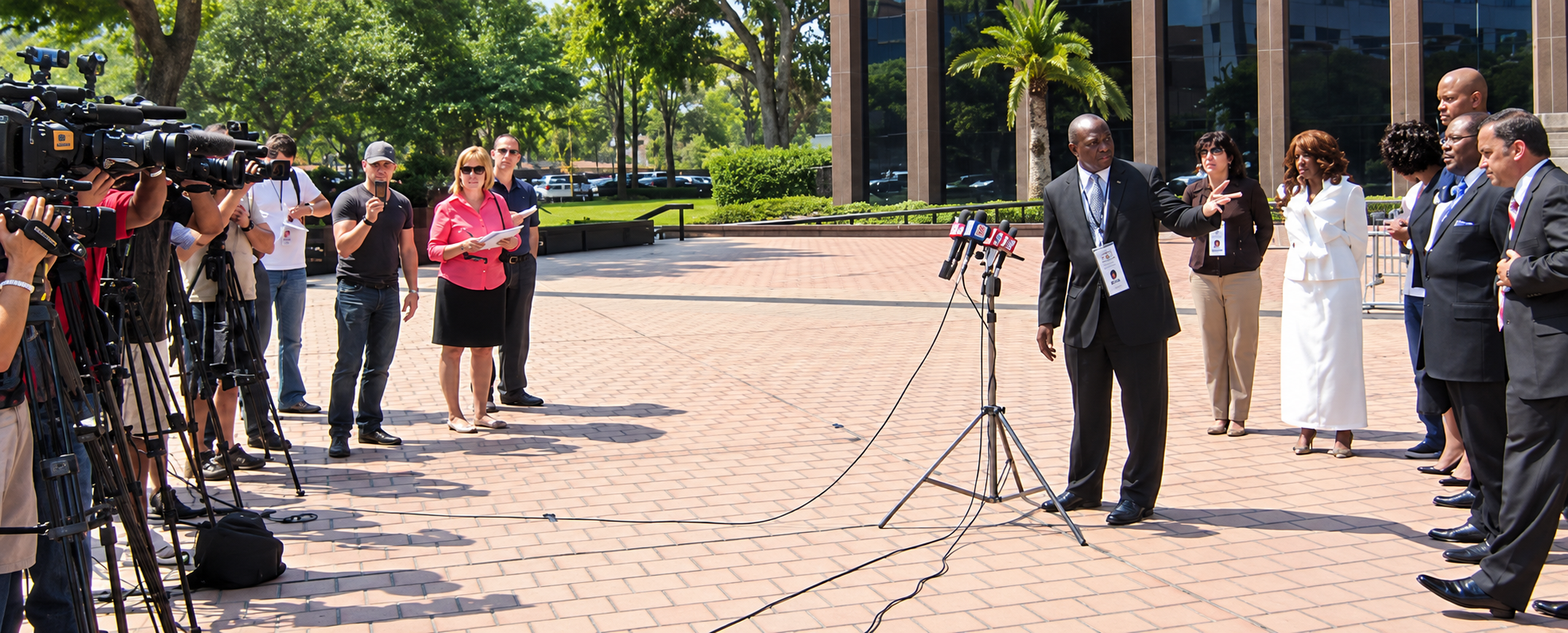
Willie DavidORLANDO, Fla. (FNN) — The Central Florida Black Caucus of Local Elected Officials held a press conference on the steps of Orlando City Hall, criticizing a new congressional map signed into law by Florida Governor Ron DeSantis.
Speakers included U.S. Congressman Maxwell Frost, State Senator Lavon Bracy-Davis, State Representative Bruce Antone, Orange County Clerk of Courts Tiffany Moore Russell, representatives from Equal Ground, and the Central Florida Urban League. Officials argued the map weakens minority representation and follows a recent U.S. Supreme Court ruling that scaled back key protections under the Voting Rights Act.
Florida National News has learned that three lawsuits have been filed seeking to block the newly approved congressional map following the redistricting process. The map is widely viewed as an effort to expand Republican representation in Florida’s congressional delegation ahead of upcoming elections.
IMPACT ON BLACK REPRESENTATION
Leaders warned the redistricting plan could significantly reduce the influence of Black voters in Central Florida and across the state. They argued that dismantling historically minority-access districts undermines decades of progress in equitable representation.
LEGAL CHALLENGES UNDERWAY
At least three lawsuits have been filed challenging the legality of the new map. Civil rights advocates contend the redistricting plan violates federal protections and could further erode voting rights following the Supreme Court’s recent decision.
FUTURE OF BLACK CONGRESSIONAL LEADERSHIP
Elected officials and advocacy groups expressed concern about the long-term effects on Black congressional representation. They emphasized the need for continued legal action and community engagement to protect fair representation in future elections.
Trending
Entertainment4 days agoHow Orlando International Fashion Week Builds Confidence: A Belonging-Driven Casting Experience
Central Florida News2 days agoOrlando Commissioner Tony Ortiz Files for Mayor, Could Become City’s First Puerto Rican Mayor
Florida6 hours agoDarren Soto Faces Toughest Re-Election Fight as Puerto Rican Political Influence Shifts in Central Florida