Connect with us

US NATIONAL NEWS

Biden Calls on Congress to Approve $100 Billion for Helene, Milton Disaster Relief Package

Published

on

Biden Calls on Congress to Approve $100 Billion for Helene, Milton Disaster Relief Package
Credit: Manuel Balce Ceneta | AP

WASHINGTON (FNN) – In a letter to Speaker of the House Mike Johnson, President Joe Biden urged Congress to act swiftly in approving a $100 billion disaster relief package. This request comes in response to the devastation caused by Hurricanes Helene and Milton, as well as other recent disasters, including wildfires and tornadoes. The president emphasized the importance of bipartisan action to support recovery efforts, rebuild critical infrastructure, and assist impacted communities.

Key Points from the Letter

  • Immediate Needs:
    • Replenishment of the Small Business Administration’s (SBA) disaster loan program, which has already processed over 100,000 applications.
    • Funding for the Disaster Relief Fund (DRF) managed by FEMA, which is crucial for recovery efforts across affected states.
    • Support for farmers and rural communities through the Department of Agriculture.
  • Long-Term Recovery:
    • Investments in infrastructure, including roads, bridges, and water systems, with specific funding for EPA and Department of Energy projects.
    • Housing recovery via HUD’s Community Development Block Grant Disaster Recovery program.
  • Supply Chain Resilience:
    • Funding for HHS to address shortages of IV fluids and other critical medical supplies impacted by Hurricane Helene.
  • Flood Insurance Sustainability:
    • Relief for the National Flood Insurance Program (NFIP), which faces significant financial strain.
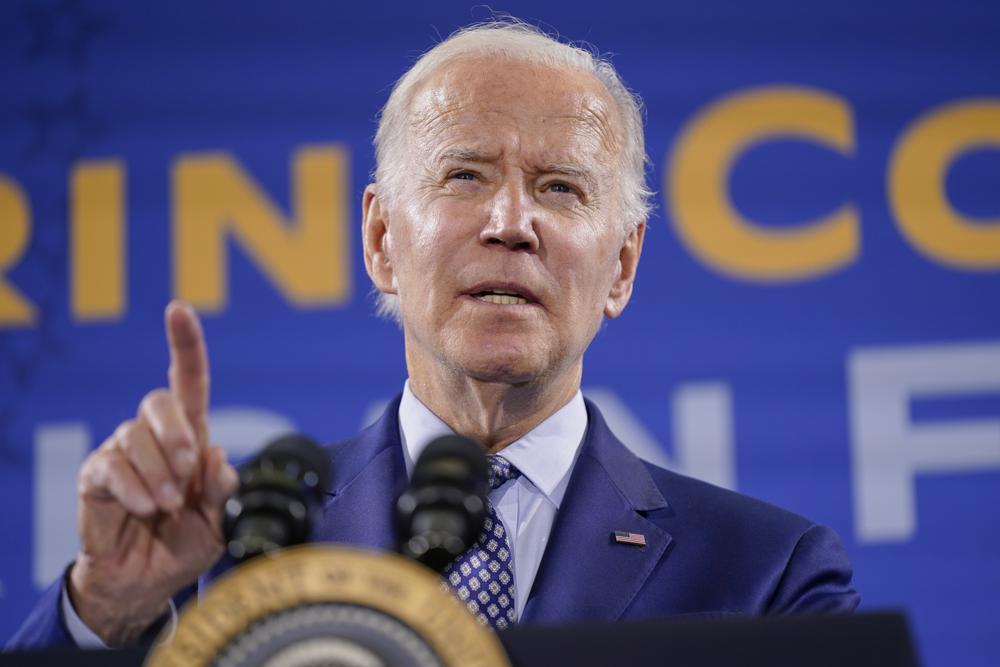
President Joe Biden speaks about his student debt relief plan at Central New Mexico Community College, Thursday, Nov. 3, 2022, in Albuquerque, N.M. (AP Photo/Patrick Semansky)

President Biden’s Appeal

“We cannot afford any further delay,” the president wrote, pointing to past bipartisan responses to disasters like Hurricane Katrina and Hurricanes Harvey, Irma, and Maria. He emphasized the urgent need for Congress to follow through for the families and communities still recovering from recent catastrophic events.
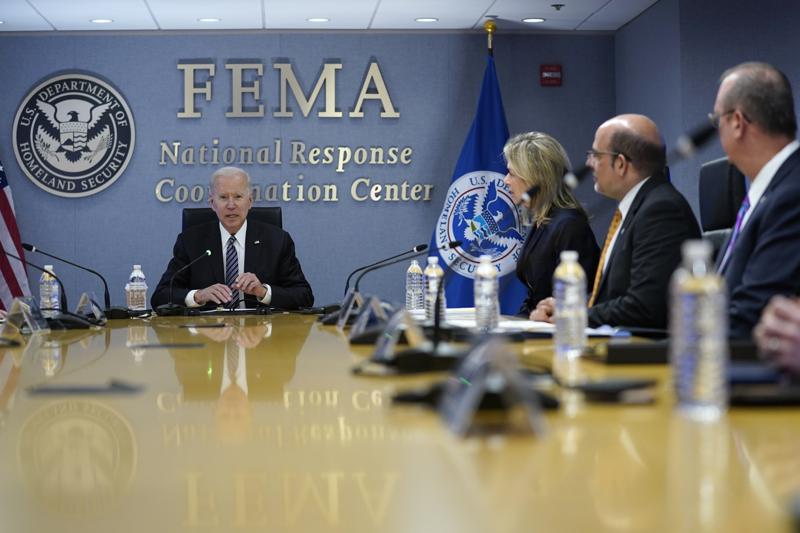
President Joe Biden participates in a briefing on the upcoming Atlantic hurricane season, at FEMA headquarters, Monday, May 24, 2021, in Washington. (AP Photo/Evan Vucci)

Statements from Federal Leaders

  • FEMA Administrator Deanne Criswell: “Disaster relief funding is the lifeline that enables us to help communities recover faster and more comprehensively. We’re asking Congress to move quickly.”
  • Agriculture Secretary Tom Vilsack: “Farmers and ranchers have faced extraordinary losses, and this relief package is vital to their recovery.”

Funding Breakdown Highlights

  • Small Business Support: Restores SBA loans for businesses and individuals, critical for home and property repairs.
  • Healthcare Supply Chain: Ensures restoration of production and capacity for medical products.
  • Rural and Agricultural Aid: Provides emergency support to restore operations in farming communities.

Impact and Call to Action

President Biden noted the far-reaching impacts of the storms, from the devastation in Florida to the wildfire-ravaged regions in Hawaii. He urged swift congressional action to ensure critical resources reach those in need without delay.

_________________________________________________________________

J Willie David, III
Florida National News and FNN News Network
News@FloridaNationalNews.com


Tech

NASA Rolls Out Massive SLS Rocket Stage for Artemis III Mission to Kennedy Space Center

Published

on

Pictured above is the top four-fifths of the SLS (Space Launch System) core stage – the section containing the liquid hydrogen tank, liquid oxygen tank, intertank, and forward skirt. NASA will roll the largest section of the agency’s SLS rocket that will launch the second crewed Artemis mission under the Artemis III mission out of NASA’s Michoud Assembly Facility on Monday, April 20. Credit: NASA

NEW ORLEANS (FNN) — NASA will roll out the largest section of its Space Launch System rocket on Monday, April 20, marking a major milestone for the Artemis III mission.

The section, representing the top four-fifths of the SLS core stage, is being moved from NASA’s Michoud Assembly Facility in New Orleans. It includes the liquid hydrogen tank, liquid oxygen tank, intertank and forward skirt. The structure will be loaded onto NASA’s Pegasus barge for transport to Kennedy Space Center in Florida.

CORE STAGE DELIVERY AND INTEGRATION

Once the core stage arrives at Kennedy Space Center, teams will complete final outfitting and vertical integration. The hardware will then be transferred to NASA’s Exploration Ground Systems Program for stacking and launch preparation.

The Artemis III engine section and boat-tail, which protects the engines during launch, were previously moved to the Vehicle Assembly Building in July 2025. The four RS-25 engines are scheduled to arrive from Stennis Space Center in Mississippi no later than July 2026 for integration.

POWERING THE ARTEMIS III MISSION

Equipped with four RS-25 engines, the SLS core stage will generate more than 2 million pounds of thrust, enabling the launch of astronauts aboard the Orion spacecraft.

Artemis III is currently targeted for launch in 2027, following the successful Artemis II mission, which completed a crewed flight around the Moon on April 10.

NASA’S MOON-TO-MARS STRATEGY

The Artemis III mission is part of NASA’s broader Artemis program, aimed at returning astronauts to the Moon and establishing a sustained human presence.

The mission will test critical capabilities, including rendezvous and docking between the Orion spacecraft and commercial systems needed for future lunar landings, currently planned for 2028.

NASA is working in partnership with Boeing, the SLS core stage lead contractor, and L3Harris Technologies, the lead contractor for the RS-25 engines. The core stage remains the backbone of the SLS rocket and is manufactured at the Michoud Assembly Facilit

Continue Reading

Tech

NASA’s Artemis II Astronauts Begin Historic Journey Around the Moon After Key Orion Engine Burn

Published

on

Earth's crescent is seen from a solar array camera on the Orion spacecraft on the first flight day of the Artemis II mission. Credit: NASA

CAPE CANAVERAL, Fla. (FNN) — For the first time in more than 50 years, astronauts on a NASA mission are headed around the Moon after successfully completing a critical burn of the Orion spacecraft’s main engine.

The approximately six-minute firing of Orion’s service module engine Thursday — known as the translunar injection burn — accelerated the spacecraft and its crew beyond Earth’s orbit, placing them on a trajectory toward the Moon.

Aboard the spacecraft are NASA astronauts Reid Wiseman, Victor Glover and Christina Koch, along with Canadian Space Agency astronaut Jeremy Hansen.

“Today, for the first time since Apollo 17 in 1972, humans have departed Earth orbit,” said Dr. Lori Glaze, acting associate administrator for NASA’s Exploration Systems Development Mission Directorate. “Reid, Victor, Christina and Jeremy now are on a precise trajectory toward the Moon. Orion is operating with crew for the first time in space, and we are gathering critical data and learning from each step.”

NASA’s Space Launch System rocket and Orion spacecraft lifted off from Launch Pad 39B at Kennedy Space Center at 6:35 p.m. EDT on April 1, beginning a planned 10-day test mission around the Moon and back.

Successful Launch and Spacecraft Activation

Shortly after reaching space, Orion deployed its four solar array wings, allowing the spacecraft to generate power from the Sun. The crew and mission controllers then began transitioning the spacecraft from launch to normal flight operations while checking critical onboard systems.

About 49 minutes into the flight, the rocket’s upper stage fired to place Orion into an elliptical orbit around Earth. A second burn propelled the spacecraft — named “Integrity” by the crew — into a high Earth orbit extending roughly 46,000 miles above the planet for nearly 24 hours of system testing.

Following the maneuver, Orion separated from the upper stage and began flying independently.

System Tests and Crew Operations in Space

During the early phase of the mission, the astronauts conducted a manual piloting demonstration to evaluate Orion’s handling capabilities using the Interim Cryogenic Propulsion Stage as a docking target.

After the test, Orion executed an automated departure burn to safely move away from the stage. The propulsion stage later performed a disposal burn before re-entering Earth’s atmosphere over a remote area of the Pacific Ocean.

Before its re-entry, four small CubeSats were deployed from the rocket’s Orion stage adapter to conduct separate scientific missions.

Mission teams also transitioned communications to NASA’s Deep Space Network while the crew adjusted to the space environment. Astronauts completed their first rest periods, performed onboard exercise routines, restored the spacecraft’s toilet to normal operations and prepared the spacecraft for the translunar injection burn.

Lunar Flyby and Artemis Program Goals

The crew is scheduled to conduct a lunar flyby Monday, April 6, when astronauts will capture high-resolution images and make observations of the Moon’s surface — including portions of the lunar far side rarely seen directly by humans.

Although the far side will only be partially illuminated during the flyby, the lighting conditions are expected to cast long shadows across the terrain, highlighting ridges, slopes and crater rims that are difficult to observe under full sunlight.

After completing the flyby, the astronauts will return to Earth and splash down in the Pacific Ocean off the coast of San Diego.

The mission marks a major milestone for NASA’s Artemis program, which aims to send astronauts on increasingly ambitious missions to explore the Moon, advance scientific discovery, stimulate economic growth and prepare for the first crewed missions to Mars.

Continue Reading

Politics

Donald Trump Marks Policy Shift on Gender Identity, Education, and Federal Programs

Published

on

WASHINGTON (FNN) — The administration of Donald Trump announced a series of policy changes affecting federal positions on gender identity, education standards, health care funding, and military service. Officials say the actions are intended to redefine federal policy around biological sex and limit government involvement in gender-related medical and educational programs.

The policy changes follow criticism from Republicans of earlier initiatives introduced during the administration of Joe Biden that expanded federal recognition of transgender individuals in several areas of public policy.

Federal Policy Defines Sex as Male or Female

The Trump administration declared that the official policy of the federal government recognizes only two sexes — male and female — based on biological characteristics.

Administration officials say the policy affects federal documents, agency rules and programs across multiple departments. The move also ended the practice of gender self-identification on certain federal records, including passports, according to officials.

Supporters say the change restores clarity to federal policy, while critics argue it removes recognition for transgender Americans in official government documentation.

Funding and Health Care Policies Adjusted

Federal agencies were directed to halt funding, sponsorship or promotion of certain medical procedures related to gender transition for minors. Administration officials say the directive is intended to prevent what they describe as irreversible medical interventions involving children.

Following the policy shift, several major health systems announced reviews, suspensions or changes to pediatric gender-related medical programs. The administration also directed the U.S. Department of Health and Human Services to review existing medical evidence surrounding gender-related care for minors.

Changes in Education, Sports, and Military Policies

The administration also ended federal support for gender identity and equity curricula in public education programs receiving federal funds, stating the move reinforces parental rights and state oversight of school content.

Additional directives address athletic competition and military service. The administration announced policies intended to ensure that women’s sports competitions are limited to biological female athletes and reinstated standards for military service based on biological sex through the United States Department of Defense.

Officials say the changes are intended to focus federal programs on what they describe as fairness, safety and readiness across government institutions.

Continue Reading
Advertisement
Advertisement Ticket Time Machine ad
Advertisement Orlando Regional REALTOR Association logo
Advertisement Parts Pass App
Advertisement Hispanic Chamber of Commerce of Metro Orlando
Advertisement
Advertisement African American Chamber of Commerce of Central Florida
Advertisement FNN News en Español
Advertisement Indian American Chamber of Commerce logo
Advertisement Florida Sports Channel

FNN Newsletter

Trending