

Politics
Black History Month at 100: Florida Civil Rights Association, NAACP and the Million Man March Legacy of J. Willie David III


ORLANDO, Fla. (FNN) – As Black History Month marks 100 years of honoring the legacy, sacrifice, and achievements of African Americans, Florida shines a spotlight on one of its boldest modern-day civil rights leaders — a trailblazer and changemaker who not only shaped the present but continues to inspire the future: Orlando-based activist, entrepreneur, and founder of the Florida Civil Rights Association, J Willie David III.
FCRA, NAACP, and the Million Man March
Born in 1965, David has dedicated more than three decades to protecting civil and human rights, defending civil liberties, advancing equal justice, and confronting systemic injustice throughout Florida and beyond. Bold beyond his time, he challenged institutions when it was unpopular, demanded accountability when it was resisted, and stood firm when others remained silent.
As Founder and President of the Florida Civil Rights Association (FCRA), established in 2005, David built an organization centered on transparency, policy reform, and community empowerment — transforming grassroots advocacy into measurable impact.
His early leadership roots trace back to the late 1990s, when he was elected as 2nd Vice President of the Orange County branch of the National Association for the Advancement of Colored People (NAACP), where he also chaired the Labor and Industry Committee. In the early 2000s, he was elected as a state member of the Special Committee on Internal Affairs of the Florida State Conference NAACP, helping shape accountability measures within one of the nation’s most historic civil rights institutions.
David often reflects that his passion for civil rights was ignited during a transformative journey to Washington, D.C., to participate in the historic Million Man March on October 16, 1995 — a defining moment that would alter the trajectory of his life.
“The Million Man March changed my life. It taught me that leadership is not about position — it’s about purpose,” David said. “I returned to Florida committed to being a voice for those who felt unheard and unseen. If you see injustice and remain silent, you become part of the problem.”
For David, civil rights work is not about recognition — it is about responsibility. His leadership reflects courage under pressure, conviction in the face of opposition, and an unwavering belief that justice must be pursued, not postponed.
As Black History Month reaches its centennial milestone, David’s story stands as a reminder that history is not only remembered — it is made by those bold enough to challenge the status quo and courageous enough to demand change.

Florida Civil Rights Association President J. Willie David III, alongside the Consul of Haiti in Orlando and members of the Haitian community, held a press conference calling on the Orange County Sheriff’s Office to hold its deputies accountable in a deadly police vehicle pursuit that accidentally claimed the lives of a former Haitian Cabinet Minister and his wife in Orlando.
Fighting for Reform Across Florida and Beyond
David built a reputation as a go-to civil and human rights leader in Florida — advocating for justice, equity, transparency, and due process for all people. Alongside a dedicated team of attorneys, clergy, and community activists, he became known for being media-savvy, strategic, and responsive — often emerging as an immediate newsmaker when civil rights issues surfaced in Florida and beyond.
David joined thousands in Washington, D.C., protesting for immigrant rights outside the headquarters of the United States Department of Homeland Security and marched with more than 25,000 immigrants calling for fair, humane, and comprehensive reform. His activism emphasized constitutional protections, family unity, and equal application of the law.
Across Florida, he organized statewide protests against red-light camera enforcement, marched against violent crime, and led public demonstrations demanding accountability in both the public and private sectors. He worked to ensure that communities affected by police misconduct, economic injustice, and discrimination had coordinated legal support, media access, and organized civic engagement.
In moments of tragedy, David unified communities through both prayer and action. During an MLK Holiday Parade, he paused the event to lead thousands in prayer for those injured and killed in Haiti’s devastating earthquake, demonstrating international solidarity and humanitarian compassion.
David also organized protests and labor actions involving more than 100 taxi drivers at Orlando International Airport and Orlando City Hall, advocating for fair wages, equitable regulations, and economic justice for working-class drivers. His ability to mobilize workers, faith leaders, and legal advocates reflected his broad coalition-building approach.
As a featured panel speaker on civil rights at the American Bar Association Midyear Conference — themed “Defending Liberty and Pursuing Justice” — David contributed to national discussions on constitutional rights, policing reform, and safeguarding civil liberties.
His advocacy has spanned a wide and intersectional range of issues, including:
Women’s rights and gender equity
Missing women of color and disparities in media coverage
Discrimination impacting Hispanic and immigrant communities
Police misconduct and excessive use of force
Education discrimination and school discipline disparities
Disability rights access and accommodations
Fair housing protections and anti-discrimination enforcement
Healthcare access and affordability
Economic justice and labor fairness
Beyond protests and public statements, David frequently convened town halls bringing together law enforcement officials, elected leaders, attorneys, clergy, and residents to foster dialogue and pursue measurable reform. He leveraged media platforms, legal filings, policy proposals, and peaceful demonstrations to drive sustained attention toward systemic change.
Whether through marches, press conferences, negotiations, town hall forums, media appearances, or direct legal advocacy, David consistently positioned himself at the forefront of efforts demanding institutional accountability — reinforcing his standing as a modern civil rights leader committed to confronting injustice wherever it appears and ensuring that marginalized communities are seen, heard, and protected under the law.
Federal agents from the Federal Bureau of Investigation (FBI) met with David regarding federal civil rights complaints he filed with the U.S. Department of Justice concerning police misconduct — underscoring the seriousness and impact of his advocacy.
“Civil rights work is not about creating division. It’s about creating accountability. When systems fail the people, we must demand reform — peacefully, lawfully, and relentlessly.”

Florida Civil Rights Association President J. Willie David III says that meeting civil rights icons and legends — including the late Rev. Jesse Jackson of the Rainbow/PUSH Coalition, Rev. Al Sharpton of the National Action Network, the late Julian Bond, former chairman of the National Association for the Advancement of Colored People (NAACP), and the late Rev. C. T. Vivian — gave deeper meaning to his commitment to carry the torch of modern-day civil rights advocacy for a new generation.
Standing on the Shoulders of Civil Rights Giants
David says he is honored to have met civil rights icons and legends whose work shaped American democracy, including the late Rev. Jesse Jackson, Rev. Al Sharpton, late NAACP Chairman Julian Bond, and the late Rev. C. T. Vivian.
David reflected on the enduring legacy of the late Rev. Jesse Jackson, honoring his lifelong commitment to justice and equality:
“Rev. Jesse Jackson understood that civil rights were inseparable from politics and economics. He led and joined boycotts, pressured corporations to open their doors, and demanded that businesses invest in fairness and opportunity. Because of his courage, Black Americans gained greater access to corporate leadership, public office, and even the highest office in the land — the presidency of the United States. His life’s work lives on through modern-day civil rights leaders who continue to fight for social and economic justice. His voice may be quiet now, but his impact will echo through generations.”
Meeting these towering figures firsthand had a profound impact on him.
“To stand in the presence of leaders who helped deliver historic change in America’s democracy is humbling. If I can play even a small part in the civil rights movement during Black History Month’s 100-year milestone, then my sacrifice was worth it.”

Florida Civil Rights Association President J. Willie David III, alongside attorneys and faith leaders, held a press conference outside of Florida Government Agencies Regional Office in Orlando and later erected a cross in Sanford, Florida, to honor the life of Trayvon Martin, who was killed by George Zimmerman. Through these visible and symbolic actions, David helped amplify national attention on the case, positioning Florida as the epicenter of an intense and far-reaching debate over civil rights, self-defense laws, and racial justice. His leadership during this pivotal moment underscored his role in mobilizing communities, engaging legal and faith-based voices, and elevating the conversation beyond state lines to a worldwide audience focused on justice and accountability.
Advocacy in a New Era
From the national outcry over Trayvon Martin to movements such as Black Lives Matter, the cries of “Hands Up, Don’t Shoot” and “I Can’t Breathe” became defining calls for justice in a new generation’s struggle to dismantle what many describe as the modern-day “New Jim Crow.”
David believes advocacy must remain central to democracy.
“Trayvon Martin, Black Lives Matter, ‘Hands Up, Don’t Shoot,’ ‘I Can’t Breathe’ — these moments remind us why advocacy must be the lifeline that keeps democracy alive.”

Florida Civil Rights Association President J. Willie David III met with officials from the United Kingdom’s homeland security delegation during their visit to Orlando, Florida, to exchange best practices on improving race relations between law enforcement and the communities they serve. David has also met with diplomats representing various nations to discuss immigrant rights, human rights protections, and the fair treatment of their nationals within the United States. These international engagements reflect his broader impact beyond Florida — positioning him as a civil rights leader whose work contributes to global dialogue on policing reform, equity, and justice across borders.
National and International Influence
David’s work extended beyond Florida. He engaged in discussions involving immigrants and human rights, detention cases, and economic concerns affecting nationals from countries including Kenya, Jamaica, Haiti, Grenada, Antigua and Barbuda, Peru, Colombia, Japan, Taiwan, China, Venezuela, France, and the United Kingdom.
In 2013, U.S. Congressman Alan Grayson awarded David and the Florida Civil Rights Association a Certificate of Special Congressional Recognition during a regional fair housing summit in Orlando.
The Consul General of Haiti in Miami issued David a Diplomatic Recognition Letter for his advocacy surrounding the accidental deaths of a former Haitian Cabinet Minister and his wife during a police pursuit.
Additionally, officials from the United Kingdom traveled to Orlando to meet with David to discuss human and civil rights relations between the United States and the communities it serves.

Florida Civil Rights Association President J. Willie David III was a frequent guest on News 6 Flashpoint, where he participated in in-depth discussions alongside county commissioners, police chiefs, faith leaders, and missing persons advocates. During these televised forums, David addressed critical issues including police misconduct, strategies for strengthening relationships between law enforcement and the community, and the lack of consistent media coverage surrounding missing women of color. He also discussed organizing and convening town hall meetings that brought together police officials, community members, and religious leaders to foster dialogue, transparency, and collaborative solutions. His appearances reinforced his role as a leading civil rights voice in Central Florida — leveraging media platforms to advocate for accountability, unity, and equitable public attention for marginalized communities.
Historic Community Engagement
David made history by convening town hall meetings that brought together the Orange County UnderSheriff and 13 local police chiefs in one room to address community-police relations, misconduct concerns, and juvenile justice reform.
“True leadership means bringing everyone to the table — even when the conversation is uncomfortable. Progress begins with dialogue, but it must end with action.”
Despite his strong stance on accountability, David also built bridges. He has been honored by the U.S. Marshals Service, the Orange County Sheriff’s Office, and the Orlando Police Department for collaborative efforts in promoting community safety.

Florida Civil Rights Association President J. Willie David III, joined by victims’ family members, held a press conference outside the U.S. Attorney’s Office for the Middle District of Florida in Orlando, where he formally hand-delivered a federal civil rights complaint alleging police misconduct and requesting an investigation by the U.S. Department of Justice. The action underscored David’s leadership in pursuing accountability at the highest levels of government, ensuring that affected families had a direct voice in seeking federal oversight and justice.
Media Savvy, Messaging & Movement Building
Media strategy was not an accessory to his leadership — it was a tool for transformation. J Willie David III strategically leveraged local, national, and international media platforms to elevate civil rights issues from neighborhood concerns to public policy conversations. He understood that visibility creates accountability, and that when the public is informed, systems are forced to respond.
His ability to merge advocacy with disciplined, strategic messaging positioned him as one of Florida’s influential modern-day civil rights leaders. He did not use communication merely to inform — he used it to mobilize, to challenge power, and to drive measurable change. Speaking truth to power was not a slogan; it was a strategy.
David became widely known in the news media for his bold and uncompromising approach to accountability. He would march into local police departments and U.S. Attorneys’ Offices to formally deliver federal civil rights complaints alleging police misconduct — ensuring that complaints were not buried in bureaucracy. On multiple occasions, he publicly called on police chiefs and their legal teams to step forward and accept the complaints directly, demanding transparency over silence.
These decisive actions — often covered by numerous media outlets — were designed to shine a public light on policies he believed harmed the community and to pressure leadership to reconsider practices that undermined trust and constitutional rights.

At the same time, David worked across party lines, building relationships with Democratic and Republican elected officials, governors, state legislators, members of Congress, cabinet secretaries, and White House aides. His advocacy consistently centered on constituents and underserved communities — not political affiliation.
“Justice is not partisan. Equality is not political. Civil rights belong to every American — regardless of race, party, or background.”

Florida Civil Rights Association President J. Willie David III founded and organized the first-ever Dr. Martin Luther King Jr. Holiday Parade in downtown Kissimmee, Florida, in collaboration with a Kissimmee city commissioner. The historic parade was established to honor the life and legacy of Dr. King and also paid tribute to global freedom icon Nelson Mandela. The event created a new platform for unity, cultural celebration, and civic engagement within the community, further reflecting David’s commitment to advancing civil rights, inclusion, and international solidarity.
Honoring Dr. King’s Dream in Action
Beyond policy reform, David is the founder and organizer of the first Dr. Martin Luther King Jr. Holiday Parade in the City of Kissimmee, Florida — expanding opportunities for unity and remembrance of Dr. King’s enduring legacy.

Florida Civil Rights Association President J. Willie David III was presented with a Certificate of Special Congressional Recognition by U.S. Congressman Alan Grayson in honor of his leadership and unwavering commitment to eliminating prejudice and discrimination in both the public and private sectors. The recognition from a member of the United States Congress underscored the impact of David’s sustained civil rights advocacy — affirming his role in advancing accountability, equal opportunity, and justice for underserved communit throughout Florida and beyond.
A Living Legacy
J. Willie David III’s life work reflects a model of 21st-century civil rights leadership — combining grassroots activism, legislative advocacy, diplomacy, media strategy, and coalition building.
He has been honored and awarded:
For advancing legislative reform in policing and civil rights policy
For securing accountability and financial settlements for affected families
For international human rights advocacy
For bipartisan engagement to drive meaningful change
For building institutions that empower communities
For bridging law enforcement and community dialogue
“My legacy will not be measured by titles or awards. It will be measured by whether future generations inherit a system more just than the one we found.”
As Black History Month marks 100 years of honoring trailblazers, and as February 28, 2026, closes this historic observance, Florida recognizes J. Willie David III as a leader whose work continues the long march toward justice — proving that civil rights history is not only something we remember, but something we continue to write, advance, and act upon because it matters.


Central Florida News
Broadcaster Ray Cruz Santiago Criticizes Samuel Vilchez Santiago With Communist Graphics, Puerto Rican Identity Claims


The commentator’s video pairs the Democrat’s image with Soviet-style imagery and references his grandfather’s communist beliefs; Vilchez Santiago has publicly rejected socialism.
ORLANDO, Fla. (FNN) — Hispanic broadcaster Ray Cruz Santiago is targeting Florida House Democratic nominee Samuel Vilchez Santiago in a video that depicts the candidate in a Soviet-style military uniform and pairs his name with a hammer-and-sickle graphic.
The approximately two-minute video invokes Vilchez Santiago’s description of his grandfather as a communist while presenting images of the candidate, former Venezuelan President Hugo Chávez and Republican opponent Jorge Malavet.
In separate Facebook posts, Cruz Santiago also accuses the Venezuelan-born Democrat of misleading Puerto Rican voters about his heritage. The material reviewed does not substantiate that allegation, and Vilchez Santiago has publicly rejected the socialist label.
Video visually links candidate to communism
The uploaded video shows an apparent composite depicting Vilchez Santiago in a military uniform and peaked cap. Another graphic places the name “Samuel Vilchez” beneath a red flag bearing a hammer and sickle.
An on-screen caption describes him, translated from Spanish, as a “Democratic candidate in District 43 with a communist grandfather.”
The sequence also juxtaposes footage of Chávez with an image of Vilchez Santiago draped in a Venezuelan flag. Later frames display Malavet and Vilchez Santiago alongside Puerto Rican and Venezuelan flag symbols, respectively.
Together, those visual choices suggest an association between the Democratic candidate and communism. They do not independently establish his political beliefs, affiliations or support for Venezuela’s government. The uniform depiction should be understood as an apparent composite, rather than documentary evidence that he wore such a uniform.
Grandfather’s statement includes family opposition to Chavismo
The reference to Vilchez Santiago’s grandfather has a documented source.
“My grandfather was a communist,” Vilchez Santiago said in a 2019 Princeton University profile. In the same discussion, he described his parents as politically active opponents of Venezuela’s Chavista government and discussed his family’s departure because of political persecution. pace.princeton.edu
That account describes an ideological divide within his family. His grandfather’s beliefs do not establish the candidate’s own ideology.
Candidate has rejected socialist label
Cruz Santiago’s supplied posts describe Vilchez Santiago as a socialist or democratic socialist, a characterization the candidate has disputed.
“I am not a socialist. I have never been a socialist,” Vilchez Santiago said in Spanish in an interview published Sept. 29 by La Prensa Florida.
He argued that proposals involving health care, Social Security and lower household expenses should not automatically be labeled socialist. His stated priorities included easing property tax increases for first-time homebuyers, reducing toll expenses and simplifying small-business registration. laprensafl.com

Separate posts question Puerto Rican campaign imagery
Cruz Santiago’s heritage criticism appears in separate Facebook posts alleging that Vilchez Santiago is presenting himself as Puerto Rican to attract voters. www.facebook.com
A screenshot of a campaign advertisement supplied to FNN shows a photograph of Vilchez Santiago holding a Puerto Rican flag alongside two women, with his campaign branding displayed over the image.
The photograph places a recognizable symbol of Puerto Rican identity within the campaign’s presentation of his personal story. Viewers unfamiliar with his Venezuelan background could interpret it as suggesting Puerto Rican heritage. The materials reviewed do not establish whether viewers reached that conclusion or whether the campaign intended it.
The screenshot contains no explicit claim of Puerto Rican ancestry. Vilchez Santiago’s Venezuelan background is publicly documented in the Princeton profile and a Venezuelan-American Caucus biography. pace.princeton.edu
Why the presentation matters to voters
The criticism combines two distinct subjects: the candidate’s heritage and his political beliefs.
For voters evaluating the material, the central distinction is between documented statements and associations created through editing. The grandfather’s communist beliefs are supported by the candidate’s published account. The uniform, hammer-and-sickle graphic and Chávez juxtaposition are elements of the video’s presentation, rather than proof of the candidate’s ideology.
Likewise, the Puerto Rican flag photograph documents the campaign’s use of cultural imagery without establishing a false claim of ancestry.
Broadcaster brings criticism into District 43 contest
Cruz Santiago hosts El Escándalo del Día on Miami’s Radio Mambí 710 AM, according to his professional profile. Salsoul’s official website also lists him among its personalities. www.linkedin.com
Readers can review his commentary on Facebook and visit his website.
Vilchez Santiago and Malavet are the Democratic and Republican candidates, respectively, in the Nov. 3 election for Florida House District 43, according to state election records. dos.elections.myflorida.com

Florida
Donalds, Jolly Court Black Voters In Governor’s Race. How Much Are They Spending With Black-Owned Media?

Endorsements and community visits highlight the competition for Black support, while advertising purchases remain an unanswered question.
ORLANDO, Fla. (FNN) — Republican Byron Donalds and Democrat David Jolly are courting Black voters through endorsements, community appearances and organizing efforts, but how much their political operations are spending with Black-owned media remains unverified in the reporting reviewed for this article.
Donalds has secured support from Eatonville Vice Mayor Angela Thomas and Gainesville City Commissioner Cynthia Moore Chestnut, a longtime Democrat. Jolly has assembled a statewide coalition of Black elected officials, religious leaders and policy advisers ahead of the Nov. 3 election.
The endorsements show how individual leaders are approaching the governor’s race. Advertising records would help answer a separate question: How much business are the political operations seeking Black votes directing to Black-owned publishers and broadcasters?

Donalds Gains Endorsements
Thomas endorsed Donalds on Oct. 19, the same day Jolly visited Eatonville for a get-out-the-vote event, according to News 6.
“I am honored to have Vice Mayor Angela Thomas’s support,” Donalds wrote in the Facebook statement announcing her endorsement.
“Eatonville’s story of self-governance is one of the proudest in Florida’s history, and her leadership carries that legacy forward today.”
Donalds connected her support to his message about individual freedom and local decision-making.
“That’s the kind of trust in communities I’ll bring to Tallahassee — letting Floridians run their own lives, not Tallahassee,” he wrote.
Chestnut’s endorsement brought a prominent Black Democratic voice into Donalds’ camp. In a statement published by WCJB, she acknowledged policy disagreements with him while defending her decision to cross party lines.
“I want to see a Black governor of Florida in my lifetime,” Chestnut said.
She also encouraged voters to question Donalds directly about public education, property taxes, voting rights and economic opportunity.
Donalds would become Florida’s first Black governor if elected. Support from individual officials, however, does not establish a statewide shift among Black voters.
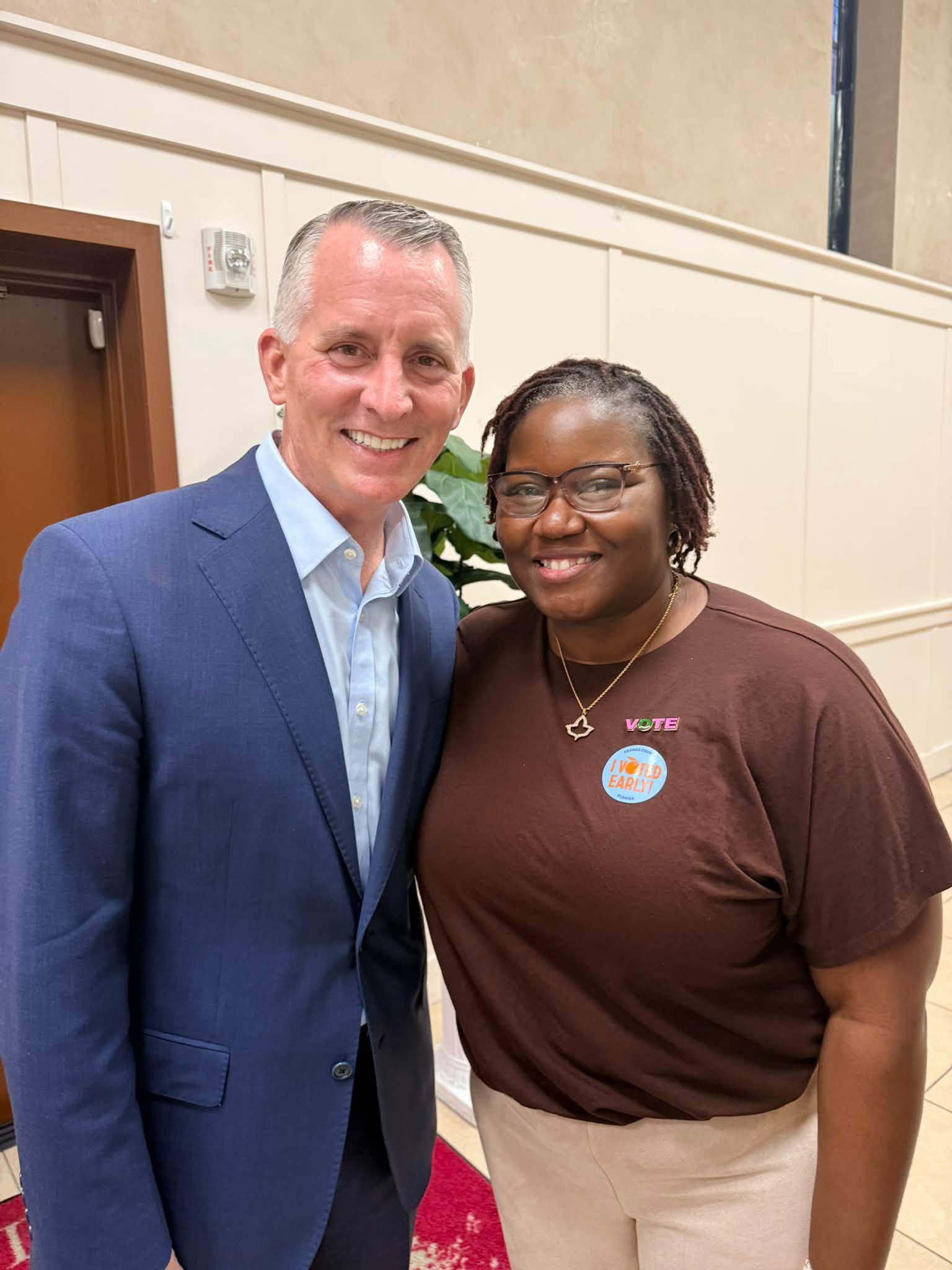
Jolly Builds a Black Leadership Coalition
Jolly’s campaign announced a Black leadership coalition Sept. 10 that includes former Jacksonville Mayor Alvin Brown, state Sens. Shevrin Jones and Tracie Davis, former state Sen. Arthenia Joyner and Pinellas County Commissioner Rene Flowers.
The campaign said the group would organize voters, help develop policy and expand community engagement. Jolly’s announced commitments include establishing an office of civil rights, supporting voting rights legislation and opposing restrictions targeting the teaching of Black history.
During his Eatonville visit, Jolly emphasized his responsibility to reach communities throughout Florida.
“Part of running for governor is representing every community across the state,” he told News 6.
A former Republican congressman who later became an independent before joining the Democratic Party, Jolly has made homeowners insurance reform, access to primary health care and public education central campaign issues.
Following the Advertising Dollars
Both political operations have announced substantial advertising efforts.
Florida Politics reported that Friends of Byron Donalds announced a $20 million statewide advertising buy ahead of the August primary. The publication separately reported that Jolly launched a multimillion-dollar statewide advertising effort in September. The announcements cover different periods and political entities and cannot be treated as equivalent spending totals.
Those announcements do not provide a complete accounting of purchases from Black-owned media.
Advertisements aimed at Black voters can run through companies with different ownership structures. Reaching a Black audience does not necessarily mean a campaign purchased advertising from a Black-owned business.
A comparable accounting would identify which Black-owned outlets received payments, how much they received and when. It would include purchases placed through agencies and separate candidate spending from political committee spending.
Without those figures, the available reporting does not establish whether either operation’s investment falls short of a stated commitment or other defined benchmark.
Florida’s Black Media Network
Florida’s established Black press includes The Miami Times in South Florida, the statewide Florida Courier, Daytona Times, The Florida Star in Jacksonville, Florida Sentinel Bulletin in Tampa and The Weekly Challenger in St. Petersburg and Pinellas County.
These publications illustrate the geographic reach of the state’s Black press. Their inclusion is not an audience ranking or a finding that they received advertising from either political operation.
The National Newspaper Publishers Association describes the Black press as a source of community news, information and commentary delivered through print and digital platforms.
Why the Spending Question Matters
For voters, the governor’s race involves representation and decisions affecting insurance costs, schools, health care and civil rights. Endorsements provide one perspective on the candidates; their records and proposals provide another.
Advertising disclosure would add a financial measure of outreach. It would show which Black-owned media businesses received campaign purchases and allow readers to compare those payments with each operation’s overall advertising budget.
As Donalds and Jolly compete for Black support, that accounting would help the public evaluate how their spending decisions align with their community engagement.
Florida National News calls on the Donalds and Jolly campaigns and their affiliated political committees to publicly announce their advertising spending with Black-owned media.
The disclosure should identify outlets, amounts paid, spending periods and purchases placed through agencies. Planned purchases should be listed separately from completed payments.
The same disclosure standard should apply to Democratic and Republican political operations seeking Black voters’ support. Advertising purchases must remain independent of editorial coverage and endorsements.


