

Consumer
Can Your City Make You Healthy? 15 Iowa Blue Zones Project Communities Transform Street Design to Meet Demand for Walkable, Livable Neighborhoods


FRANKLIN, Tenn., (FNN NEWS) By Blue Zones Project — In the 1920s Herbert Hoover called for a chicken in every pot and a car in every garage, and the subsequent build of the nation’s infrastructure paid little heed to the needs of pedestrians or cyclists. Today, Americans seem to be looking for a return to a simpler life. According to the National Association of Realtors, nearly 80 percent of the home-buying public want to live in a walkable community. Yet real estate brokerage Redfin reports that only 14 percent of neighborhoods qualify. Now, Blue Zones Project® communities throughout the country are reversing that trend.
Blue Zones Project, a growing nationwide well-being improvement initiative, is helping cities redesign infrastructure in a way that meets that demand and gets people out of their cars and onto their feet. Incorporating principles from the world’s Blue Zones®areas, where people live longer lives with less chronic disease, Blue Zones Project works with communities to make healthy choices easier through permanent changes to environment, policy, and social networks. That means evaluating and sometimes redesigning a community’s streets and built environment, otherwise known as the human-made places where people live, work, and play.
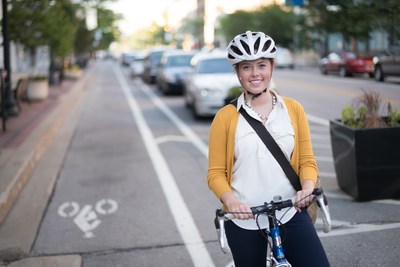
That’s where Dan Burden comes in. Named by Time Magazine in 2011 as “one of the six most important civic innovators in the world,” Burden is an international walkability expert who works directly with Blue Zones Project communities to reshape their built environment. He helps civic leaders rethink the design and construction of streets and other areas where people walk, drive, and ride their bikes.
“Communities are recognizing the need to make roads and public transportation more accessible, and to accommodate pedestrians and cyclists, so residents are encouraged to move naturally,” said Burden, director of innovation and inspiration at Blue Zones, LLC.
Burden and other experts work with participating Blue Zones Project cities, including 15 certified Blue Zones Communities® inIowa, to develop 21st-century complete street policies and built environment improvements by creating protected bike lanes, sidewalks with benches and landscaping, and comfortable transit stations, among other features.
While Iowa is often thought of as a rural state, Blue Zones Project is helping communities change that perception by leading the way on urban policies to promote active transportation. Fifteen certified Blue Zones Communities have passed Complete Streets policies, boasting more than half of the policies adopted statewide. They’ve redesigned major thoroughfares and reimagined downtown areas to encourage pedestrian and bicycle traffic. Three of those communities — Cedar Falls, Waterloo, and Muscatine — landed a prestigious spot on Smart Growth America’s list of the nation’s top 15 Complete Streets policies passed in 2013.
Brought to Iowa by Wellmark Blue Cross and Blue Shield, Blue Zones Project played a key role in that effort. Since 2012, participating cities have realized benefits for public safety, community health, and economic development. In cities like Cedar Rapids, Marion, and Muscatine, the changes have made it easier for residents to get around without a vehicle, improved safety for children walking to school, reduced accidents, and transformed city centers. Other Iowa communities taking on the challenge include Algona, Cedar Falls, Fairfield, Harlan, Iowa City, Mason City, Oskaloosa, Sioux City, Spencer, Spirit Lake, Waterloo, andWoodbine.
“Iowa’s Blue Zones Project communities are setting an example for other cities throughout the state as they represent a majority of the communities statewide to pass Complete Streets policies,” said Laura Jackson, executive vice president of Wellmark Blue Cross and Blue Shield. “These communities are making an investment in a healthier future, and it is one that will pay off for generations to come.”
CEDAR RAPIDS, IOWA
One of the first Iowa communities to pass a comprehensive Complete Streets policy, Cedar Rapids evolved from a city with fragmented recreational cycling opportunities to a community connected by bike lanes and trails. In 2009, the city had only one bikeway. Since then, 19 have been added, and nearly five miles of newly constructed bikeways are expected by 2017. Cedar Rapids was one of the first cities in Iowa to develop protected bike lanes, creating barriers to shield cyclists from cars. With support from Blue Zones Project, the city also converted most one-way downtown streets to two-way streets, encouraging foot traffic for shops and restaurants, and made improvements to residential areas, adding traffic-calming medians and crossing signals as part of a project that supports safe walking routes to schools.
MARION, IOWA
Marion developed guidelines to integrate trees, green space, and other natural features to make streets more walkable. City policy requires consideration of pedestrian and cyclists’ needs in every street-related project, and new developments must have sidewalks installed within five years. Marion’s Complete Streets policy has revitalized its historic Uptown area, diverting cars and creating a pedestrian-friendly atmosphere. Since 2014, Marion has seen a 16 percent increase in people who feel active and productive every day, from 65.6 percent in 2014 to 76.2 percent in 2015, according to the Gallup-Healthways Well-Being Index.
MUSCATINE, IOWA
Recognized by the National Complete Streets Coalition for having one of the top policies in the country in 2013, Muscatine has added approximately 10 miles of new sidewalks and trails—improving community connectivity and making it easier for residents to move naturally. In fact, since 2012, Muscatine has seen a more than 17 percent increase in exercise levels, from 47.5 percent in 2012 to 55.8 percent in 2016, while stress levels dropped 13.6 percent, from 40.4 percent in 2012 to 34.9 percent in 2016, according to the Gallup-Healthways Well-Being Index.
With guidance and support from Blue Zones Project, the city converted an old rural road with a T-style intersection to a roundabout that links schools, the post office, a recreation center, and a hospital. Muscatine also added a 10-foot-wide trail along the redesigned road, where people run, walk, bike, and push children in strollers. The street now counts at least 10,000 pedestrian trips a year. In addition, planning is under way to transform a four-lane highway that separates downtown Muscatinefrom the riverfront. The new vision will create a modern gateway linking the river and urban center, with pedestrian-safe crossings, reduced lanes of traffic, and green space.
“It isn’t easy to reverse engineer a society that has grown dependent on fast food and automobiles, but we have to do just that if we are going to stem the tide of obesity and chronic disease in our nation,” said Dan Buettner, a National Geographic explorer and New York Times best-selling author who founded Blue Zones Project based on his research into the world’s longest living people. “When the environment makes it easy to be active, people naturally make better choices—so instead of driving to the store or to a restaurant, they may walk or ride a bike. They become more engaged in their community, and research shows they live longer, healthier lives.”
According to Smart Growth America, this type of community transformation can also be directly tied to economic benefits such as increased employment, higher property values, and stronger sales for local business.

Business
Military Simulation and STEM on Display at I/ITSEC Conference at Orange County Convention Center


Cupertino, CA (FNN NEWS) — July 17th is National Emoji Day! What better way to celebrate this holiday with an announcement of a fresh batch of emojis from Apple?
With the next major update bringing more animals, faces and food, these fun new additions to apple products are set to release as soon as this fall.

The company is also going to include hand-holding emojis that contain 75+ combinations of skin shades and genders, as well as emoticons for people with disabilities, further broadening their range of inclusion and shedding light on diversity.
Only 20 emojis have been revealed out of the the 50+ being released, and consumers are eager to see and use them all.
________________________________________________________
Jay Pina is a Florida National News contributor. | social@floridanationalnews.com


 Florida3 days ago
FNN Perspective: Black Leaders Back Byron Donalds for Governor. Will More Black and Hispanic Leaders Follow?
 Basketball2 days ago
UPSHOT Announces Professional Women’s Basketball Franchise for Tampa Bay
 Florida16 hours ago
FNN PERSPECTIVE | Byron Donalds Visits ONYX Gala in Orlando: Could Orange County Help Him Win Florida’s Governor’s Race?


 World12 hours ago
UN Chief Guterres Praises Pakistan’s Peacekeeping, Calls for Climate Funding
 Central Florida News5 days ago
Temple Hands USF First Loss, 17-13


