

US NATIONAL NEWS
NASA’s Day of Remembrance Honors Fallen Heroes of Exploration


Entertainment
Kym Whitley, Yvette Nicole Brown to Headline First Ladies Health Initiative Brain Health Luncheon

Entertainment
Chaka Khan, Q Parker to Lead Living Legends Foundation’s 35th Anniversary Gala in Atlanta

Milestone celebration will recognize the executives, radio personalities, entrepreneurs and cultural leaders who helped shape Black music and entertainment
ATLANTA, Ga. (FNN) — Ten-time Grammy Award winner Chaka Khan will serve as honorary ambassador and Grammy-winning singer and founding 112 member Q Parker as honorary gala chair for the Living Legends Foundation’s 35th Anniversary Awards Dinner & Gala, the organization announced.
The milestone celebration is scheduled for Friday, Oct. 2, in Atlanta and will bring together artists, music executives, radio personalities, creatives, entrepreneurs and cultural leaders to recognize the people whose work has helped shape Black music, media and entertainment.
For Khan, the role marks a return to an organization that recognized her more than three decades ago. She was among the artists honored by the Living Legends Foundation in 1992.
“When you cross a bridge, you don’t think about all the hands that built it. Some of the most important contributions are the ones we never see,” Khan said in the announcement. “Thank you, Living Legends Foundation, for seeing that every story matters and for honoring those hands and hearts that helped build the way for all of us.”
Chaka Khan Returns for Milestone Anniversary
Living Legends Foundation Chairman David C. Linton said Khan’s connection to the organization makes her participation especially significant during its 35th anniversary.
“Having Chaka Khan serve as our Honorary Ambassador during this milestone year is incredibly meaningful,” Linton said. “Chaka’s history with the Foundation reaches back to our earliest years, and her extraordinary career represents the excellence, longevity and cultural impact we have worked to celebrate for 35 years.”
Khan’s appearance also comes as she prepares for another chapter in her recording career. According to the foundation’s announcement, her new album, “Chakzilla,” is scheduled for release Sept. 18. The project, described as her first full-length album in seven years, includes collaborations with Sia, Snoop Dogg and Lenny Kravitz.
The combination of Khan’s new music and her honorary role highlights one of the gala’s central themes: connecting the legacy of Black music with the people continuing to move the industry forward.
Q Parker to Serve as Honorary Gala Chair
Joining Khan is Q Parker, a founding member of Grammy-winning R&B group 112. Parker will serve as honorary gala chair and help promote the foundation’s work recognizing and supporting music industry professionals.
“Black music has given me a career, a community, and an opportunity to use my gifts to impact people around the world, so serving as Honorary Chair for the Living Legends Foundation’s 35th anniversary is truly an honor,” Parker said.
Parker said the industry’s success extends far beyond the artists audiences see on stage.
“This organization understands that our industry is bigger than the names we see on the marquee,” Parker said. “There are countless people behind the scenes who have dedicated their lives to moving our culture forward.”
Parker recently released the single “Stare,” from his forthcoming album, “Evolution of Romance, Volume Two,” expected this fall, according to the announcement.
Honoring the People Behind Black Music and Culture
Founded in 1991, the Living Legends Foundation has built its mission around recognizing professionals whose work has helped bring Black music and culture to audiences around the world.
Beyond its annual honors, the nonprofit provides support to music industry professionals with confirmed needs and invests in future generations through mentorship, scholarships and other assistance.
The anniversary gala will continue that mission by placing executives, broadcasters, advocates, entrepreneurs and other behind-the-scenes leaders alongside some of the most recognizable figures in entertainment.
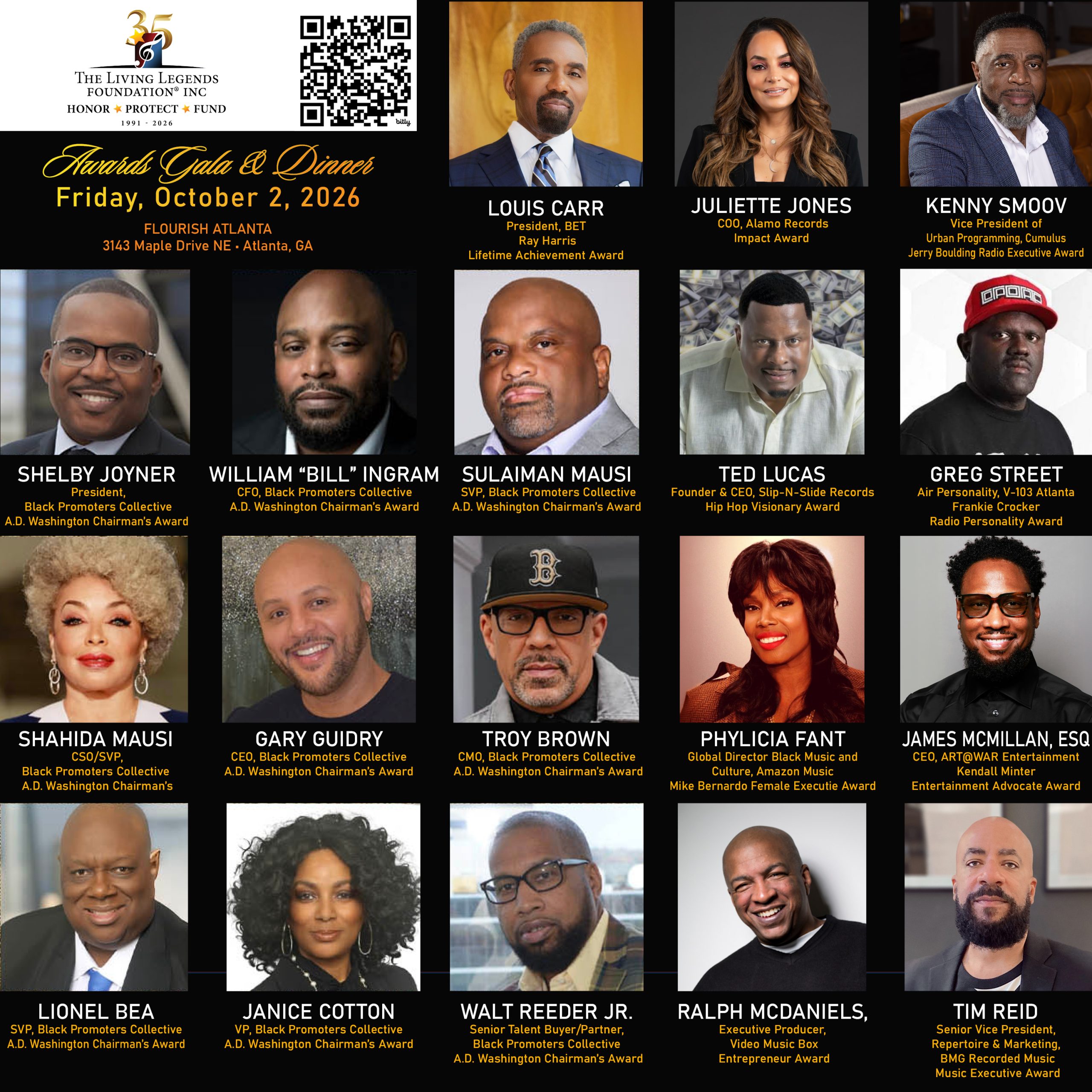
2026 Living Legends Foundation Honorees
This year’s honorees include:
- Ray Harris Lifetime Achievement Award: Louis Carr, president of BET
- A.D. Washington Chairman’s Award: Black Promoters Collective
- Jerry Boulding Radio Executive Award: Kenny Smoov, vice president of urban programming, Cumulus
- Frankie Crocker Radio Personality Award: Greg Street, air personality, V-103 Atlanta
- Impact Player Award: Juliette Jones, COO, Alamo Records
- Music Executive Award: Tim Reid, senior vice president, repertoire and marketing, BMG Recorded Music
- Mike Bernardo Female Executive Award: Phylicia Fant, global director, Black Music + Culture, Amazon Music
- Kendall Minter Entertainment Advocate Award: James McMillan, Esq., CEO, ART@WAR Entertainment
- Hip-Hop Visionary Award: Ted Lucas, founder and CEO, Slip-N-Slide Records
- Entrepreneur Award: Ralph McDaniels, executive producer, “Video Music Box”
Why the 35th Anniversary Matters
The anniversary reflects more than three decades of recognizing people whose contributions to Black music and entertainment have not always received the same public attention as the artists they helped build, promote and sustain.
That history is reflected in Khan’s return. After being recognized by the foundation in its early years, she will now help honor another generation of industry leaders.
The 35th Anniversary Awards Dinner & Gala will continue the Living Legends Foundation’s tradition of celebrating achievement, leadership, innovation and service while preserving the stories of the people who helped build the business and culture surrounding Black music.
Business
DOJ, DOT and DHS Launch Nationwide Crackdown on CDL Fraud, Trucking Schools and Unqualified Drivers


