US NATIONAL NEWS
Secretary Antony J. Blinken Remarks to Employees at the Office of the Director of National Intelligence
Published
4 years agoon
MR BARRETT: All right, good afternoon. Thank you for waiting. My name is Tim Barrett, lead the communications office. We’re delighted to welcome the Secretary of State here, and it’s my pleasure to introduce the Honorable Avril Haines, Director of National Intelligence. (Applause.)
DIRECTOR HAINES: Clap on demand. I know. So truly it is my great, great pleasure and distinct honor to introduce to you our Secretary of State Tony Blinken along with the wonderful Director of INR Brett Holmgren, who is with us today, and his Chief of Staff Suzy George (inaudible), and so we have quite the group that has come to visit us.
I’ve known Tony for close to 20 years, and I can tell you he is one of the most extraordinary human beings I have ever had the great fortune to call a boss, a friend, or even a colleague. Tony has perhaps one of the most generous hearts you could hope for. He is empathetic, thoughtful, consistently guided by his values. He is brilliant, but that is not what makes him rare. I know a great many people who are extremely intelligent and capable, but to combine that with an ego that is focused on respect for others, a drive to consistently look for ways to make the world a better place, and a heart that prioritizes human dignity is truly unusual and so critical to have in leadership. And I am so grateful, frankly, that he is our voice to the world.
When I first met Tony he was the staff director for then-Chairman Biden of the Senate Committee on Foreign Relations, and I was a lawyer for the Bush administration, and I was detailed over to serve as a lawyer for the majority staff on the committee. And he immediately treated me with respect, always made me feel part of the team, and taught me more than I can recount here, though I will tell you I still rely on many of those lessons today.
Not, though, when it comes to his sense of humor. I remember when we were working on the Law of the Sea Treaty, sometimes known by its acronym LOS, Tony threatened to get us t-shirts that said Get LOST in full caps, “Get lost.” He really does have a seriously questionable sense of humor.
He is, however, a voracious consumer of our work in the Intelligence Community. Tony often refers to analytic pieces that he has read in Principals Committee meetings and when he looks at our analysis he asks great questions, frequently making us better. But never have I seen him be anything other than respectful of our role to provide honest, high-quality, apolitical information, whether in our analysis, our briefings, or our counsel. And I can tell you that in my experience he does the same when he’s advising the President.
In short, I am so grateful that he is with us today and that all of you will have a chance to hear from him yourself. So thank you so much, Tony, (inaudible). (Applause.)
SECRETARY BLINKEN: That’s great. Thank you, thank you. Thank you all very much, and wow, Avril, first, could you repeat that verbatim for my wife? (Laughter.) I’d very much appreciate that. And in all seriousness, all I can really say is right back at you. I think everything you so generously said about me I would apply to you by a 10x factor. We go back a long ways. In fact, we worked so closely together on the SFRC staff, Senate Foreign Relations Committee staff, with then-Senator Biden. I am reminded that when I took that job where we worked together, I was staff director, and you all will appreciate this. When I took the job, someone said there are two words in your title of staff director; only one of them counts, and it’s not director. (Laughter.)
But thank you not just for the incredibly kind words but thank you for the outstanding leadership of this organization, which is simply absolutely vital to the well-being and security of the country that we share and the country that we love. We have had the great privilege of working together for all too long now. I think we must have started together in some kind of program for junior high school kids, but it’s been a while. And there is also no doubt in my mind that there is no one better suited to be leading this community, particularly given the extraordinary complex challenges we’re facing, than Director Haines.
And though it’s a relatively new office in the overall scheme of things, probably you are the only director, at least in the history of this institution, who can, if necessary, rebuild the electronics of an airplane, spar on a judo mat, talk theoretical physics, maybe sell a few books at the same time. So it’s actually powerful because I think one of the things that makes Avril so extraordinary is the incredible diversity of her experience and the different inputs in her life. So much of what we are doing, so much of what you’re doing, has more interconnections than at any time in our professional experience. Having someone with the breadth and depth of your experience at this particular moment in our history, I think we could not be in a better place.
And I think all of you who have been working with the Director know that when it comes to being kind, when it comes to being decent, when it comes to having an intellect that is only surpassed by your character, we couldn’t be better off. So to you, I am so grateful.
Morgan? Where is Morgan? Is he here? So my hat’s off to you as well. We go back a long ways, too. I can think of a few – just a few holidays ruined by some crisis where we were on a SVTC together at all hours in all parts of the world, and it’s wonderful to continue this collaboration, have all of you – and have you in particular as a colleague.
To everyone who is joining across the ODNI enterprise, the broader Intelligence Community, it’s very simple. I really wanted to come both to have a chance for an exchange this afternoon but just to say the two words that don’t get said often enough but that are really, really important, and that’s thank you. Thank you for the incredible dedication that you’re bringing every single day to making sure that this government is informed and that our country is a little bit safer and a little bit more secure. Thank you for the extraordinary professionalism you bring to that and thank you for being wonderful colleagues across the board.
As Avril said, throughout my time in government, and it’s – I’m now coming on to 30 years, which is hard to believe – but on the Hill, at the White House during a couple of stints, at the State Department during a couple of stints, I have, and I continue every single day, to rely on the IC. And everyone I’ve worked with, starting with the President of the United States, has relied on the IC every single day.
When the Obama-Biden administration came to an end, and I started working with then-former Vice President Biden helping to set up an institution with the University of Pennsylvania, we spent a fair bit of time together getting that off the ground. And the thing that he told me he missed the most about being vice president was starting the day with the PDB. He felt like there was something so unique, so special about that, and that he’d been a little bit disconnected from this lifeblood of information that you were providing to him as vice president every day. Well, I think one of the things he’s most pleased about being back as President is being able to tap into that again.
There are a lot of truisms when it comes to the work you’re in, but it doesn’t mean that they’re any less true for being truisms. You do make sure that we on the policy-making side of the equation have the information, have the insights, have the analysis that we need to try to make the best decisions possible. No guarantee, alas, that we’ll make the right decisions, but at least it won’t be for lack of information, it won’t be for lack of intelligence, it won’t be for lack of analysis.
And then the thing that is maybe as important as anything is the fact that you give us your unvarnished take on what we are learning, what we’re picking up, including when it isn’t what we would most hope we would hear; it’s what we need to know. And as long as that continues, then I think we’ll really and you really will be doing your jobs. Maybe that’s the most important thing of all.
I said we’re – state the obvious – dealing with a world of incredible complexity and a world that’s incredibly fast-moving in ways it never was before. In my own 30 years, I think the thing that’s changed most as I thought back on it is the information environment that we’re operating in. Think about it this way. And again, a lot of this is obvious, but it’s worth occasionally just stepping back and remembering this. When I started in government in 1993, the information set that we were dealing with as policy makers consisted primarily of three networks that everyone tuned into at 6:30 or 7 o’clock at night; a couple of national newspapers – the Times, The Washington Post, maybe The LA Times or The Wall Street Journal – that everyone got a physical copy of, a hardcopy of, when they woke up in the morning by opening the door to their apartment or their house, and that was pretty much it. That was – there was a common base of information. Then, of course, there was the work that the Intelligence Community was providing and our embassies were providing.
Now, of course, we’re living in a world where we’re getting some kind of information feed intravenously every millisecond. The pressure on policy makers to respond, to react, to just do something on the basis of every single input of information we get is intense, and the Director knows this from having been on both sides of the equation.
I think one of the most important things that we can try to do and that you’re making sure that we can do is to be also a little bit of a circuit breaker in this process, to be able to not only make sure that, yes, we are getting the information in real time and getting it before everyone else, but also helping to put it in perspective, helping to understand what it means, helping to make sure that to the extent we’re being proactive, that’s great and it’s as we should be; to the extent we’re being reactive, we’re doing it in a smart and deliberate way, not simply reacting for the sake of reacting because there’s intense pressure to do that.
It’s really hard to get that right. I can just tell you as a policy maker it’s very, very challenging. I know the demands on you to provide the information as quickly as possible – in a sense, sometimes, to get it first but not necessarily to get it right – is intense. And I would just say one of the things I think we have to do together is constantly remind ourselves that we need to try to make sure we get it right even as we get it first.
But when you’re putting everything together – whether it’s cyber security or food insecurity that we’re dealing with now; the climate crisis and all of its implications, particularly the security implications that flow from it; the ongoing challenges posed by the proliferation of weapons of mass destruction; terrorist threats to the United States, which have not gone away, to our people, to our interests overseas, so much else – your ability to deliver the most relevant, the most timely, the most objective data, analysis, information is simply indispensable to us doing our jobs and keeping people safe, in collaborating effectively with our allies and partners, and getting results.
This collaboration piece to me is also more important than ever. Another truism that I repeat endlessly – but I think it’s just important for people to step back and think about this – is that there is virtually not a challenge that we face as a country, as a nation, in terms of the impact of these issues on our people that we can effectively, truly effectively, advance alone. And whether it’s climate, whether it’s COVID, whether it’s the impact of emerging technologies, each of these defies unilateral solutions, and at least in my 30 years, there’s a greater premium than there’s ever been before on finding ways to collaborate, to coordinate, to cooperate with others, whether it’s other countries, whether it’s other groupings of countries, whether it’s other institutions. And we know how challenging that is. We know the frustrations that come along with that. But it is absolutely vital.
And there, thanks to this extraordinary community, we have in my 30 years experienced one of the greatest examples of how the Intelligence Community enabled collaboration and cooperation the likes of which we have not seen before when it comes to Ukraine and when it comes to Russia’s aggression. It is really one of the moments that I take the greatest satisfaction in and that I hope you take the greatest pride in, because we spent, as you all know very well, many months as we saw the mounting potential for Russian aggression against Ukraine trying to build the strongest possible collaboration and coalition of countries, both to make sure that support for Ukraine would be there if Russia followed through on the aggression, that pressure on Russia to end the aggression would be there through meaningful coordinated sanctions, and of course, that we would also make sure we were shoring up the defenses of our Alliance in NATO. And we were doing that even as we were pursuing as aggressively as we possibly could diplomacy to try to ward off the aggression at the end of last year.
The fact that we were able to bring to our allies and partners the extraordinary information that you were able to find – to do it in real time and to lay out for them and ultimately to lay out for the world, including at the United Nations – in the immediate lead-up to the aggression exactly what we saw the Russians as preparing to do and then do was extraordinary. Months of intelligence collection, reporting, analysis. You had confidence long before it happened that President Putin planned to launch this second military assault on Ukraine, and the fact that we were able and you were able to get to a place where we could downgrade and declassify an unprecedented amount of intelligence made all the difference in building that coalition so that we were ready to go on day one and we had the world with us.
So one fun – sort of fun – anecdote about this that – appreciate. You’ll all remember that in the immediate run-up to the aggression, we had a pretty good idea that the Russians were likely to press go at a certain time, and then there were arguably a few things that derailed the exact timing. But we had been telling people this is likely to happen in the next 48, 72 hours. Got put off a little bit by some of their own misadventures; I’ll leave it at that. On the day that it actually happened, I was on the phone that morning with a very senior European colleague who I will not identify. And I said to this colleague, “It’s going to happen next 24 hours.” And the colleague responded, “You’re still saying that?” This person called me at about 1:30 in the morning saying “I guess you were right.”
Well, I was right only because you were right. And you were right before anyone, and that empowered our diplomacy in ways that I had never seen in my experience. So thank you, thank you, thank you for that. It’s made all the difference in the world.
Now, the only problem with the success that you’ve achieved is that you’re only as good as your last success. So we have to keep doing it. And we are. The exchanges that you’re having, everything that we’re doing with our counterparts around the world to continue to share whatever we can share about what we’re seeing, what we’re understanding, what we’re analyzing, that is going to remain critical to the success that we’re having.
But here’s the bottom line: I suspect that people are going to be studying for a long time how we deployed the intelligence in this crisis way ahead of schedule, and they’re going to be studying that for a long time. Moving forward, if we continue to hold ourselves to the highest standards of accuracy, credibility, transparency, I think we can leverage intelligence in new ways to support our diplomacy. That’s what we’ve learned from this. There is a profound synergy between our intelligence and our diplomacy that we’ve now discovered in new ways and that I think we really need to continue to make part of our thinking, not just when it comes to Russia’s aggression against Ukraine but across the board, whenever and wherever it’s appropriate. It’s the biggest difference-maker I’ve seen.
So we’ll continue to look for ways to use intelligence to try to spotlight dangerous, destabilizing activities by adversaries and competitors, but also I want to make sure that we’re using it to leverage positive opportunities that are also out there and that we can’t lose sight of. And maybe we’ll have a chance to talk about that a little bit more this afternoon.
So let me just conclude with a couple of quick thoughts. So many of you have been working more than overtime these last few months, since before the war in Ukraine began. I know that that brings with it a lot of personal sacrifices when it comes to family, when it comes to friends, to make sure you get the job done. And yet this is still – more than still – it remains something that is immediately only the front burner, continues to demand tremendous time, tremendous energy, tremendous resources.
And we have to keep digging in. The crucial updates on the Russian aggression; tracking disinformation, including threats to our elections; working with the State Department, with our allies to identify, to assess, to document evidence of atrocities in Ukraine as they happen – all of this is also part of the commitment we have to hold accountable those responsible for the atrocities.
Last week we were able to put out to the public a lot of what we’ve learned about one of the many horrific aspects of this aggression, and that is the deportation of hundreds of thousands of people from Ukraine into Russia – including orphans, some made orphan by the Russian aggression. It’s so vital that the world continue to see and understand the human dimension of what’s going on. So much of this becomes an abstraction, but being able to share with the world what we’ve learned about some of what this means on a human level is, I think, hugely important.
Having said all of that and despite this unprecedented declassification strategy, you know this better than I: Much of what you do, most of what you do, remains outside of public view. But what I really wanted to share again today, and I know this not just from me but, even more important, from the President, is that he knows, I know because I see it every morning, how much you’re doing to advance our interests, to defend our security, to keep this country safe.
Speaking for the State Department, we’re particularly grateful for the partnership with ODNI and all of the IC agencies. Now, some of you know this, some of you don’t: Our Bureau of Intelligence and Research, INR, actually has its roots in the Office of Strategic Services, which was created during the Second World War to try to coordinate espionage behind enemy lines, which actually makes INR the oldest civilian intelligence element in the U.S. Government, even older than the CIA. (Laughter.) Just thought I’d mention that for the record.
And I’m especially pleased to be joined here today by the leader of INR, Assistant Secretary Brett Holmgren, who’s doing an outstanding job for us. And what I hear from Brett virtually every single day is the strength of the collaboration and the coordination we have across the IC. So much of the work that our team does at INR is possible because of the collection, the analysis, the coordination that happens here at ODNI and across the entire Intelligence Community.
And through the Joint Duty Rotation program we have literally dozens of IC employees with unique skills, technical expertise, perspectives that have been placed in bureaus across the State Department. Your diplomat colleagues basically help us do our jobs better, smarter, more effectively. So thank you for that.
The bottom line is this, two words that really stand out: professionalism, patriotism. That sums up the IC for me. That sums up my experience with it. And maybe I’ll just add one other P, and that’s partnership. We’re grateful for it every single day. Thank you.
You may like
Entertainment
Kym Whitley, Yvette Nicole Brown to Headline First Ladies Health Initiative Brain Health Luncheon
Published
4 days agoon
September 15, 2026The Sept. 19 luncheon in Marina del Rey will spotlight Alzheimer’s, dementia, caregiving and brain health as the First Ladies Health Initiative celebrates new grant support for programs empowering girls.
LOS ANGELES, Calif. (FNN) — Emmy-nominated actresses Kym Whitley and Yvette Nicole Brown will headline a First Ladies Health Initiative luncheon focused on Alzheimer’s disease, dementia, caregiving and brain health on Saturday, Sept. 19, in Marina del Rey.
The First Ladies Health Initiative, or FLHI, will host its leaders summit luncheon, “Mindful of the Memories: A Path to Better Brain Health,” beginning at 11 a.m. at The Ritz-Carlton, Marina del Rey.
Whitley, whose credits include Act Your Age and Raising Whitley, and Brown, known for Community, Act Your Age and The Mayor, will participate in a fireside conversation moderated by Dr. Shalonda “Sunshine” Crawford, co-pastor of Experience Christian Ministries.
The discussion will address the experiences of families affected by Alzheimer’s and dementia, including the demands placed on caregivers and the challenges of balancing caregiving with careers and other responsibilities.
Personal Experiences Bring Caregiving Into Focus
FLHI Co-Executive Director Marquisé Alston-Allison said Whitley and Brown were selected in part because both have personal experience caring for their fathers.
“Alzheimer’s disease has a devastating impact on the African American community, where individuals are approximately twice as likely to develop Alzheimer’s or other forms of dementia,” Alston-Allison said in the organization’s announcement.
The luncheon takes place two days before World Alzheimer’s Day on Sept. 21.
Brain Health and Prevention Take Center Stage
FLHI is also partnering with the INSPIRE-Faith program at Charles R. Drew University of Medicine and Science, led by neurologists Drs. Dean and Ayesha Sherzai.
The program emphasizes lifestyle factors associated with brain and overall health, including nutrition, physical activity, sleep, stress management and social connections.
The initiative brings prevention-focused health education into faith and community settings while addressing conditions such as dementia, diabetes, hypertension, heart disease and stroke.
Luncheon to Feature Music and Special Honors
Radio personality Aundrae Russell of 102.3 KJLH-FM will serve as emcee, with a musical performance by recording artist David Daughtry.
FLHI will also pay tribute to its founding president, Tracey Alston, who died last year.
Dr. Betty Ruth Price, former first lady, co-founder and matriarch of Crenshaw Christian Center, will also be honored during the event.
FLHI Among Organizations Receiving Girls Opportunity Alliance Support
The event comes as FLHI celebrates its selection for support through the Obama Foundation’s Girls Opportunity Alliance.
According to the announcement, a total of $500,000 will be distributed among 10 organizations working to empower girls, with FLHI among the selected recipients.
FLHI is currently led by second-generation co-executive directors Marquisé Alston-Allison and Taylor Alston-Cleveland, alongside co-founder and National Chair Jamell Meeks of Salem Baptist Church in Chicago and Los Angeles Chair Crawford.
The organization also acknowledged support from Charles R. Drew University of Medicine and Science, Healthy Mind Initiatives, Black Girl Vitamins and The Ritz-Carlton.
For additional information, visit First Ladies Health Initiative.
Entertainment
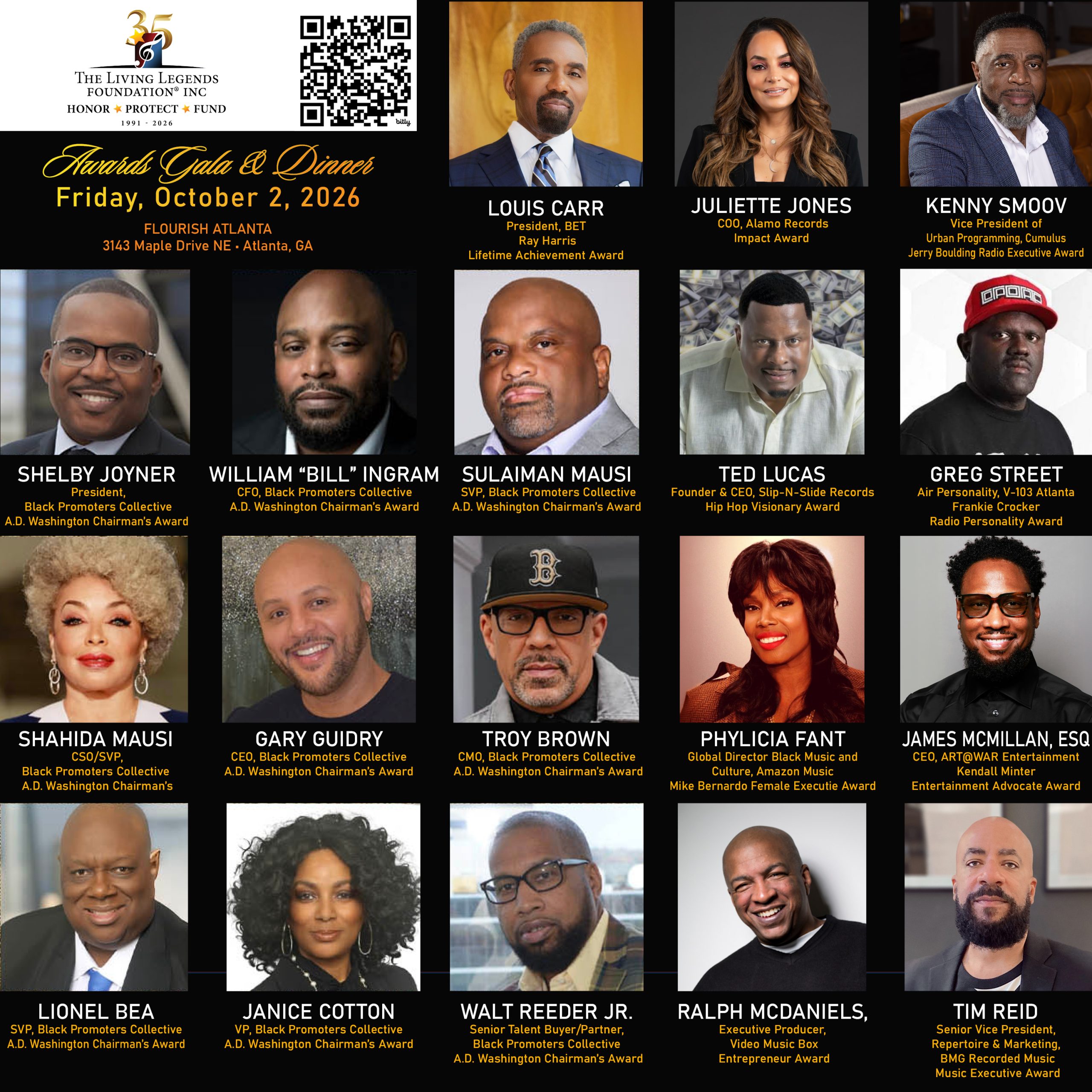
Chaka Khan, Q Parker to Lead Living Legends Foundation’s 35th Anniversary Gala in Atlanta
Published
1 week agoon
September 12, 2026Milestone celebration will recognize the executives, radio personalities, entrepreneurs and cultural leaders who helped shape Black music and entertainment
ATLANTA, Ga. (FNN) — Ten-time Grammy Award winner Chaka Khan will serve as honorary ambassador and Grammy-winning singer and founding 112 member Q Parker as honorary gala chair for the Living Legends Foundation’s 35th Anniversary Awards Dinner & Gala, the organization announced.
The milestone celebration is scheduled for Friday, Oct. 2, in Atlanta and will bring together artists, music executives, radio personalities, creatives, entrepreneurs and cultural leaders to recognize the people whose work has helped shape Black music, media and entertainment.
For Khan, the role marks a return to an organization that recognized her more than three decades ago. She was among the artists honored by the Living Legends Foundation in 1992.
“When you cross a bridge, you don’t think about all the hands that built it. Some of the most important contributions are the ones we never see,” Khan said in the announcement. “Thank you, Living Legends Foundation, for seeing that every story matters and for honoring those hands and hearts that helped build the way for all of us.”
Chaka Khan Returns for Milestone Anniversary
Living Legends Foundation Chairman David C. Linton said Khan’s connection to the organization makes her participation especially significant during its 35th anniversary.
“Having Chaka Khan serve as our Honorary Ambassador during this milestone year is incredibly meaningful,” Linton said. “Chaka’s history with the Foundation reaches back to our earliest years, and her extraordinary career represents the excellence, longevity and cultural impact we have worked to celebrate for 35 years.”
Khan’s appearance also comes as she prepares for another chapter in her recording career. According to the foundation’s announcement, her new album, “Chakzilla,” is scheduled for release Sept. 18. The project, described as her first full-length album in seven years, includes collaborations with Sia, Snoop Dogg and Lenny Kravitz.
The combination of Khan’s new music and her honorary role highlights one of the gala’s central themes: connecting the legacy of Black music with the people continuing to move the industry forward.
Q Parker to Serve as Honorary Gala Chair
Joining Khan is Q Parker, a founding member of Grammy-winning R&B group 112. Parker will serve as honorary gala chair and help promote the foundation’s work recognizing and supporting music industry professionals.
“Black music has given me a career, a community, and an opportunity to use my gifts to impact people around the world, so serving as Honorary Chair for the Living Legends Foundation’s 35th anniversary is truly an honor,” Parker said.
Parker said the industry’s success extends far beyond the artists audiences see on stage.
“This organization understands that our industry is bigger than the names we see on the marquee,” Parker said. “There are countless people behind the scenes who have dedicated their lives to moving our culture forward.”
Parker recently released the single “Stare,” from his forthcoming album, “Evolution of Romance, Volume Two,” expected this fall, according to the announcement.
Honoring the People Behind Black Music and Culture
Founded in 1991, the Living Legends Foundation has built its mission around recognizing professionals whose work has helped bring Black music and culture to audiences around the world.
Beyond its annual honors, the nonprofit provides support to music industry professionals with confirmed needs and invests in future generations through mentorship, scholarships and other assistance.
The anniversary gala will continue that mission by placing executives, broadcasters, advocates, entrepreneurs and other behind-the-scenes leaders alongside some of the most recognizable figures in entertainment.
2026 Living Legends Foundation Honorees
This year’s honorees include:
- Ray Harris Lifetime Achievement Award: Louis Carr, president of BET
- A.D. Washington Chairman’s Award: Black Promoters Collective
- Jerry Boulding Radio Executive Award: Kenny Smoov, vice president of urban programming, Cumulus
- Frankie Crocker Radio Personality Award: Greg Street, air personality, V-103 Atlanta
- Impact Player Award: Juliette Jones, COO, Alamo Records
- Music Executive Award: Tim Reid, senior vice president, repertoire and marketing, BMG Recorded Music
- Mike Bernardo Female Executive Award: Phylicia Fant, global director, Black Music + Culture, Amazon Music
- Kendall Minter Entertainment Advocate Award: James McMillan, Esq., CEO, ART@WAR Entertainment
- Hip-Hop Visionary Award: Ted Lucas, founder and CEO, Slip-N-Slide Records
- Entrepreneur Award: Ralph McDaniels, executive producer, “Video Music Box”
Why the 35th Anniversary Matters
The anniversary reflects more than three decades of recognizing people whose contributions to Black music and entertainment have not always received the same public attention as the artists they helped build, promote and sustain.
That history is reflected in Khan’s return. After being recognized by the foundation in its early years, she will now help honor another generation of industry leaders.
The 35th Anniversary Awards Dinner & Gala will continue the Living Legends Foundation’s tradition of celebrating achievement, leadership, innovation and service while preserving the stories of the people who helped build the business and culture surrounding Black music.
Business
DOJ, DOT and DHS Launch Nationwide Crackdown on CDL Fraud, Trucking Schools and Unqualified Drivers
Published
2 weeks agoon
September 8, 2026Federal agencies say the new Joint Task Force Crossroads of America will target fraudulent CDL training and testing, identity and document fraud, unauthorized employment and suspected criminal activity across the commercial trucking industry.
DETROIT (FNN) — The Justice, Transportation and Homeland Security departments have launched a sweeping federal initiative targeting alleged fraud and public-safety violations in the commercial trucking industry, including questionable driver training, commercial driver’s license testing, identity fraud and suspected criminal activity.
Eight U.S. attorneys joined federal transportation and homeland security officials Aug. 31 to announce Joint Task Force Crossroads of America, a multistate law enforcement partnership initially bringing together U.S. attorney’s offices in Illinois, Indiana, Michigan and Ohio with federal, state and local agencies.
The initiative brings together DOJ, the Department of Transportation, Department of Homeland Security, Federal Motor Carrier Safety Administration and other law enforcement agencies.
Among the most immediate actions, FMCSA announced the emergency removal of more than 110 commercial driver training providers associated with more than 5,000 drivers who failed federal English-language proficiency requirements. The agency is also proposing removal of more than 160 additional training providers and launching a nationwide audit of third-party CDL skills testers.
DHS, meanwhile, announced enforcement activity involving more than 200 driving schools and related businesses across 23 states.
Federal Government Targets CDL Fraud
Federal officials say the initiative is designed to identify fraudulent training and licensing practices while determining whether trucking companies, schools, testing operations or other businesses are circumventing federal requirements.
Attorney General Todd Blanche said DOJ will work with federal, state and local partners to investigate and prosecute alleged fraud affecting highway safety.
“The safety of American roadways affects everyone across the country,” Blanche said in the federal announcement.
Transportation Secretary Sean P. Duffy said federal transportation regulators need law enforcement support to pursue suspected fraud involving training schools and other participants in the commercial licensing system.
The government’s announcement also included broader claims by administration officials concerning immigration enforcement and highway safety. Those statements represent the administration’s characterization of the problem; the specific enforcement actions announced by FMCSA focus on compliance with federal commercial-driver training, testing and qualification requirements.
110 CDL Training Providers Face Emergency Removal
FMCSA said it examined roadside inspection records involving commercial drivers cited for failing federal English-language proficiency requirements and compared those records with its Training Provider Registry.
That analysis identified training providers that repeatedly certified drivers who subsequently failed the federal requirement, according to the agency.
FMCSA said it will emergency-remove more than 110 Entry-Level Driver Training providers from its registry. The affected providers must cease federally recognized training operations, including classroom and behind-the-wheel instruction.
The government says those schools are associated with more than 5,000 drivers who failed English-language proficiency tests.
Removal from the federal registry is an administrative action and should not, by itself, be characterized as a criminal conviction or finding of criminal fraud.
40-State Investigation Finds Training Problems
The enforcement campaign extends beyond the 110 providers.
FMCSA said it deployed 175 investigators across 40 states in July to conduct nearly 400 investigations of entry-level driver training providers.
According to the agency, investigators identified problems including instructors who lacked appropriate licenses, inadequate facilities for required driving maneuvers and missing assessment records.
One provider allegedly claimed its classroom operated from a school bus located inside the back of a trailer, according to FMCSA.
The investigations resulted in more than 160 notices of proposed removal from the federal Training Provider Registry.
FMCSA further said drivers certified by those providers have been linked to 239 commercial motor vehicle-related fatalities.
That figure warrants careful distinction: the agency’s release describes the drivers as linked to those fatalities; it does not establish from that statistic alone that training deficiencies caused each crash.
Nationwide Audit of CDL Skills Testers
Federal regulators are also turning their attention to the people and organizations administering commercial driving tests.
FMCSA announced a nationwide audit of third-party CDL skills testers and state oversight of those testers.
The agency said more than 28,000 commercial drivers have been placed out of service for English-language proficiency violations since June 2025. FMCSA argues that the number raises concerns about whether testing and state oversight are consistently enforcing federal requirements.
States found substantially out of compliance with federal CDL requirements can face corrective action and, eventually, financial consequences.
According to FMCSA, unresolved substantial noncompliance can result in withholding of federal highway funds—up to 4% initially and potentially 8% in subsequent years. Serious deficiencies can also lead toward decertification of a state’s CDL program.
DHS Targets More Than 200 Driving Schools
DHS is conducting a parallel criminal-investigation and immigration-enforcement effort.
Homeland Security Investigations said its initiative is examining suspected CDL fraud, unauthorized employment, identity-document fraud, financial crimes, money laundering and labor exploitation, along with potential connections to human smuggling, drug trafficking and cartel activity.
Those categories describe investigative targets and potential violations identified by DHS; they do not mean every school, trucking company or driver contacted by investigators has committed a crime.
According to the federal announcement, HSI planned coordinated activity involving more than 200 driving schools across 23 states and said more than 1,000 business leads had been distributed to investigators.
Field offices had also issued more than 80 notices of inspection and opened multiple investigations, according to DHS.
Investigations Include DMV Employees, Medical Certifications and Trucking Companies
Federal authorities disclosed several categories of ongoing investigations.
HSI said investigators are examining allegations that some state motor vehicle employees accepted payments to help applicants circumvent driver’s license and CDL requirements.
Other investigations involve suspected misuse of B-1/B-2 visa holders for domestic cargo transportation, potentially improper medical certifications, identity fraud and alleged labor exploitation involving visa holders.
DHS also said investigators are examining possible shell companies, financial crimes and transportation businesses potentially connected to broader criminal activity.
Because many of these matters remain investigations, allegations of misconduct have not necessarily resulted in criminal charges or convictions.
Federal Trucking Enforcement Reaches Florida
The federal initiative also includes activity in Florida.
According to the government’s announcement, DHS’s Enforcement and Removal Operations Miami Field Office coordinated an operation with the Florida Department of Transportation, FMCSA and commercial vehicle enforcement authorities during the week of Aug. 24.
Other coordinated operations were identified in Illinois, Indiana, Maine, Michigan and Wisconsin.
DHS also identified several broader enforcement initiatives involving commercial transportation, including Operation ICE Wall, Operation Guardrail and Operation Freightliner.
What It Means for Trucking Companies and CDL Schools
The initiative significantly expands federal scrutiny beyond individual commercial drivers.
Training schools could face removal from FMCSA’s registry, while third-party testers will face a nationwide audit. State licensing agencies could also come under federal review if regulators identify systemic compliance failures.
Trucking companies may face additional scrutiny involving driver qualifications, employment authorization, federal employment records and compliance with commercial vehicle regulations.
At the same time, the government’s actions distinguish between administrative enforcement and criminal prosecution. A provider’s removal from a federal training registry does not automatically establish criminal fraud, while criminal cases require prosecutors to establish violations under applicable law.
Joint Task Force Brings Multiple Agencies Together
Joint Task Force Crossroads of America combines the U.S. attorney’s offices in Illinois, Indiana, Michigan and Ohio with agencies including FMCSA, FBI, Drug Enforcement Administration, Homeland Security Investigations, Immigration and Customs Enforcement and Bureau of Alcohol, Tobacco, Firearms and Explosives.
Eight U.S. attorneys participated in the announcement, representing federal districts in Michigan, Indiana, Ohio and Illinois.
Federal officials say the task force’s goals include reducing highway fatalities and serious injuries, identifying criminal networks, deterring fraudulent trucking practices and improving coordination among federal, state and local authorities.
What’s Next?
FMCSA is expected to proceed with the emergency removal of the identified training providers while continuing proposed-removal proceedings involving more than 160 others.
Federal transportation officials will also conduct the nationwide examination of third-party CDL skills testers and state oversight programs.
DHS and HSI investigations into suspected licensing fraud, unauthorized employment, document fraud and related financial crimes are continuing, while the newly established DOJ task force provides a mechanism for federal prosecutors and law enforcement agencies to coordinate potential criminal cases.
The next major question will be how many of the regulatory investigations ultimately produce administrative sanctions, license actions or federal criminal charges.
For drivers, trucking companies and CDL schools, the announcement signals that federal enforcement is expanding from roadside driver inspections into the broader system responsible for training, testing, licensing and employing commercial drivers.
Trending
Florida4 days agoRepublicans for Jolly Launches as GOP Supporters Back Democrat David Jolly for Florida Governor
Central Florida News4 days agoWake Forest All-American Macy Pate Earns Sponsor Invitation to 2026 ANNIKA LPGA Event
Central Florida News4 days agoOrlando International Fashion Week 2026 Opens Early Bird Pass Sales for November Runway Shows
Business4 days agoExperience Kissimmee CEO DT Minich Inducted Into Florida Tourism Hall of Fame
Central Florida News4 days agoMario Andretti Headlines First 15 Drivers Named to Sebring’s Historic ‘Class of 75’