

Politics
Trump says response to Puerto Rico storm ‘underappreciated’


WASHINGTON (AP) — President Donald Trump said Wednesday the government is ready for massive Hurricane Florence and insisted that his administration’s response to the devastation in Puerto Rico last year was an “underappreciated great job.”
In a series of morning tweets as Florence bore down on the Southeast U.S. coast, Trump bristled over criticism of the response to Hurricane Maria, in which 3,000 people died in Puerto Rico.
“We got A Pluses for our recent hurricane work in Texas and Florida (and did an unappreciated great job in Puerto Rico, even though an inaccessible island with very poor electricity and a totally incompetent Mayor of San Juan). We are ready for the big one that is coming!” Trump tweeted.
His next dispatch warned people about Florence, predicted to dump massive amounts of rain on the already-soggy Southeast later this week.
“Hurricane Florence is looking even bigger than anticipated. It will be arriving soon. FEMA, First Responders and Law Enforcement are supplied and ready. Be safe!”
The administration’s efforts in Puerto Rico received widespread criticism, and he battled with Mayor Carmen Yulín Cruz. But after visiting the island last September, Trump said that Puerto Ricans were fortunate that the storm did not yield a catastrophe akin to the havoc wreaked by Hurricane Katrina along the Gulf Coast.
All told, about 1,800 people died in that 2005 storm. Puerto Rico’s governor last month raised the U.S. territory’s official death toll from Hurricane Maria from 64 to 2,975. The storm is also estimated to have caused $100 billion in damage.
A day earlier, the president praised the response to the series of storms. “I think Puerto Rico was an incredible, unsung success.”
The governor of Puerto Rico, Ricardo Rossello, seized on Trump’s use of the word “successful” and said in a statement issued later Tuesday: “No relationship between a colony and the federal government can ever be called ‘successful’ because Puerto Ricans lack certain inalienable rights enjoyed by our fellow Americans in the states.”
Rossello called Hurricane Maria “the worst natural disaster in our modern history” and said work still remained before they could move on to other stages of recovery. He also said he was still waiting for Trump to respond to a petition to help Puerto Rico complete work on emergency housing restoration programs and debris removal.
Trump, having long struggled to express empathy at times of national crises, sparked outrage when during his visit to the island he feuded with the mayor of San Juan and passed out paper towels to victims like he was shooting baskets.
While defending the handling of the previous storm, he urged caution in regards to the new one bearing down on North Carolina, South Carolina and Virginia.
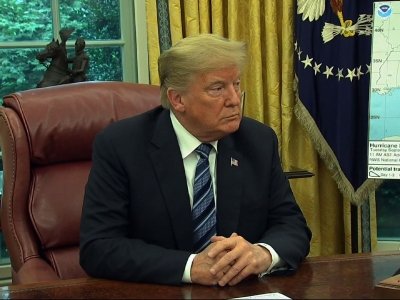
“The safety of American people is my absolute highest priority,” Trump told reporters in the Oval Office. “We are sparing no expense. We are totally prepared. We are ready. We are ready as anybody has ever been.”
The president, flanked by maps of the storm and the heads of the Department of Homeland Security and the Federal Emergency Management Agency, said Florence was unlikely to change course before it is expected to make landfall with 130 mph winds and potentially ruinous rains in the coming days.
“They haven’t seen anything like what’s coming at us in 25, 30 years, maybe ever,” Trump said of the states in the storm’s path. “It’s tremendously big and tremendously wet. Tremendous amount of water.”
Florence was expected to blow ashore late Thursday or early Friday, then slow down and wring itself out for days, unloading 1 to 2½ feet (0.3 to 0.8 meters) of rain that could cause flooding well inland and wreak environmental havoc by washing over industrial waste sites and hog farms. North and South Carolina and Virginia ordered mass evacuations along the coast.

Florida
FNN Perspective: Black Leaders Back Byron Donalds for Governor. Will More Black and Hispanic Leaders Follow?


Lawsuits challenging Democratic campaign tactics raise questions about party trust as David Jolly faces the task of holding his coalition together.
ORLANDO, Fla. (FNN) — A coalition of Black leaders backing Republican gubernatorial nominee Byron Donalds raises a broader question: Could frustration with Democratic campaign tactics make additional leaders and voters willing to consider his candidacy?
More than two dozen pastors, elected officials, business owners, educators and civic leaders have joined the Florida Coalition of Black Leaders for Donalds. Among them is Gainesville City Commissioner Cynthia Chestnut, a Democrat whose endorsement demonstrates that his outreach has attracted support beyond Republicans. If elected, Donalds would become Florida’s first Black governor.
For Democratic nominee David Jolly, the challenge involves both presenting an alternative to Donalds and maintaining confidence within his own coalition. Separate lawsuits involving Democratic candidates have brought questions about campaign fairness and accountability into that debate.
Campaign Lawsuits Raise Questions About Fairness
Former Democratic state Reps. Daisy Morales and James Bush III filed separate defamation lawsuits naming the Florida House Democratic Campaign Committee as a defendant.
Bush’s August 2025 lawsuit challenges communications distributed during his 2022 campaign. Morales’ August 2026 lawsuit challenges primary campaign claims about her alleged Republican endorsements and Democratic Party status. Both contend that false communications damaged their reputations and misled voters.
The allegations remain disputed. Ashley Gantt and her attorney have called Bush’s lawsuit baseless. Samuel Vilchez Santiago has rejected Morales’ allegations and characterized her lawsuit as politically motivated.
Beyond the legal disputes lies a political question: Can Democrats preserve relationships with candidates and supporters who believe party campaign resources were used unfairly against them?
Bipartisan Work Produced Results for Constituents
Morales and Bush have documented records of participating in legislation supported by both parties.
Morales and Christopher Benjamin sponsored bipartisan HB 45, joined by 17 co-introducers, including James Bush III. Passed unanimously by both chambers and signed by Gov. Ron DeSantis in 2022, the law supplements federal Post-9/11 GI Bill benefits by waiving remaining tuition and fees for qualifying Florida disabled veterans receiving less than the full federal benefit at eligible public institutions.
Republican former state Rep. Rene Plascencia praised Morales’ constituent service in an August 2022 statement reproduced by FNN:
“She worked hard for her constituents, always trying to find common ground to build relationships off of while never compromising her principles.”
Bush similarly called for solutions that “we can all work together in a bipartisan way” during a July 2026 interview with El Vocero News. He identified housing, education, property taxes and transportation as priorities.
Those examples provide context for evaluating their relationships with Republicans. Legislative cooperation can deliver public benefits without constituting a partisan endorsement.
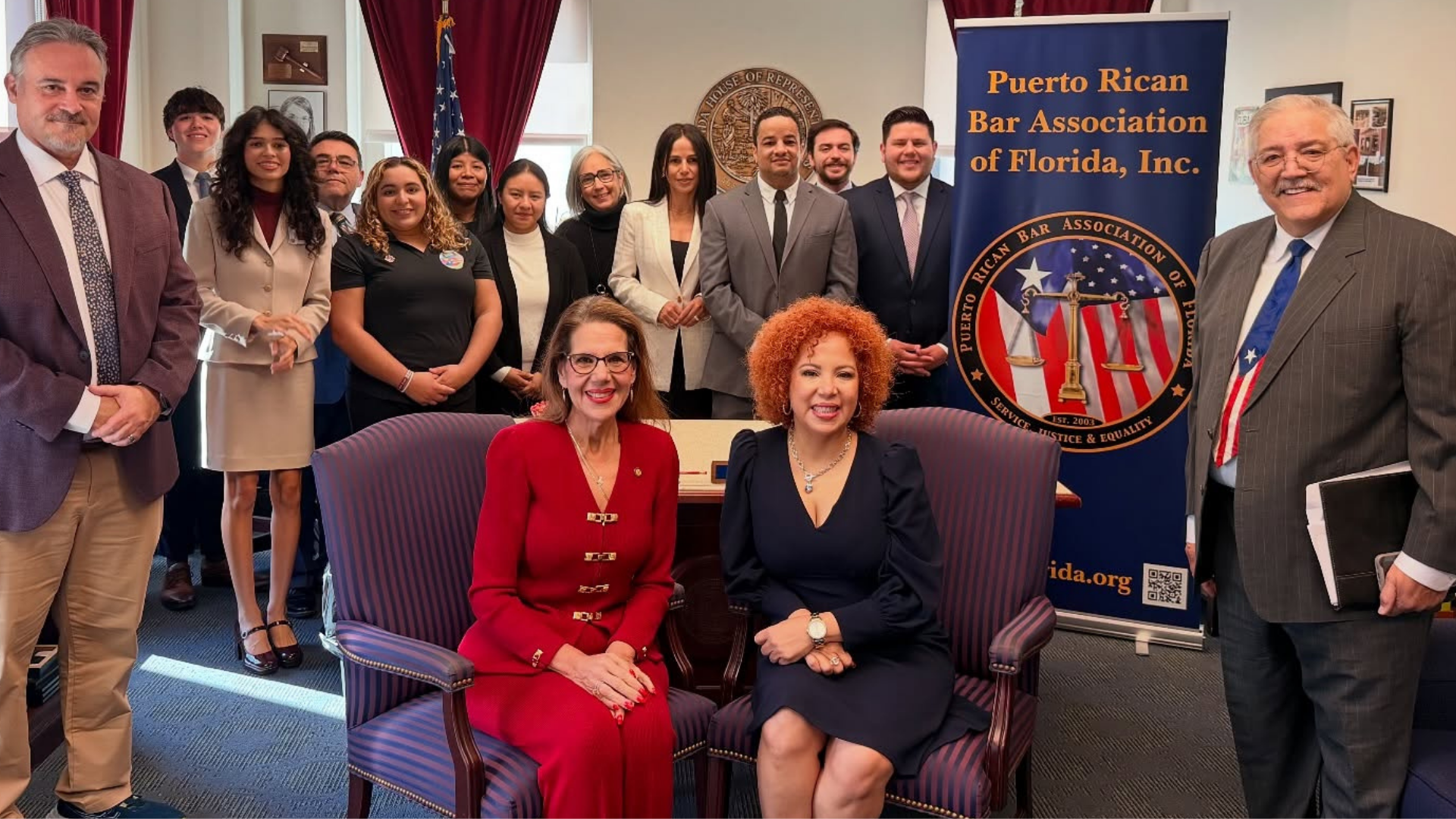
PHOTO CAPTION: Republican state Rep. Susan Valdés appears with Orange County Democratic political figures and other attendees during a gathering involving the Puerto Rican Bar Association of Florida at the Florida Capitol in Tallahassee. Among those identified are Samuel Vilchez Santiago, Johanna López and Joel Montilla. Valdés left the Democratic Party for the GOP in December 2024. Courtesy photo.
Recent Departures Show the Stakes of Party Division
Florida Democrats have already experienced departures by sitting lawmakers.
State Rep. Susan Valdés joined Republicans in December 2024, criticizing Democratic caucus leadership and saying she felt ignored. Later that month, state Rep. Hillary Cassel also joined Republicans, citing differences over party values, support for Israel and her ability to deliver for constituents.
In April 2025, Senate Democratic Leader Jason Pizzo left the party and registered with no party affiliation after criticizing its direction. Party Chair Nikki Fried rejected his assessment and attributed his departure to personal political ambitions.
Their circumstances differ from the Morales and Bush disputes, but the departures demonstrate that shared party registration does not guarantee lasting loyalty.
Democratic Leaders and Caucus Members Face Questions About Accountability
Repeated news reports about lawsuits challenging campaign tactics and the Florida House Democratic Campaign Committee’s use of resources warrant a public response from Democratic leaders and caucus members.
If those concerns remain unanswered, the party risks deepening distrust among affected candidates and their supporters heading into the general election. Leaders should explain how committee resources are allocated, whether the disputed tactics comply with party policies and how allegations of misconduct are reviewed.
The allegations remain contested, but accountability requires addressing them openly. Party unity depends on fair treatment and credible answers.
Jolly Faces a Test of Policy and Party Trust
Jolly has centered his campaign on housing, health care and education. His proposals include a state catastrophe fund intended to reduce property insurance costs, greater access to primary health care and investment in public schools. Those are campaign proposals whose effectiveness voters must evaluate.
His campaign also emphasizes stronger ethics and campaign finance rules. That platform invites scrutiny of whether accountability standards apply consistently—including when concerns involve Democratic campaign organizations.
Jolly does not control every party committee, and the lawsuits do not establish wrongdoing. Nevertheless, his candidacy faces a credibility test: Can a campaign promising fairer government maintain the confidence of supporters who question fairness within its own party?
His background as a former Republican congressman also highlights the distinction between changing political affiliations and working across party lines. The election will test how voters assess each candidate’s record, proposals and commitments.
Winning a Primary Does Not Secure November
Florida Democrats’ most recent statewide victory came in 2018, when Nikki Fried won the agriculture commissioner’s race. The party has not won a gubernatorial election since Lawton Chiles’ reelection in 1994.
Defeating another Democrat in a primary offers no assurance of defeating Republicans statewide.
Neither Morales’ nor Bush’s lawsuit establishes support for Donalds, and endorsements by individual leaders cannot predict how Black or Hispanic voters will vote.
The political possibility remains: Unresolved grievances could weaken enthusiasm or make some voters more receptive to alternatives. Donalds must turn outreach into confidence in his policies. Jolly faces the parallel challenge of making his case while retaining the trust of the coalition he needs to win.
Central Florida News
Orange County Announces $28,200 Public Art Opportunity at Tangelo Park Community Center

Florida
Republicans for Jolly Launches as GOP Supporters Back Democrat David Jolly for Florida Governor


