

World
G7 Foreign Ministers Issue Joint Statement on Peace, Security, and Global Economy

Published
2 years agoon

We, the G7 Foreign Ministers of Canada, France, Germany, Italy, Japan, the United Kingdom and the United States of America and the High Representative of the European Union, reiterate our commitment to foster respect for international law, including the Charter of the United Nations, to protect human rights and dignity for all individuals and to promote gender equality.
As the international community is facing a growing number of challenges, including climate change and biodiversity loss, disaster risks, the eradication of hunger and poverty, emerging and disruptive technologies, we renew our determination to foster collective action in the pursuit of common solutions.
Following the adoption of the Pact for the Future and its Annexes last September, we will work towards its implementation with all UN Member States and relevant stakeholders, through dialogue and mutual understanding. We reaffirm our commitment to work with all UN member states to strengthen the roles of the UNSG as well as the UNGA. We also recommit to the reform of the UNSC.
Today, we reiterate our determination to further strengthen G7 unity and sense of common purpose, building on commitments taken by leaders at the Apulia G7 Summit and at our previous Foreign Ministers’ meetings.
II. STEADFAST SUPPORT FOR UKRAINE
On 19th of November 2024, 1000 days have passed since Russia started its illegal, unjustifiable and unprovoked full-scale invasion of Ukraine, causing immense human suffering and destruction. We stand firm against Russia’s war of aggression. We vehemently condemn the brutal attacks against Ukraine’s cities and critical civilian infrastructure and its unacceptable toll on the civilian population. Russia’s use of an intermediate range ballistic missile on 21 November is further evidence of its reckless and escalatory behaviour. Our support for Ukraine’s territorial integrity, sovereignty and independence will remain unwavering.
In the G7+ Ministerial Meeting on Ukraine Energy Sector Support on the margins of the 79th Session of the UN General Assembly we committed to continue to give immediate priority to Ukraine’s early recovery and energy resilience for this winter season, protecting and restoring the grid and bolstering generation capacity to protect the livelihoods of millions of Ukrainians and avoid a further, catastrophic deterioration of the humanitarian situation.
We condemn Russia’s seizure and continued control and militarization of Ukraine’s Zaporizhzhia Nuclear Power Plant, which poses severe risks for nuclear safety and security, with implications for the broader international community. We support the International Atomic Energy Agency’s efforts directed at mitigating such risks, including through the continuous presence of IAEA experts and its focus on ensuring nuclear safety and security at the site.
We condemn the recent increase in Russian attacks on commercial shipping and civilian port infrastructure in the Black Sea, which undermines international law, including UNCLOS, puts maritime safety and security at risk and impacts global food security.
We condemn in the strongest possible terms Russia’s irresponsible and threatening nuclear rhetoric as well as its posture of strategic intimidation. We will never tolerate threats to use nuclear weapons, let alone any use of nuclear weapons, by Russia in the context of its war of aggression against Ukraine. We also express our deepest concern about the use of chemical weapons as well as riot control agents as a method of warfare by Russia in Ukraine. As the findings of the report issued recently by the Organization for the Prohibition of Chemical Weapons (OPCW) have confirmed the presence of riot control agents in samples collected from the frontlines in Dnipropetrovsk region in Ukraine, we emphasize that the use of such weapons as a method of warfare is a flagrant violation of the Chemical Weapons Convention. We call on OPCW to shed full light on the use of these grenades and on other relevant incidents in the context of Russia’s war of aggression against Ukraine.
We also condemn in the strongest terms Russia’s widespread and systematic torture and ill treatment of Ukrainian prisoners of war, and civilian detainees including the use of sexual violence, as reported by the UN Human Rights Monitoring Mission in Ukraine.
We welcome the approval by Finance Ministers of the principles and technical features of the Extraordinary Revenue Acceleration (ERA) Loans initiative for the benefit of Ukraine, which was announced by G7 Leaders at the Apulia Summit in June. The ERA Loan initiative will disburse approximately USD 50 billion (EUR 45 billion) for the benefit of Ukraine. These loans will be serviced and repaid by future flows of extraordinary revenues stemming from the immobilization of Russian Sovereign Assets, in line with G7 respective legal systems and international law. This historic G7 Leaders’ decision and its timely implementation confirm that the G7 remains steadfast in its solidarity to support Ukraine’s fight for freedom, and its recovery and reconstruction. Russian illegal and unprovoked aggression has caused untold harm to the people of Ukraine and to global peace and security. We will not tire in our resolve to give Ukraine the support it needs to prevail. With the large amount of financing from the ERA loans directed at Ukraine’s pressing budgetary, military and reconstruction need, we have once again made clear our unwavering commitment to stand by Ukraine’s territorial integrity, sovereignty and independence. Our aim is to begin disbursing the funds by the end of the year.
We will build on our comprehensive sanctions and economic measures to further restrict the revenues, goods, and technology Russia uses to fund and conduct its war.
We will take appropriate measures, consistent with our legal systems, against actors in China and in other third countries that materially support Russia’s war machine, including financial institutions and other entities that facilitate Russia’s acquisition of equipment and items for its defense industrial base. We will continue to apply significant pressure on Russian revenues from energy, metals and other commodities including through the effective implementation of existing measures and further actions against the “shadow fleet”. We will take robust action against actors who aid Russia in circumventing our sanctions.
We are seriously concerned about the deployment of the DPRK’s troops to Russia and their use on the battlefield against Ukraine. The DPRK’s direct support for Russia’s war of aggression against Ukraine, besides signaling Russia’s desperate efforts to compensate its losses, marks a dangerous expansion of the conflict, with serious consequences for European and Indo-Pacific security. We are working with our international partners for a coordinated response to this development. We are also deeply concerned about the potential for any transfer of nuclear or ballistic missiles-related technology to the DPRK in violation of the relevant UNSC resolutions. We urge countries with ties to Russia and the DPRK, including China, to uphold international law by opposing this dangerous expansion of the conflict and implementing all relevant UNSC resolutions.
We condemn in the strongest possible terms the increasing military cooperation between DPRK and Russia, including DPRK’s export and Russia’s procurement of North Korean ballistic missiles and munitions in direct violation of relevant UNSC Resolutions, as well as Russia’s use of these missiles and munitions against Ukraine.
We condemn the use of Foreign Information Manipulation and Interference (FIMI) by the Russian Government and its proxies to support its war against Ukraine and fuel global tensions. Collectively responding to FIMI remains central to the G7. Developing a Collective Response Framework by the end of the year via the G7 Rapid Response Mechanism (RRM) is a crucial step in that direction, as tasked by the G7 Leaders.
We remain fully committed to contributing to Ukraine’s future reconstruction as a driver for inclusive growth, green transition and prosperity, while also closely linked to the reform agenda and the related EU accession path. We look forward to the next Ukraine Recovery Conference, to be hosted in Rome next 10-11 July 2025. We commend Ukraine’s progress so far and will continue to provide all the necessary support as it advances on its path towards EU and Euro-Atlantic integration.
Our ultimate goal remains to reach a comprehensive, just and lasting peace, capable of restoring full respect for the fundamental principles of international law, blatantly breached by Russia. We welcome the Summit on Peace in Ukraine that took place in Switzerland on June 15-16 and its focus on the key priorities needed to achieve a framework for peace based on international law, including the UN Charter and its principles, and respect for Ukraine’s sovereignty and territorial integrity. We stress that no initiative about Ukraine can be taken without Ukraine. To that end, we will continue engaging also with global partners and actors to achieve the widest possible international support for the key principles and objectives of Ukraine’s Peace Formula, in line with international law including the UN Charter principles of sovereignty and territorial integrity.
We condemn Russia’s unlawful deportation and forcible transfer of Ukrainian children. We welcome the Montreal Pledge as the outcome of the Ministerial Conference on the Human Dimension of Ukraine’s 10-Point Peace Formula, co-hosted by Canada, Ukraine and Norway as well as the offers by Qatar, South Africa and the Holy See to serve as intermediaries to support and negotiate the return of children; the continuing role of the United Arab Emirates on mediating the exchanges of prisoners of war; and the offers by Norway, Lithuania and Qatar to provide a supportive environment for Ukrainians returning home.
We reiterate our condemnation of the Belarusian regime’s complicity in Russia’s war against Ukraine. We express our continued concern over the regime’s continuing repression of independent media, civil society, political opposition, and citizens peacefully expressing their views. We also condemn the ill treatment of political prisoners and ask for their immediate and unconditional release.
III. SITUATION IN THE MIDDLE EAST
We reaffirm our unequivocal condemnation of the terrorist attacks carried out by Hamas and other terrorist groups against Israel on October 7, 2023. These atrocities, including the taking of hostages, are intolerable. We continue to call for the immediate release of all hostages, and for the remains held by Hamas in Gaza to be returned to their loved ones. We are deeply concerned by the escalating violence across the Middle East, which threatens regional stability and shatters the lives of civilians. An immediate halt to this destructive cycle is imperative, as no country stands to gain from further escalation in the region.
Our commitment remains steadfast to the full implementation of UNSC resolution 2735 (2024) and to the comprehensive agreement advanced by President Biden in May. This plan would lead to an immediate ceasefire in Gaza, the release of all hostages, a significant and sustained increase in the flow of humanitarian assistance throughout Gaza, and an enduring end to the crisis, to secure a pathway to a two-state solution, with Israel and a sovereign Palestinian state living side by side in peace and mutual safety. We urge all parties to accept the ceasefire and call on countries with influence to help reinforce mediation efforts conducted by the US, Egypt and Qatar.
We are alarmed by the increasing toll of hostilities along the Blue Line and beyond. We are gravely concerned about the very high number of civilian casualties, the destruction of critical civilian infrastructure, including hospitals and health care centers. The growing number of internally displaced persons in Lebanon is alarming. Displaced persons on both sides of the Blue Line must be allowed to return to their homes in safety and security. We remain concerned about the massive displacement of Lebanese people and Syrian refugees in Lebanon to Syria and Iraq. We urge the respect of international humanitarian law in all circumstances.
We support the ongoing negotiation for an immediate ceasefire between Israel and Hezbollah and the full implementation of UNSC resolution 1701 (2006). Now is the time to conclude a diplomatic settlement and we welcome efforts deployed in that regard. We emphasize again the role played by the Lebanese Armed Forces and the UN Interim Force in Lebanon (UNIFIL), whose posture should be strengthened, in order to fulfill their respective responsibilities. In this regard, we express deep concern over the recent attacks and strikes on UNIFIL, which have injured several peacekeepers and damaged facilities. We condemn any threats to the security of UNIFIL personnel and call on all parties to uphold their obligations to ensure their safety, allowing them to fulfill their mandate.
We welcome discussions held at the Humanitarian Conference organized in the framework of the G7 Ministers’ Meeting on Development in Pescara on October 22 with countries from the region and International Organizations, and at the International Conference in Support of Lebanon’s people and Sovereignty hosted in Paris on October 24, to assess and address the urgent humanitarian needs in the region and accelerate coordination to alleviate the suffering of the civilian population.
We also welcome the progress in the implementation of the “Food for Gaza” initiative – launched by Italy together with the Food and Agriculture Organization, the World Food Programme and International Federation of Red Cross and Red Crescent to facilitate the delivery of aid.
The death toll in Gaza is tragic and continues to rise. The situation in Gaza has led to unprecedented levels of food insecurity, affecting much of the population, particularly in the North. Securing humanitarian access through all crossing points is a priority, as is ensuring security for aid to actually be delivered to the most vulnerable inside Gaza. All parties must facilitate aid delivery and protect humanitarian workers by implementing necessary de-confliction measures. It is critical that there be no interruption in the delivery of aid and essential services to those who need it most. We express our support to UNRWA to effectively uphold its mandate and we emphasize the vital role that the UN Agency plays. We urge the Israeli Government to abide by its international obligations, and fulfill its responsibility to facilitate full, rapid, safe and unhindered humanitarian assistance in all its forms as well as the provision of sorely needed basic services to the civilian population in Gaza, the West Bank and East Jerusalem.
We express our concern for the deteriorating security situation in the West Bank. All parties must refrain from unilateral actions and from divisive statements that may undermine the prospect of a two-state solution including Israeli’s expansion of settlements, legalization of settlement outposts and any annexation of the West Bank. We express our strongest condemnation for the rise in extremist settler violence committed against Palestinians, which undermines security and stability in the West Bank and threatens prospects for a lasting peace. Maintaining economic stability in the West Bank is critical for regional security. We urge Israeli authorities to release all withheld clearance revenues, remove measures that exacerbate the economic situation in the West Bank and extend correspondent banking relationships with Palestinian financial institutions.
In exercising its right to defend itself, Israel must fully comply with its obligations under international law in all circumstances, including International Humanitarian Law. We reiterate our commitment to International Humanitarian Law and will comply with our respective obligations. We underline that there can be no equivalence between the terrorist group Hamas and the State of Israel.
We reaffirm our unwavering commitment, through reinvigorated efforts in the Middle East Peace Process, to the vision of a two-state solution where two democratic states, Israel and Palestine, live side by side in peace within secure and recognized borders, consistent with international law and relevant UN resolutions. In this regard, we stress the importance of unifying the Gaza Strip with the West Bank under the Palestinian Authority.
We reiterate our commitment to support civil society peacebuilding efforts, ensuring that they are part of a larger strategy to build the foundation for a negotiated and lasting Israeli-Palestinian peace.
We reiterate our strong condemnation of Iran’s missile attacks against Israel, which pose a serious threat to regional stability. We also condemn continuous destabilizing actions of Iran’s affiliated armed groups – including Hamas, Hezbollah and the Houthis, as well as armed militias in Iraq and Syria.
We will continue to work to avoid further escalation. A wider conflict in the region is in nobody’s interest. We call on all parties to show restraint.
We reiterate our determination that Iran must never develop or acquire a nuclear weapon. We will continue to work together, and with other international partners, to address Iran’s nuclear escalation. A diplomatic solution remains the best way to resolve this issue. Iran must cease and reverse nuclear activities that have no credible civilian justification and cooperate with the International Atomic Energy Agency without further delay to fully implement its legally binding safeguards agreement and commitments under UNSC resolution 2231 (2015). We reiterate our deep concern over Iran’s human rights violations, especially against women, girls and minority groups. We call on Iran’s leadership to end all unjust and arbitrary detentions, including of dual and foreign citizens, and condemn the unacceptable harassment of its citizens. We call on Iran to allow access to the country to relevant Human Rights Council Special Procedures mandate holders.
We strongly condemn the transfer of Iranian weaponry to Russia. We are already responding with new and significant measures. Iran must immediately cease all support to Russia’s war of aggression against Ukraine and halt such transfers of ballistic missiles, UAVs and related technology.
The Houthis attacks against commercial shipping transiting the Red Sea and the Gulf of Aden must stop. These attacks constitute an egregious violation of international law. They have killed innocent seafarers, continue to endanger the lives and safety of crews and have exposed ecosystems in the area and coastal States to serious and grave environmental risks. We urge the Houthis to immediately release the MV Galaxy Leader and its crew. We note with satisfaction the intervention of the EU maritime operation ASPIDES and partners in preventing an environmental disaster in the case of the MT Delta Sounion. We reaffirm the right of countries to defend their vessels, in line with UNSC resolution 2722 (2024) and in accordance with international law. We applaud the efforts of ASPIDES and the US-led operation Prosperity Guardian in protecting vital sea lanes.
We strongly condemn the Houthis’ unjustified detention of UN, NGO, civil society and diplomatic personnel in Yemen, demanding their immediate release. We urge the Houthis to respect international humanitarian law and ensure the safety of humanitarian workers.
We express deep concern about the repercussions of the crisis in the Red Sea also on the peace process in Yemen. We call on all parties, especially the Houthis, to resume negotiations in a responsible and constructive manner, in line with the UN-facilitated understanding reached in December 2023.
IV. INDO-PACIFIC AND THE REGION
We are committed to upholding a free and open Indo-Pacific, based on the rule of law, which is inclusive, prosperous and secure, grounded on sovereignty, territorial integrity, peaceful resolution of disputes, fundamental freedoms and human rights. We reaffirm our unwavering support for ASEAN centrality and unity and our commitment to promoting cooperation in line with ASEAN Outlook on the Indo-Pacific. We reaffirm our support for the objectives set in the PIF 2050 Strategy for the Blue Pacific Continent.
We will continue strengthening the work of the Partnership for Global Infrastructure and Investment (PGII) in the Indo-Pacific, including through the PGII-Indo-Pacific Economic Framework for Prosperity (IPEF) Investment Accelerator. We welcome the development of the Luzon Economic Corridor, the first PGII corridor in the Indo-Pacific, which will bring quality infrastructure and investment to the region.
As we seek constructive and stable relations with China, we recognize the importance of direct and candid engagement to express concerns and manage differences. We reaffirm our readiness to cooperate with China to address global challenges
We are deeply concerned by China’s increasing support to Russia and Russia’s defense industrial base, which is decisively enabling Russia to maintain its illegal war in Ukraine and to reconstitute its armed forces and has significant broad-based security implications. China must prevent its companies from transferring weapons, especially attack Unmanned Aerial Vehicles (UAVs), dual-use materials, including weapons components, and equipment. We also call on China to step up efforts to promote international peace and security and to press Russia to stop its military aggression and immediately, completely and unconditionally withdraw its troops from Ukraine.
We recognize the importance of China in global trade. We are not trying to harm China or thwart its economic development, indeed a growing China that plays by international rules and norms would be of global interest. However, we express our concerns about China’s non-market policies and practices that are leading to harmful overcapacity and market distortions, undermining our workers, industries and economic resilience and security. We are not decoupling or turning inwards. Together with our partners, we are de-risking and diversifying supply chains, where necessary and appropriate to reduce critical dependencies and vulnerabilities and to foster resilience to economic coercion. We further call on China to refrain from adopting export control measures, particularly on critical minerals, that could lead to significant supply chain disruptions.
We remain seriously concerned about the situation in the East and South China Seas. We reiterate our strong opposition to any unilateral attempts to change the status quo by force or coercion. There is no legal basis for China’s expansive maritime claims in the South China Sea. We reiterate our opposition to China’s militarization and coercive and intimidation activities in the South China Sea. We re-emphasize the universal and unified character of the United Nations Convention on the Law of the Sea and reaffirm its important role in setting out the legal framework that governs all activities in the oceans and seas. We continue to oppose China’s dangerous use of coast guard and maritime militia in the South China Sea and its repeated obstruction of countries’ freedom of navigation and overflight. We express deep concern over the increasing use of dangerous maneuvers and water cannons against Philippine and Vietnamese vessels. We reiterate that the award rendered by the Arbitral Tribunal on 12 July 2016 is a significant milestone, which is legally binding upon the parties to those proceedings and a useful basis for peacefully resolving disputes between the parties.
Maintaining peace and stability across the Taiwan Strait is indispensable to international security and prosperity. We call for the peaceful resolution of cross-Strait issues. There is no change in the basic position of the G7 members on Taiwan, including stated One-China policies. We support Taiwan’s meaningful participation in international organizations as a member where statehood is not a prerequisite and as an observer or guest where it is.
We remain concerned by the human rights situation in China, including in Xinjiang and Tibet. We remain concerned by the erosion of civil society, human rights and fundamental freedoms in Hong Kong. The sentencing of 45 pro-democracy politicians and activists marks a further deterioration of democratic participation and pluralism, which undermines confidence in the rule of law as enshrined in the Hong Kong Basic Law, and therefore Hong Kong’s and the People’s Republic of China’s international legal obligations. We urge China and the Hong Kong authorities to abide by their international human rights commitments and legal obligations.
We call on China not to conduct or condone activities aimed at undermining the security and safety of our communities and the integrity of our democratic institutions, and to act in strict accordance with its obligations under the Vienna Convention on Diplomatic Relations and the Vienna Convention on Consular Relations.
We strongly condemn the DPRK’s continuing expansion of its unlawful nuclear and ballistic missile programs and its continuous destabilizing activities. We further reiterate our call for the complete denuclearization of the Korean Peninsula and demand that DPRK abandon all its nuclear weapons, existing nuclear programs, and any other WMD and ballistic missile programs in a complete, verifiable, and irreversible manner, in accordance with all relevant UNSC resolutions. We urge all UN Member States to fully implement all relevant UN Security Council resolutions.
Following Russia’s disturbing veto last March on the mandate renewal of the UNSC 1718 Committee Panel of Experts, we are working with the international community to establish alternative multilateral mechanisms, including the recently established Multilateral Sanctions Monitoring Team (MSMT), to monitor and report on violations and evasions of the sanction measures stipulated in the relevant UNSC resolutions , based on our commitment to uphold international peace and security and to safeguard the global non-proliferation regime.
We strongly condemn DPRK’s systematic human rights violations and abuses and its choice to prioritize its unlawful weapons development programs over the welfare of the people of DPRK. We call upon DPRK to resolve the abductions issue immediately.
V. PARTNERSHIPS WITH AFRICAN COUNTRIES
We reiterate our commitment to support African nations in the pursuit of peace, stability and sustainable development, as well as the creation of jobs and growth. We will continue to build equitable and sustainable partnerships with Africa based on result-based initiatives, aligned with the African Union Agenda 2063 and the integrated African continental thematic plans, in order to jointly tackle global challenges. We reiterate our commitment to support the African Union in the pursuit of peace and stability.
We recognize the importance of bridging digital divides and strengthening the value chain between G7 and African countries. In this respect, we welcome the progress made by the G7 Italian Presidency in collaboration with UNDP in the co-design of the “AI Hub for Sustainable Development,” set to focus on key sectors including agriculture, health, infrastructure, education and training, water, and energy, in the spirit of the Mattei Plan. The Hub embodies the G7’s commitment to “Growing Together” with partner countries, advancing shared goals of sustainable development and ensuring that the digital age contributes to a more inclusive and prosperous future for all. We also welcome the G20 recognition of the WHO-led Global Initiative on Digital Health (GIDH) and the Global Digital Health Certification Network, aligning support and guidance for digital transformation.
Building on the achievements of previous G7 Presidencies, we will continue strengthening the G7 Partnership for Global Infrastructure and Investment (PGII) in the African continent as well as initiatives such as the EU Global Gateway. PGII offers a framework to promote sustainable, climate neutral, inclusive, resilient and economically viable quality infrastructure, underpinned by high standards, transparent project selection, procurement and finance. While PGII has a global reach, we commit to focus on regions and sectors where infrastructure investment has the greatest impact, including the African continent.
We welcome the decisions taken at the G7 Development Ministers’ meeting in Pescara to launch the PGII secretariat, for effective implementation and investment coordination with partners, and to support the implementation of the African Virtual Investment Platform (AVIP), to enhance data and information, transparency and public policies on investment in Africa, in line with the Apulia G7 Leaders’ commitment to enhance the PGII. PGII will work together with Public Development Banks, Development Finance Institutions, Multilateral Development Banks and the private sector to improve enabling environments and country-based investment design, coordination and co-financing.
In line with the integrated African continental plans for improved local and regional infrastructure, trade and food security, initial pilots will be linked to economic corridors, such as the Lobito Corridor in Southern and Central Africa.
We welcome the G7 leader’s decision to launch the “Energy for Growth in Africa” initiative, that will help to overcome barriers to investments in clean energy across Africa.
We also welcome the launch of the G7 Apulia Food Systems Initiative (AFSI), a package of initiatives to improve food security and nutrition and harness the role of agriculture and food systems for achieving the Sustainable Development Goals (SDGs), with a focus on Africa. The AFSI will concentrate on concrete actions on the ground, supporting multi-stakeholder initiatives to promote sustainable and resilient agriculture and food systems, including in coffee value-chains, and fight malnutrition, with a focus on childhood stunting and wasting.
We commend the launch of Gavi’s African Vaccine Manufacturing Accelerator (AVMA) and look forward to collaborating with Gavi, the African Union and Africa CDC to develop regional vaccine manufacturing capacity.
VI. MIGRATION
In line with the Apulia G7 Leaders’ Communiqué, we affirm our collective commitment to enhance cooperation to address the drivers of irregular migration and forced displacement, such as global poverty, instability, climate change and seize the opportunities migration brings globally. In doing so we will work in partnership with countries of origin, transit and destination to support their sustainable development, resilience and stability.
VII. REGIONAL ISSUES
Afghanistan
We are appalled by the continued and systemic abuses of human rights and the growing restrictions imposed by the Taliban on the lives of the Afghan people, particularly women and girls, in violation of international obligations and Treaties to which Afghanistan is a State Party. We will continue to provide assistance to address the severe and deteriorating humanitarian crisis in the country.
We remain committed to supporting the people of Afghanistan. The objective of an Afghanistan at peace with itself and its neighbors, fully reintegrated into the international community and meeting international obligations can only be achieved through an inclusive and representative political process regarding the future of the country, ensuring the full, equal, safe and meaningful participation of Afghan women, in line with the UN independent assessment – as recognized by UNSC Resolution 2721 (2023) – and UNSC resolution 2593 (2021).
Great Lakes
The G7 is deeply concerned by the ongoing crisis in the Great Lakes region, marked by armed violence, widespread human rights violations and abuses, and worsening displacement of populations. We strongly condemn the atrocities committed by any armed groups, as well as the violations of international law by any parties. We continue to express deep concern about the reports on foreign military support for M23 and direct military interventions on Democratic Republic of Congo (DRC) territory. We call for the territorial integrity of the DRC to be respected. We stress the urgent need for immediate, safe, and unimpeded humanitarian access to affected populations.
We fully support the mediation led by Angola and President Joao Lourenço between the Democratic Republic of Congo and Rwanda. We urge the Democratic Republic of Congo and Rwanda to achieve swift progress in the implementation of the commitments made through the Luanda Process. The current ceasefire, which went into effect on August 4th, should be respected strictly. It is imperative that all regional actors refrain from any direct or indirect support to armed groups.
We reaffirm our support for efforts to combat the illegal exploitation of natural resources and to promote sustainable and equitable development for the benefit of local populations.
Haiti
We condemn the continued violence and human rights abuses perpetrated by armed gangs in Haiti. We reiterate our support to the efforts of the Transitional Presidential Council (CPT) and we take note of the appointment of Mr Alix Didier Fils-Aimé as Prime Minister of Haiti. We call upon all Haitian political actors to work together to restore democratic institutions and the rule of law in Haiti, leading the Country to a new democratically elected government in office by February 2026. We reiterate our full support to the Multinational Security Support (MSS) mission, which is providing critical support to the Haitian National Police against criminal gangs. We emphasize the importance of continued financial contributions to the UN Trust Fund as well as contributions in kind to the MSS mission, in the face of persisting dire conditions on the ground. It remains essential to create the necessary security conditions for convening the elections. We are gravely concerned that nearly half of Haiti’s population is acutely food insecure. We call on all Haiti’s partners to continue their support for humanitarian and development assistance to the Haitian people. We support Haiti’s request for the United Nations to consider a transition of the MSS mission to a peacekeeping operation.
Libya
We reaffirm our commitment to preserving Libya’s sovereignty, stability, independence, territorial integrity, and national unity, and support a positive response to Libya’s request to the UN Security Council for international assistance to enhance security coordination among Libyan security forces throughout the country. We deplore Russia’s malign activities in Libya, which undermine Libyan sovereignty and regional security and we call for the withdrawal of all foreign fighters and mercenaries from Libya without delay. We strongly support the longstanding efforts by the United Nations and UNSMIL officer in charge Stephanie Koury to facilitate meaningful and inclusive dialogue among Libyan parties in order to reverse institutional fragmentation and move towards sustainable stability and security. In this regard, the recent agreement on the appointment of the new leadership of the Central Bank of Libya represents an opportunity to relaunch a process towards a comprehensive political agreement based on compromise. That will pave the way towards free, fair and inclusive presidential and parliamentary elections conducive to the reunification of Libya’s government and political, economic and military institutions. We furthermore affirm our support for the High National Elections Commission and the first round of municipal elections held on November 16, which offer Libyans the chance to exercise their democratic rights.
Myanmar
The brutal military regime in Myanmar must stop all violence – including airstrikes – that harm civilians, release all those arbitrarily detained and engage in a truly inclusive dialogue with all stakeholders. UNSC Resolution 2669 (2022) must be implemented fully and without conditions. We call on all armed actors to protect civilians and allow unhindered humanitarian access. We support ASEAN’s efforts to achieve swift and complete implementation of the Five-Point Consensus and advocate for a strengthened UN engagement. We welcome the UN Special Evoy’s recent visit to Myanmar and her efforts to resolve the crisis. We call for the regime to stop restricting access to UN Agencies, humanitarian aid, independent and international humanitarian actors, and allow full and unimpeded access to the Independent Investigative Mechanism for Myanmar. We call for the cessation of any arms and dual-use materials’ transfers to the Myanmar military, including jet fuel. It is necessary to work towards a political solution that truly honors the aspirations of the Myanmar people to live in peace, freedom and democracy. We reiterate the need to create conditions for sustainable, voluntary, safe and dignified returns of displaced Rohingya and other refugees.
Somalia
We welcome Somalia’s enduring efforts at institution building and in the fight against terrorism. We deem the stabilization of Somalia as a relevant factor to guaranteeing that both the Horn of Africa and the Red Sea lanes be secure. We encourage the Somali Government to continue in its path of consolidation of the Federal institutional framework and to undertake a transparent and inclusive constitutional reform process. We stand alongside Somalia in its fight against the terrorist movement of Al-Shabaab and other violent organizations. As for the upcoming termination of the African Union Transitional Mission (ATMIS), we believe it is essential to avoid any security gap that jihadist terrorism could exploit, before the transfer of responsibilities to national security forces is completed. Therefore, we support the new African Union Support Mission to Somalia (AUSSOM) and we encourage both the Somali Government and the AU to envisage an operational framework than ensures the mission can truly continue to provide stability to both the Country and the region. We call on all partners to ensure that the new mission has the support and funding it requires to succeed.
Sudan
A year and a half into the fighting, Sudan’s civil war has taken a devastating toll on human lives and vital infrastructure. We reiterate our firm condemnation of ongoing attacks, including indiscriminate and direct targeting of civilians by both parties, which is causing massive displacement of people throughout the region, and worsening an already dreadful humanitarian situation. We call for an immediate end to violence. We especially note the impact of the crisis on women and girls and condemn the atrocities being committed by both sides, including kidnapping and sexual violence. All parties to the conflict must engage in serious negotiations aimed at achieving a lasting ceasefire, humanitarian access and protection of civilians without pre-conditions. All external actors must stop fueling the conflict, in line with the commitments made in the Declaration of Principles adopted at the Paris Conference, and respect the UN arms embargo on Darfur.
We urge the Sudanese Armed Forces, the Rapid Support Forces and their allied militias to comply with International Humanitarian Law, protecting civilians and facilitating rapid, safe and unhindered humanitarian access both into Sudan and across lines of conflict.
We note with grave concern that the UN Fact Finding Mission has found reasonable grounds to believe that Rapid Support Forces and allied militias have “committed crimes against humanity, including persecution on the basis of ethnicity and forcible displacement of the population”, and that Sudanese Armed Forces have committed “war crimes of violence to life and person, in particular murder of all kinds, mutilation, cruel treatment and torture”.
We urge the warring parties to implement their Jeddah Declaration commitments, and we urge for the establishment of a robust and transparent monitoring and verification mechanism for the protection of civilians.
Venezuela
On July 28 the Venezuelan people made a clear choice in the polls, voting for democratic change and supporting Edmundo González Urrutia by a significant majority according to publicly available electoral records. We will continue to support efforts by regional partners to facilitate a Venezuelan-led democratic and peaceful transition that will ensure respect for the will of the voters.
We are deeply troubled by the continued violations and abuses of human rights, including arbitrary detentions and severe restrictions on fundamental freedoms, targeting in particular political opponents, civil society, and independent media. All unjustly detained political prisoners must be released.

You may like
Florida
Civil Rights Group Honors Nobel Peace Prize Winner Navi Pillay, Highlights Florida’s Trayvon Martin Connection
Published
2 weeks agoon
October 13, 2026
The Orlando-based civil rights association recalls supporting the former U.N. human rights chief’s 2012 call for an investigation into the teenager’s killing in Sanford.
ORLANDO, Fla. (FNN) — The Florida Civil Rights Association is congratulating 2026 Nobel Peace Prize winner Navanethem “Navi” Pillay, recalling her call for an investigation into Trayvon Martin’s killing and the international attention it brought to questions of racial equality and justice in Florida.
The Norwegian Nobel Committee announced Pillay’s selection Oct. 9 for her efforts to promote peace and international law. The South African jurist served as United Nations high commissioner for human rights from 2008 to 2014 and helped shape landmark international court decisions.
In a press release, FCRA President J. Willie David III said Pillay’s intervention connected a Florida family’s demand for answers to a broader concern for human rights.
“Pillay’s call for an investigation reinforced that a family’s demand for justice in Sanford mattered beyond Florida and the United States,” David said.
“We welcomed her intervention in 2012 because families deserve answers and the law must protect everyone equally.”
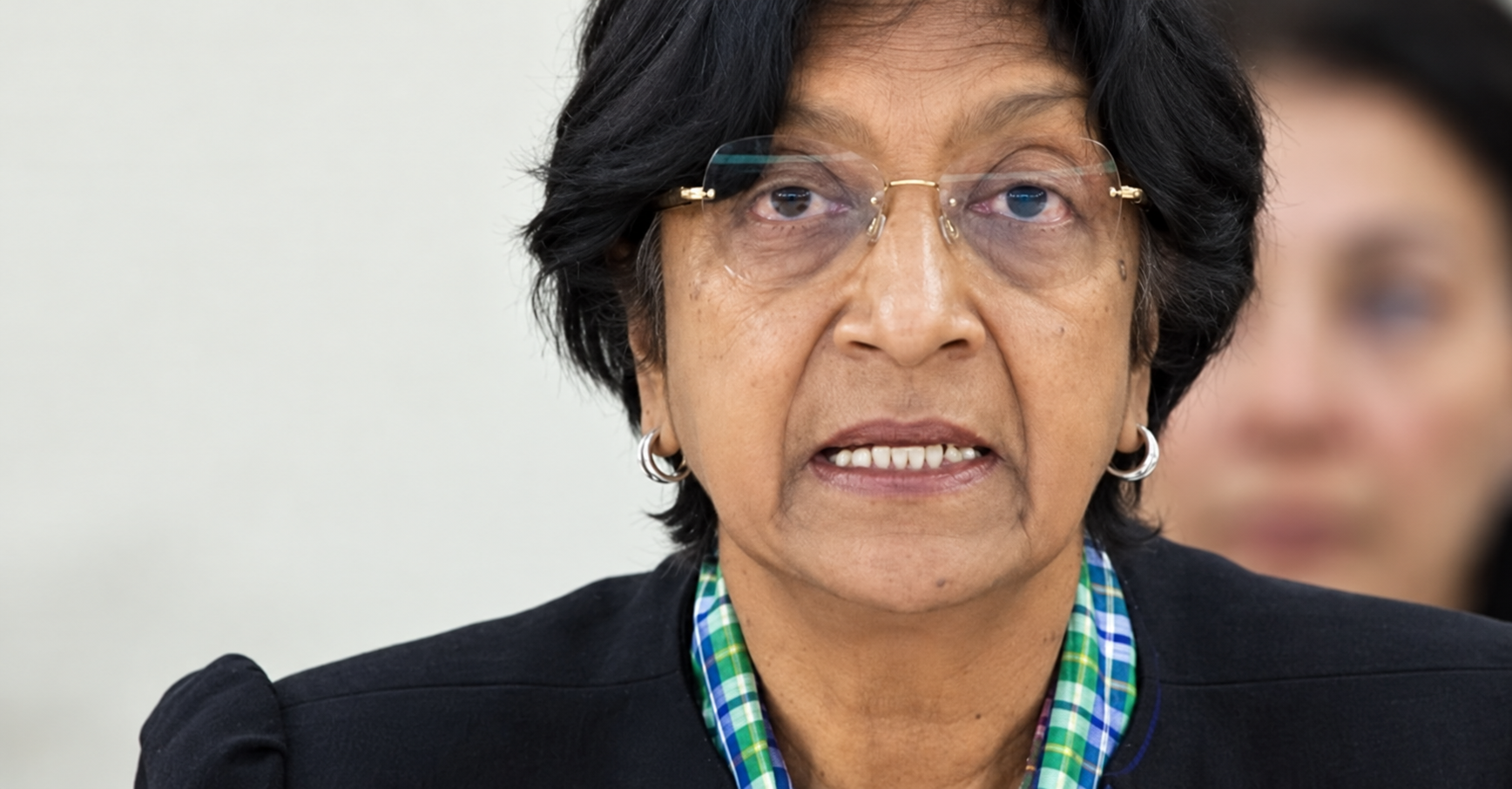
UN Human Rights Commissioner Navi Pillay (Photo credit: UN Photo/Jean-Marc Ferre)
FCRA recalls its response in 2012
Martin, an unarmed Black 17-year-old, was fatally shot by neighborhood watch volunteer George Zimmerman on Feb. 26, 2012, in Sanford, northeast of Orlando.
In April 2012, Pillay called for an immediate investigation into the killing as the case drew international attention and scrutiny of Florida’s Stand Your Ground law.
FCRA welcomed that call. The association’s current release cites an April 7, 2012, West Orlando News report that quoted David discussing the case’s global impact.
“The shooting death of Trayvon Martin and Florida’s Stand Your Ground Law have created a worldwide movement that calls into question how justice is delivered to victims of color,” David said at the time, according to the release.
FCRA describes the activism surrounding Martin’s death as a defining moment that galvanized a new generation of civil rights advocates.
Zimmerman was charged with second-degree murder and acquitted in July 2013. In February 2015, the U.S. Justice Department closed its separate investigation, finding insufficient evidence to pursue federal criminal civil rights charges.
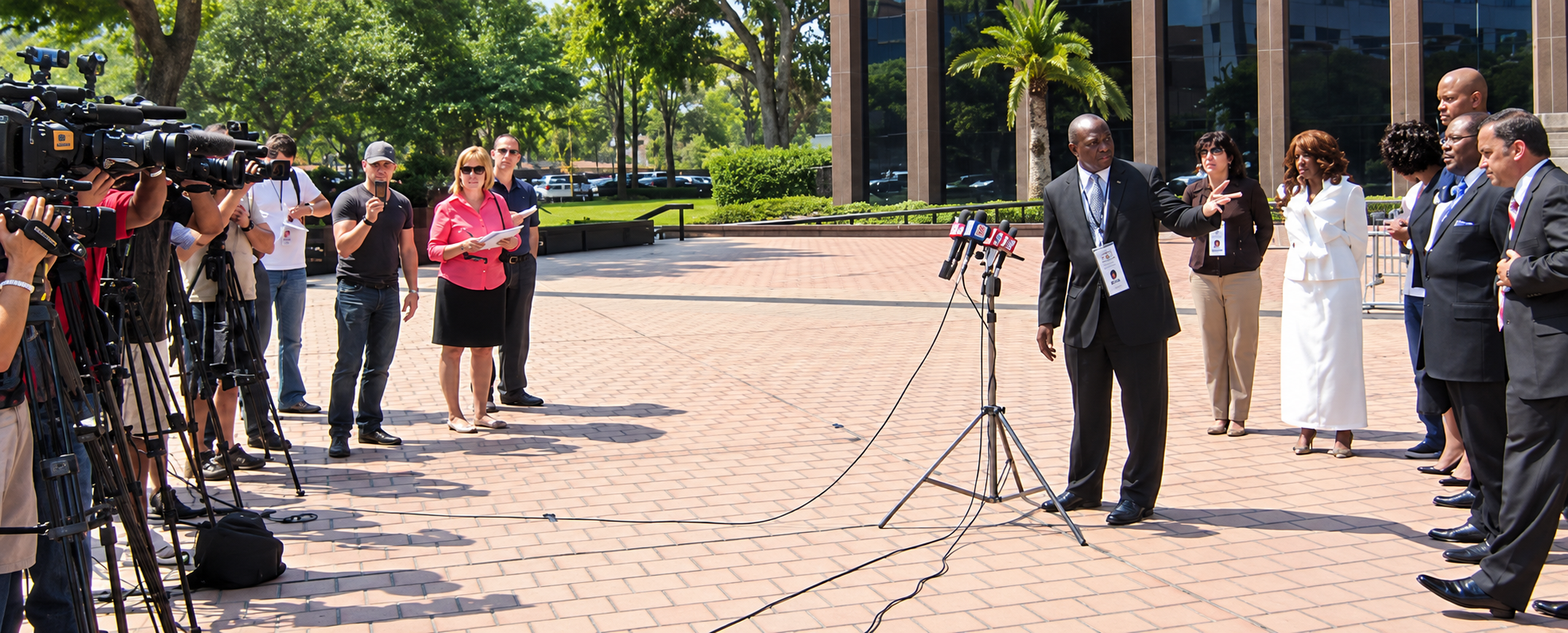
The Florida Civil Rights Association (FCRA) held a press conference outside the State of Florida’s regional offices in Orlando in 2012, calling on then-Gov. Rick Scott to take action following Trayvon Martin’s killing. Photo by FCRA.
Why Florida’s case drew global scrutiny
The Florida connection shows how the handling of a local killing can draw international scrutiny over racial discrimination, access to justice and the protection of human rights.
Pillay’s intervention brought those concerns into the international discussion surrounding Martin’s death. In September 2013, U.N. human rights experts also urged the United States to complete its civil rights investigation and examine concerns about racial profiling.
The significance lies in human rights oversight: how public institutions investigate deaths and provide equal treatment can attract attention beyond national borders. Pillay’s call was an appeal for investigation, rather than an international court judgment about Zimmerman’s guilt or Florida’s compliance with international law.
For FCRA, that connection remains relevant to how Florida leaders evaluate laws and practices affecting the communities they serve.
Pillay’s record in international justice
Pillay challenged discrimination under apartheid before serving on South Africa’s High Court, the International Criminal Tribunal for Rwanda and the International Criminal Court.
At the Rwanda tribunal, she was part of the judicial panel that established that rape and sexual violence can constitute acts of genocide, a landmark development in international criminal law.
David said honoring that career should also encourage accountability at home.
“Her Nobel Peace Prize recognizes a career built on confronting injustice through the rule of law,” he said. “Honoring that work means demanding transparent investigations and equal protection here at home. Rights belong to everyone.”
A renewed call for fairness in Florida
FCRA urged Florida leaders to safeguard impartial investigations, examine whether Stand Your Ground and other laws are applied fairly, and address policies or practices that produce discriminatory outcomes.
Founded in 2005, the association advocates for civil rights, human rights and civil liberties through education, advocacy and accountability. Its statement links Pillay’s international recognition to a continuing demand for fairness and human dignity in Florida.
World
UN Chief Guterres Praises Pakistan’s Peacekeeping, Calls for Climate Funding
Published
3 weeks agoon
October 8, 2026
Speaking at Pakistan’s Foreign Service Academy, the UN secretary-general praised the country’s humanitarian and diplomatic contributions while calling for financial reforms and inclusive artificial intelligence governance.
ISLAMABAD (FNN) — United Nations Secretary-General António Guterres praised Pakistan’s contributions to peacekeeping, refugee protection and climate action during an Oct. 7 address in Islamabad, urging world leaders to strengthen cooperation as conflicts, inequality and technological change reshape international affairs.
Speaking at the Foreign Service Academy, Guterres highlighted Pakistan’s history of hosting Afghan refugees, its service in UN peacekeeping operations and its efforts to promote dialogue between the United States and Iran, according to a UN release of his remarks.
He identified four major challenges facing international cooperation: peace and security, inequality, climate change and artificial intelligence.
“Today, humanity faces challenges on a scale no nation can solve by itself,” Guterres said.
Pakistan’s peacekeeping and humanitarian contributions
Guterres described Pakistan as a country whose generosity and resilience he had witnessed during his service as UN high commissioner for refugees and secretary-general.
He recalled Pakistani families sharing their homes and limited resources with Afghan refugees, as well as communities supporting people displaced by terrorism.
Pakistani peacekeepers, he said, have served for generations in dangerous environments, protecting civilians and supporting fragile peace processes.
He also praised Pakistan’s role on the UN Security Council and its diplomatic efforts to reduce tensions between Washington and Tehran.
“I commend Pakistan’s efforts to help forge peace between the United States and Iran,” he said.
Climate funding and the legacy of the 2022 floods
Recalling his visit during Pakistan’s devastating 2022 floods, Guterres said the disaster illustrated the unequal burden of climate change.
Pakistan contributes around 1% of global emissions but faces severe climate risks, he said. Millions of people experienced catastrophic losses from a crisis they did little to create.
He described meeting residents who abandoned their possessions to rescue neighbors, children, older adults and people with disabilities.
“In moments of crisis, saving ourselves begins with helping each other,” Guterres said.
He credited Pakistan’s leadership of the Group of 77 and China with helping secure the Loss and Damage Fund, which is intended to assist developing countries facing climate-related losses.
However, he said less than $500 million had been transferred to the fund’s trust fund nearly four years later, compared with an annual global climate disaster bill of about $200 billion.
“A crisis costing billions cannot be answered with funding counted in the millions,” he said.
Guterres also highlighted Pakistan’s solar energy expansion, calling for greater support for renewable energy, resilient infrastructure and climate adaptation.
Debt, development and financial reform
Guterres warned that rising debt burdens and inadequate development financing are limiting opportunities in developing countries.
He called for changes to the international financial system to give those countries greater representation and access to financing for sustainable growth.
“Developing countries should not have to choose between servicing debt and investing in their future,” he said.
Pakistan’s young, entrepreneurial population offers substantial potential, he said, but realizing it requires economic opportunity, respect for human rights, the rule of law and protection of civic space.
Artificial intelligence: Opportunity and risk
Guterres said artificial intelligence could improve health care, education, agriculture and disaster preparedness.
He also warned that AI could deepen inequality, concentrate power, spread disinformation and disrupt employment.
Developing countries must help shape the rules and institutions governing the technology, he said, rather than serve only as consumers of systems developed elsewhere.
“The governance of AI must reflect the interests of all humanity,” Guterres said.
He identified the United Nations as a forum where every country can participate in shaping that future.
Conflict, Gaza and international cooperation
Marking the third anniversary of the Oct. 7, 2023, Hamas attacks, Guterres condemned the attacks and said nothing justified the scale of death and destruction that followed for Palestinians in Gaza.
He warned of the threat of ethnic cleansing in the occupied Palestinian territory and called for full implementation of the Gaza peace plan and preservation of a two-state solution.
More broadly, he said a world with multiple centers of power needs effective international institutions to prevent fragmentation and instability.
He called for a UN-centered system that better reflects today’s distribution of countries, economies and influence.
A closing message of dialogue and mutual respect
Guterres concluded by describing a painting by Pakistani artist Abdur Rahman Chughtai displayed between his personal office and conference room.
The artwork, a gift from Pakistan to the United Nations more than 60 years ago, depicts Mughal Emperor Jehangir and his wife, Nur Jehan.
He said it symbolizes Pakistan’s cultural heritage and the value of wisdom, listening and exchange among civilizations.
“Dialogue, understanding, cooperation — that is the spirit reflected in that magnificent Pakistani painting,” Guterres said.
Source attribution: This article is based on the United Nations release of Secretary-General António Guterres’ Oct. 7, 2026, address to the Foreign Service Academy in Islamabad. All direct quotations are attributed to Guterres.
World
Guterres Marks Third Anniversary of Oct. 7 Attacks With Call for Israeli-Palestinian Peace
Published
3 weeks agoon
October 8, 2026
The UN secretary-general condemned the 2023 Hamas-led attacks, honored victims and former hostages, and urged an end to Palestinian suffering through a permanent ceasefire and expanded humanitarian assistance.
UNITED NATIONS (FNN) — UN Secretary-General António Guterres called for a permanent ceasefire and expanded humanitarian assistance in Gaza in a message marking the third anniversary of the Oct. 7, 2023, attacks on Israel.
According to a United Nations press release, Guterres urged all parties to fulfill their commitments and advance to the next phase of the ceasefire under the Comprehensive Plan to End the Gaza Conflict.
“It is time for the ceasefire to become permanent,” Guterres said. “It is time to allow humanitarian assistance at scale. And it is time to respect international law.”
Remembering victims of the Oct. 7 attacks
Guterres condemned the attacks by Hamas and other Palestinian armed groups, which he said killed more than 1,200 Israelis and foreign nationals. He said civilians were deliberately targeted in their homes, communities and at a music festival.
A total of 251 people were abducted and taken into Gaza, including women, children and older adults, according to his message.
Guterres said hostages endured torture, sexual violence and other forms of abuse. Some were killed by their captors or during the subsequent hostilities, he said.
“Nothing can justify these atrocities,” Guterres said.
Honoring survivors, former hostages and grieving families
The secretary-general described meetings with Israeli families, survivors and former hostages who shared accounts of lasting physical and emotional trauma.
He expressed relief for those who regained their freedom and reunited with loved ones, while mourning people killed in the attacks and those who died in captivity.
“Their suffering, and the enduring grief of their families, must never be forgotten,” he said.
Guterres emphasized that the horrors of Oct. 7 must never be repeated.
Calling for an end to suffering in Gaza
Guterres also addressed the devastating consequences of the hostilities for Palestinians in Gaza, citing widespread loss of life, displacement and destruction.
He said civilians continued to face intolerable conditions and called for their suffering to end immediately.
“Their suffering, too, demands an end — now,” he said.
Although the ceasefire reached in 2025 brought some relief, Guterres said it had not yet delivered security, sufficient humanitarian assistance or a credible route toward recovery and peace.
Making the ceasefire permanent
Guterres urged all parties to implement their commitments fully and move forward under the Comprehensive Plan to End the Gaza Conflict.
His message called for a permanent ceasefire, humanitarian assistance at the scale needed and respect for international law. He also emphasized the need for a political process that supports lasting peace throughout the region.
“The United Nations remains unwavering in its commitment to these imperatives,” he said.
A future of peace, security and dignity
Guterres urged leaders to make the anniversary a turning point toward a different future for Israelis and Palestinians.
“Let this anniversary mark not only another year of mourning, but also a renewed determination to build a different future,” he said.
He envisioned Israelis and Palestinians living side by side in peace and security, with their rights, dignity and aspirations fulfilled.


