

US NATIONAL NEWS
In campaign swing, Biden focuses on incumbent Democrats


Sports
U.S. U-19 Men’s National Team Advances to Fifth Straight Concacaf U-20 Championship Final With 2-0 Win Over Costa Rica


Central Florida News
ActBlue Managers Samuel Vilchez Santiago, Jose Gamboa Hold Key Roles in Florida House Race Amid Federal Investigations

ORLANDO, Fla. (FNN NEWS) — ActBlue, one of the Democratic Party’s most influential online fundraising platforms, remains under federal and congressional investigations over its donor-verification, fraud-prevention and compliance practices as two ActBlue employees — Florida House District 43 candidate Samuel Vilchez Santiago and campaign treasurer Jose Gamboa — hold key political and campaign-finance roles in the same Central Florida race.

Vilchez Santiago publicly identifies ActBlue as his employer while seeking the Democratic nomination for Florida House District 43. Gamboa, who is publicly identified as an ActBlue employee, serves as Vilchez Santiago’s campaign treasurer and also holds a leadership role with Central Floridians for Change, a Florida political committee associated with Vilchez Santiago.
The overlap places two ActBlue employees at the center of a competitive Orlando-area legislative contest while congressional investigators and federal authorities continue examining allegations involving straw donors, potentially prohibited foreign contributions, donor verification, payment safeguards and ActBlue’s internal compliance procedures.
There is no public evidence identified by Florida National News that Samuel Vilchez Santiago or Jose Gamboa has been named as a subject or target of any federal investigation involving ActBlue.
Their employment with ActBlue does not establish that either participated in, knew about or was responsible for any conduct being examined by federal authorities.
The federal scrutiny concerns ActBlue’s broader fundraising and compliance practices and should be distinguished from the activities of individual employees unless evidence establishes a connection.

ActBlue Faces Continuing Federal Scrutiny
ActBlue has faced congressional and federal scrutiny involving its online political fundraising practices.
Congressional inquiries have examined issues including donor identity verification, fraud prevention, potentially prohibited foreign contributions, prepaid-card transactions, suspicious contribution patterns and ActBlue’s internal compliance procedures.
The scrutiny has involved the U.S. House Committee on House Administration, House Committee on the Judiciary and House Committee on Oversight and Government Reform.
Federal scrutiny expanded following President Donald Trump’s April 24, 2025 presidential memorandum, which directed the attorney general, in consultation with the Treasury secretary, to investigate allegations involving online political fundraising platforms.
The memorandum addressed allegations involving straw or “dummy” contributions, prohibited foreign contributions, identity-related fraud and other potential violations of federal campaign-finance law.
The presidential memorandum ordered federal officials to investigate the allegations. It did not establish that ActBlue or any individual committed a crime.
Straw and “Dummy” Donor Allegations
One focus of the federal scrutiny involves allegations of straw donations, generally referring to political contributions made in another person’s name to conceal the true source of the funds.
Federal law prohibits making a political contribution in the name of another person or knowingly permitting one’s name to be used to disguise the actual source of a contribution.
Investigators have examined whether vulnerabilities in online fundraising systems could potentially allow political money to be divided into smaller transactions and attributed to other individuals.
Trump’s April 2025 memorandum specifically directed federal officials to investigate allegations involving “straw” or “dummy” contributions and potentially prohibited foreign contributions made through online fundraising platforms.
Federal scrutiny has also included questions about whether prepaid cards, gift cards, false identities, unauthorized payment information or other methods could be used to conceal the actual source of political contributions or circumvent fraud-detection systems.
The directive ordered an investigation into allegations; it did not establish that those allegations were proven.
Foreign Contributions and Online Fundraising
Another focus has been whether prohibited foreign money could enter U.S. elections through online fundraising platforms.
Federal law generally prohibits foreign nationals from directly or indirectly making contributions or donations in connection with federal, state or local elections.
Congressional investigators have examined whether foreign individuals or organizations could exploit weaknesses in online donation systems to route political contributions into American campaigns while obscuring the original source.
The April 2025 presidential memorandum cited congressional investigative findings stating that ActBlue had detected at least 22 “significant fraud campaigns,” nearly half of which reportedly had a foreign nexus.
The memorandum also cited findings that during one 30-day period in the 2024 election cycle, ActBlue detected 237 donations originating from foreign IP addresses and involving domestic prepaid cards.
Those figures were cited as reasons for further investigation.
They do not establish that all 237 transactions were illegal foreign contributions or that the individuals involved violated federal law.
Donor Identity and Payment Verification
Congressional scrutiny has also focused on how ActBlue verifies donor identities and determines whether the person making a contribution is the individual identified in the transaction.
Investigators have examined issues involving donor identity verification, suspicious-transaction detection, prepaid cards, foreign IP addresses, potentially unauthorized payment information and repeated or unusual contribution patterns.
Another area of inquiry has involved ActBlue’s historical policies concerning card verification value, or CVV, the security code commonly associated with credit- and debit-card transactions.
Investigators have questioned whether stronger identity and payment-verification requirements could help prevent fraudulent transactions, contributions made in another person’s name or attempts by prohibited foreign sources to participate financially in U.S. elections.
Congressional Investigation Reaches ActBlue Personnel
Congressional scrutiny has expanded beyond ActBlue’s fundraising technology to include current and former employees, executives and personnel involved in legal and compliance operations.
House investigators have sought documents and testimony concerning ActBlue’s handling of potentially fraudulent or prohibited contributions and what employees and executives knew about suspicious fundraising activity.
Congressional investigators reported that five current or former ActBlue employees invoked their Fifth Amendment rights in response to substantive questions during depositions, according to a 2026 joint congressional staff report.
Invoking the Fifth Amendment is a constitutional right and does not establish guilt or prove that an individual committed a crime.
Investigators have also examined personnel changes within ActBlue’s legal and compliance operations following the 2024 election and sought information about how senior officials responded to internal concerns.
Scrutiny Expands to ActBlue Leadership
Congressional investigators have also sought information from individuals within ActBlue’s leadership structure, including members of its board.
Investigators have requested documents, communications and testimony concerning what senior leadership knew about fraud concerns, potentially prohibited foreign contributions, internal compliance procedures and ActBlue’s responses to congressional inquiries.
Congressional committees have additionally examined whether requested information was fully provided and whether representations made to lawmakers accurately reflected ActBlue’s internal fraud-prevention and compliance practices.
Those allegations remain disputed and do not constitute findings of criminal wrongdoing by a court.
Justice Department and FBI Scrutiny
The scrutiny has extended beyond Congress.
Trump’s April 24, 2025 memorandum directed the attorney general, in consultation with the Treasury secretary, to investigate allegations involving unlawful straw or dummy contributions, prohibited foreign contributions and other potential violations involving online fundraising platforms.
Congressional investigators have also referred or provided information from their ActBlue investigation to federal law-enforcement authorities.
House Administration Committee Chairman Bryan Steil said in 2025 that he received a classified briefing at FBI headquarters concerning active campaign-finance investigations following congressional concerns about potential foreign participation in U.S. elections through online fundraising platforms.
Because portions of federal investigative activity are not public, the full scope and current status of any Justice Department or FBI investigation cannot necessarily be determined from publicly available information.
The existence of an investigation does not establish that ActBlue, its employees or campaigns using its platform committed a crime.

ActBlue Denies Wrongdoing
ActBlue has denied allegations of wrongdoing and has maintained that it complies with federal campaign-finance laws and maintains systems designed to detect and prevent fraudulent or prohibited contributions.
Evidence that ActBlue detected suspicious transactions does not necessarily mean those transactions were completed, accepted as lawful political contributions or ultimately determined to violate federal law.
Congressional subpoenas, investigative reports, federal inquiries and employee testimony likewise do not, by themselves, establish criminal or civil liability.
Against that national backdrop, the involvement of ActBlue employees Samuel Vilchez Santiago and Jose Gamboa in Florida House District 43 gives the federal scrutiny a direct Central Florida political connection.

Samuel Vilchez Santiago, Jose Gamboa Hold Key HD 43 Roles
Public campaign records identify Samuel Vilchez Santiago as a candidate for the Democratic nomination for Florida House District 43.
Publicly available professional information identifies Vilchez Santiago as holding a management position with ActBlue. His employment with the organization is separate from his candidacy for public office.
Vilchez Santiago’s campaign website states that, as a Senior Nonprofit Manager at ActBlue, he helps thousands of nonprofits and grassroots movements across the country build people-powered fundraising programs aimed at shifting political influence away from corporations and toward communities.
Jose Gamboa is publicly identified as an Account Management Specialist at ActBlue and serves as treasurer of Vilchez Santiago’s campaign.
Florida campaign-finance records also identify Gamboa as an officer of Central Floridians for Change, a Florida political committee associated with Vilchez Santiago.
The arrangement places Vilchez Santiago and Gamboa — both publicly identified ActBlue employees — in significant campaign and campaign-finance positions surrounding the same Florida legislative contest.
Vilchez Santiago is the candidate.
Gamboa is responsible for campaign treasury operations while also holding leadership roles (chairman and treasurer) with an associated political committee.
Their employment and campaign roles do not, by themselves, establish a violation of state or federal law.
They do, however, create a public-interest question about what safeguards ActBlue maintains when its employees simultaneously become candidates, campaign treasurers or political committee officials.
Political Relationship Between Vilchez Santiago and Gamboa Dates to 2020
The political relationship between Samuel Vilchez Santiago and Jose Gamboa predates the current House District 43 campaign.
When Vilchez Santiago sought the Democratic nomination for the Florida House in 2020, then-Orange County School Board member Johanna López served as his campaign manager.
Gamboa served as deputy campaign manager, while Diana Joaquin served as campaign treasurer.
Vilchez Santiago ultimately lost the 2020 Democratic primary to Daisy Morales, who went on to win the general election and serve in the Florida House.
The political relationships continued to overlap in later election cycles.
According to campaign-finance reports from López’s 2024 Florida House campaign, the campaign reported $2,250 in expenditures to Joaquin and $1,440 in expenditures to Gamboa.
López has endorsed Vilchez Santiago’s 2026 House District 43 campaign, while Central Floridians for Change reported contributing $1,000 to López’s 2026 Orange County Commission District 4 campaign on or about March 20.
The contribution and endorsement do not establish an exchange, agreement or improper relationship.
However, together with the documented campaign relationships dating to 2020, they provide additional context for examining the financial, professional and political relationships surrounding the House District 43 race.
Overall, those expenditures do not indicate wrongdoing. They provide historical context showing that several individuals involved in the current political network have worked together across multiple Central Florida Democratic campaigns.
Gamboa’s involvement with Vilchez Santiago therefore dates at least to the 2020 election cycle, progressing from deputy campaign manager to campaign treasurer while he also holds a leadership position with Central Floridians for Change.
Credit: Samuel Vilchez Santaiago Campaign
Vilchez Santiago Campaign, Associated Committee Report About $217,000 Combined
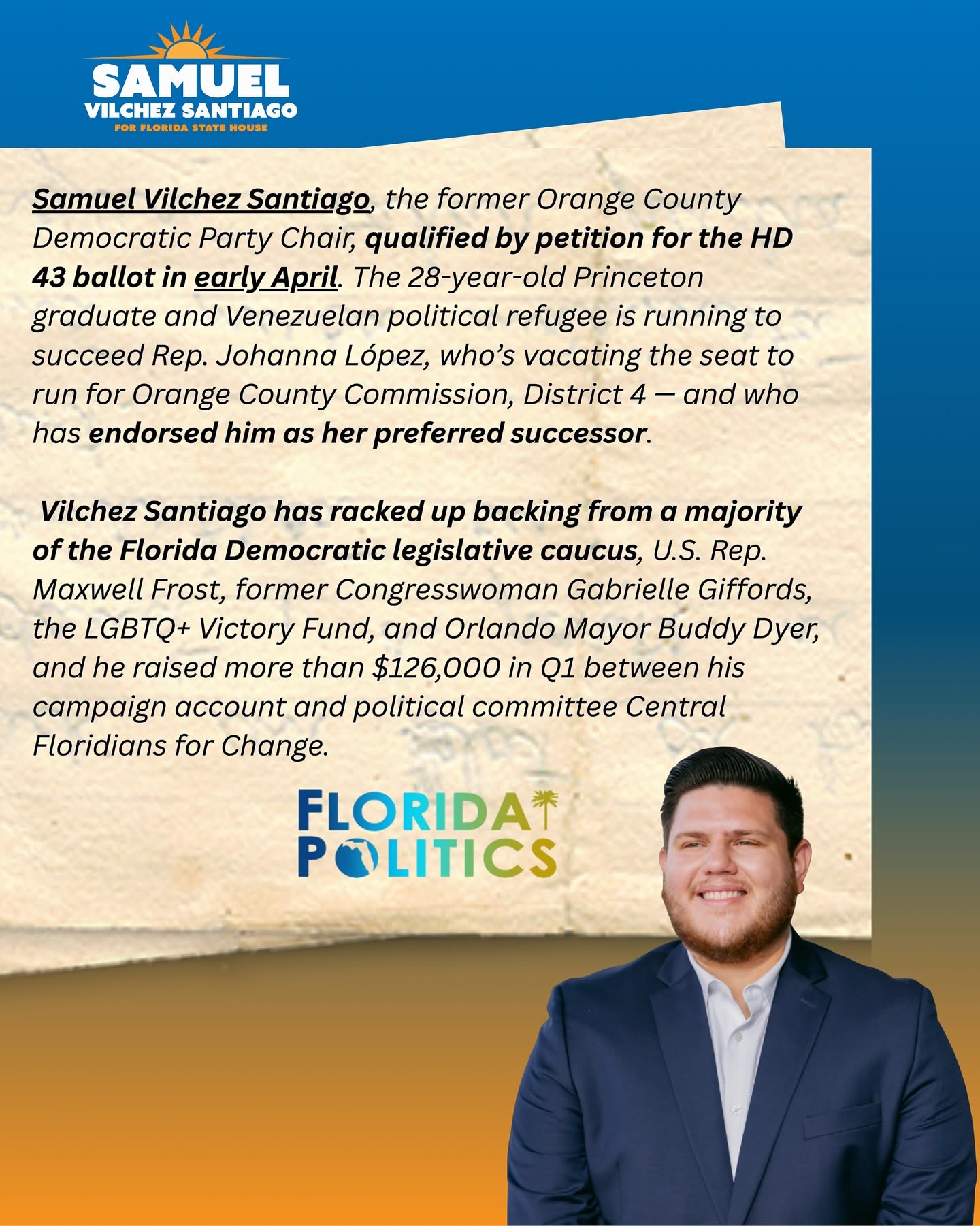
Campaign-finance reports show substantial fundraising surrounding Vilchez Santiago’s campaign and Central Floridians for Change.
According to publicly reported figures:
- Samuel Vilchez Santiago campaign: approximately $155,000 raised
- Central Floridians for Change: approximately $62,000 raised
- Combined reported fundraising: approximately $217,000
The campaign and political committee are legally separate entities and report their finances independently.
One transaction has drawn particular attention during the closing weeks of the Democratic primary.

Central Floridians for Change contributed $50,000 to the Florida House Democratic Campaign Committee in July 27, 2026, through three separate contributions of $25,000, $15,000 and $10,000, according to Florida campaign-finance reports.
Based on approximately $62,000 in reported committee fundraising, the $50,000 contribution represents roughly 81% of the committee’s reported receipts.
The contribution came weeks before the Aug. 18 Democratic primary.
The Florida House Democratic Campaign Committee is an affiliated party committee that raises and spends political funds in connection with Democratic efforts involving Florida House races.
The contribution itself does not establish wrongdoing.
Its size and timing, however, add another campaign-finance dimension to a primary in which an ActBlue employee is the candidate and another ActBlue employee serves as campaign treasurer and a political committee official.
Credit: Samuel Vilchez Santaiago Campaign
Vilchez Santiago Draws Major Democratic Support
Vilchez Santiago has announced endorsements from numerous elected officials, labor organizations and political groups.
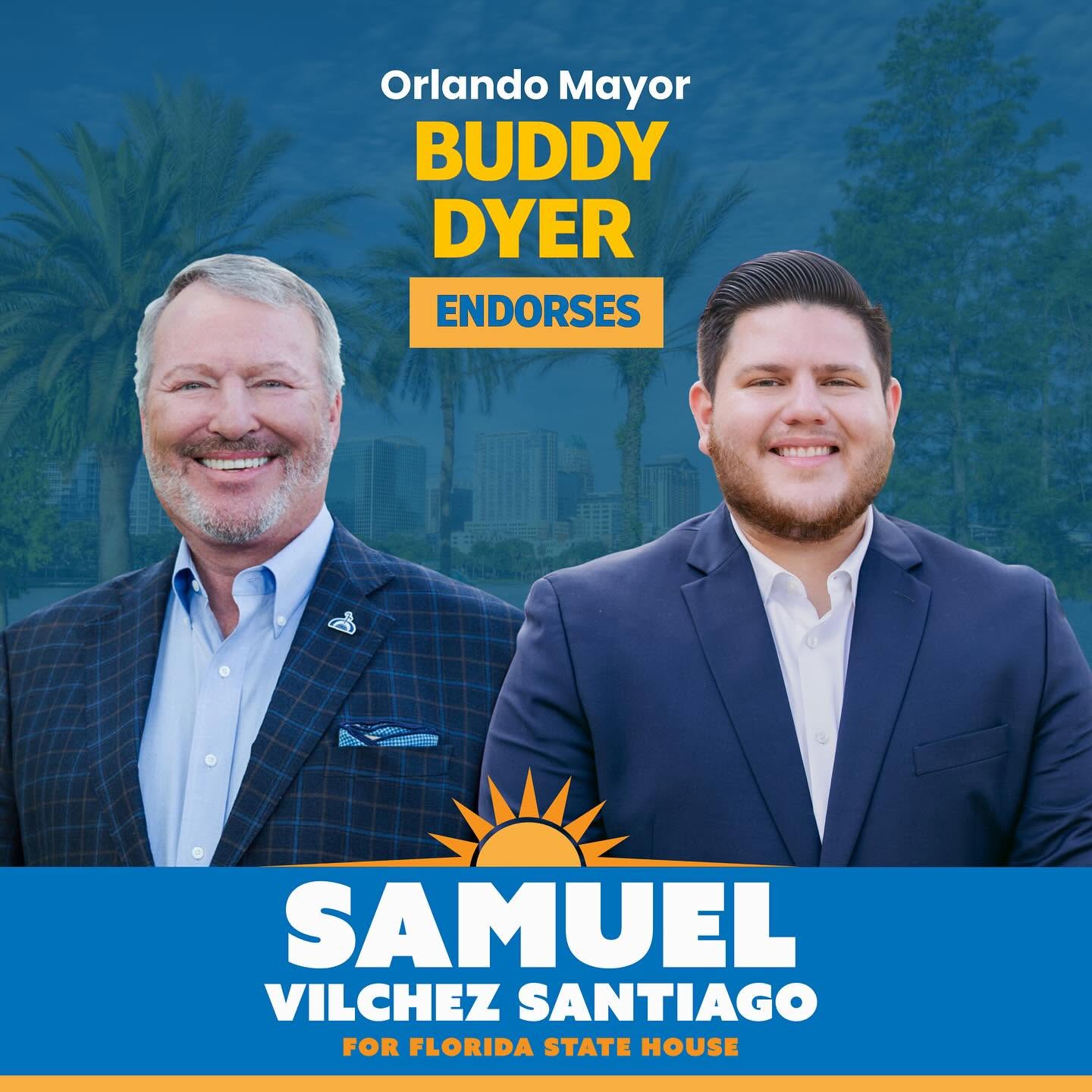
His publicly announced supporters include U.S. Reps. Darren Soto and Maxwell Frost, Orange County Mayor Jerry Demings, Orlando Mayor Buddy Dyer, State Attorney Monique Worrell and State Rep. Johanna López, along with other current and former elected officials.
Organizational endorsements announced by the campaign include the Florida Education Association, Orange County Classroom Teachers Association and Orange County Fire Fighters Association, among other labor and advocacy organizations.
The endorsements demonstrate substantial institutional and political support for Vilchez Santiago.
However, an endorsement should not be interpreted as evidence that an elected official or organization independently investigated, reviewed or cleared Vilchez Santiago, Gamboa or ActBlue regarding matters under federal scrutiny unless that official or organization specifically states that such a review occurred. (vetting a candidate for endorsement)
The endorsements represent support for Vilchez Santiago’s candidacy.
No Public Evidence Vilchez Santiago or Gamboa Are Federal Targets
The distinction between federal scrutiny of ActBlue and the status of Samuel Vilchez Santiago and Jose Gamboa is critical.
Florida National News has identified no public evidence naming either Vilchez Santiago or Gamboa as a subject or target of the congressional or federal investigations involving ActBlue.
Their employment with the organization should therefore not be interpreted as evidence that either participated in, knew about or was responsible for conduct under investigation.
FNN has also identified no public announcement by federal authorities alleging that Vilchez Santiago’s House campaign or Central Floridians for Change is part of the federal inquiries into ActBlue.
Credit: Samuel Vilchez Santiago Campaign
ActBlue Employee Political Activity Raises Policy Questions
While there is no public indication that Vilchez Santiago or Gamboa is individually under federal investigation, their simultaneous professional and political roles raise broader policy, transparency and compliance questions.
Among them:
What policies does ActBlue maintain when an employee becomes a candidate for public office?
Are ActBlue employees permitted to serve simultaneously as campaign treasurers or officers of political committees?
What safeguards separate an employee’s ActBlue responsibilities from outside campaign or PAC activities?
Are employees with access to political fundraising systems subject to additional compliance requirements when they become candidates or campaign-finance officers?
Have congressional investigators sought information concerning ActBlue employees who simultaneously serve as candidates, campaign treasurers, political committee officials or political consultants?
The existence of these questions does not establish misconduct.
Answers could provide voters with a clearer understanding of how ActBlue manages employee political activity and potential conflicts involving outside campaigns..
ActBlue Connection Adds National Dimension to Central Florida Primary
The House District 43 Democratic primary is fundamentally a Central Florida legislative contest.
But the employment of candidate Samuel Vilchez Santiago and campaign treasurer Jose Gamboa by ActBlue adds a national dimension as the fundraising organization continues to face congressional and federal scrutiny.
Vilchez Santiago has assembled significant financial, labor and political support as he seeks the Democratic nomination.
Morales is seeking to return to the Legislature after representing Florida House District 48 from 2020 to 2022.
The candidates previously faced each other in the 2020 Democratic primary for House District 48, when Morales defeated Vilchez Santiago and two other candidates before winning the general election.
Redistricting later changed the legislative boundaries, with portions of the former House District 48 now located within House District 43.
FNN Continuing Coverage
Florida National News will continue examining the ActBlue federal investigations and their broader implications while separately monitoring the political and campaign-finance activities of ActBlue employees Samuel Vilchez Santiago and Jose Gamboa in Florida House District 43.
FNN will seek responses from ActBlue, Vilchez Santiago, Gamboa and other individuals or organizations identified in this report when their comments materially contribute to the public’s understanding of the issues.
FNN will also monitor campaign-finance disclosures, congressional developments and any publicly released information from the Justice Department or other federal authorities.
Florida National News will update, correct or clarify this reporting when new verified information warrants doing so.
Election Day Aug. 18
The Democratic primary for Florida House District 43 will be held Aug. 18, 2026, with early voting underway.
The Democratic nominee will advance to the Nov. 3 general election to face the Republican nominee and any qualified write-in candidate.


 Sports3 days ago
McCumbee McAleer Racing Parts Ways With Nate Cicero, New Driver Announcement Coming
 Florida3 days ago
ActBlue Investigations Raises Vetting, Due-Diligence Questions for Samuel Vilchez Santiago’s Florida House Endorsers
 Florida2 days ago
FNN FACT CHECK: Democratic PAC Mailer Backing Samuel Vilchez Santiago Rated ‘Mostly False’


 Central Florida News3 days ago
FL NOW PAC Endorses Eric Gray, Jane Aman, Felipe Sousa-Lazaballet and Samuel Vilchez-Santiago in Florida House Races
 Sports3 days ago
U.S. U-19 Men’s National Team Advances to Fifth Straight Concacaf U-20 Championship Final With 2-0 Win Over Costa Rica

