

US NATIONAL NEWS
N. Korea fires ICBM it says is ‘significantly more’ powerful


SEOUL, South Korea (AP) — After 2 ½ months of relative quiet, North Korea launched its most powerful weapon yet early Wednesday, claiming a new type of intercontinental ballistic missile that some observers believe could reach Washington and the entire eastern U.S. seaboard.
In a special state media broadcast hours later, North Korea said it successfully fired a “significantly more” powerful, nuclear-capable ICBM it called the Hwasong-15. Outside governments and analysts concurred the North had made a jump in missile capability.
A resumption of Pyongyang’s torrid testing pace in pursuit of its goal of a viable arsenal of nuclear-tipped missiles that can hit the U.S. mainland had been widely expected, but the power of the missile and suddenness of the test still jolted the Korean Peninsula and Washington. The launch at 3:17 a.m. local time and midday in the U.S. capital indicated an effort to perfect the element of surprise and to obtain maximum attention in the United States.
In a government statement released through state media, North Korea said the Hwasong-15, the “greatest ICBM,” could be armed with a “super-large heavy nuclear warhead” and is capable of striking the “whole mainland” of the United States. The North said the missile reached a height of 4,475 kilometers (2,780 miles) and traveled 950 kilometers (590 miles) before accurately hitting a sea target, similar to the flight data announced by South Korea’s military.
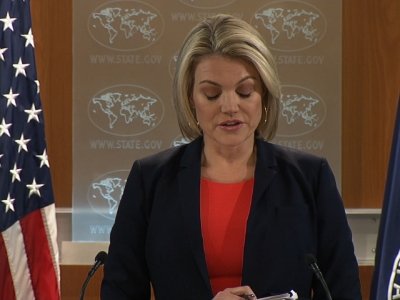
It said leader Kim Jong Un after the successful launch “declared with pride” that the country has achieved its goal of becoming a “rocket power.” State TV said Kim gave the order on Tuesday and broadcast a photo of Kim’s signed order where he wrote: “Test launch is approved. Taking place at the daybreak of Nov. 29! Fire with courage for the party and country!”
The firing is a clear message of defiance aimed at the Trump administration, which a week earlier had restored North Korea to a U.S. list of terror sponsors. It also ruins nascent diplomatic efforts, raises fears of war or a pre-emptive U.S. strike and casts a deeper shadow over the security of the Winter Olympics early next year in South Korea.
A rattled Seoul responded by almost immediately launching three of its own missiles in a show of force. President Moon Jae-in expressed worry North Korea’s missile threat could force the United States to attack the North before it masters a nuclear-tipped long-range missile, something experts say may be imminent.
“If North Korea completes a ballistic missile that could reach from one continent to another, the situation can spiral out of control,” Moon said at an emergency meeting in Seoul, according to his office. “We must stop a situation where North Korea miscalculates and threatens us with nuclear weapons or where the United States considers a pre-emptive strike.”
Moon has repeatedly declared the U.S. cannot attack the North without Seoul’s approval, but many here worry Washington may act without South Korean input.
The launch was North Korea’s first since it fired an intermediate-range missile over Japan on Sept. 15 and may have broken any efforts at diplomacy. U.S. officials have sporadically floated the idea of direct talks with North Korea if it maintained restraint.
The missile also appears to improve on North Korea’s past launches.
If flown on a standard trajectory, instead of Wednesday’s lofted angle, the missile would have a range of more than 13,000 kilometers (8,100 miles), said U.S. scientist David Wright, a physicist who closely tracks North Korea’s missile and nuclear programs. “Such a missile would have more than enough range to reach Washington, D.C., and in fact any part of the continental United States,” Wright wrote in a blog post for the Union for Concerned Scientists.

North Korea’s description of a “super-large heavy” warhead could raise debate on whether it plans another nuclear test to demonstrate it has such a weapon. When the North flight-tested two of its older ICBM models, the Hwasong-14s, in July, it said the missiles were capable of delivering “large-sized heavy” warheads. The North went on to conduct its sixth and most powerful nuclear test on Sept. 3, which it described as a detonation of a weapon built for ICBMs.
South Korea’s National Intelligence Service told lawmakers in a closed-door briefing the possibility of a nuclear test “cannot be discounted,” lawmaker Kim Byung-kee said.
The missile was launched from near Pyongyang, and Japanese Defense Minister Itsunori Onodera said it landed inside of Japan’s special economic zone in the Sea of Japan, about 250 kilometers (155 miles) west of Aomori, which is on the northern part of Japan’s main island of Honshu.
A big unknown, however, is the missile’s payload. If, as expected, it carried a light mock warhead, then its effective range would have been shorter, analysts said.
The analyses of Wednesday’s test suggest progress by Pyongyang in developing a weapon of mass destruction that could strike the U.S. mainland. President Donald Trump has vowed to prevent North Korea from having that capability — using military force if necessary.
Kim Dong-yub, a former South Korean military official who is now an analyst at Seoul’s Institute for Far Eastern Studies, said the missile is likely an upgraded version of its old ICBM with an enhanced second-stage. He believes the North will try to evaluate the weapon’s performance, including the warhead’s ability to survive atmospheric re-entry and strike the intended target, before it attempts a test that shows the full range of the missile.
In response to the launch, Trump said the United States will “take care of it.” He told reporters after the launch: “It is a situation that we will handle.” He did not elaborate.
The U.N. Security Council scheduled an emergency meeting for Wednesday afternoon at the request of Japan, the U.S. and South Korea.
When the Trump administration declared North Korea a state sponsor of terrorism, the U.S. also imposed new sanctions on North Korean shipping firms and Chinese trading companies dealing with the North. North Korea called the terror designation a “serious provocation” that justifies its development of nuclear weapons.
South Koreans are famously nonchalant about North Korea’s military moves, but there is worry about what the North’s weapons tests might mean for next year’s Winter Olympics in the South. Moon ordered a close review of whether the launch could hurt South Korea’s efforts to successfully host the games in Pyeongchang, which begin Feb. 9.
Japanese Prime Minister Shinzo Abe, who spoke with Trump, said Japan will not back down against any provocation and would maximize pressure on the North in its strong alliance with the U.S.
___
Associated Press writers Matthew Pennington, Lolita C. Baldor and Robert Burns in Washington, Mari Yamaguchi in Tokyo and Edith M. Lederer at the United Nations contributed to this report.


Entertainment
Kym Whitley, Yvette Nicole Brown to Headline First Ladies Health Initiative Brain Health Luncheon

Entertainment
Chaka Khan, Q Parker to Lead Living Legends Foundation’s 35th Anniversary Gala in Atlanta

Milestone celebration will recognize the executives, radio personalities, entrepreneurs and cultural leaders who helped shape Black music and entertainment
ATLANTA, Ga. (FNN) — Ten-time Grammy Award winner Chaka Khan will serve as honorary ambassador and Grammy-winning singer and founding 112 member Q Parker as honorary gala chair for the Living Legends Foundation’s 35th Anniversary Awards Dinner & Gala, the organization announced.
The milestone celebration is scheduled for Friday, Oct. 2, in Atlanta and will bring together artists, music executives, radio personalities, creatives, entrepreneurs and cultural leaders to recognize the people whose work has helped shape Black music, media and entertainment.
For Khan, the role marks a return to an organization that recognized her more than three decades ago. She was among the artists honored by the Living Legends Foundation in 1992.
“When you cross a bridge, you don’t think about all the hands that built it. Some of the most important contributions are the ones we never see,” Khan said in the announcement. “Thank you, Living Legends Foundation, for seeing that every story matters and for honoring those hands and hearts that helped build the way for all of us.”
Chaka Khan Returns for Milestone Anniversary
Living Legends Foundation Chairman David C. Linton said Khan’s connection to the organization makes her participation especially significant during its 35th anniversary.
“Having Chaka Khan serve as our Honorary Ambassador during this milestone year is incredibly meaningful,” Linton said. “Chaka’s history with the Foundation reaches back to our earliest years, and her extraordinary career represents the excellence, longevity and cultural impact we have worked to celebrate for 35 years.”
Khan’s appearance also comes as she prepares for another chapter in her recording career. According to the foundation’s announcement, her new album, “Chakzilla,” is scheduled for release Sept. 18. The project, described as her first full-length album in seven years, includes collaborations with Sia, Snoop Dogg and Lenny Kravitz.
The combination of Khan’s new music and her honorary role highlights one of the gala’s central themes: connecting the legacy of Black music with the people continuing to move the industry forward.
Q Parker to Serve as Honorary Gala Chair
Joining Khan is Q Parker, a founding member of Grammy-winning R&B group 112. Parker will serve as honorary gala chair and help promote the foundation’s work recognizing and supporting music industry professionals.
“Black music has given me a career, a community, and an opportunity to use my gifts to impact people around the world, so serving as Honorary Chair for the Living Legends Foundation’s 35th anniversary is truly an honor,” Parker said.
Parker said the industry’s success extends far beyond the artists audiences see on stage.
“This organization understands that our industry is bigger than the names we see on the marquee,” Parker said. “There are countless people behind the scenes who have dedicated their lives to moving our culture forward.”
Parker recently released the single “Stare,” from his forthcoming album, “Evolution of Romance, Volume Two,” expected this fall, according to the announcement.
Honoring the People Behind Black Music and Culture
Founded in 1991, the Living Legends Foundation has built its mission around recognizing professionals whose work has helped bring Black music and culture to audiences around the world.
Beyond its annual honors, the nonprofit provides support to music industry professionals with confirmed needs and invests in future generations through mentorship, scholarships and other assistance.
The anniversary gala will continue that mission by placing executives, broadcasters, advocates, entrepreneurs and other behind-the-scenes leaders alongside some of the most recognizable figures in entertainment.
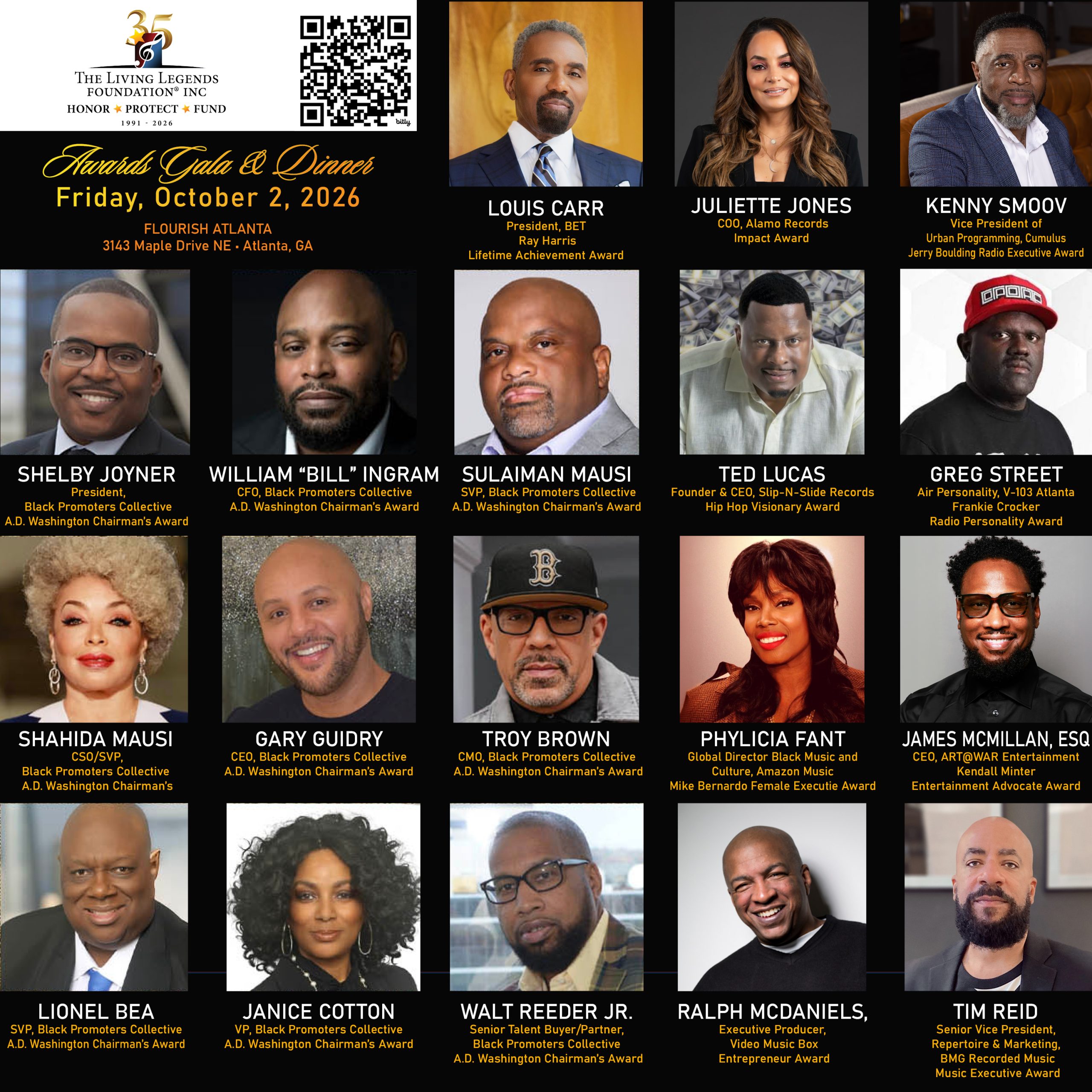
2026 Living Legends Foundation Honorees
This year’s honorees include:
- Ray Harris Lifetime Achievement Award: Louis Carr, president of BET
- A.D. Washington Chairman’s Award: Black Promoters Collective
- Jerry Boulding Radio Executive Award: Kenny Smoov, vice president of urban programming, Cumulus
- Frankie Crocker Radio Personality Award: Greg Street, air personality, V-103 Atlanta
- Impact Player Award: Juliette Jones, COO, Alamo Records
- Music Executive Award: Tim Reid, senior vice president, repertoire and marketing, BMG Recorded Music
- Mike Bernardo Female Executive Award: Phylicia Fant, global director, Black Music + Culture, Amazon Music
- Kendall Minter Entertainment Advocate Award: James McMillan, Esq., CEO, ART@WAR Entertainment
- Hip-Hop Visionary Award: Ted Lucas, founder and CEO, Slip-N-Slide Records
- Entrepreneur Award: Ralph McDaniels, executive producer, “Video Music Box”
Why the 35th Anniversary Matters
The anniversary reflects more than three decades of recognizing people whose contributions to Black music and entertainment have not always received the same public attention as the artists they helped build, promote and sustain.
That history is reflected in Khan’s return. After being recognized by the foundation in its early years, she will now help honor another generation of industry leaders.
The 35th Anniversary Awards Dinner & Gala will continue the Living Legends Foundation’s tradition of celebrating achievement, leadership, innovation and service while preserving the stories of the people who helped build the business and culture surrounding Black music.
Business
DOJ, DOT and DHS Launch Nationwide Crackdown on CDL Fraud, Trucking Schools and Unqualified Drivers


