Connect with us

Tech

NASA’s Newest Astronaut Recruits to Conduct Research off the Earth, For the Earth and Deep Space Missions

Published

on

WASHINGTON, (FNN NEWS) — After receiving a record-breaking number of applications to join an exciting future of space exploration, NASA has selected its largest astronaut class since 2000. Rising to the top of more than 18,300 applicants, NASA chose 12 women and men as the agency’s new astronaut candidates.

Vice President Mike Pence joined NASA leaders Wednesday as they introduced the members of the 2017 astronaut class during an event at the agency’s Johnson Space Center in Houston. While at Johnson, the vice president toured the International Space Station mission control center, and the historic mission control center, which was used during early NASA spaceflights, including the first moon landing mission, Apollo 11. He also was presented with a model of the International Space Station and a framed U.S. flag that was flown to and from the orbiting laboratory this winter.

“These are 12 men and women whose personal excellence and whose personal courage will carry our nation to even greater heights of discovery and who I know will inspire our children and our grandchildren every bit as much as your forebears have done so in this storied American program,” said Vice President Pence. “And to this newest class of astronauts, it’s my honor to bring the sincere congratulations of the 45th President of the United States of America, President Donald Trump. Your President is proud of you, and so am I.”

The astronaut candidates will return to Johnson in August to begin two years of training. Then they could be assigned to any of a variety of missions, including: performing research on the International Space Station, launching from American soil on spacecraft built by commercial companies, and departing for deep space missions on NASA’s new Orion spacecraft and Space Launch System rocket.

“We look forward to the energy and talent of these astronauts fueling our exciting future of discovery,” acting NASA Administrator Robert Lightfoot said. “Between expanding the crew on board the space station to conduct more research than ever before, and making preparations to send humans farther into space than we’ve ever been, we are going to keep them busy. These candidates are an important addition to the NASA family and the nation’s human spaceflight team.”

Applicants included U.S. citizens in all 50 states, the District of Columbia, and U.S. territories Puerto Rico, Guam, and American Samoa. The talented women and men selected for the new astronaut class represent the diversity of America and the career paths that can lead to a place in America’s astronaut corps.

The 2017 astronaut candidates are:

Kayla Barron, 29, Lt., U.S. Navy, is originally from Richland, Washington. She graduated from the U.S. Naval Academy with a bachelor’s degree in systems engineering. A Gates Cambridge Scholar, Barron earned a master’s degree in nuclear engineering from the University of Cambridge. As a submarine warfare officer, Barron was a member of the first class of women commissioned into the submarine community. She’ll come to NASA from the U.S. Naval Academy, where she has been serving as the flag aide to the superintendent.

Zena Cardman, 29, calls Williamsburg, Virginia, home. She completed a Bachelor of Science in Biology and Master of Science in Marine Sciences at The University of North Carolina, Chapel Hill. Cardman is currently a National Science Foundation Graduate Research Fellow working on her doctorate at The Pennsylvania State University. Her research has focused on microorganisms in subsurface environments, ranging from caves to deep sea sediments. Her field experience includes multiple Antarctic expeditions, work aboard research vessels as both scientist and crew, and NASA analog missions in British Columbia, Idaho and Hawaii.

Raja Chari, 39, Lt. Col., U.S. Air Force, hails from Waterloo, Iowa. He graduated from the U.S. Air Force Academy with bachelor’s degrees in astronautical engineering and engineering science. He continued on to earn a master’s degree in aeronautics and astronautics from Massachusetts Institute of Technology (MIT) and graduated from the U.S. Naval Test Pilot School. Chari has been serving as the commander of the 461st Flight Test Squadron and the director of the F-35 Integrated Test Force at Edwards Air Force Base in California.

Matthew Dominick, 35, Lt. Cmdr., U.S. Navy, was born and raised in Wheat Ridge, Colorado. He earned a Bachelor of Science in Electrical Engineering from the University of San Diego and a Master of Science in Systems Engineering from the Naval Postgraduate School. He also graduated from the U.S. Naval Test Pilot School. Dominick was at sea on the USS Ronald Reagan, serving as department head for Strike Fighter Squadron 115, when he got the call saying he’d been selected as an astronaut candidate.

Bob Hines, 42, considers Harrisburg, Pennsylvania, his hometown. He graduated from Boston University with a bachelor’s degree in aerospace engineering. From there, he went on to graduate from the U.S. Air Force Test Pilot School, and then the University of Alabama, where he earned a master’s degree in aerospace engineering. He has served in the U.S. Air Force and Air Force Reserves for 18 years. For the last five years, Hines has served as a NASA research pilot at Johnson.

Warren “Woody” Hoburg, 31, is originally from Pittsburgh, Pennsylvania. He earned a bachelor’s degree in aeronautics and astronautics from MIT. He continued on to earn a doctorate in electrical engineering and computer science from the University of California, Berkley. He is a private pilot and has extensive experience with wilderness search and rescue efforts. Hoburg will come to NASA from MIT, where he currently is leading a research group as an assistant professor of Aeronautics and Astronautics.

Dr. Jonny Kim, 33, Lt., U.S. Navy, was born and raised in Los Angeles. He enlisted in the U.S. Navy, then trained and operated as a Navy SEAL, completing more than 100 combat operations and earning a Silver Star and Bronze Star with Combat V. Afterward, he went on to complete a degree in mathematics at the University of San Diego and a doctorate of medicine at Harvard Medical School. Kim is a resident physician in emergency medicine at Massachusetts General Hospital.

Robb Kulin, 33, hails from Anchorage, Alaska. He earned a bachelor’s degree in mechanical engineering from the University of Denver before going on to complete a master’s degree in materials science and a doctorate in engineering at the University of California, San Diego. He has previous experience as an ice driller in Antarctica on the West Antarctic Ice Sheet and Taylor Glaciers, and as a commercial fisherman in Chignik, Alaska. Since 2011, Kulin has worked for SpaceX in Hawthorne, California, where he leads the Launch Chief Engineering group.

Jasmin Moghbeli, 33, Maj., U.S. Marine Corps, considers Baldwin, New York, her hometown. She earned a bachelor’s degree in aerospace engineering with information technology at MIT, followed by a master’s degree in aerospace engineering from the Naval Postgraduate School. She also is a distinguished graduate of the U.S. Naval Test Pilot School. Moghbeli currently tests H-1 helicopters and serves as the quality assurance and avionics officer for Marine Operational Test and Evaluation Squadron 1 in Yuma, Arizona.

Loral O’Hara, 34, calls Sugar Land, Texas, home. She earned a bachelor’s degree in aerospace engineering at the University of Kansas and a master’s degree in aeronautics and astronautics from Purdue University. As a student, she participated in NASA’s KC-135 Reduced Gravity Student Flight Opportunities Program, the NASA Academy at the agency’s Goddard Space Flight Center, and the internship program at NASA’s Jet Propulsion Laboratory. O’Hara is currently a research engineer at Woods Hole Oceanographic Institution in Woods Hole, Massachusetts.

Dr. Francisco “Frank” Rubio, 41, Maj., U.S. Army, is originally from Miami. He earned a bachelor’s degree in international relations at the U.S. Military Academy at West Point and a doctorate of medicine from the Uniformed Services University of the Health Sciences. Rubio has accumulated more than 1,100 hours of flight time in helicopters, including 600 hours of combat and imminent danger time. He’s currently serving as a surgeon for the 3rd Battalion of the Army’s 10th Special Forces Group at Fort Carson, Colorado.

Jessica Watkins, 29, hails from Lafayette, Colorado. She graduated from Stanford University with a bachelor’s degree in geological and environmental sciences, then went on to earn a doctorate in geology from the University of California, Los Angeles. Watkins has worked at NASA’s Ames Research Center and Jet Propulsion Laboratory and currently is a postdoctoral fellow at the California Institute of Technology, where she collaborates on the Mars Science Laboratory rover, Curiosity.

With the addition of these 12 members of the 2017 astronaut candidate class, NASA now has selected 350 astronauts since the original Mercury 7 in 1959.

“These women and men deserve our enthusiastic congratulations,” said astronaut and Johnson Space Center Director Ellen Ochoa. “Children all across the United States right now dream of being in their shoes someday. We here at NASA are excited to welcome them to the team and look forward to working with them to inspire the next generation of explorers.”

SOURCE | NASA

Continue Reading
Click to comment

Leave a Reply

Your email address will not be published. Required fields are marked *

Tech

NASA Rolls Out Massive SLS Rocket Stage for Artemis III Mission to Kennedy Space Center

Published

on

Pictured above is the top four-fifths of the SLS (Space Launch System) core stage – the section containing the liquid hydrogen tank, liquid oxygen tank, intertank, and forward skirt. NASA will roll the largest section of the agency’s SLS rocket that will launch the second crewed Artemis mission under the Artemis III mission out of NASA’s Michoud Assembly Facility on Monday, April 20. Credit: NASA

NEW ORLEANS (FNN) — NASA will roll out the largest section of its Space Launch System rocket on Monday, April 20, marking a major milestone for the Artemis III mission.

The section, representing the top four-fifths of the SLS core stage, is being moved from NASA’s Michoud Assembly Facility in New Orleans. It includes the liquid hydrogen tank, liquid oxygen tank, intertank and forward skirt. The structure will be loaded onto NASA’s Pegasus barge for transport to Kennedy Space Center in Florida.

CORE STAGE DELIVERY AND INTEGRATION

Once the core stage arrives at Kennedy Space Center, teams will complete final outfitting and vertical integration. The hardware will then be transferred to NASA’s Exploration Ground Systems Program for stacking and launch preparation.

The Artemis III engine section and boat-tail, which protects the engines during launch, were previously moved to the Vehicle Assembly Building in July 2025. The four RS-25 engines are scheduled to arrive from Stennis Space Center in Mississippi no later than July 2026 for integration.

POWERING THE ARTEMIS III MISSION

Equipped with four RS-25 engines, the SLS core stage will generate more than 2 million pounds of thrust, enabling the launch of astronauts aboard the Orion spacecraft.

Artemis III is currently targeted for launch in 2027, following the successful Artemis II mission, which completed a crewed flight around the Moon on April 10.

NASA’S MOON-TO-MARS STRATEGY

The Artemis III mission is part of NASA’s broader Artemis program, aimed at returning astronauts to the Moon and establishing a sustained human presence.

The mission will test critical capabilities, including rendezvous and docking between the Orion spacecraft and commercial systems needed for future lunar landings, currently planned for 2028.

NASA is working in partnership with Boeing, the SLS core stage lead contractor, and L3Harris Technologies, the lead contractor for the RS-25 engines. The core stage remains the backbone of the SLS rocket and is manufactured at the Michoud Assembly Facilit

Continue Reading

Tech

NASA’s Artemis II Astronauts Begin Historic Journey Around the Moon After Key Orion Engine Burn

Published

on

Earth's crescent is seen from a solar array camera on the Orion spacecraft on the first flight day of the Artemis II mission. Credit: NASA

CAPE CANAVERAL, Fla. (FNN) — For the first time in more than 50 years, astronauts on a NASA mission are headed around the Moon after successfully completing a critical burn of the Orion spacecraft’s main engine.

The approximately six-minute firing of Orion’s service module engine Thursday — known as the translunar injection burn — accelerated the spacecraft and its crew beyond Earth’s orbit, placing them on a trajectory toward the Moon.

Aboard the spacecraft are NASA astronauts Reid Wiseman, Victor Glover and Christina Koch, along with Canadian Space Agency astronaut Jeremy Hansen.

“Today, for the first time since Apollo 17 in 1972, humans have departed Earth orbit,” said Dr. Lori Glaze, acting associate administrator for NASA’s Exploration Systems Development Mission Directorate. “Reid, Victor, Christina and Jeremy now are on a precise trajectory toward the Moon. Orion is operating with crew for the first time in space, and we are gathering critical data and learning from each step.”

NASA’s Space Launch System rocket and Orion spacecraft lifted off from Launch Pad 39B at Kennedy Space Center at 6:35 p.m. EDT on April 1, beginning a planned 10-day test mission around the Moon and back.

Successful Launch and Spacecraft Activation

Shortly after reaching space, Orion deployed its four solar array wings, allowing the spacecraft to generate power from the Sun. The crew and mission controllers then began transitioning the spacecraft from launch to normal flight operations while checking critical onboard systems.

About 49 minutes into the flight, the rocket’s upper stage fired to place Orion into an elliptical orbit around Earth. A second burn propelled the spacecraft — named “Integrity” by the crew — into a high Earth orbit extending roughly 46,000 miles above the planet for nearly 24 hours of system testing.

Following the maneuver, Orion separated from the upper stage and began flying independently.

System Tests and Crew Operations in Space

During the early phase of the mission, the astronauts conducted a manual piloting demonstration to evaluate Orion’s handling capabilities using the Interim Cryogenic Propulsion Stage as a docking target.

After the test, Orion executed an automated departure burn to safely move away from the stage. The propulsion stage later performed a disposal burn before re-entering Earth’s atmosphere over a remote area of the Pacific Ocean.

Before its re-entry, four small CubeSats were deployed from the rocket’s Orion stage adapter to conduct separate scientific missions.

Mission teams also transitioned communications to NASA’s Deep Space Network while the crew adjusted to the space environment. Astronauts completed their first rest periods, performed onboard exercise routines, restored the spacecraft’s toilet to normal operations and prepared the spacecraft for the translunar injection burn.

Lunar Flyby and Artemis Program Goals

The crew is scheduled to conduct a lunar flyby Monday, April 6, when astronauts will capture high-resolution images and make observations of the Moon’s surface — including portions of the lunar far side rarely seen directly by humans.

Although the far side will only be partially illuminated during the flyby, the lighting conditions are expected to cast long shadows across the terrain, highlighting ridges, slopes and crater rims that are difficult to observe under full sunlight.

After completing the flyby, the astronauts will return to Earth and splash down in the Pacific Ocean off the coast of San Diego.

The mission marks a major milestone for NASA’s Artemis program, which aims to send astronauts on increasingly ambitious missions to explore the Moon, advance scientific discovery, stimulate economic growth and prepare for the first crewed missions to Mars.

Continue Reading

Florida

VIDEO: NASA Artemis II Mission Sends Astronauts Around the Moon in First Crewed Test Since Apollo

Published

on

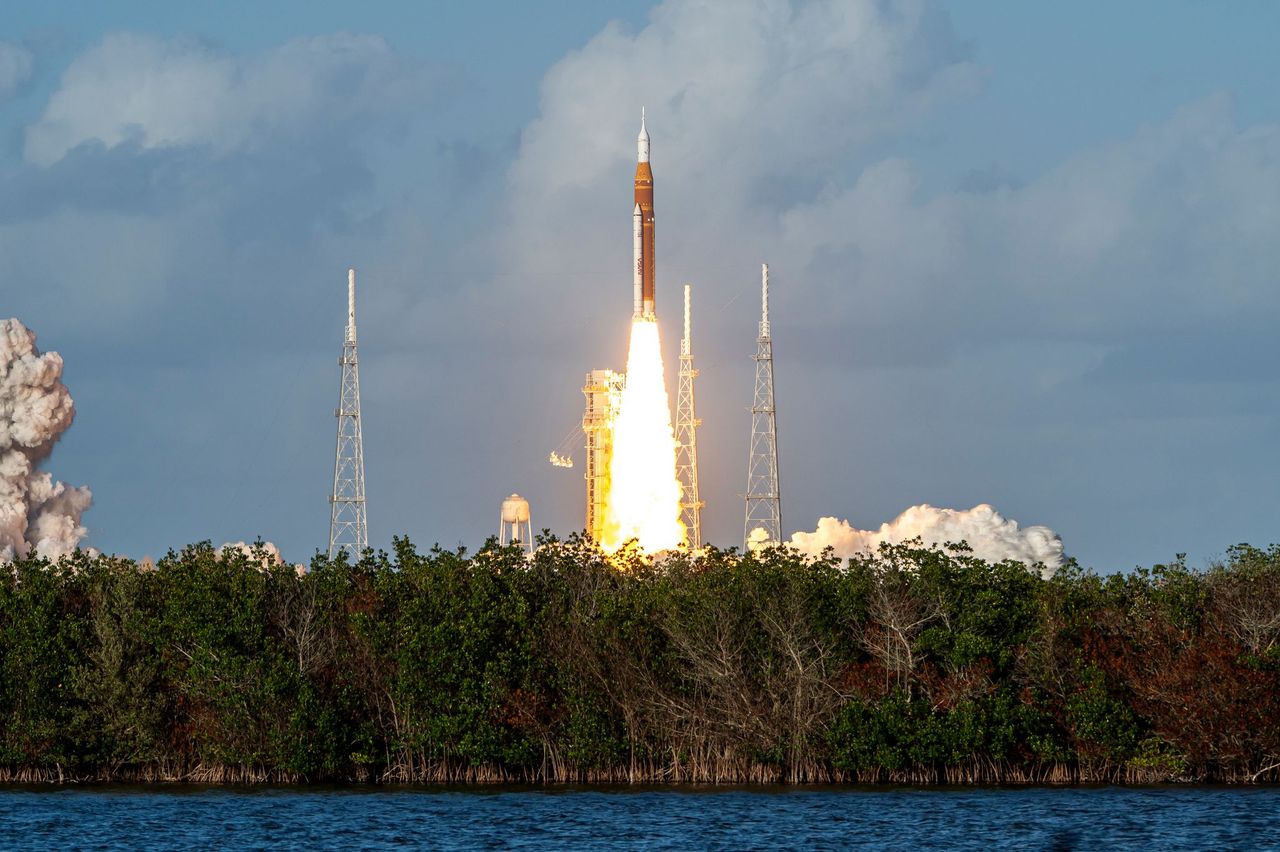
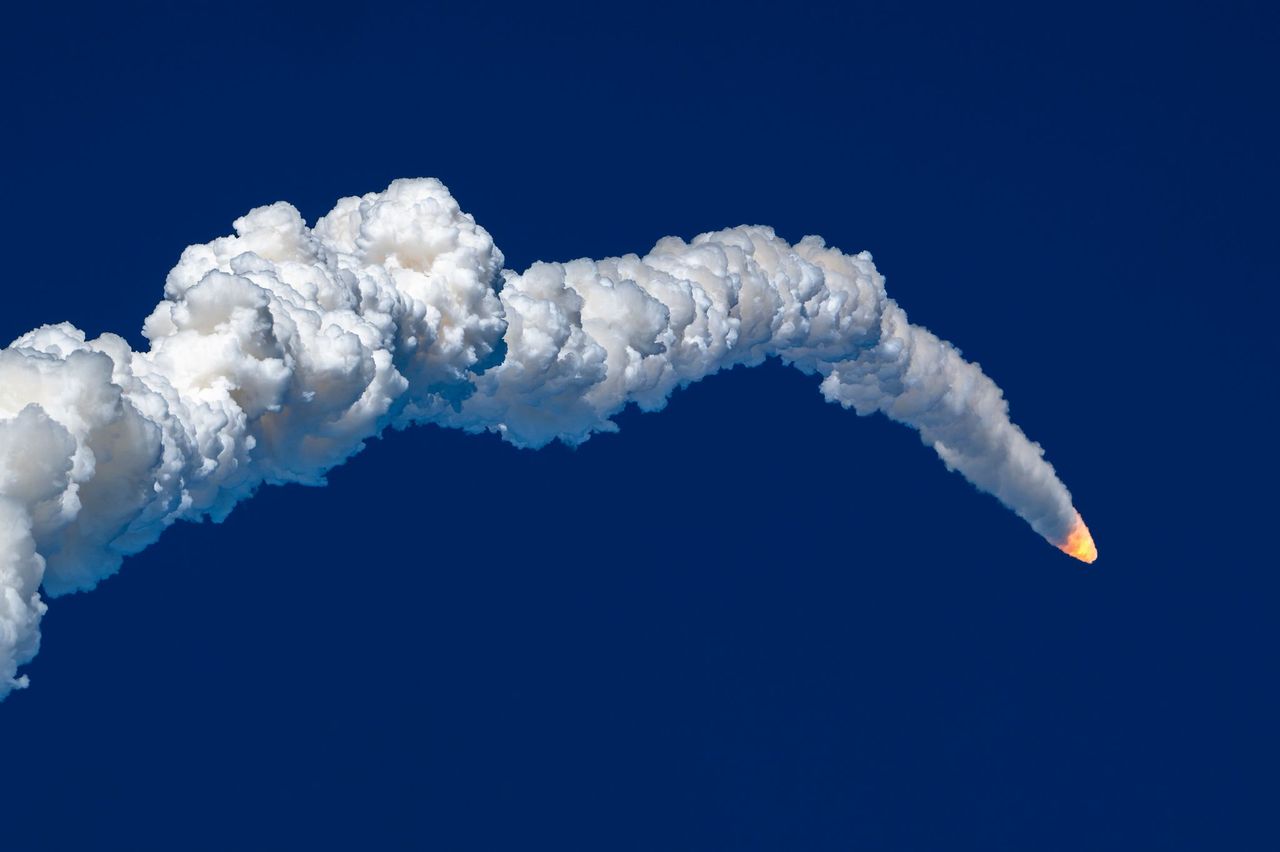
The Artemis II crewed lunar mission launches from Kennedy Space Center on April 1, 2026. Four astronauts blasted off aboard a massive NASA rocket on a long-anticipated journey around the Moon—marking the first crewed lunar flyby in more than 50 years. Photo by Nickolas Wolf / Florida National News.
CAPE CANAVERAL, Fla. (FNN) — NASA is preparing to launch the crew of Artemis II on a historic journey around the Moon, marking the first time astronauts will travel beyond low-Earth orbit since the era of Apollo Program.
The mission will lift off from Kennedy Space Center aboard the Space Launch System, carrying astronauts in the Orion spacecraft on a multi-day flight that will orbit the Moon before returning safely to Earth.

The Artemis II crewed lunar mission launches from Kennedy Space Center on April 1, 2026. Four astronauts blasted off aboard a massive NASA rocket on a long-anticipated journey around the Moon—marking the first crewed lunar flyby in more than 50 years. Photo by Nickolas Wolf / Florida National News.


Historic Return to Deep Space Artemis II is the first crewed mission in NASA’s Artemis program, designed to return humans to the Moon and eventually establish a sustainable presence there. The flight follows the successful uncrewed test mission, Artemis I, which demonstrated the Orion spacecraft’s ability to travel to lunar orbit and return to Earth. The Artemis program represents NASA’s long-term strategy to explore deep space, including preparing astronauts for future missions to Mars. Astronaut Crew to Circle the Moon

The Artemis II crew includes four astronauts selected to test Orion’s life-support systems and navigation capabilities during the mission.

The Artemis II crewed lunar mission launches from Kennedy Space Center on April 1, 2026. Four astronauts blasted off aboard a massive NASA rocket on a long-anticipated journey around the Moon—marking the first crewed lunar flyby in more than 50 years.
Photo by Nickolas Wolf / Florida National News.


Their journey will take them thousands of miles beyond the Moon before returning to Earth. The mission will also demonstrate critical technologies needed for future lunar landings planned under upcoming Artemis missions.

Florida’s Space Coast in the Global Spotlight The launch is expected to draw thousands of spectators to Florida’s Space Coast, including viewers gathering along beaches in Cocoa Beach and nearby communities to witness the historic liftoff.

Local officials and tourism leaders say the Artemis program continues to reinforce Florida’s role as the nation’s gateway to space exploration.


Continue Reading
Advertisement
Advertisement Ticket Time Machine ad
Advertisement Orlando Regional REALTOR Association logo
Advertisement Parts Pass App
Advertisement Hispanic Chamber of Commerce of Metro Orlando
Advertisement
Advertisement African American Chamber of Commerce of Central Florida
Advertisement FNN News en Español
Advertisement Indian American Chamber of Commerce logo
Advertisement Florida Sports Channel

FNN Newsletter

Trending