Opinion
[Opinion] I’m not going back in the closet because I support President Donald J. Trump.
Published
9 years agoon
By
Randy RossORLANDO, Fla. (FNN NEWS) – In the summer of 2015, as you might recall, then candidate Donald J. Trump announced he was running for President. Like many, I was ecstatic. However, he was entering a field dominated by establishment Republicans and a space that certainly would most likely elevate Hillary Clinton as the Democratic candidate. Interestingly, with Trump, something resonated in his desire to “Make America Great Again.” We all wanted and hoped for such a rallying call. It was time.
For me, a gay Republican, the obvious choice surprised and disappointed the LGBTQ community…Yet, I not only couldn’t wait to vote for him, I wanted to work on the Trump campaign. This is a story of the journey of my support for President Trump and the ups and downs that support resulted in during the campaign and even today as a member of the LGBTQ community.
Let me begin by dealing with the elephant in the article, as it were: “How can you be gay and be a Republican?”
(If I only had a dollar for every time I was asked that during the last few years.)
MY SHORT TIME ACROSS THE AISLE
I was a lifelong registered Republican until the early 2000’s. As I was coming out in 2002, it appeared the Republican Party was so ultra conservative that I looked to the Democratic Party for tolerance and acceptance of my being gay. I, like many in the LGBTQ community, watched as gay people were all but guilted to follow the Democratic Party. I liken it to blindly following lost sheep. Our country was coming out of the tragedy of 9/11 and coming into the space of the mainstream media, in recent years replaced by social media, on accepting people for who they were. Part of the acceptance process would be the beginning of many people seeing gay people differently. Gay people, for so long seen as odd and flamboyant, were finding more high profile places of influence. Everyone from teachers to television celebrities were coming out and giving the gay community a more, well, “normal” appearance to many. Ironically, however, this image transformation didn’t necessarily translate to politics. In fact, a few years back I simply decided the party of tolerance that I gravitated to was intolerant of others who had opinions different than theirs. This framework and background are necessary to understand ultimately how I found my way back to the Republican Party and why I easily supported and continue to support President Donald J. Trump.
BECOMING THE ORANGE COUNTY CAMPAIGN CHAIR
In the early fall of 2015, a local journalist had written a story on how Trump was looking to organize his campaign in Orlando–all over Florida, actually. And of course, Florida was a battleground state, the I-4 corridor being the gold crown to winning the presidency. I had just lost my own failed bid for a City Council seat, ironically to an LGBTQ incumbent, and wasn’t sure what would be my next step. I immediately applied to the Republican Party of Orange County for the Chairman role.
A few weeks went by and I assumed someone else had been chosen, but on a hunch, I contacted the local party office and learned that in fact a stack of resumes existed for the role, yet no formal decision had been made on who the Chairperson would be. It was suggested to me there was “no real interest” in organizing for Trump in Orange County. This simply infuriated me. In an effort to move the process along I contacted the Florida State Chairman for Trump, Representative Joe Gruters of Sarasota. After a few weeks of literally bugging Gruters via email and phone, I’d get the role and the real work would begin. There was just one thing: I was openly gay, and herein started the intolerance of the gay community, as well as many Democrats in general, to my being in this role as a gay man.
THE LGBTQ COMMUNITY VS. ME
Throughout the past year-and-a-half, we obviously know the ups and downs that existed in the campaign. We know the ultimate results. We now have Donald J. Trump as President of the United States. But there was a price I paid for my support of Trump not measured in numbers, but more in insults and disrespect from the LGBTQ community. A community I had been an activist in for everything from AIDS Walk fundraising, to same sex domestic abuse, to same sex marriage. Ironically, few realize how heavy the vetting was for County Chairs because of the media’s obsession with anything Trump. The campaign knew everything about me… everything (the good, bad and ugly)…including the fact that I was gay. Ultimately, I believe the campaign realized I was a hard worker for causes I believed in and to this day I appreciate everything they did to support me in light of the hate that sometimes came my way. And rest assured… it did.
In June of 2016, much to my surprise, I received a call from the Florida for Trump campaign asking if I would speak at a Trump rally in Kissimmee, Florida. “Me?” I exclaimed. I recall being emotional and excited.
When I asked Jennifer Locetta, the State Director of the campaign at the time, what I was to speak on, her response was simple: “Just tell your story.” So I realized that this would be an opportunity to openly share my support of our now President and that part of that story would be the discussion of my being a gay Republican Trump supporter and ultimately an employee of the Republican National Committee. What many don’t realize is I told very few people I was going to be speaking that day, as I didn’t want to see a rally of hate head towards the campaign in an attempt to sabotage my appearance. Most people found out when they saw me walk on stage. And for those that know me…they know keeping a secret is not easy for me.
In my speech I felt a need to publicly remind all, including those in the LGBTQ community, it was “ok to be gay and support Trump.” The video of that speech to date has received over 22,000 views since it was posted less than a year ago, entitled “Gay Speaker at Donald Trump Rally Calls out Crooked Hillary Clinton.” (I didn’t create the title, but it was on point.)
You see, one of the things I simply couldn’t wrap my head around was why so many gay people feared Trump, yet supported a woman that had a foundation taking money from countries that behead people for being gay. It baffled me. And this just on the heels of the Pulse terrorist attack and tragedy that left 49 lives lost and countless others injured, both physically and emotionally. Here’s a little known fact: then candidate Trump was planning to visit Orlando just days following the Pulse tragedy. I was involved in that planning. Ultimately, it was decided his visit would appear too political–not by Mr. Trump, but local elected officials. He ultimately abandoned that plan as to avoid burdening our already grieving community. I talk about it now because so many in the LGBTQ community never knew his true intentions. Many were displeased that he didn’t visit as the presumed Republican nominee, yet those same critics celebrated when President Obama arrived in Orlando only to use the opportunity, politically, to talk gun control. Hypocrisy at its best.
I remained confused, regarding Hillary, how the gay community could find so much admiration for a woman that had been very public in her belief that marriage was between a man and a woman. That is until she realized the gay community was loud and she needed their voices and votes if being President was ever in her future. President Trump may not agree with gay marriage…I never asked him. But what he clearly supports is the Constitution and the Supreme Court ruling. Hillary hijacked that court ruling as a way to pander to the gay community.
THE HATE WAS REAL
Here I was Trump’s only openly gay Chairman, to my knowledge, in the country. And instead of a local gay publication celebrating that any LGBTQ person was leading a Presidential campaign in our community, the editor often took more jabs to make fun of my role verses acknowledging it. Ironically, after the election was over I received a call from the editor of that publication. One I never returned. He was seeking my reaction to a win that only I, as the openly gay Chairman of the campaign, could provide firsthand. I refer to it as journalistic karma. While I did read his recap of the race, it was missing the most critical statement of all… a quote from the openly gay man that ran the Orlando campaign and that never doubted Trump would win the Presidency. “YUGE” fail.
But certainly, that wasn’t the most hate I received from the LGBTQ community. Hundreds of messages and screenshots came my way from some I knew and total strangers. (Actual messages below)
• “You’re doing this for attention.”
• “You are sick and need mental counseling.”
• “I hope you die.”
• “Your 15 minutes ran out long ago you old bitter queen.”
• “There’s no such thing as a gay Republican. Just die.”
• “You are not gay.” (One of my most entertaining messages)
• “You should be in a straight jacket and padded room.”
• “Unlike my friends that died of AIDS, you should for your support of Trump.”
• “Go back to women. Anyone that supports Trump isn’t gay.”
• “I can’t wait for Trump to lose. He’ll have faggot losers like you to blame.”
• “Please move away. You do not represent gay people.”
Some event went so far as to suggest that someone needed to reach out to my family because they felt I was unstable and might harm myself.
What?
As I look back, factoring all that was going on with the campaign, I guess I simply learned to expect the hate from the LGBTQ community and then block it. I compartmentalized the anger in my mind so I could actually get the job done. Only a few people close to me, unless they witnessed the hate on social media themselves, really knew how truly horrible many in the gay community were to me. In fact it was the straight, often very conservative supporters, that came to my defense. I’m not playing the victim card, but it’s important to share the dynamic that was part of the campaign for me personally. What I can say is those few hundred messages of hate were TRUMPED by thousands of messages of support.
THE MUST-KNOW TRUTH ABOUT GAY MARRIAGE
The Gay community thinks they are somehow better protected under Democrats. Personally, I just don’t buy it. Our President never campaigned to take away the rights of gay people. I’ve never once, in my multiple times meeting him, felt he was a hater of the gay population in any way. In fact, while I may have been openly gay, there are many gay people that worked on the campaign and in President Trump’s companies. I’d hear things like, “you support a man that wants to make my gay marriage unrecognized.” Statements like this really showed me the power of creating a false narrative of fear. Gay marriage, a Supreme Court ruling, can’t just be overturned. It doesn’t work like that. For gay marriage to be changed and unlawful it would require an entirely new case that the Supreme Court would be willing to hear. That would include the court looking at case studies and previous rulings to formulate an entirely new opinion on the merits of an anti-gay marriage case. Then to ultimately challenge the very decision the court has already ruled. Even conservative judges would not entertain that as an option. For the life of me, I wish more gay people understood these facts versus running scared of something that simply doesn’t exist. The understanding of this issue alone would enlighten many members of the LGBTQ community.
There will be members of the LGBTQ community that read this with anger instead of understanding that it’s okay for members of the gay community to be different in their opinions and beliefs. Sexual orientation is not a political fact, it’s a biological one. I remind you… you can’t “ungay” yourself. If you could, many would. It’s not always been the easiest life to live. Additionally, it’s not fair or reasonable to attack someone for their political views, but we see it on all sides of the aisle every day.
LOOKING AHEAD
Moving forward, my hope is to continue working with the local and national Republican Party to try and modify some of their hard line views regarding the LGBTQ community. The platform is far from perfect. But that work begins with building bridges and mending fences and in some small way. I’d like to think that’s what this last year-and-a-half has been about. But above all, as now the President of the Orange County Trump Republican Club and working with Republicans, my hope is that all people will explore their truth with our President. There are steps and actions he will most certainly take that will offend some. I don’t agree with every step he makes. I do, however, support what President Trump stands for. I, like so many, support his position on illegal immigration, his concerns with our trade deficit and our debt, empowering our military like never before and providing veterans the respect they deserve. Simply stated, his focus is on issues that affect all Americans impresses me. For me, just a guy with a Facebook page, that’s important. And honestly, if we could place some of the social issues aside we’ve spent years somehow letting rise to the forefront versus the security and safety of our country…well, imagine the possibilities. Because you see, without a sound, protected country, you don’t have the freedom so many think they truly have.
In the end, it will be the decisions and choices our President makes that truly move our country in a forward unified direction. But to do this, all sides have to want that partnership. It’s like being in a bad relationship that only one person wants to see successful. It’s going to take patience, understanding and compromise. But I have faith in our President and I have faith in the LGBTQ community members that are open and willing to be part of the change. No matter your race, gender, socioeconomic status, political affiliation or sexual orientation: We’re in this together!
___________________________________________
Randy Ross is a political contributor for Florida National News. info@floridanationalnews.com
You may like
Entertainment
Bad Bunny’s Halftime Show Was a Master Class in American Culture
Published
2 months agoon
February 19, 2026A reminder that diversity is not a threat — it is America’s strength.
By The Honorable Rick Singh
Former Orange County Property Appraiser
Bad Bunny’s halftime performance reminded us of something every American needs to hear right now:
We may come from different places, but we share far more in common than we sometimes realize. Our greatest strength has always been our willingness to embrace diversity — not fear it.
As an elected official, I delivered many speeches over the years. But one of the most meaningful moments of my public service was speaking to newly sworn American citizens — individuals who had taken their oath of citizenship just minutes before I addressed them.
I can tell you this: they were some of the proudest Americans I have ever encountered — men and women from every corner of the world, united by one oath and one dream.
For many, English was a second language. For some, this was the first country they had ever traveled to. But the pride in their eyes was unmistakable.
Watching them always brought me back to my own story.
I still remember arriving in America as a 10-year-old after spending my first decade of life in tropical Guyana — and experiencing so many things for the first time: winter in New York City without a coat, running water, electricity, trains, cars, and even an escalator, which absolutely terrified me.
I shared those experiences with them. I also shared my mother’s journey — her strength and sacrifice — which inspired me and reminded me of what so many immigrant families endure with quiet courage.
And I reminded those new Americans of something important:
Be proud of your culture.
Be proud of your food.
Be proud of your faith.
Be proud of your music.
Not only be proud of it — share it.
Share it with your American neighbors and friends, because that’s how we foster harmony and understanding.
When we share our traditions, we don’t just celebrate who we are — we educate. We break down stereotypes. We replace fear with familiarity. And we turn strangers into neighbors.
That is how we grow closer. That is how we build community.
And that brings me back to Bad Bunny.
His performance spoke powerfully to the idea of diversity — and to the universal language that connects all people: music. In many ways, it was world culture presented on one of America’s biggest stages.
It was also a master class in Puerto Rican culture — which I must remind some people is American culture.
Like so much of Latin America and the Caribbean, it also carried a deeper story: slavery and the legacy of indentured laborers, including those brought from India, who cut sugar cane and planted crops that fueled global empires.
When I saw the sugar cane fields in the performance visuals, I was reminded of where I was born — Guyana — where I spent my first ten years of life. My parents were humble sugar cane farmers.
The coconut stand selling fresh coconuts reminded me of Bourda Market in Georgetown.
And the vibrant Latin music took me right back to my childhood in the Bronx — hearing legends like El Gran Combo de Puerto Rico, Tito Puente, Eddie Palmieri, and Iris Chacón playing from apartment windows or speakers on fire escapes.
Different cultures.
Different rhythms.
Different drums from different lands.
But one shared spirit.
That’s America.
And when we embrace that truth, we don’t become weaker — we become stronger.
Because the reality is simple:
Together, we are all American.
Across Latin America and the Caribbean — regardless of language, flag, or heritage — we share lived experiences shaped by common history: agricultural roots, multi-generational homes, the neighborhood bodega or corner shop, struggle and resilience, rhythm and resistance, elders playing dominoes, and families gathering around food and music.
It’s not geography.
It’s identity.
It’s music.
In the end, Bad Bunny delivered something meaningful — not just for Puerto Ricans, but for every immigrant and every family with a story like mine.
His performance wasn’t just music and spectacle. It was a reflection of who we are, where we come from, and what we’ve overcome.
It reminded millions that being American isn’t about looking a certain way or speaking a certain language. It’s about owning your story, celebrating your roots, and contributing that richness to the shared tapestry of this country.
Boricua love, baby — you’ve got to love it.
Opinion
Commentary: Civility as Moral Power: What Gandhi Gave King — and What King Gave America and the World
Published
3 months agoon
January 19, 2026Dr. Martin Luther King Jr. did not merely change laws. He changed the moral tone of a nation.
At a time when America was convulsed by racism, violence, and injustice, Dr. King chose a path many dismissed as weak or naïve: civility, nonviolence, and disciplined love. History proved otherwise. In King’s hands, civility was neither politeness nor passivity. It was moral power.
That power did not arise in isolation. King drew deeply from the life and philosophy of Mahatma Gandhi. While studying theology and social ethics, he encountered Gandhi’s doctrine of satyagraha — the “force of truth.” What struck King most was Gandhi’s insistence that injustice must be resisted, but never with methods that corrupt the soul or mirror the cruelty of the oppressor. King later called Gandhi “the guiding light of our technique of nonviolent social change.”
From India’s struggle against British colonialism to America’s fight against segregation, the moral logic was the same: suffering willingly endured, without hatred or retaliation, can awaken the conscience of a nation. Nonviolence was not weakness; it was moral jiu-jitsu — exposing injustice by refusing to cooperate with it, while refusing to become it.
For King, civility did not mean silence in the face of injustice. In his Letter from Birmingham Jail, he made clear that unjust laws must be broken — openly, lovingly, and with a willingness to accept the penalty. Like Gandhi, King rejected both cowardly submission and violent revolt. His method of nonviolent civil disobedience was precise and intentional: it disrupted injustice while preserving the moral legitimacy of the movement.
This moral lineage from Gandhi to King remains one of the most remarkable transmissions of ethical philosophy in modern history. Different cultures. Different continents. One moral grammar. Both men believed that love is a social force, not merely a private virtue; that hatred multiplies hatred; and that the means we use to pursue justice shape the society we ultimately create.
When children were attacked by fire hoses in Birmingham and peaceful marchers were beaten on the Edmund Pettus Bridge, it was not rage that moved the conscience of the nation. It was the devastating contrast between the dignity of the protesters and the brutality of their oppressors. Civility gave the movement credibility. Nonviolence gave it legitimacy. Moral discipline gave it victory.
Neither Gandhi nor King was “nice” in the shallow sense. Both condemned injustice relentlessly. Both disrupted the comfort of the powerful. Yet neither surrendered to cruelty or dehumanization. They understood a hard truth: a movement that loses its soul cannot save a society.
Today, in an age of outrage, humiliation, and political tribalism, their shared example speaks with renewed urgency. We cancel rather than persuade. We humiliate rather than debate. We dehumanize rather than disagree — and we call it authenticity.
Gandhi and King would have rejected this moral downgrade.
They would remind us:
That cruelty is not courage.
That rage is not righteousness.
That humiliation is not justice.
Gandhi lit the torch. King carried it across an ocean. Now it rests in our hands.
To honor them is not merely to quote them once a year. It is to practice what they practiced: to resist injustice without surrendering our humanity, to speak with moral clarity without moral cruelty, and to pursue change without poisoning the future with hatred.
Their revolution was not only political.
It was moral.
And it remains ours.
Hon. Rick Singh is a former Orange County property appraiser and a civic leader in Central Florida. He writes on ethics, public service, and democratic culture.
Opinion
OPINION: Puerto Rican Political Power in Florida Faces Decline Post-2024 Losses
Published
1 year agoon
January 10, 2025By
Willie DavidThe 2024 elections marked a troubling turning point for Puerto Rican political representation in Florida. What was once a growing force of influence in state and national politics now faces a steep decline, raising alarms about the future of Puerto Rican voices in government.
In 2016, our community achieved historic milestones: Darren Soto became the first Puerto Rican from Florida elected to the U.S. Congress, Victor Torres won a seat in the Florida Senate, and four Puerto Ricans—John Cortes, Amy Mercado, René Plasencia, and Bob Cortes—held seats in the Florida State House. This wave of representation was a proud moment for Puerto Ricans, a sign that our voices were finally being heard at the highest levels.
2016 Representation Snapshot:
- 1 U.S. Representative Seat
- 1 Florida State Senate Seat
- 4 Florida State House Seats
Fast forward to 2025, and the numbers tell a much different story:
- 1 U.S. Representative Seat (Darren Soto)
- 0 Florida State Senate Seats
- 2 Florida State House Seats (Johanna López and Susan Plasencia)
The losses in 2024 have decimated our influence in state government. The Florida State Senate, once home to a Puerto Rican voice, is now silent. The reduction in House seats has further diminished our ability to shape policy and advocate for our community.
This is a moment for reflection and action. As a former Puerto Rican Florida State Representative, I understand the hard work it takes to elevate our community’s concerns and ensure they are heard. But these latest setbacks demonstrate that we cannot afford complacency.
We must:
- Prioritize leadership development by identifying and mentoring the next generation of Puerto Rican leaders.
- Strengthen voter engagement efforts to increase turnout and political awareness within our community.
- Build coalitions across Florida to amplify our collective voice and work toward shared goals.
- Focus on unity, setting aside partisan divides to protect and grow Puerto Rican representation.
Puerto Ricans in Florida contribute significantly to the state’s economy, culture, and community development. Yet, without strong political representation, our ability to advocate for critical issues—such as disaster recovery, housing, healthcare, and education—is severely hampered.
The time to act is now. If we fail to address this decline, the consequences for Puerto Rican communities across Florida could be dire. Let us remember that our representation is not just about holding titles but about driving meaningful change for the people we serve. Together, we can rebuild and ensure that Puerto Rican political power not only survives but thrives for future generations.
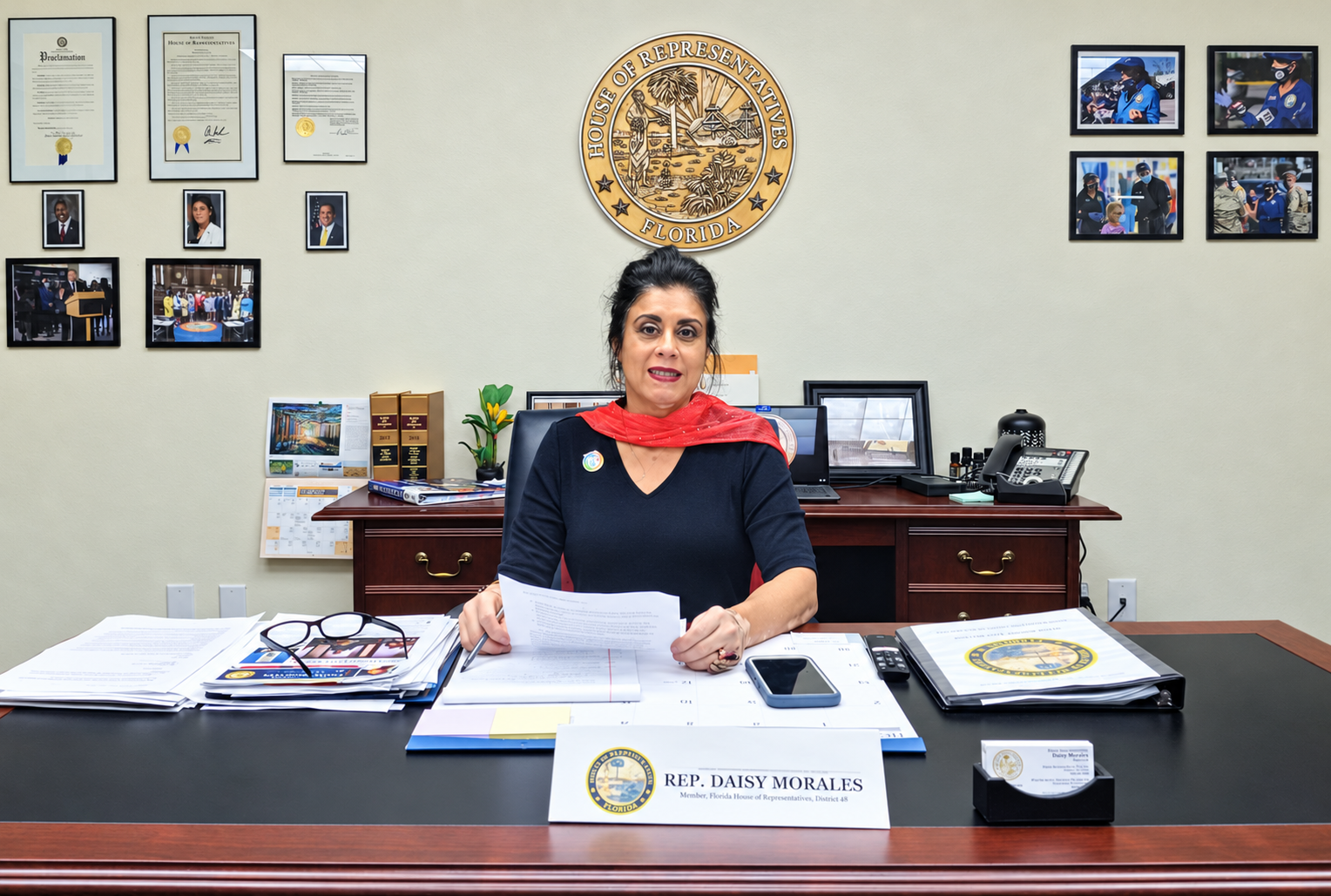
Daisy Morales
Former Florida State Representative
Advocate for Puerto Rican Leadership and Progress
_______________________________________________________________
To contribute to Florida National News, you can submit Letters to the Editor (up to 200 words) or My Voice columns (approximately 500 words) by emailing them to letters@FloridaNationalNews.com. Please include your address for verification purposes only. If submitting a My Voice column, also attach a photo and a 1-2 line bio about yourself.
Submissions are considered for publication based on space availability. All contributions may be edited for content, clarity, and length and may also be republished across any platform within the FNN News Network.
We value your voice and look forward to hearing from you!