Connect with us

Opinion

[OPINION] The Truth About America’s Immigration Problem

Published

on

In 1972, Crosby, Stills Nash and Young wrote a song called Immigration Man which detailed their struggles crossing the border back from Mexico as one of the band members was accused of drug smuggling or something similar. For many years, that’s how much I knew or really cared about the immigration “issue.” For a long time, my view has been that it is not a major problem for people who should be more concerned about what enters this country rather than who.
Approximately $500 billion more cash leaves this country to purchase goods and services from overseas which is the real cause of the chronic poverty and unemployment that we have been experiencing in a 35 year ongoing economic recession. In 1970, we imported fewer than 10 percent of the goods and services we consumed. Today, it is over 65%. Since that time over 150,000 factories have closed their doors leaving steadily increasing numbers in poverty and despair. Although government figures don’t reflect the real situation, any observer can see the homeless everywhere. It is not confined to large cities with numerous social and outsized economic problems such as New York, Chicago, Los Angeles and San Francisco. In virtually every city in the US, you see displaced workers, people with mental issues and economically forgotten folks begging for money for their next meal, next drink or next hit of whatever they happen to be consuming. No one really knows, but the problem has gotten worse in the last three decades. The increasing numbers of homeless and the struggle is mainly due to chronic, long term unemployment caused by a shrinking labor market, falling wages resulting from the tightening market and an ever rising cost of living due to expansionary monetary and fiscal policies of the United States federal government.
While issues like the federal budget deficit are discussed periodically by politicians in both political cartels, the trade deficit is not. The trade deficit translates directly into jobs lost and the decline and hollowing of our manufacturing base that people rely on for employment. In 1960, over 35 percent of jobs were in manufacturing. Today, the number is less than 10 percent. It doesn’t take a mathematical genius to tell that more people have experienced poverty, homelessness, and despair as a result of our disastrous trade policies that were left ignored from the end of WW2 to around 1993 and from 1993 until late last year, actively wrecked. Trade has been at the center of our economic problems. And with economic problems, social problems follow. Because the public at large has not been educated in economics, attempts are made to find a bogeyman.
Instead of understanding that trade, trade deficits and expansionary fiscal and monetary polices have been at the center of economic difficulties, the public at large has been convinced that immigration has been at the center of joblessness among Americans, increasing public expenditures for education and healthcare and basic overcrowding of our roads, streets, bridges and even crime. For many, it has been easy to pick on people of color who ostensibly have been “stealing our jobs.” It is easy to scream about those who speak broken English or go into their native tongue when going about their daily tasks. It is easy to dislike others music, foods or culture. It is easy to create a hostile environment for people coming into the United States. It is also wrong. Our problems are and have always been economic. They are not personal. But some of our issues are tied to the immigration system currently in effect. Some are tied to increasing numbers of people here with a lack of understanding of the nation’s founding principles.
The United States government is schizophrenic on the issue of immigration. On one hand, we have an immigration policy that allows foreign workers to directly compete with American citizens and green card holders through H1B visas. The number of H1B visa entries varies by year and results from a desire for companies to cut costs. We also have a relatively porous border because of the those in and outside of government who are willing to protect those coming into the country without “proper paperwork”
On the other hand, we have a government that will deport people who’s only “crime” is to not have proper “paperwork” that their parents or relatives improperly filled out a long time ago. Or their immigration “status” was unclear when they arrived years ago. For a small but significant number, those years are measured in decades. In the 1970s, social security cards were issued legally to everyone applying who came in under a visa.
The ability to earn a living is a basic human right that should be denied no one regardless of their immigration status. People who have emigrated to the United States of America come in search of a better life for them and their families. This country above all provides that opportunity. Many immigrants have come here, set up businesses and led productive lives. Some haven’t, but there is little evidence that immigrant on American crime is any better or worse than average.
On the other hand, a flood of job applicants, H1B visa holders and immigrant business owners has a depressing effect on prevailing wages. Many American citizens are rightfully angry about that as unemployment can jump higher in times of economic contraction. Others are rightfully annoyed at their individual votes being diluted by a flood of newcomers into the country.
Some feel that America has not properly assimilated immigrants into the American way of life.
A balance between the needs of immigrants and Americans needs and interests to be made when crafting a fair and equitable immigration policy which will lead to better conditions for all people. It should include the following:
  1. Legalization of all persons living in the United States of America after reviewing a criminal record. Issue Green Cards to everyone so that people can live productive lives without fear of being deported to countries that many have not seen since early childhood.
  2. Deportation of all immigrants with violent criminal offenses on their records in the last 10 years
  3. A 20 year moratorium on all citizenship applications.
  4. Restriction on ownership of more than one pieces of residential property for all non-green card holders.
  5. A 10,000 person annual cap on H1B work visas.
  6. End to birthright citizenship for those whose parents came here illegally. The next generations will have that right.
  7. Immediate termination of the E-verify program that is basically a permission slip for a human right.
Although this appears to create two separate immigration status, for most immigrants, it is more lenient than the current system. It allows an immigrant to quickly become part of the American system and build a life here in a still great country. It still affords an immigrant full constitutional rights and the ability to defend his or herself in the current court system as the legal system is supposed to act without fear of favor.
For the American it enhances the status of American citizenship. Americans who understand the American system deserve to have their voices heard and a stake in the American system.
While still imperfect, this proposal is a fair and realistic one for Americans and immigrants alike. Politicians need to be held accountable for a system that is fair to neither Americans nor immigrants. This idea is fair to both. The time is now for real immigration reform that will be fair to everyone. Republicans and Democrats need to quit playing politics with people’s lives. Both parties need to be tossed in a landfill for how they have treated immigrants and Americans as well.
____________________________
Henry Stowe | National Contributor | news@FloridaNationalNews.com
He is a moderate conservative member of the National Motorists Association. He is also former Transportation Chairman at the Florida Civil Rights Association. He is passionate about civil rights and liberties and wants an immigration system that will be fair to all sides of this debate and won’t require the aid of immigration attorneys to apply for residency.

Continue Reading
Click to comment

Leave a Reply

Your email address will not be published. Required fields are marked *

Entertainment

Bad Bunny’s Halftime Show Was a Master Class in American Culture

Published

on

Bad Bunny appears on stage during the Super Bowl LX Pregame & Apple Music Super Bowl LIX Halftime Show Press Conference on Feb. 5, 2026, in San Francisco (Kevin Mazur/Getty Images for Roc Nation)

A reminder that diversity is not a threat — it is America’s strength.

By The Honorable Rick Singh
Former Orange County Property Appraiser

Bad Bunny’s halftime performance reminded us of something every American needs to hear right now:

We may come from different places, but we share far more in common than we sometimes realize. Our greatest strength has always been our willingness to embrace diversity — not fear it.

As an elected official, I delivered many speeches over the years. But one of the most meaningful moments of my public service was speaking to newly sworn American citizens — individuals who had taken their oath of citizenship just minutes before I addressed them.

I can tell you this: they were some of the proudest Americans I have ever encountered — men and women from every corner of the world, united by one oath and one dream.

For many, English was a second language. For some, this was the first country they had ever traveled to. But the pride in their eyes was unmistakable.

Watching them always brought me back to my own story.

I still remember arriving in America as a 10-year-old after spending my first decade of life in tropical Guyana — and experiencing so many things for the first time: winter in New York City without a coat, running water, electricity, trains, cars, and even an escalator, which absolutely terrified me.

I shared those experiences with them. I also shared my mother’s journey — her strength and sacrifice — which inspired me and reminded me of what so many immigrant families endure with quiet courage.

And I reminded those new Americans of something important:

Be proud of your culture.
Be proud of your food.
Be proud of your faith.
Be proud of your music.

Not only be proud of it — share it.

Share it with your American neighbors and friends, because that’s how we foster harmony and understanding.

When we share our traditions, we don’t just celebrate who we are — we educate. We break down stereotypes. We replace fear with familiarity. And we turn strangers into neighbors.

That is how we grow closer. That is how we build community.

And that brings me back to Bad Bunny.

His performance spoke powerfully to the idea of diversity — and to the universal language that connects all people: music. In many ways, it was world culture presented on one of America’s biggest stages.

It was also a master class in Puerto Rican culture — which I must remind some people is American culture.

Like so much of Latin America and the Caribbean, it also carried a deeper story: slavery and the legacy of indentured laborers, including those brought from India, who cut sugar cane and planted crops that fueled global empires.

When I saw the sugar cane fields in the performance visuals, I was reminded of where I was born — Guyana — where I spent my first ten years of life. My parents were humble sugar cane farmers.

The coconut stand selling fresh coconuts reminded me of Bourda Market in Georgetown.

And the vibrant Latin music took me right back to my childhood in the Bronx — hearing legends like El Gran Combo de Puerto Rico, Tito Puente, Eddie Palmieri, and Iris Chacón playing from apartment windows or speakers on fire escapes.

Different cultures.
Different rhythms.
Different drums from different lands.

But one shared spirit.

That’s America.

And when we embrace that truth, we don’t become weaker — we become stronger.

Because the reality is simple:

Together, we are all American.

Across Latin America and the Caribbean — regardless of language, flag, or heritage — we share lived experiences shaped by common history: agricultural roots, multi-generational homes, the neighborhood bodega or corner shop, struggle and resilience, rhythm and resistance, elders playing dominoes, and families gathering around food and music.

It’s not geography.
It’s identity.

It’s music.

In the end, Bad Bunny delivered something meaningful — not just for Puerto Ricans, but for every immigrant and every family with a story like mine.

His performance wasn’t just music and spectacle. It was a reflection of who we are, where we come from, and what we’ve overcome.

It reminded millions that being American isn’t about looking a certain way or speaking a certain language. It’s about owning your story, celebrating your roots, and contributing that richness to the shared tapestry of this country.

Boricua love, baby — you’ve got to love it.

Continue Reading

Opinion

Commentary: Civility as Moral Power: What Gandhi Gave King — and What King Gave America and the World

Published

on

Dr. Martin Luther King Jr. did not merely change laws. He changed the moral tone of a nation.

At a time when America was convulsed by racism, violence, and injustice, Dr. King chose a path many dismissed as weak or naïve: civility, nonviolence, and disciplined love. History proved otherwise. In King’s hands, civility was neither politeness nor passivity. It was moral power.

That power did not arise in isolation. King drew deeply from the life and philosophy of Mahatma Gandhi. While studying theology and social ethics, he encountered Gandhi’s doctrine of satyagraha — the “force of truth.” What struck King most was Gandhi’s insistence that injustice must be resisted, but never with methods that corrupt the soul or mirror the cruelty of the oppressor. King later called Gandhi “the guiding light of our technique of nonviolent social change.”

From India’s struggle against British colonialism to America’s fight against segregation, the moral logic was the same: suffering willingly endured, without hatred or retaliation, can awaken the conscience of a nation. Nonviolence was not weakness; it was moral jiu-jitsu — exposing injustice by refusing to cooperate with it, while refusing to become it.

For King, civility did not mean silence in the face of injustice. In his Letter from Birmingham Jail, he made clear that unjust laws must be broken — openly, lovingly, and with a willingness to accept the penalty. Like Gandhi, King rejected both cowardly submission and violent revolt. His method of nonviolent civil disobedience was precise and intentional: it disrupted injustice while preserving the moral legitimacy of the movement.

This moral lineage from Gandhi to King remains one of the most remarkable transmissions of ethical philosophy in modern history. Different cultures. Different continents. One moral grammar. Both men believed that love is a social force, not merely a private virtue; that hatred multiplies hatred; and that the means we use to pursue justice shape the society we ultimately create.

When children were attacked by fire hoses in Birmingham and peaceful marchers were beaten on the Edmund Pettus Bridge, it was not rage that moved the conscience of the nation. It was the devastating contrast between the dignity of the protesters and the brutality of their oppressors. Civility gave the movement credibility. Nonviolence gave it legitimacy. Moral discipline gave it victory.

Neither Gandhi nor King was “nice” in the shallow sense. Both condemned injustice relentlessly. Both disrupted the comfort of the powerful. Yet neither surrendered to cruelty or dehumanization. They understood a hard truth: a movement that loses its soul cannot save a society.

Today, in an age of outrage, humiliation, and political tribalism, their shared example speaks with renewed urgency. We cancel rather than persuade. We humiliate rather than debate. We dehumanize rather than disagree — and we call it authenticity.

Gandhi and King would have rejected this moral downgrade.

They would remind us:
That cruelty is not courage.
That rage is not righteousness.
That humiliation is not justice.

Gandhi lit the torch. King carried it across an ocean. Now it rests in our hands.

To honor them is not merely to quote them once a year. It is to practice what they practiced: to resist injustice without surrendering our humanity, to speak with moral clarity without moral cruelty, and to pursue change without poisoning the future with hatred.

Their revolution was not only political.

It was moral.

And it remains ours.


Hon. Rick Singh is a former Orange County property appraiser and a civic leader in Central Florida. He writes on ethics, public service, and democratic culture.

Continue Reading

Opinion

OPINION: Puerto Rican Political Power in Florida Faces Decline Post-2024 Losses

Published

on

The 2024 elections marked a troubling turning point for Puerto Rican political representation in Florida. What was once a growing force of influence in state and national politics now faces a steep decline, raising alarms about the future of Puerto Rican voices in government.

In 2016, our community achieved historic milestones: Darren Soto became the first Puerto Rican from Florida elected to the U.S. Congress, Victor Torres won a seat in the Florida Senate, and four Puerto Ricans—John Cortes, Amy Mercado, René Plasencia, and Bob Cortes—held seats in the Florida State House. This wave of representation was a proud moment for Puerto Ricans, a sign that our voices were finally being heard at the highest levels.

2016 Representation Snapshot:

  • 1 U.S. Representative Seat
  • 1 Florida State Senate Seat
  • 4 Florida State House Seats

Fast forward to 2025, and the numbers tell a much different story:

  • 1 U.S. Representative Seat (Darren Soto)
  • 0 Florida State Senate Seats
  • 2 Florida State House Seats (Johanna López and Susan Plasencia)

The losses in 2024 have decimated our influence in state government. The Florida State Senate, once home to a Puerto Rican voice, is now silent. The reduction in House seats has further diminished our ability to shape policy and advocate for our community.

This is a moment for reflection and action. As a former Puerto Rican Florida State Representative, I understand the hard work it takes to elevate our community’s concerns and ensure they are heard. But these latest setbacks demonstrate that we cannot afford complacency.

We must:

  1. Prioritize leadership development by identifying and mentoring the next generation of Puerto Rican leaders.
  2. Strengthen voter engagement efforts to increase turnout and political awareness within our community.
  3. Build coalitions across Florida to amplify our collective voice and work toward shared goals.
  4. Focus on unity, setting aside partisan divides to protect and grow Puerto Rican representation.

Puerto Ricans in Florida contribute significantly to the state’s economy, culture, and community development. Yet, without strong political representation, our ability to advocate for critical issues—such as disaster recovery, housing, healthcare, and education—is severely hampered.

The time to act is now. If we fail to address this decline, the consequences for Puerto Rican communities across Florida could be dire. Let us remember that our representation is not just about holding titles but about driving meaningful change for the people we serve. Together, we can rebuild and ensure that Puerto Rican political power not only survives but thrives for future generations.

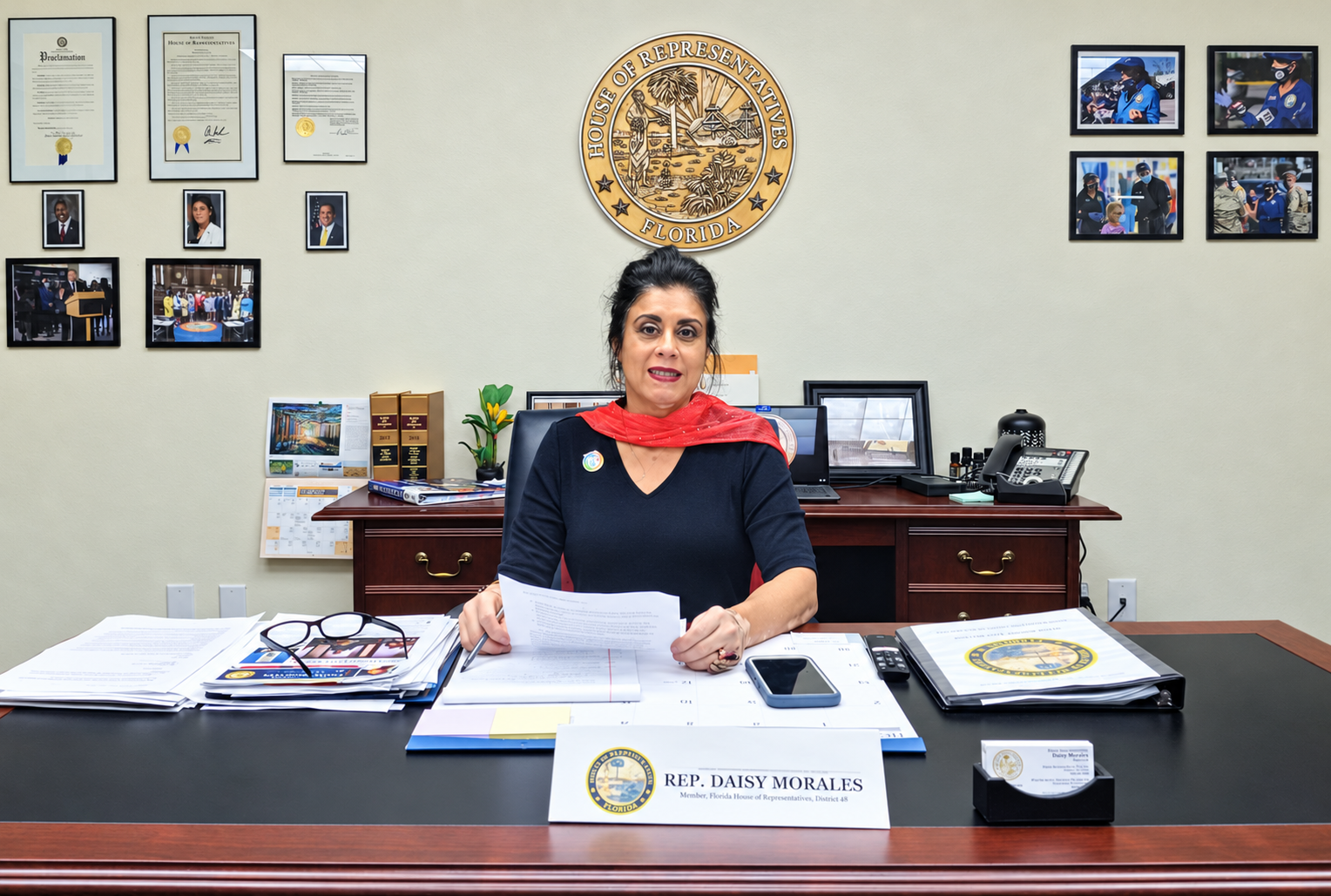
Daisy Morales
Former Florida State Representative
Advocate for Puerto Rican Leadership and Progress
_______________________________________________________________

To contribute to Florida National News, you can submit Letters to the Editor (up to 200 words) or My Voice columns (approximately 500 words) by emailing them to letters@FloridaNationalNews.com. Please include your address for verification purposes only. If submitting a My Voice column, also attach a photo and a 1-2 line bio about yourself.

Submissions are considered for publication based on space availability. All contributions may be edited for content, clarity, and length and may also be republished across any platform within the FNN News Network.

We value your voice and look forward to hearing from you!

Continue Reading
Advertisement
Advertisement Ticket Time Machine ad
Advertisement Orlando Regional REALTOR Association logo
Advertisement Parts Pass App
Advertisement Hispanic Chamber of Commerce of Metro Orlando
Advertisement
Advertisement African American Chamber of Commerce of Central Florida
Advertisement FNN News en Español
Advertisement Indian American Chamber of Commerce logo
Advertisement Florida Sports Channel

FNN Newsletter

Trending