Connect with us

Crimes and Courts

Police: Bomber’s video amounts to confession, but no motive

Published

on

PFLUGERVILLE, Texas (AP) — A 25-minute cellphone video left behind by the bomber whose deadly explosives terrorized Austin for weeks details the differences among the weapons he built and amounts to a confession, police said. But his motive remains a mystery.

Mark Anthony Conditt, an unemployed college dropout who bought bomb-making materials at Home Depot, recorded the video hours before he died after detonating one of his own devices as SWAT teams closed in. It seemed to indicate the 23-year-old knew he was about to be caught, said Austin Police Chief Brian Manley.

“It is the outcry of a very challenged young man talking about challenges in his own life,” Manley said of the recording, which authorities declined to release amid the ongoing investigation.

Conditt was tracked down using store surveillance video, cellphone signals and witness accounts of a customer shipping packages in a disguise that included a blond wig and gloves. Police finally found him early Wednesday at a hotel in a suburb north of Austin.

Officers prepared to move in for an arrest. When the suspect’s sport utility vehicle began to drive away, they followed. Conditt ran into a ditch on the side of the road, and SWAT officers approached, banging on his window.
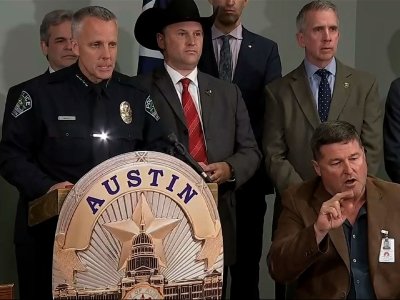
Police have discovered a 25-minute recording on a cellphone found with bombing suspect Mark Conditt and Austin Police Chief Brian Manley says he considers it a “confession.” (March 21)

Within seconds, the suspect had detonated a bomb inside his vehicle, blasting the officers backward, Manley said. One officer then fired his weapon at Conditt, the chief said. The medical examiner has not finalized the cause of death, but the bomb caused “significant” injuries, he said.

Law enforcement officials did not immediately say whether Conditt acted alone in the five bombings in the Texas capital and suburban San Antonio that killed two people and badly wounded four others. Fred Milanowski of the U.S. Bureau of Alcohol, Tobacco, Firearms and Explosives said investigators were confident that “the same person built each one of these devices.”

Investigators released few details about Conditt, except his age and that he was white. Neighbors say he was home-schooled. He later attended Austin Community College from 2010 to 2012, according to a college spokeswoman, but he did not graduate.

In a 2012 online blog that the college spokeswoman said Conditt created as part of a U.S. government class project, he gives his opinion on several issues, often in response to someone else’s commentary. Conditt wrote that gay marriage should be illegal, argued in favor of the death penalty and gave his thoughts on “why we might want to consider” eliminating sex offender registries.

In the “about me” section of the blog, Conditt wrote that he wasn’t “that politically inclined” but did view himself as conservative.

Jay Schulze, who lives in Pflugerville, said he was jogging Tuesday night when he was stopped by police and asked about the bombings. He said police flew drones over Conditt’s home for about six hours between Tuesday evening and early Wednesday morning.

Schulze described the home as “a weird house with a lot of people coming and going” and a bit rundown.

A neighbor who watched Conditt grow up said he always seemed smart and polite. Jeff Reeb said he has lived next to Conditt’s parents for about 17 years and described them as good neighbors. Conditt had visited his parents regularly, he said.

Conditt’s family released a statement saying they had “no idea of the darkness that Mark must have been in.” His uncle, Mike Courtney, said his nephew was a “computer geek” who was intelligent and kind.

Austin was hit with four bombings starting on March 2. The first explosions were from packages left on doorsteps. Then a bomb with a tripwire was placed near a public trail. A fifth parcel bomb detonated early Tuesday at a FedEx distribution center near San Antonio.

Rep. Michael McCaul, a Republican from Austin, said Conditt’s “fatal mistake” was walking into a FedEx store to mail a package because that allowed authorities to obtain surveillance video that showed him and his vehicle, along with his license plate number. From there, investigators could identify the suspect and eventually track him using his cellphone.

Police warned of the possibility that more bombs had yet to be found.

“We don’t know where this suspect has spent his last 24 hours, and therefore we still need to remain vigilant to ensure that no other packages or devices have been left to the community,” Manley said.

By late afternoon, federal officials had a “reasonable level of certainty” that there were no more package bombs “out in the public,” said Milanowski, the agent in charge of the Houston division of the ATF. But authorities urged continued awareness just in case.

“We think we’re on top of this, but we just don’t know,” FBI agent Chris Combs said.

Homemade explosives were recovered from Conditt’s home in Pflugerville, a community where portions of “Friday Night Lights” were filmed. His two roommates were detained for questioning. One was later released.

Investigators said one room in the home contained bomb components and explosive materials but no finished bombs. They were analyzing Conditt’s internet history to find out how he learned to make bombs.

Isaac Figueroa said he and his brother heard sirens and helicopters around 2 a.m. Wednesday in the area and drove toward them, then cut through nearby woods on foot after they hit a police roadblock.
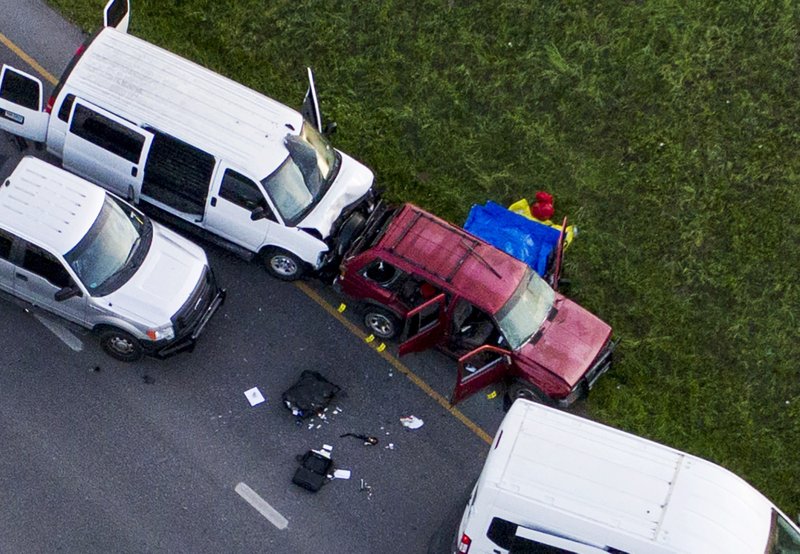
Officials investigate near a vehicle, center, where a suspect in the deadly bombings that terrorized Austin blew himself up as authorities closed in on him, in Round Rock, Texas, Wednesday, March 21, 2018. (Jay Janner/Austin American-Statesman via AP)

The 26-year-old said they saw an SUV that was pinned between large vans and “looked like it had been rammed off the road.” He said police later deployed a robot to go examine the vehicle.

The suspect’s death followed a day of rapid-fire developments in the case. On Tuesday, the bomb at the FedEx shipping center in suburban San Antonio exploded on a conveyer belt.

Later, police sent a bomb squad to a FedEx facility outside the Austin airport to check on a suspicious package. Authorities subsequently said that package contained an explosive that was tied to the other bombings.

Officers then recovered footage of Conditt wearing a blond wig and gloves as he turned over packages to send at a FedEx store in south Austin. That was enough to set in motion the manhunt that ended with Wednesday’s fatal explosion.

Continue Reading
Click to comment

Leave a Reply

Your email address will not be published. Required fields are marked *

Crimes and Courts

Florida Gaming Control Commission Seizes 163 Illegal Slot Machines, $247K in St. Petersburg

Published

on

Florida Gaming Control Commission

State gaming agents and partner law enforcement agencies targeted two St. Petersburg businesses, seizing more than $247,000 in cash and issuing notices to appear to three people.

ST. PETERSBURG, Fla. (FNN) — The Florida Gaming Control Commission seized 163 alleged illegal slot machines and $247,285 in cash during searches of two St. Petersburg businesses as part of an enforcement action dubbed “Operation Final Spin,” according to the agency.

The Sept. 10 operation was conducted with the Pinellas County Sheriff’s Office, Florida Highway Patrol and Florida Department of Business and Professional Regulation’s Division of Alcoholic Beverages and Tobacco, according to an FGCC news release.

The searches targeted Action Arcade, 6541 54th Ave. N., and The Zoo Sports Club and Grille, 5111 66th St. N.

FGCC is responsible for regulating authorized gambling and enforcing Florida’s criminal gambling prohibitions. Its stated enforcement priorities include investigating illegal arcades, slot-machine businesses and the distribution of illegal gambling devices.

163 Machines Seized at Two Locations

According to FGCC, agents seized 90 machines and $142,020 from Action Arcade.

Two people were issued notices to appear, with each accused of one count of possession of slot machines and one count of keeping a gambling house, the agency said.

At The Zoo Sports Club and Grille, agents seized another 73 machines and $105,265, according to FGCC. One person was issued a notice to appear on allegations of possession of slot machines and acting as an agent or employee of a gambling house.

The allegations are charges, and the individuals are presumed innocent unless proven guilty.

State Rep. Berny Jacques Joins Enforcement Action

Florida Gaming Control Commission Vice Chair Tina Repp and state Rep. Berny Jacques participated in the enforcement action, according to the commission.

“These machines are designed to take advantage of people, and far too often that means senior citizens living on fixed incomes who can least afford to lose what they have,” Jacques said in the agency’s release.

Jacques thanked FGCC and participating law enforcement agencies and said the operation was intended to protect vulnerable residents.

Repp said the operation was part of a broader statewide enforcement effort.

“Operation Final Spin and the more than 200 illegal arcades we have shut down before this should make it clear that our goal is to disrupt and dismantle illegal gaming across the state of Florida,” Repp said.

The claim that more than 200 illegal arcades have previously been shut down is attributed to Repp and FGCC.

Where Slot Machines Are Legal in Florida

Florida tightly restricts where slot machines can legally operate. FGCC says slot-machine gaming is authorized at eight licensed pari-mutuel facilities in Miami-Dade and Broward counties and at certain tribal gaming facilities. The agency says offering slot-machine gaming at an unlicensed establishment, including bars, restaurants and adult arcades, violates state law.

FGCC also warns that illegal gambling businesses operate outside regulatory safeguards governing licensed slot machines, including requirements related to game integrity and minimum payout percentages.

Florida’s gambling laws and regulations are primarily contained in Chapters 550, 551 and 849 of the Florida Statutes.

Reporting Suspected Illegal Gambling

People who suspect illegal gambling activity can submit information through the Florida Gaming Control Commission’s reporting system or call 850-880-3433.

Additional information about authorized gambling locations is available through the FGCC Gaming Locations directory.

Continue Reading

Crimes and Courts

DOJ: Man Charged With Laundering Conspiracy in $1.3 Billion Medicare, Health Insurance Fraud Scheme

Published

on

Federal prosecutors allege Erekle Gugava helped move proceeds from a transnational fraud operation that used stolen identities and submitted at least $1.3 billion in fraudulent medical-equipment claims to Medicare and private insurers.

BOSTON (FNN) — A federal grand jury in Massachusetts has indicted a 33-year-old Georgian national on a money laundering conspiracy charge stemming from an alleged $1.3 billion health care fraud operation, according to the U.S. Department of Justice.

Federal prosecutors allege Erekle Gugava served as a money launderer for a transnational criminal organization accused of orchestrating a multibillion-dollar scheme targeting Medicare and other health insurers.

The Justice Department announced the indictment Friday, Sept. 4.

According to DOJ, the organization, which prosecutors said was based in Russia and elsewhere, was previously identified through Operation Gold Rush, part of what the department has described as the largest health care fraud case it has prosecuted.

DOJ: $1.3 Billion in Allegedly Fraudulent Claims

According to charging documents cited by DOJ, Gugava purportedly owned ND Medical Solutions LLC, a Pennsylvania durable medical equipment company, from February through July 2025.

During that five-month period, prosecutors allege ND Medical submitted at least $1.3 billion in fraudulent durable medical equipment claims to Medicare, private insurers providing Medicare supplemental coverage, employer-sponsored health plans and other insurers.

Those insurers paid ND Medical approximately $6.5 million, according to the Justice Department.

The distinction between the $1.3 billion and $6.5 million figures is significant: DOJ alleges $1.3 billion was billed, while approximately $6.5 million was actually paid to the company.

Prosecutors Allege Money Was Transferred Overseas

Federal prosecutors allege Gugava facilitated the deposit and transfer of proceeds generated by the scheme.

According to DOJ, Gugava opened several bank accounts in ND Medical’s name and was the sole signatory. Checks from Medicare supplemental insurers and other health insurers were allegedly deposited into those accounts.

Prosecutors allege the money was ultimately transferred to overseas bank accounts for the benefit of the transnational organization.

“Fraud networks cannot function without people willing to launder and transmit their proceeds,” Assistant Attorney General Colin M. McDonald of DOJ’s National Fraud Enforcement Division said in the department’s announcement.

McDonald said prosecutors allege Gugava helped move fraud proceeds through domestic and international financial channels.

DOJ: Stolen Identities Used to Support Claims

The alleged scheme also involved stolen identities, according to federal prosecutors.

DOJ said the fraudulent claims relied in part on identities belonging to people in Massachusetts, elsewhere in New England and across the United States.

Some were elderly or disabled Americans who reported receiving insurance explanation-of-benefits forms showing medical equipment they said they never received, according to the Justice Department.

Prosecutors said some records also identified doctors the beneficiaries said they had never visited and listed equipment as coming from ND Medical, a company with which they said they were unfamiliar.

Operation Gold Rush

DOJ said Gugava’s case is connected to Operation Gold Rush, an investigation targeting a transnational organization accused of exploiting Medicare and other insurers.

According to the Justice Department, the organization allegedly used payments originating from legitimate government programs and established insurance companies to facilitate money laundering. Because the payments came from legitimate insurers, prosecutors contend the proceeds initially appeared legitimate.

The department previously identified Operation Gold Rush as part of its broader national effort targeting health care fraud.

Six Federal Agencies Investigating

The investigation involves multiple federal law enforcement and oversight agencies, including:

  • Department of Health and Human Services Office of Inspector General
  • FBI
  • U.S. Postal Inspection Service
  • IRS Criminal Investigation
  • Homeland Security Investigations
  • Department of Labor’s Employee Benefits Security Administration

Prosecutors from DOJ’s National Fraud Enforcement Division’s Health Care Fraud Section and the U.S. Attorney’s Office for the District of Massachusetts are handling the case.

Defendant Faces Up to 20 Years if Convicted

Gugava is charged with one count of conspiracy to commit money laundering.

If convicted, he faces a statutory maximum penalty of 20 years in federal prison, according to DOJ. A maximum statutory penalty does not indicate what sentence would ultimately be imposed if a defendant is convicted.

The Justice Department also described Gugava in its announcement as an “illegal alien from Georgia.” That description reflects DOJ’s characterization of his immigration status in its Sept. 4 press release.

DOJ Expands Federal Fraud Enforcement

The Justice Department said the prosecution is part of its broader federal campaign against fraud involving government benefit programs.

According to DOJ, its Health Care Fraud Strike Force Program has charged more than 6,200 defendants since 2007 in cases involving more than $45 billion in alleged billings to federal health care programs and private insurers.

The department also announced the creation of its National Fraud Enforcement Division earlier this year to coordinate investigations and prosecutions involving fraud against federal programs and the public.

Indictment Contains Allegations

An indictment is a formal accusation and does not establish guilt.

Gugava is presumed innocent unless and until proven guilty beyond a reasonable doubt in a court of law.

Continue Reading

Crimes and Courts

DOJ Charges Five in Pennsylvania, New Jersey and Wisconsin in Alleged Illegal Voting, Voter Registration Cases

Published

on

WASHINGTON (FNN) — Five people in Pennsylvania, New Jersey and Wisconsin face federal charges in separate cases involving alleged illegal voting, false claims of U.S. citizenship or fraudulent voter registration connected to the 2022 or 2024 elections, according to the U.S. Department of Justice.

The Justice Department announced the charges Friday, Sept. 4, saying the defendants include four non-U.S. citizens accused of illegally voting and one U.S. citizen accused of aiding and abetting election-related offenses.

The cases were brought in the Middle District of Pennsylvania, District of New Jersey and Western District of Wisconsin.

DOJ: Election Fraud Will Be Prosecuted

Attorney General Todd Blanche said in the DOJ announcement that election integrity is fundamental to American democracy and emphasized that voting in federal elections is limited to eligible U.S. citizens.

“Election fraud is a serious crime, and it is the duty of the Department of Justice to treat it as such,” Blanche said.

FBI Director Kash Patel said the bureau considers election integrity a priority and would investigate credible allegations of election fraud and illegal voting.

Federal officials also emphasized that the charges are allegations and have not resulted in findings of guilt.

Pennsylvania: Three People Charged

According to the Justice Department, Thomas Holtzman, 68, and his wife, Marisol Guzman, 50, both of Carlisle, Pennsylvania, were indicted by a federal grand jury in connection with allegations that Guzman illegally voted as a non-U.S. citizen in the 2024 election.

DOJ said Guzman was charged with voting as an alien.

Holtzman, a U.S. citizen, was charged with making a false statement of citizenship in order to vote and aiding and abetting, as well as fraudulent registration and aiding and abetting, according to federal prosecutors.

In a separate Pennsylvania case, Katya Rodriguez, 30, a Mexican national living in Harrisburg, was indicted by a federal grand jury on charges related to alleged illegal voting in the 2024 election.

According to DOJ, Rodriguez was charged with making a false statement of citizenship in order to vote, fraudulent registration and voting as an alien.

If convicted, Holtzman faces a statutory maximum of 10 years in prison, Guzman up to one year and Rodriguez up to 11 years, according to the Justice Department. Any sentence would be determined by a federal judge based on applicable law and federal sentencing guidelines.

Homeland Security Investigations investigated the Pennsylvania cases, DOJ said.

New Jersey: Federal Complaint Alleges Noncitizen Voted in 2024 Primary

In New Jersey, Mercedes Alexandra Cardoso of Union County was charged with voting by an alien in a federal election, according to the Justice Department.

The federal complaint alleges Cardoso was not a U.S. citizen when she registered through the New Jersey Division of Elections’ Online Voter Registration System.

According to prosecutors, Cardoso falsely certified on her voter registration application that she was a U.S. citizen.

DOJ said Cardoso allegedly cast a ballot in the June 2024 primary election, which included candidates seeking federal office.

Federal prosecutors said Cardoso entered the United States from Ecuador on a B-2 visa and was not a U.S. citizen when she allegedly voted.

If convicted, Cardoso faces a statutory maximum of one year in prison. Her initial court appearance was scheduled for Sept. 8, according to DOJ.

The FBI, Homeland Security Investigations and U.S. Citizenship and Immigration Services investigated the case.

Wisconsin: 2022 Election Vote Leads to Federal Charge

In Wisconsin, Jesus Javier Jurado Garcia, 25, a Mexican national living in Beloit, was charged Sept. 2 with illegally voting as an alien in the November 2022 election, according to the Justice Department.

A federal criminal information alleges Jurado Garcia knew he was not a U.S. citizen when he voted on Nov. 8, 2022, in an election that included races for the U.S. Senate and House of Representatives.

If convicted, Jurado Garcia faces a statutory maximum sentence of one year in prison, DOJ said.

Federal Officials Emphasize Election-Law Enforcement

U.S. attorneys in all three jurisdictions used the announcement to emphasize federal enforcement of election laws.

U.S. Attorney Brian Miller for the Middle District of Pennsylvania said his office would prosecute people accused of illegally voting in federal elections as well as those accused of facilitating illegal voting.

U.S. Attorney Robert Frazer for the District of New Jersey said the federal government has a responsibility to safeguard elections and investigate alleged violations of federal election law.

U.S. Attorney Chadwick M. Elgersma for the Western District of Wisconsin similarly said his office is committed to enforcing federal election laws.

Homeland Security Investigations also said its agents worked with federal partners to investigate the alleged conduct and support the prosecutions.

Charges Remain Allegations

The cases are at the charging stage.

A criminal complaint, indictment or information contains allegations and does not establish that a defendant committed a crime. All five defendants are presumed innocent unless and until proven guilty beyond a reasonable doubt in a court of law.

Continue Reading
Advertisement
Advertisement Ticket Time Machine ad
Advertisement Orlando Regional REALTOR Association logo
Advertisement Parts Pass App
Advertisement Hispanic Chamber of Commerce of Metro Orlando
Advertisement
Advertisement African American Chamber of Commerce of Central Florida
Advertisement FNN News en Español
Advertisement Indian American Chamber of Commerce logo
Advertisement Florida Sports Channel

FNN Newsletter

Trending