Connect with us

US NATIONAL NEWS

President Joe Biden Increases Federal Cost-Share for Florida’s Hurricane Ian Recovery

Published

on

WASHINGTON — FEMA Administrator Deanne Criswell announced today that President Joseph R. Biden, Jr. made additional disaster assistance available to the state of Florida to supplement recovery efforts in the areas affected by Hurricane Ian between Sept. 23 – Nov. 4, 2022.

The President authorized the federal cost-share for public assistance to be increased from 75% to 90% of total eligible costs.

“It has been a little over a year since Hurricane Ian devastated Fort Myers and surrounding communities in Florida. Sadly, more than 140 people lost their lives, and over 33,000 survivors were displaced from their homes,” said Administrator Criswell. “However, Floridians remained strong in the face of this tragedy, and with the support of our federal, state and local partners, we have used every tool at our disposal to help Florida recover from this disaster. To date, the Biden-Harris Administration has provided over $8 billion in federal assistance, and this latest cost-share adjustment means that even more federal assistance is on the way. The road to recovery is long, and at times difficult, but FEMA will be there every step of the way.”

To date, federal support following Hurricane Ian for Florida totals $8.69 billion:

  • FEMA provided $1.13 billion in grants to more than 386,000 households in 26 counties.
  • The U.S. Small Business Administration approved $1.94 billion in disaster loans for homeowners, renters and businesses.
  • FEMA’s National Flood Insurance Program paid $4.38 billion for more than 47,300 claims filed.
  • FEMA obligated more than $1.8 billion to reimburse state and local applicants for emergency response, debris removal and repair or replacement of public facilities.

Continue Reading
Click to comment

Leave a Reply

Your email address will not be published. Required fields are marked *

Politics

Voters Give Democrats Congressional Majorities as Affordability and Iran War Shape Trump Rebuke

Published

on

Chuck Schumer raises both fists beside Hakeem Jeffries, with American flags behind them

Hakeem Jeffries and Chuck Schumer prepare for a shift in congressional power, with voters demanding economic relief and stronger presidential oversight while Trump retains his veto.

WASHINGTON (FNN) — Democrats won control of the House and Senate in Tuesday’s midterm elections, delivering a major setback to President Donald Trump and positioning congressional Democratic leaders Hakeem Jeffries and Chuck Schumer to challenge his administration during the final two years of his presidency.

The victories extended into traditionally Republican territory, with economic anxiety and opposition to the Iran war helping reshape the electoral map. Reuters reported Democratic breakthroughs in states including Texas, Kansas and South Carolina.

The results put Democrats in position to control both chambers when the new Congress convenes in January. Several contests remained unresolved Wednesday, leaving the final size of their majorities unsettled.

Jeffries positioned for historic House speakership

The Democratic House victory puts Jeffries, a New York congressman, in line to become the first Black speaker of the House.

His elevation is not automatic. Winning a congressional majority gives Democrats the opportunity to elect the speaker, but Jeffries must secure the necessary support in a House floor vote.

Jeffries will also face the task of uniting moderate and progressive Democrats around an agenda that can survive divided government. Reuters reported that his priorities include addressing affordability and reversing Republican cuts to Medicaid.

“We’re going to fight to make sure that we make this country affordable for every single American,” Jeffries told supporters, according to NPR.

Senate victory expands Democrats’ leverage

The Senate result gives Democrats influence over legislation, presidential nominations and committee investigations.

Schumer, the Senate Democratic leader, described the outcome as a “generational remake of the Senate map,” according to reporting published by WTTW. His leadership position in the incoming Congress remains subject to the Democratic caucus’s selection process.

Democratic Senate victories included Republican-held seats in North Carolina, Ohio, Iowa, Kansas, Texas and South Carolina, according to Roll Call. The gains give the party an opportunity to scrutinize administration nominees and shape the chamber’s agenda.

A majority, however, does not eliminate every procedural obstacle. Under existing Senate rules, ending debate on most legislation generally requires 60 votes, making Republican cooperation important for many proposals.

Affordability crisis moves to the center of the agenda

The election creates pressure on Democrats to demonstrate that congressional control can produce practical relief.

Jeffries has outlined priorities involving affordable housing, education, health care and retirement security. Those subjects reflect the household expenses that helped drive the campaign and will shape expectations for the incoming majority.

But passing bills through Congress and delivering changes in law are separate challenges. Democrats will need agreement between their chambers, a workable approach to federal spending and, in many cases, negotiations with the White House.

Their political test will extend beyond opposition to Trump: Voters will be able to judge whether the new majority advances credible proposals and explains the costs, benefits and obstacles involved.

Iran war raises questions about congressional authority

Opposition to the Iran war helped fuel the Democratic gains, according to Reuters. The outcome increases pressure for congressional scrutiny of military objectives, spending and the administration’s strategy.

For lawmakers seeking to prevent wars they consider unnecessary, Congress has constitutional tools that extend beyond public criticism.

The Constitution gives Congress authority to declare war, raise and support armed forces, and control appropriations. The president serves as commander in chief, creating a division of responsibilities rather than placing every military decision in one branch.

A Democratic Congress could hold hearings, examine the administration’s legal justifications and consider legislation governing military operations or funding. Such measures would face their own legal, procedural and political constraints; an election result alone does not end a conflict.

Trump retains veto power

Trump will remain president, and the change in congressional control does not remove his constitutional authority to veto legislation.

A veto can be overridden only with a two-thirds vote in both the House and Senate. Democratic majorities therefore do not, by themselves, guarantee enactment of their legislative agenda.

Trump signaled resistance to the incoming majority’s proposals after the election, sharing an image of a cap bearing the word “VETO,” according to WTTW’s reporting.

The result sets up negotiations and potential confrontations over spending, domestic programs and national security. Congress can also conduct oversight without first obtaining the president’s agreement to new legislation.

“No king”: Voters seek stronger checks and balances

The election offered evidence of substantial public demand for Congress to exercise greater independence.

About seven in 10 voters said Congress was not doing enough to provide checks and balances on the president, according to the AP Voter Poll. The finding also carries a caution for Democrats: Dissatisfaction with Republican governance does not necessarily translate into unconditional support for the opposing party.

The phrase “no king in America” expresses a principle underlying the constitutional system: Presidential authority exists alongside the powers of Congress and the courts. The same constitutional limits apply regardless of which party controls an institution.

For Jeffries, Schumer and the incoming majorities, the task will be to translate electoral success into accountable government — addressing economic concerns, examining military commitments and exercising congressional authority within the Constitution.

Continue Reading

Central Florida News

FBI Director Kash Patel Addresses Global Threats, Crime-Fighting Partnerships at International Police Conference in Orlando

Published

on

Kash Patel seated onstage in a gray suit and dark tie, speaking with one hand raised against a black and turquoise background.

ORLANDO, Fla. (FNN) — FBI Director Kash Patel discussed bureau priorities, violent crime and cooperation across jurisdictions during the 2026 International Association of Chiefs of Police conference at the Orange County Convention Center.

The annual conference and exposition, held Oct. 24-27, brought together law enforcement professionals from the United States and abroad for training, presentations and discussions about public safety.

Patel addressed the evolving global threat environment and the importance of partnerships among federal, state, local, territorial and international law enforcement agencies confronting violent crime and transnational threats.

FBI priorities and violent crime

Violent crime enforcement was among the priorities Patel discussed during his Orlando visit.

Published coverage of his weekly update from Orlando described a broader agenda encompassing cybercrime, fraud and other investigative responsibilities. The update also highlighted cooperation among the FBI, the Justice Department and state and local authorities.

The conference provided an opportunity for bureau leadership to discuss those priorities with police executives whose agencies work alongside federal investigators.

Photo by Florida National News


Cooperation across jurisdictions

Partnerships were a central theme of Patel’s appearance, including coordination among agencies at different levels of government and cooperation with international counterparts.

Transnational investigations can involve suspects, evidence and criminal activity spanning multiple jurisdictions, requiring agencies to work across geographic and institutional boundaries.

Published coverage of Patel’s visit also reported plans for meetings with the Major Cities Chiefs Association and the IACP Board of Directors.

Patel highlights partnerships in X post

“Great to be in Orlando visiting with our brilliant law enforcement partners,” Patel wrote in a post on X about the conference.

Patel described the gathering as drawing more than 20,000 law enforcement professionals, leaders and partners. He credited cooperation with the FBI for reductions in crime.

In the post, Patel cited a 20% reduction in the national murder rate and more than 54,000 FBI violent crime arrests, which he described as a 90% increase.

The post did not specify the reporting periods or underlying datasets for those figures. The statistics were not independently verified for this article..

Global threats and local policing

The changing threat environment was another focus of Patel’s remarks, connecting the FBI’s national responsibilities with challenges facing police departments and their international partners.

The gathering offered law enforcement leaders an opportunity to discuss shared concerns, exchange professional knowledge and strengthen relationships that support investigations.

IACP President David B. Rausch, left, gestures over an open notebook while FBI Director Kash Patel listens from a gray armchair onstage.

FBI Director Kash Patel, right, participates in a fireside chat with IACP President David B. Rausch during the Closing General Assembly of the 2026 International Association of Chiefs of Police conference at the Orange County Convention Center in Orlando, Florida. Photo by Florida National News.

Training and professional development

Beyond executive presentations, the four-day conference featured educational sessions, networking opportunities and an exposition showcasing products and services for law enforcement.

Organizers identified training, networking and exhibit hall education as the conference’s three central components.

The Orlando event brought those activities together to help police leaders develop their agencies and exchange approaches to public safety.

__________________________________________________

Florida National News Staff | News@FloridaNationalNews.com

Continue Reading

Florida

Trump Plans Fort Myers Rally as Byron Donalds Seeks to Become Florida’s First Black Governor

Published

on

President Donald Trump, wearing a dark suit and yellow tie, descends aircraft stairs at Palm Beach International Airport with three men behind him.

FORT MYERS, Fla. (FNN) — President Donald Trump is scheduled to hold a midterm rally in Fort Myers on Friday, Oct. 23, bringing his campaign efforts to the congressional district represented by his endorsed candidate for Florida governor, U.S. Rep. Byron Donalds.

Donalds, the Republican nominee, faces Democrat David Jolly in the Nov. 3 election. If elected, Donalds would become Florida’s first Black governor, succeeding term-limited Republican Gov. Ron DeSantis.
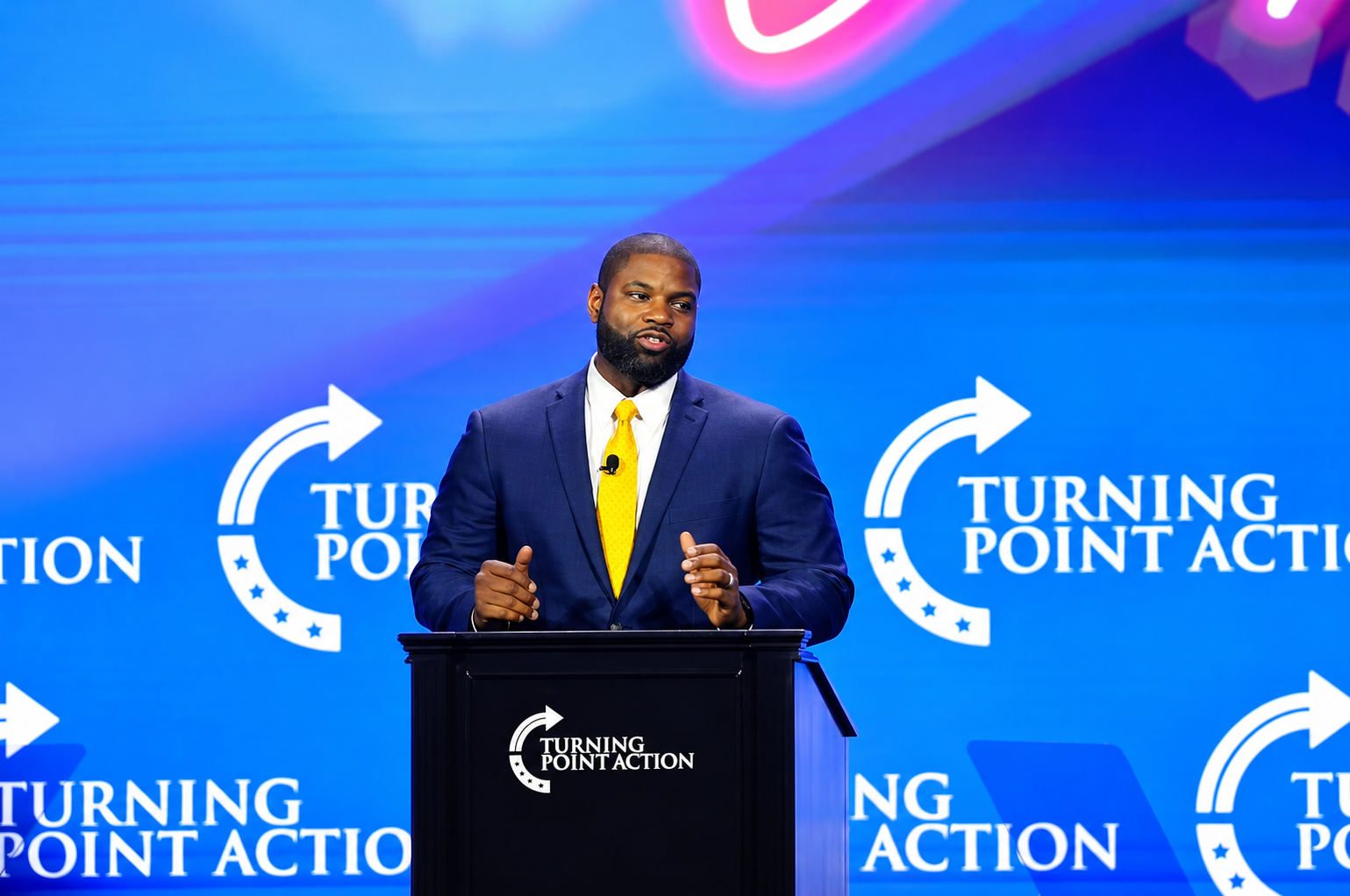
Byron Donalds, wearing a navy suit and yellow tie, gestures while speaking behind a Turning Point Action podium.

U.S. Rep. Byron Donalds speaks at a Turning Point Action event in Florida. Photo by Roman Garay / Florida National News.

Rally Set for Oct. 23

Trump’s remarks are scheduled to begin at 2 p.m., with doors opening at 10:30 a.m., according to the Republican Party’s event registration page. All times are Eastern.

Gulf Coast News reports that the rally will take place at Alico Arena at Florida Gulf Coast University. However, the official GOP registration page still lists the venue as “To Be Announced.” Attendees should check that page for confirmation and updates.
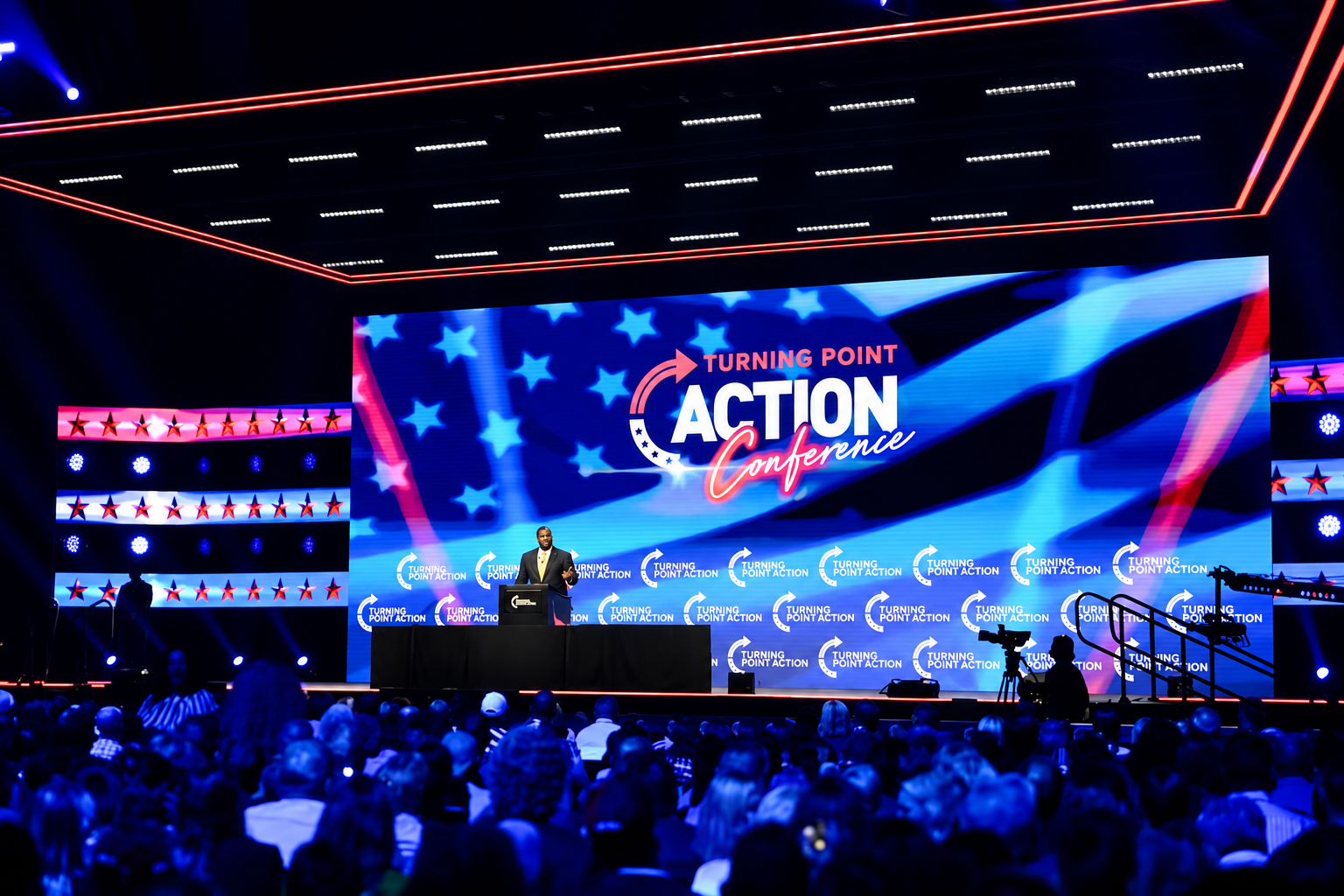
Prominent conservative figures, including Tucker Carlson, then-former President Donald Trump, U.S. Rep. Byron Donalds and Megyn Kelly, rallied Republican voters during the Turning Point Action Conference at the Palm Beach County Convention Center, July 15-16, 2023.
Photo by Roman D. Garay / Florida National News.

Trump’s Endorsement Connects President to Historic Bid

Trump has endorsed Donalds, whose campaign lists the president among its prominent Republican supporters. The Fort Myers visit places Trump in Donalds’ Southwest Florida political base during the closing weeks of the election.

Following his primary victory, Donalds acknowledged Trump’s influence among Republican voters.

“Obviously, he has the strongest following of anybody in our party,” Donalds said, according to Associated Press reporting.

A Donalds victory would give Florida its first Black governor and extend Republican leadership in the governor’s office. Trump’s endorsement connects the president to that potentially historic outcome, although the rally announcement does not identify the event as exclusively supporting Donalds.

Republican Unity and Voter Turnout

Donalds called for Republicans to unite after the primary, telling supporters, “Tonight we are one united Republican Party,” according to the AP.

The Fort Myers rally will provide Trump another platform to address supporters ahead of the Nov. 3 midterm elections. The published event announcement confirms his appearance but does not list additional speakers.

Continue Reading
Advertisement
Advertisement Ticket Time Machine ad
Advertisement Orlando Regional REALTOR Association logo
Advertisement Parts Pass App
Advertisement Hispanic Chamber of Commerce of Metro Orlando
Advertisement
Advertisement African American Chamber of Commerce of Central Florida
Advertisement FNN News en Español
Advertisement Indian American Chamber of Commerce logo
Advertisement Florida Sports Channel

FNN Newsletter

Trending