

Politics
Russia arrests 3,800 during wide protests backing Navalny


MOSCOW (AP) — Chanting slogans against President Vladimir Putin, tens of thousands took to the streets Sunday across Russia to demand the release of jailed opposition leader Alexei Navalny, keeping up nationwide protests that have rattled the Kremlin. More than 3,800 people were detained by police, according to a monitoring group, and some were beaten.
Russian authorities mounted a massive effort to stem the tide of demonstrations after tens of thousands rallied across the country last weekend in the largest, most widespread show of discontent that Russia has seen in years. Yet despite threats of jail terms, warnings to social media groups and tight police cordons, the protests again engulfed cities across Russia’s 11 time zones on Sunday.
The 44-year-old Navalny, an anti-corruption investigator who is Putin’s best-known critic, was arrested on Jan.17 upon returning from Germany, where he spent five months recovering from nerve-agent poisoning that he blames on the Kremlin. Russian authorities have rejected the accusations. He was arrested for allegedly violating his parole conditions by not reporting for meetings with law enforcement when he was recuperating in Germany.
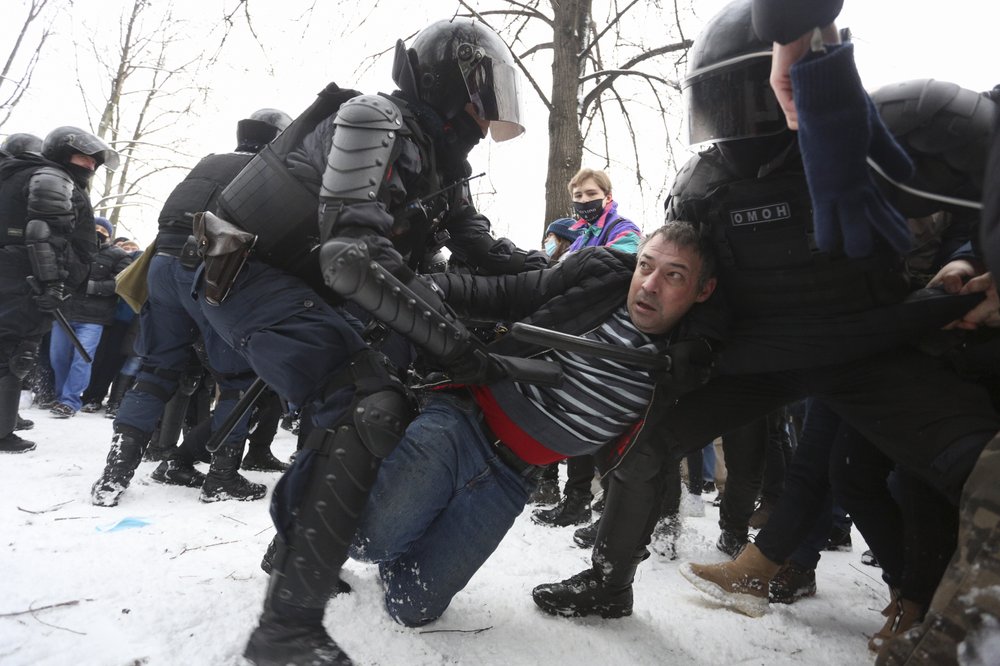
Police detain a protester in St. Petersburg. (AP Photo/Valentin Egorshin)
The United States urged Russia to release Navalny and criticized the crackdown on protests.
“The U.S. condemns the persistent use of harsh tactics against peaceful protesters and journalists by Russian authorities for a second week straight,” U.S. Secretary of State Antony Blinken said on Twitter.
The Russian Foreign Ministry rejected Blinken’s call as a “crude interference in Russia’s internal affairs” and accused Washington of trying to destabilize the situation in the country by backing the protests.
On Sunday, police detained more than 3,800 people at protests in cities nationwide, according to OVD-Info, a group that monitors political arrests.
In Moscow, authorities introduced unprecedented security measures in the city center, closing subway stations near the Kremlin, cutting bus traffic and ordering restaurants and stores to stay closed.

Police stand blocking approaches to the square during a protest against the jailing of opposition leader Alexei Navalny in Volgograd, Russia, Sunday, Jan. 31, 2021. Thousands of people have taken to the streets across Russia to demand the release of jailed opposition leader Alexei Navalny, keeping up the wave of nationwide protests that have rattled the Kremlin. Many chanted slogans against President Vladimir Putin. The authorities mounted a massive effort to stem the tide of demonstrations after tens of thousands rallied across the country last weekend in the most widespread show of discontent Russia has seen in years. (AP Photo/Dmitry Rogulin)
Navalny’s team initially called for Sunday’s protest to be held on Moscow’s Lubyanka Square, home to the main headquarters of the Federal Security Service, which Navalny claims was responsible for his poisoning. Facing police cordons around the square, the protest shifted to other central squares and streets.
Police were randomly picking up people and putting them into police buses, but thousands of protesters marched across the city center for hours, chanting “Putin, resign!” and Putin, thief!” — a reference to an opulent Black Sea estate reportedly built for the Russian leader that was featured in a widely popular video released by Navalny’s team.
“I’m not afraid, because we are the majority,” said Leonid Martynov, who took part in the protest. “We mustn’t be scared by clubs because the truth is on our side.”
At one point, crowds of demonstrators walked toward the Matrosskaya Tishina prison where Navalny is being held. They were met by phalanxes of riot police who pushed the march back and chased protesters through courtyards, detaining scores and beating some with clubs. Still, demonstrators continued to march around the Russian capital, zigzagging around police cordons.
Over 1,000 were detained in Moscow, including Navalny’s wife, Yulia, who joined the protest. “If we keep silent, they will come after any of us tomorrow,” she said on Instagram before turning out to protest.
Several thousand people marched across Russia’s second-largest city of St. Petersburg, and occasional scuffles erupted as some demonstrators pushed back police who tried to make detentions. Nearly 800 were arrested.
Some of the biggest rallies were held in Novosibirsk and Krasnoyarsk in eastern Siberia and Yekaterinburg in the Urals.
“I do not want my grandchildren to live in such a country,” said 55-year-old Vyacheslav Vorobyov, who turned out for a rally in Yekaterinburg. “I want them to live in a free country.”
As part of a multipronged effort by authorities to block the protests, courts have jailed Navalny’s associates and activists across the country over the past week. His brother Oleg, top aide Lyubov Sobol and three other people were put Friday under a two-month house arrest on charges of allegedly violating coronavirus restrictions during last weekend’s protests.
Prosecutors also demanded that social media platforms block calls to join the protests.
The Interior Ministry issued stern warnings to the public not to join the protests, saying participants could be charged with taking part in mass riots, which carries a prison sentence of up to eight years.
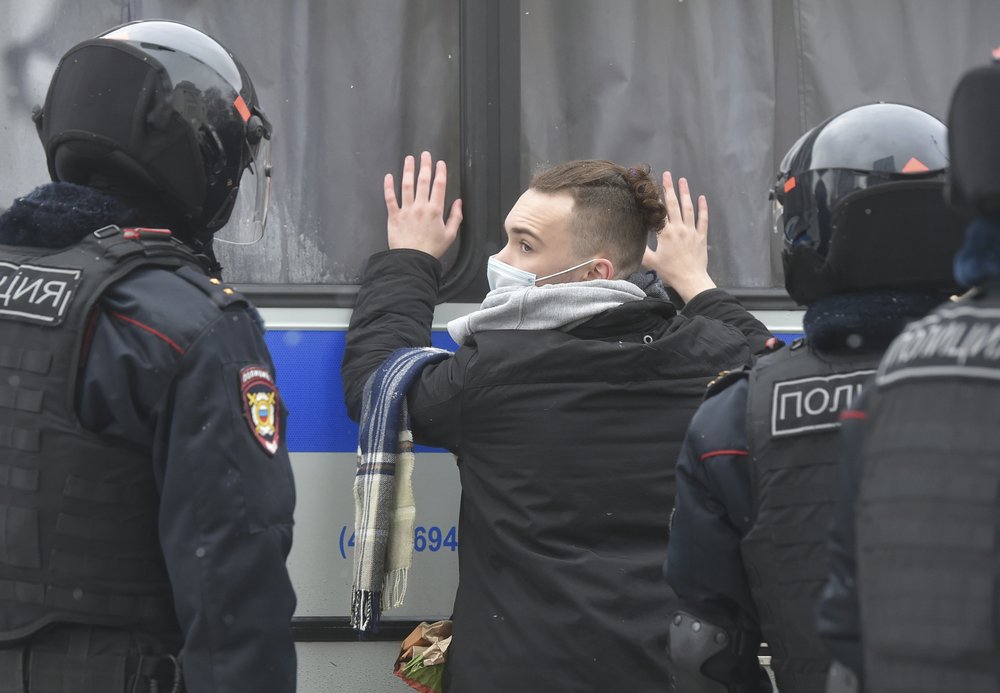
Nearly 4,000 people were reportedly detained at demonstrations on Jan. 23 calling for Navalny’s release that took place in more than 100 Russian cities.
Soon after Navalny’s arrest, his team released a two-hour video on his YouTube channel about the Black Sea residence purportedly built for Putin. The video has been viewed over 100 million times, helping fuel discontent and inspiring a stream of sarcastic jokes on the internet amid an economic downturn.
Russia has seen extensive corruption during Putin’s time in office while poverty has remained widespread.
Demonstrators in Moscow chanted “Aqua discotheque!” — a reference to one of the fancy amenities at the residence that also features a casino and a hookah lounge equipped for watching pole dances.
Putin says neither he nor any of his close relatives own the property. On Saturday, construction magnate Arkady Rotenberg, a longtime Putin confidant and his occasional judo sparring partner, claimed that he himself owned the property.
Navalny fell into a coma on Aug. 20 while on a domestic flight from Siberia to Moscow and the pilot diverted the plane so he could be treated in the city of Omsk. He was transferred to a Berlin hospital two days later. Labs in Germany, France and Sweden, and tests by the Organization for the Prohibition of Chemical Weapons, established that he was exposed to the Novichok nerve agent.
Russian authorities have refused to open a full-fledged criminal inquiry, claiming a lack of evidence that he was poisoned.
Navalny was arrested immediately upon his return to Russia earlier this month and jailed for 30 days on the request of Russia’s prison service, which alleged he had violated the probation of his suspended sentence from a 2014 money-laundering conviction that he has rejected as political revenge.
On Thursday, a Moscow court rejected Navalny’s appeal to be released, and another hearing next week could turn his 3 1/2-year suspended sentence into one he must serve in prison.

Florida
Republicans for Jolly Launches as GOP Supporters Back Democrat David Jolly for Florida Governor

Florida
FNN ANALYSIS: After 2024 Defections, Florida Democrats Face 2026 Election Test: Can They Rebuild as Republicans Expand Their Advantage?


 Central Florida News3 days ago
ANNIKA Media Day Brings Melanie Green Back to Tampa Bay Ahead of Tournament Debut
 Central Florida News3 days ago
USF Pulls Away From Delaware State in 59-17 Win
 Business22 hours ago
FNN News Expands National Event Coverage With Los Angeles, Atlanta and Las Vegas Plans
 Central Florida News2 days ago
Buccaneers Stunned by Browns 23-19 in Home Opener, Fall to 0-2
 Business20 hours ago
Addition Financial, Rosen Preschools Partner to Expand Financial Literacy for Central Florida Children


