Connect with us

Tech

Scientists warn of AI dangers but don’t agree on solutions

Published

on

CAMBRIDGE, Mass. (AP) — Computer scientists who helped build the foundations of today’s artificial intelligence technology are warning of its dangers, but that doesn’t mean they agree on what those dangers are or how to prevent them.

After retiring from Google so he could speak more freely, so-called Godfather of AI Geoffrey Hinton plans to outline his concerns Wednesday at a conference at the Massachusetts Institute of Technology. He’s already voiced regrets about his work and doubt about humanity’s survival if machines get smarter than people.

Fellow AI pioneer Yoshua Bengio, co-winner with Hinton of the top computer science prize, told The Associated Press on Wednesday that he’s “pretty much aligned” with Hinton’s concerns brought on by chatbots such as ChatGPT and related technology, but worries that to simply say “We’re doomed” is not going to help.

“The main difference, I would say, is he’s kind of a pessimistic person, and I’m more on the optimistic side,” said Bengio, a professor at the University of Montreal. “I do think that the dangers — the short-term ones, the long-term ones — are very serious and need to be taken seriously by not just a few researchers but governments and the population.”

There are plenty of signs that governments are listening. The White House has called in the CEOs of Google, Microsoft and ChatGPT-maker OpenAI to meet Thursday with Vice President Kamala Harris in what’s being described by officials as a frank discussion on how to mitigate both the near-term and long-term risks of their technology. European lawmakers are also accelerating negotiations to pass sweeping new AI rules.

But all the talk of the most dire future dangers has some worried that hype around superhuman machines — which don’t yet exist — is distracting from attempts to set practical safeguards on current AI products that are largely unregulated.

Margaret Mitchell, a former leader on Google’s AI ethics team, said she’s upset that Hinton didn’t speak out during his decade in a position of power at Google, especially after the 2020 ouster of prominent Black scientist Timnit Gebru, who had studied the harms of large language models before they were widely commercialized into products such as ChatGPT and Google’s Bard.

“It’s a privilege that he gets to jump from the realities of the propagation of discrimination now, the propagation of hate language, the toxicity and nonconsensual pornography of women, all of these issues that are actively harming people who are marginalized in tech,” said Mitchell, who was also forced out of Google in the aftermath of Gebru’s departure. “He’s skipping over all of those things to worry about something farther off.”

Bengio, Hinton and a third researcher, Yann LeCun, who works at Facebook parent Meta, were all awarded the Turing Prize in 2019 for their breakthroughs in the field of artificial neural networks, instrumental to the development of today’s AI applications such as ChatGPT.

Bengio, the only one of the three who didn’t take a job with a tech giant, has voiced concerns for years about near-term AI risks, including job market destabilization, automated weaponry and the dangers of biased data sets.

But those concerns have grown recently, leading Bengio to join other computer scientists and tech business leaders like Elon Musk and Apple co-founder Steve Wozniak in calling for a six-month pause on developing AI systems more powerful than OpenAI’s latest model, GPT-4.

Bengio said Wednesday he believes the latest AI language models already pass the “Turing test” named after British codebreaker and AI pioneer Alan Turing’s method introduced in 1950 to measure when AI becomes indistinguishable from a human — at least on the surface.

“That’s a milestone that can have drastic consequences if we’re not careful,” Bengio said. “My main concern is how they can be exploited for nefarious purposes to destabilize democracies, for cyber attacks, disinformation. You can have a conversation with these systems and think that you’re interacting with a human. They’re difficult to spot.”

Where researchers are less likely to agree is on how current AI language systems — which have many limitations, including a tendency to fabricate information — will actually get smarter than humans.

Aidan Gomez was one of the co-authors of the pioneering 2017 paper that introduced a so-called transformer technique — the “T” at the end of ChatGPT — for improving the performance of machine-learning systems, especially in how they learn from passages of text. Then just a 20-year-old intern at Google, Gomez remembers laying on a couch at the company’s California headquarters when his team sent out the paper around 3 a.m. when it was due.

“Aidan, this is going to be so huge,” he remembers a colleague telling him, of the work that’s since helped lead to new systems that can generate humanlike prose and imagery.

Six years later and now CEO of his own AI company, Cohere, Gomez is enthused about the potential applications of these systems but bothered by fearmongering he says is “detached from the reality” of their true capabilities and “relies on extraordinary leaps of imagination and reasoning.”

“The notion that these models are somehow gonna get access to our nuclear weapons and launch some sort of extinction-level event is not a productive discourse to have,” Gomez said. “It’s harmful to those real pragmatic policy efforts that are trying to do something good.”

Continue Reading
Click to comment

Leave a Reply

Your email address will not be published. Required fields are marked *

Tech

NASA Rolls Out Massive SLS Rocket Stage for Artemis III Mission to Kennedy Space Center

Published

on

Pictured above is the top four-fifths of the SLS (Space Launch System) core stage – the section containing the liquid hydrogen tank, liquid oxygen tank, intertank, and forward skirt. NASA will roll the largest section of the agency’s SLS rocket that will launch the second crewed Artemis mission under the Artemis III mission out of NASA’s Michoud Assembly Facility on Monday, April 20. Credit: NASA

NEW ORLEANS (FNN) — NASA will roll out the largest section of its Space Launch System rocket on Monday, April 20, marking a major milestone for the Artemis III mission.

The section, representing the top four-fifths of the SLS core stage, is being moved from NASA’s Michoud Assembly Facility in New Orleans. It includes the liquid hydrogen tank, liquid oxygen tank, intertank and forward skirt. The structure will be loaded onto NASA’s Pegasus barge for transport to Kennedy Space Center in Florida.

CORE STAGE DELIVERY AND INTEGRATION

Once the core stage arrives at Kennedy Space Center, teams will complete final outfitting and vertical integration. The hardware will then be transferred to NASA’s Exploration Ground Systems Program for stacking and launch preparation.

The Artemis III engine section and boat-tail, which protects the engines during launch, were previously moved to the Vehicle Assembly Building in July 2025. The four RS-25 engines are scheduled to arrive from Stennis Space Center in Mississippi no later than July 2026 for integration.

POWERING THE ARTEMIS III MISSION

Equipped with four RS-25 engines, the SLS core stage will generate more than 2 million pounds of thrust, enabling the launch of astronauts aboard the Orion spacecraft.

Artemis III is currently targeted for launch in 2027, following the successful Artemis II mission, which completed a crewed flight around the Moon on April 10.

NASA’S MOON-TO-MARS STRATEGY

The Artemis III mission is part of NASA’s broader Artemis program, aimed at returning astronauts to the Moon and establishing a sustained human presence.

The mission will test critical capabilities, including rendezvous and docking between the Orion spacecraft and commercial systems needed for future lunar landings, currently planned for 2028.

NASA is working in partnership with Boeing, the SLS core stage lead contractor, and L3Harris Technologies, the lead contractor for the RS-25 engines. The core stage remains the backbone of the SLS rocket and is manufactured at the Michoud Assembly Facilit

Continue Reading

Tech

NASA’s Artemis II Astronauts Begin Historic Journey Around the Moon After Key Orion Engine Burn

Published

on

Earth's crescent is seen from a solar array camera on the Orion spacecraft on the first flight day of the Artemis II mission. Credit: NASA

CAPE CANAVERAL, Fla. (FNN) — For the first time in more than 50 years, astronauts on a NASA mission are headed around the Moon after successfully completing a critical burn of the Orion spacecraft’s main engine.

The approximately six-minute firing of Orion’s service module engine Thursday — known as the translunar injection burn — accelerated the spacecraft and its crew beyond Earth’s orbit, placing them on a trajectory toward the Moon.

Aboard the spacecraft are NASA astronauts Reid Wiseman, Victor Glover and Christina Koch, along with Canadian Space Agency astronaut Jeremy Hansen.

“Today, for the first time since Apollo 17 in 1972, humans have departed Earth orbit,” said Dr. Lori Glaze, acting associate administrator for NASA’s Exploration Systems Development Mission Directorate. “Reid, Victor, Christina and Jeremy now are on a precise trajectory toward the Moon. Orion is operating with crew for the first time in space, and we are gathering critical data and learning from each step.”

NASA’s Space Launch System rocket and Orion spacecraft lifted off from Launch Pad 39B at Kennedy Space Center at 6:35 p.m. EDT on April 1, beginning a planned 10-day test mission around the Moon and back.

Successful Launch and Spacecraft Activation

Shortly after reaching space, Orion deployed its four solar array wings, allowing the spacecraft to generate power from the Sun. The crew and mission controllers then began transitioning the spacecraft from launch to normal flight operations while checking critical onboard systems.

About 49 minutes into the flight, the rocket’s upper stage fired to place Orion into an elliptical orbit around Earth. A second burn propelled the spacecraft — named “Integrity” by the crew — into a high Earth orbit extending roughly 46,000 miles above the planet for nearly 24 hours of system testing.

Following the maneuver, Orion separated from the upper stage and began flying independently.

System Tests and Crew Operations in Space

During the early phase of the mission, the astronauts conducted a manual piloting demonstration to evaluate Orion’s handling capabilities using the Interim Cryogenic Propulsion Stage as a docking target.

After the test, Orion executed an automated departure burn to safely move away from the stage. The propulsion stage later performed a disposal burn before re-entering Earth’s atmosphere over a remote area of the Pacific Ocean.

Before its re-entry, four small CubeSats were deployed from the rocket’s Orion stage adapter to conduct separate scientific missions.

Mission teams also transitioned communications to NASA’s Deep Space Network while the crew adjusted to the space environment. Astronauts completed their first rest periods, performed onboard exercise routines, restored the spacecraft’s toilet to normal operations and prepared the spacecraft for the translunar injection burn.

Lunar Flyby and Artemis Program Goals

The crew is scheduled to conduct a lunar flyby Monday, April 6, when astronauts will capture high-resolution images and make observations of the Moon’s surface — including portions of the lunar far side rarely seen directly by humans.

Although the far side will only be partially illuminated during the flyby, the lighting conditions are expected to cast long shadows across the terrain, highlighting ridges, slopes and crater rims that are difficult to observe under full sunlight.

After completing the flyby, the astronauts will return to Earth and splash down in the Pacific Ocean off the coast of San Diego.

The mission marks a major milestone for NASA’s Artemis program, which aims to send astronauts on increasingly ambitious missions to explore the Moon, advance scientific discovery, stimulate economic growth and prepare for the first crewed missions to Mars.

Continue Reading

Florida

VIDEO: NASA Artemis II Mission Sends Astronauts Around the Moon in First Crewed Test Since Apollo

Published

on

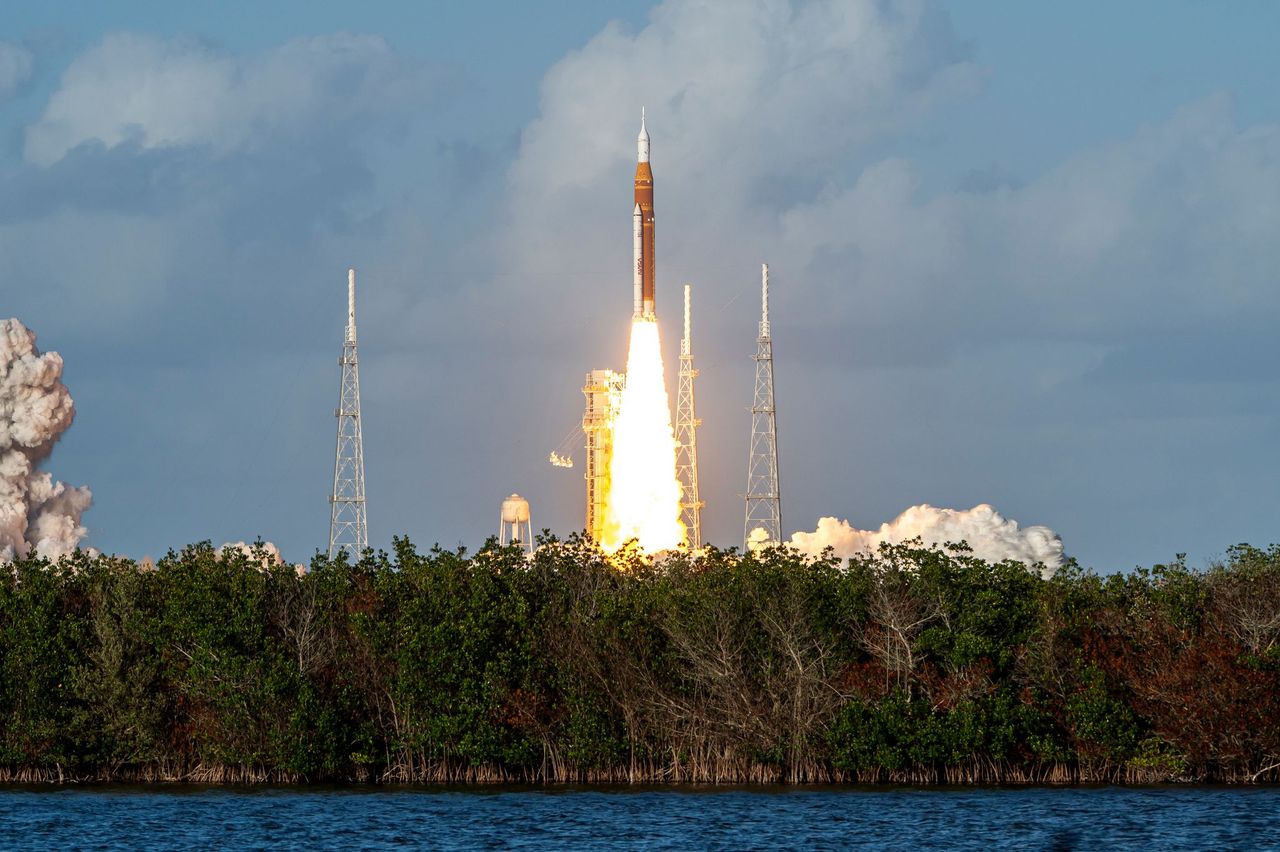
The Artemis II crewed lunar mission launches from Kennedy Space Center on April 1, 2026. Four astronauts blasted off aboard a massive NASA rocket on a long-anticipated journey around the Moon—marking the first crewed lunar flyby in more than 50 years. Photo by Nickolas Wolf / Florida National News.
CAPE CANAVERAL, Fla. (FNN) — NASA is preparing to launch the crew of Artemis II on a historic journey around the Moon, marking the first time astronauts will travel beyond low-Earth orbit since the era of Apollo Program.
The mission will lift off from Kennedy Space Center aboard the Space Launch System, carrying astronauts in the Orion spacecraft on a multi-day flight that will orbit the Moon before returning safely to Earth.

The Artemis II crewed lunar mission launches from Kennedy Space Center on April 1, 2026. Four astronauts blasted off aboard a massive NASA rocket on a long-anticipated journey around the Moon—marking the first crewed lunar flyby in more than 50 years. Photo by Nickolas Wolf / Florida National News.


Historic Return to Deep Space Artemis II is the first crewed mission in NASA’s Artemis program, designed to return humans to the Moon and eventually establish a sustainable presence there. The flight follows the successful uncrewed test mission, Artemis I, which demonstrated the Orion spacecraft’s ability to travel to lunar orbit and return to Earth. The Artemis program represents NASA’s long-term strategy to explore deep space, including preparing astronauts for future missions to Mars. Astronaut Crew to Circle the Moon

The Artemis II crew includes four astronauts selected to test Orion’s life-support systems and navigation capabilities during the mission.

The Artemis II crewed lunar mission launches from Kennedy Space Center on April 1, 2026. Four astronauts blasted off aboard a massive NASA rocket on a long-anticipated journey around the Moon—marking the first crewed lunar flyby in more than 50 years.
Photo by Nickolas Wolf / Florida National News.


Their journey will take them thousands of miles beyond the Moon before returning to Earth. The mission will also demonstrate critical technologies needed for future lunar landings planned under upcoming Artemis missions.

Florida’s Space Coast in the Global Spotlight The launch is expected to draw thousands of spectators to Florida’s Space Coast, including viewers gathering along beaches in Cocoa Beach and nearby communities to witness the historic liftoff.

Local officials and tourism leaders say the Artemis program continues to reinforce Florida’s role as the nation’s gateway to space exploration.


Continue Reading
Advertisement
Advertisement Ticket Time Machine ad
Advertisement Orlando Regional REALTOR Association logo
Advertisement Parts Pass App
Advertisement Hispanic Chamber of Commerce of Metro Orlando
Advertisement
Advertisement African American Chamber of Commerce of Central Florida
Advertisement FNN News en Español
Advertisement Indian American Chamber of Commerce logo
Advertisement Florida Sports Channel

FNN Newsletter

Trending