Politics
Trump issues first veto after rebuke of border order
Published
7 years agoon
WASHINGTON (AP) — Unbowed by a congressional rebuke, President Donald Trump issued the first veto of his presidency on Friday in a demonstration that he is not through fighting for his signature campaign promise, which stands largely unfulfilled 18 months before voters decide whether to grant him another term.
Trump rejected an effort by Congress to block the emergency declaration he’d used to circumvent lawmakers as he tried to shake loose funds for his long-promised wall along the U.S.-Mexico border. The monthslong confrontation now moves to the courts, but not before marking a new era of divided government in Washington and Republicans’ increasing independence from the White House.
“Congress has the freedom to pass this resolution,” Trump said, “and I have the duty to veto it.”
A dozen defecting Republicans joined Senate Democrats in approving the joint resolution on Thursday as both parties strained to exert their power in new ways. It is unlikely that Congress will have the two-thirds majority required to override Trump’s veto, though House Democrats will try nonetheless on March 26.
Despite the reproach, Trump seized the opportunity to publicly rebuff Congress and show his commitment to the border wall. In embracing the opportunity to deploy the constitutional power of the veto for the first time, he treated the occasion with all the traditional pomp of a bill-signing.
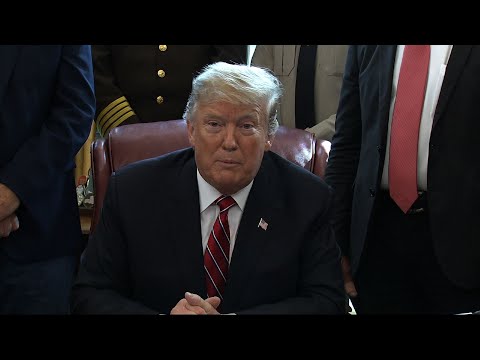
Trump was surrounded in the Oval Office by supporters, including law enforcement officials and the parents of children killed by people in the country illegally, who offered profuse thanks and frequent applause. Trump dramatically signed his veto message and then held the document up for the cameras to capture.
Trump wants to use the emergency order to divert billions of federal dollars earmarked for defense spending toward the southern border wall. It still faces several legal challenges from Democratic state attorneys general and environmental groups who argue the emergency declaration was unconstitutional.
Those cases could prevent Trump from diverting extra money to barrier construction for months or longer. American Civil Liberties Union, which filed one of the challenges, said the veto is meaningless, like the declaration in the first place.
“Congress has rejected the president’s declaration, and now the courts will be the ultimate arbiter of its legality. We look forward to seeing him in court and to the shellacking that he will receive at the hands of an independent judiciary,” said Executive Director Anthony Romero.
House Speaker Nancy Pelosi called Trump’s veto a “lawless power grab” and railed that, even after both chambers tried to stop him, Trump “has chosen to continue to defy the Constitution, the Congress and the will of the American people.”
Trump, however, insisted the situation on the southern border is “a tremendous national emergency,” adding, “our immigration system is stretched beyond the breaking point.”
Many lawmakers said Thursday’s vote was not necessarily a rejection of the president or the wall, but protections against future presidents — namely a Democrat who might want to declare an emergency on climate change, gun control or any number of other issues.
It was the first direct challenge to the 1976 National Emergencies Act, just as a Wednesday vote on Yemen was the first time Congress invoked the decades-old War Powers Act to try to rein in a president. That resolution seeking to end U.S. backing for the Saudi Arabian-led coalition fighting in Yemen was approved in the aftermath of the killing of journalist Jamal Khashoggi in the Saudi Consulate in Istanbul and is expected to be the subject of Trump’s second veto.
Despite the embarrassing defections of the 12 GOP senators, Trump’s grip on the party remains strong and the White House made it clear that Republicans resisting Trump could face political consequences. Ahead of the voting, Trump framed the issue as with-him-or-against-him on border security, a powerful argument with many.
But Friday, Trump said he had sympathy for the Republicans who voted against him and emphasized that he never truly twisted the arms of lawmakers, because he knew there were not enough votes to override the veto.
“Look, they were doing what they have to do,” Trump said, insisting he “put no pressure” on lawmakers to vote against the resolution because he realized that the measure was likely to pass.
Still, a White House official said Trump won’t forget when senators who opposed him want him to attend fundraisers or provide other help. The official was not authorized to speak publicly on internal deliberations so spoke on condition of anonymity.
Speaking in the Oval Office, Trump painted his usual portrait of a lawless and violent border. He cited “thousands and thousands” of gang arrests and claimed many of the asylum seekers released into the U.S. were “stone-cold killers,” ignoring data that shows immigrants are less likely to commit crime. He noted, correctly, a spike in the number of people coming to the border to claim asylum.
Trump initiated the showdown months ago when he all but dared Congress not to give him the $5.7 billion he was demanding to build the U.S.-Mexico wall, by threatening a federal government shutdown.
Congress declined and the result was the longest shutdown in U.S. history. Against the advice of GOP leaders, Trump invoked the national emergency declaration last month, allowing him to try to tap about $3.6 billion for the wall by shuffling money from military projects, and that drew outrage from many lawmakers. Trump had campaigned for president promising Mexico would pay for the wall.
You may like
Florida
Central Florida Lawmakers Challenge DeSantis Redistricting Map as Lawsuits Mount
Published
3 days agoon
May 6, 2026By
Willie DavidORLANDO, Fla. (FNN) — The Central Florida Black Caucus of Local Elected Officials held a press conference on the steps of Orlando City Hall, criticizing a new congressional map signed into law by Florida Governor Ron DeSantis.
Speakers included U.S. Congressman Maxwell Frost, State Senator Lavon Bracy-Davis, State Representative Bruce Antone, Orange County Clerk of Courts Tiffany Moore Russell, representatives from Equal Ground, and the Central Florida Urban League. Officials argued the map weakens minority representation and follows a recent U.S. Supreme Court ruling that scaled back key protections under the Voting Rights Act.
Florida National News has learned that three lawsuits have been filed seeking to block the newly approved congressional map following the redistricting process. The map is widely viewed as an effort to expand Republican representation in Florida’s congressional delegation ahead of upcoming elections.
IMPACT ON BLACK REPRESENTATION
Leaders warned the redistricting plan could significantly reduce the influence of Black voters in Central Florida and across the state. They argued that dismantling historically minority-access districts undermines decades of progress in equitable representation.
LEGAL CHALLENGES UNDERWAY
At least three lawsuits have been filed challenging the legality of the new map. Civil rights advocates contend the redistricting plan violates federal protections and could further erode voting rights following the Supreme Court’s recent decision.
FUTURE OF BLACK CONGRESSIONAL LEADERSHIP
Elected officials and advocacy groups expressed concern about the long-term effects on Black congressional representation. They emphasized the need for continued legal action and community engagement to protect fair representation in future elections.
Florida
DeSantis’ New Florida Congressional Map Could Spark Lawsuits, Legislative Showdown, and Statewide Protests
Published
2 weeks agoon
April 27, 2026TALLAHASSEE, Fla. (FNN) — Governor Ron DeSantis unveiled a proposed congressional redistricting map that could significantly reshape Florida’s representation in the U.S. House ahead of the 2026 midterm elections.
The proposal, released Monday, outlines districts that could favor Republicans in 24 seats, compared to four Democratic-leaning districts. Currently, Florida’s congressional delegation includes 20 Republicans and seven Democrats, with one vacant seat.
REDISTRICTING PROPOSAL & POLITICAL IMPACT
The governor said the new map reflects Florida’s population changes and fulfills his commitment to mid-decade redistricting. Lawmakers have been called into a special legislative session to consider the proposal.
The map appears to eliminate four Democratic-held seats, including a Tampa-area district represented by U.S. Rep. Kathy Castor, an Osceola County district held by U.S. Rep. Darren Soto—the first Puerto Rican elected to Congress from Florida—and a Palm Beach-Broward district that could displace U.S. Rep. Jared Moskowitz.
The proposal also affects a majority-Black voting district spanning Palm Beach and Broward counties, previously represented by former U.S. Rep. Sheila Cherfilus-McCormick, raising concerns about the future of minority representation.
Supporters, including Evan Power, say the map could better align districts with voter distribution. Critics, including Nikki Fried, have called the proposal unconstitutional gerrymandering. Florida law prohibits partisan gerrymandering, setting up potential legal challenges.
Rep. Tray McCurdy, D-Orlando and Rep. Angie Nixon, D-Jacksonville sit on the Florida Seal in protest as debate stops on Senate Bill 2-C: Establishing the Congressional Districts of the State in the House of Representatives Thursday, April 21, 2022 at the Capitol in Tallahassee, Fla. Rep. Daisy Morales, D-Orlando, joins the protest, holding a sign. The session was halted on the protest. (AP Photo/Phil Sears)
LOOKING BACK: 2022 PROTESTS OVER REDISTRICTING
The current debate mirrors tensions from 2022, when Democratic lawmakers staged a sit-in protest on the Florida House floor in opposition to a previous congressional map backed by DeSantis.
Lawmakers including Yvonne Hinson, Angie Nixon, Travaris McCurdy, Felicia Robinson, and Daisy Morales participated in the protest, temporarily halting legislative proceedings.
Morales, a member of the Congressional Redistricting Subcommittee and the only Hispanic lawmaker involved in the sit-in, strongly criticized the map at the time.
“Our democracy is being attacked. The governor eliminating two Black congressional seats is a power grab and it’s wrong,” Morales said in a written statement. “Stripping seats from Black representation is the same as saying the Black voice—the Black vote—doesn’t matter.”
She also warned about potential impacts on Hispanic representation:
“With this map passing, I’m deeply concerned it could target the only Puerto Rican representing Florida in Congress, Darren Soto, to benefit partisan interests. We don’t want to disenfranchise the 1.2 million Puerto Ricans in Florida.”
WHAT COMES NEXT IN 2026
As lawmakers prepare to debate the new proposal, Democrats are expected to push back through legal challenges, legislative opposition, and public advocacy.
The outcome of Florida’s redistricting battle could play a pivotal role in shaping control of the U.S. House and influence the national political landscape heading into the 2026 midterm elections.
Politics
Gov. Ron DeSantis Orders Flags at Half-Staff for Slain Coral Springs Vice Mayor Nancy M. Metayer Bowen
Published
3 weeks agoon
April 16, 2026TALLAHASSEE, Fla. (FNN) — Gov. Ron DeSantis has ordered flags to be flown at half-staff in honor of Coral Springs Vice Mayor Nancy M. Metayer Bowen, who was killed April 1 in what authorities describe as a domestic violence incident.
The directive calls for U.S. and Florida state flags to be lowered from sunrise to sunset Friday, April 17, 2026, at the State Capitol in Tallahassee and at all local and state buildings, installations and grounds throughout Coral Springs.
According to Coral Springs Police, officers conducted a wellness check at Metayer Bowen’s home after city staff raised concerns when she missed scheduled meetings and could not be reached. Responding officers found her deceased inside the residence.
Investigators said the killing appears to be a domestic violence incident. Her husband, Stephen Bowen, was later taken into custody and faces charges of premeditated murder and tampering with evidence. The case remains under active investigation.
State and local leaders say the half-staff order honors Metayer Bowen’s service and legacy in the Coral Springs community, where she was recognized for her leadership and commitment to public service.
What We Know About Her Death
Police say Metayer Bowen was killed April 1 at her Coral Springs home. Officers discovered her body during a wellness check prompted by her unexplained absence from official duties and lack of communication.
Husband Arrested, Faces Charges
Authorities arrested her husband, Stephen Bowen, who now faces premeditated murder and evidence-tampering charges. Investigators have identified the case as an apparent domestic violence incident.
State Honors Her Legacy
Gov. DeSantis ordered flags lowered across key government buildings in Tallahassee and Coral Springs, recognizing Metayer Bowen’s public service and the impact of her loss on the community.