Politics
US conducts medical checks on children after 2 deaths
Published
7 years agoon
By
Willie DavidHOUSTON (AP) — U.S. immigration authorities said Wednesday that they have done new medical checks on nearly every child in Border Patrol custody after the death of a second youngster in the agency’s care in the span of less than three weeks.
Authorities did not disclose the results of the examinations.
An 8-year-old boy, identified by Guatemalan authorities as Felipe Gómez Alonzo, died on Christmas Eve just before midnight. He had been in the custody of U.S. Customs and Border Protection with his father, Agustin Gomez, since Dec. 18.
CBP said in a statement that an agent first noticed the boy had a cough and “glossy eyes” at about 9 a.m. Monday. He was hospitalized twice that day before dying, the agency said. The cause of death was under investigation.
Officials at the Department of Homeland Security told reporters Wednesday that almost all checks ordered in reaction to the boy’s death had been completed. Some children detained in more remote areas were re-screened by emergency medical technicians or Border Patrol agents, officials said. In other places, some children were taken to medical facilities.
DHS wouldn’t say how many children are in Border Patrol custody.
The agency also wouldn’t say why Felipe and his father were detained for almost a week, an unusually long time, or why they were placed back in detention — at a Border Patrol highway checkpoint — after being released from the hospital.
Another Guatemalan child in U.S. custody, 7-year-old Jakelin Caal, died on Dec. 8 and was returned to her village for burial. Her death — which brought down heavy criticism on U.S. immigration authorities — is also under investigation.
Immigration advocates and human rights groups sharply criticized CBP in the wake of Felipe’s death.
Margaret Huang, executive director of Amnesty International USA, said the Trump administration’s “policies of cruelty toward migrants and asylum-seekers at the border must cease immediately before any more children are harmed.”
CBP said in a statement late Tuesday that it needs the help of other government agencies to provide health care.
The agency “is considering options for surge medical assistance” from the Coast Guard and may request help from the U.S. Department of Health and Human Services, the Department of Defense and the Federal Emergency Management Agency.
With border crossings surging, CBP processes thousands of children — both alone and with their parents — every month. According to CBP statistics, border agents detained 5,283 children unaccompanied by a parent in November alone. Agents last month also apprehended 25,172 “family units,” or parents and children together.
CBP typically holds children for no more than a few days. Youngsters who arrive unaccompanied are turned over to longer-term facilities operated by the HHS. The Associated Press reported this month that 14,300 children were being detained by HHS, most in facilities with more than 100 kids.
U.S. Customs and Border Protection Commissioner Kevin McAleenan said Wednesday that the agency has more than 1,500 emergency medical technicians on staff and that officers are taking dozens of sick children to hospitals every day.
“This is an extraordinarily rare occurrence,” McAleenan told “CBS This Morning” of the recent child deaths. “It’s been more than a decade since we’ve had a child pass away anywhere in a CBP process, so this is just devastating for us.”
CBP officers and the Border Patrol remain on the job despite the partial government shutdown over President Donald Trump’s demand for funding for a border wall.
McAleenan said in a statement that the child’s death was a “tragic loss.”
CBP issued a timeline of what it said happened before Felipe’s death.
Felipe was taken with his father to a hospital in Alamogordo, New Mexico, where he was diagnosed with a common cold, according to the timeline.
The boy was released just before 3 p.m., about 90 minutes after he had been found to have a fever of 103 degrees Fahrenheit (39.4 Celsius), CBP said. He was prescribed the antibiotic amoxicillin and the pain reliever and fever-reducer ibuprofen, and was taken with his father to a holding facility at a highway checkpoint.
Around 7 p.m., agents helped clean up the boy’s vomit. CBP said the father “declined further medical assistance” then.
The agency said that its officers repeatedly conducted welfare checks on Felipe and his father, and that agents decided to take the boy back to the hospital at about 10 p.m. because the boy “appeared lethargic and nauseous again.”
He died at 11:48 p.m. Monday, the agency said.
CBP typically detains adult immigrants for no more than a few days when they cross the border before either releasing them or turning them over to U.S. Immigration and Customs Enforcement for longer-term detention.
Agency guidelines say immigrants generally shouldn’t be detained for more than 72 hours in CBP holding facilities, which are usually smaller and have fewer services than ICE detention centers.
You may like
Florida
Central Florida Lawmakers Challenge DeSantis Redistricting Map as Lawsuits Mount
Published
2 days agoon
May 6, 2026By
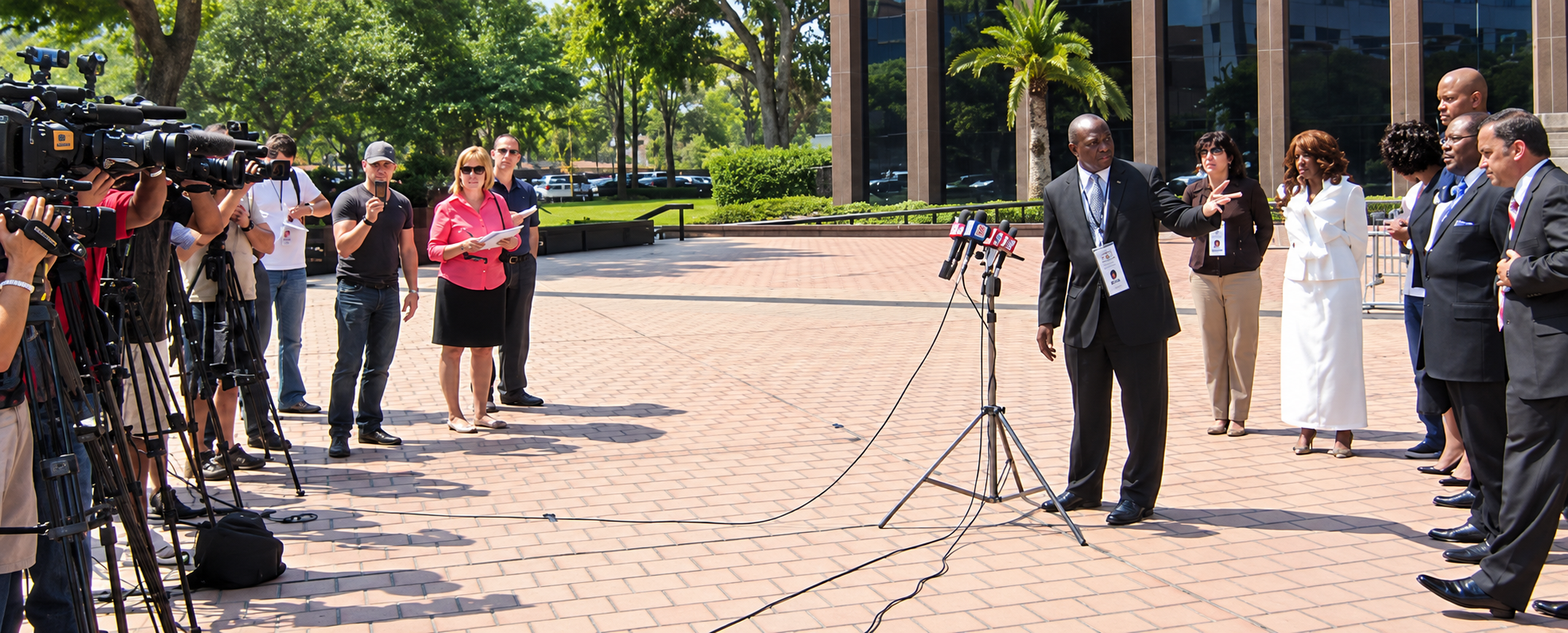
Willie DavidORLANDO, Fla. (FNN) — The Central Florida Black Caucus of Local Elected Officials held a press conference on the steps of Orlando City Hall, criticizing a new congressional map signed into law by Florida Governor Ron DeSantis.
Speakers included U.S. Congressman Maxwell Frost, State Senator Lavon Bracy-Davis, State Representative Bruce Antone, Orange County Clerk of Courts Tiffany Moore Russell, representatives from Equal Ground, and the Central Florida Urban League. Officials argued the map weakens minority representation and follows a recent U.S. Supreme Court ruling that scaled back key protections under the Voting Rights Act.
Florida National News has learned that three lawsuits have been filed seeking to block the newly approved congressional map following the redistricting process. The map is widely viewed as an effort to expand Republican representation in Florida’s congressional delegation ahead of upcoming elections.
IMPACT ON BLACK REPRESENTATION
Leaders warned the redistricting plan could significantly reduce the influence of Black voters in Central Florida and across the state. They argued that dismantling historically minority-access districts undermines decades of progress in equitable representation.
LEGAL CHALLENGES UNDERWAY
At least three lawsuits have been filed challenging the legality of the new map. Civil rights advocates contend the redistricting plan violates federal protections and could further erode voting rights following the Supreme Court’s recent decision.
FUTURE OF BLACK CONGRESSIONAL LEADERSHIP
Elected officials and advocacy groups expressed concern about the long-term effects on Black congressional representation. They emphasized the need for continued legal action and community engagement to protect fair representation in future elections.
Florida
DeSantis’ New Florida Congressional Map Could Spark Lawsuits, Legislative Showdown, and Statewide Protests
Published
2 weeks agoon
April 27, 2026TALLAHASSEE, Fla. (FNN) — Governor Ron DeSantis unveiled a proposed congressional redistricting map that could significantly reshape Florida’s representation in the U.S. House ahead of the 2026 midterm elections.
The proposal, released Monday, outlines districts that could favor Republicans in 24 seats, compared to four Democratic-leaning districts. Currently, Florida’s congressional delegation includes 20 Republicans and seven Democrats, with one vacant seat.
REDISTRICTING PROPOSAL & POLITICAL IMPACT
The governor said the new map reflects Florida’s population changes and fulfills his commitment to mid-decade redistricting. Lawmakers have been called into a special legislative session to consider the proposal.
The map appears to eliminate four Democratic-held seats, including a Tampa-area district represented by U.S. Rep. Kathy Castor, an Osceola County district held by U.S. Rep. Darren Soto—the first Puerto Rican elected to Congress from Florida—and a Palm Beach-Broward district that could displace U.S. Rep. Jared Moskowitz.
The proposal also affects a majority-Black voting district spanning Palm Beach and Broward counties, previously represented by former U.S. Rep. Sheila Cherfilus-McCormick, raising concerns about the future of minority representation.
Supporters, including Evan Power, say the map could better align districts with voter distribution. Critics, including Nikki Fried, have called the proposal unconstitutional gerrymandering. Florida law prohibits partisan gerrymandering, setting up potential legal challenges.
Rep. Tray McCurdy, D-Orlando and Rep. Angie Nixon, D-Jacksonville sit on the Florida Seal in protest as debate stops on Senate Bill 2-C: Establishing the Congressional Districts of the State in the House of Representatives Thursday, April 21, 2022 at the Capitol in Tallahassee, Fla. Rep. Daisy Morales, D-Orlando, joins the protest, holding a sign. The session was halted on the protest. (AP Photo/Phil Sears)
LOOKING BACK: 2022 PROTESTS OVER REDISTRICTING
The current debate mirrors tensions from 2022, when Democratic lawmakers staged a sit-in protest on the Florida House floor in opposition to a previous congressional map backed by DeSantis.
Lawmakers including Yvonne Hinson, Angie Nixon, Travaris McCurdy, Felicia Robinson, and Daisy Morales participated in the protest, temporarily halting legislative proceedings.
Morales, a member of the Congressional Redistricting Subcommittee and the only Hispanic lawmaker involved in the sit-in, strongly criticized the map at the time.
“Our democracy is being attacked. The governor eliminating two Black congressional seats is a power grab and it’s wrong,” Morales said in a written statement. “Stripping seats from Black representation is the same as saying the Black voice—the Black vote—doesn’t matter.”
She also warned about potential impacts on Hispanic representation:
“With this map passing, I’m deeply concerned it could target the only Puerto Rican representing Florida in Congress, Darren Soto, to benefit partisan interests. We don’t want to disenfranchise the 1.2 million Puerto Ricans in Florida.”
WHAT COMES NEXT IN 2026
As lawmakers prepare to debate the new proposal, Democrats are expected to push back through legal challenges, legislative opposition, and public advocacy.
The outcome of Florida’s redistricting battle could play a pivotal role in shaping control of the U.S. House and influence the national political landscape heading into the 2026 midterm elections.
Politics
Gov. Ron DeSantis Orders Flags at Half-Staff for Slain Coral Springs Vice Mayor Nancy M. Metayer Bowen
Published
3 weeks agoon
April 16, 2026TALLAHASSEE, Fla. (FNN) — Gov. Ron DeSantis has ordered flags to be flown at half-staff in honor of Coral Springs Vice Mayor Nancy M. Metayer Bowen, who was killed April 1 in what authorities describe as a domestic violence incident.
The directive calls for U.S. and Florida state flags to be lowered from sunrise to sunset Friday, April 17, 2026, at the State Capitol in Tallahassee and at all local and state buildings, installations and grounds throughout Coral Springs.
According to Coral Springs Police, officers conducted a wellness check at Metayer Bowen’s home after city staff raised concerns when she missed scheduled meetings and could not be reached. Responding officers found her deceased inside the residence.
Investigators said the killing appears to be a domestic violence incident. Her husband, Stephen Bowen, was later taken into custody and faces charges of premeditated murder and tampering with evidence. The case remains under active investigation.
State and local leaders say the half-staff order honors Metayer Bowen’s service and legacy in the Coral Springs community, where she was recognized for her leadership and commitment to public service.
What We Know About Her Death
Police say Metayer Bowen was killed April 1 at her Coral Springs home. Officers discovered her body during a wellness check prompted by her unexplained absence from official duties and lack of communication.
Husband Arrested, Faces Charges
Authorities arrested her husband, Stephen Bowen, who now faces premeditated murder and evidence-tampering charges. Investigators have identified the case as an apparent domestic violence incident.
State Honors Her Legacy
Gov. DeSantis ordered flags lowered across key government buildings in Tallahassee and Coral Springs, recognizing Metayer Bowen’s public service and the impact of her loss on the community.