

Entertainment
Why Hollywood writers are striking and the immediate impact


LOS ANGELES (AP) — The union representing 11,500 writers of film, television and other entertainment forms are now on strike. It’s the first writers’ strike — and the first Hollywood strike of any kind — in 15 years. Here’s a look at the storylines the fight has spawned.

WHY ARE THE WRITERS STRIKING?
Streaming and its ripple effects are at the center of the dispute. The guild says that even as series budgets have increased, writers’ share of that money has consistently shrunk.
Streaming services’ use of smaller staffs — known in the industry as “mini rooms” — for shorter stints has made sustained income harder to come by, the guild says. And the number of writers working at guild minimums has gone from about a third to about half in the past decade.
“On TV staffs, more writers are working at minimum regardless of experience, often for fewer weeks,” the guild said in a March report.
The lack of a regular seasonal calendar in streaming has depressed pay further, the report says. And scheduled annual pay bumps under the current contract have fallen well short of increases in inflation.
The weekly minimum for a staff writer on a television series in the 2019-2020 season was $4,546, according to industry trade outlet Variety. They work an average of 29 weeks on a network show for $131,834 annually, or an average of 20 weeks on a streaming show for $90,920. For a writer-producer, the figure is $6,967 per week. Writers of comedy-variety shows for streaming have no minimum protections at all, the guild says.
The Alliance of Motion Picture and Television Producers, which represents Hollywood’s studios, streamers and production companies, says the writers’ demands would require that they be kept on staff and paid when there is no work for them. “If writing needs to be done, writers are hired, but these proposals require the employment of writers whether they’re needed for the creative process or not,” the group said in a document outlining its positions.
And the AMPTP says its offers included the first-ever minimums for streaming comedy-variety writers.
The group also said that writers’ healthcare, child care and pension benefits set them far apart from the “gig economy” workers the writers have compared themselves to.
HOW DID WE GET HERE?
Months of negotiations still left considerable distance between writers and the AMPTP. The Writers Guild of America — whose East and West versions are technically two unions that act as a unit in these negotiations.
Talks, which often extend for hours or days past a contract deadline, instead ended hours before the most recent contract expired Monday night. By that point writers, who voted overwhelmingly to authorize their leaders to call a strike, had already begun making signs for picket lines, Which they promptly put to use Tuesday.
The AMPTP said that it had offered “generous increases in compensation for writers as well as improvements in streaming residuals,” including the highest first-year wage increase in a WGA contract in more than 25 years, and the creation of a new category of rates that would mean a new, higher minimum for mid-level writers. The group said it was prepared to improve its offers, but the union was asking for so much more than companies were willing to offer that it cut off negotiations hours before the contract expired.
WHAT SHOWS WILL BE AFFECTED FIRST?
Late-night talk shows, heavily dependent on same-day, current-events-based comedy writing, were the first to feel the strike’s effect. The shows have been the de facto frontline during previous writers strikes. NBC’s “The Tonight Show Starring Jimmy Fallon,” ABC’s “ Jimmy Kimmel Live!” and CBS’s “The Late Show With Stephen Colbert” all went immediately into hiatus and will air reruns. James Corden’s Thursday night farewell to his “Late Late Show” was well-timed.
“Saturday Night Live,” nearly as dependent on last-minute writing, has already axed this week’s episode with host Pete Davidson. The final two episodes in the season that follow it are in serious jeopardy.
Forthcoming awards shows are keeping plans in place for now, but those could easily fall apart.
HOW WILL THE STRIKE AFFECT SCRIPTED SERIES AND MOVIES?
The strike’s impact on scripted series could take far longer to manifest. Noticeable effects on the movie release calendar could take even longer.
Shows where writers had begun work on forthcoming seasons — including Showtime’s “Yellowjackets” — have now paused the process, and would have to scramble after the strike to stay on schedule.
Production on finished screenplays can proceed as planned (without the benefit of last-minute rewrites). In general, Hollywood’s other unions — including guilds for actors and directors, both of which face expiring deals with AMPTP in the coming months — are forbidden by their contracts to join the current strike and must continue working, though both members and leaders have expressed solidarity with the WGA.
Productions, long aware of the looming deadline, sought to wrap before it arrived. FilmLA, which hands out location permits for the Los Angeles area, say that none have been requested for television dramas or sitcoms this week.
Depending on their media consumption methods, many viewers and moviegoers may not notice the effects of a strike until long after it’s over, if at all. The menus on Netflix and Amazon Prime Video will look no different next week, but because this would be the first writers’ strike of the streaming era, there is no template for how they will look months down the line.
During the last strike, when broadcast and cable networks with well-established seasonal schedules were still predominant, many shows, including “30 Rock,” “CSI,” and “Grey’s Anatomy,” shortened their seasons.
WHAT HAPPENS NOW FOR THE WRITERS?
The full stop to work will mean major economic losses for screenwriters, though many say it’s worth it to fight the day-to-day dwindling of income.
Guild strike rules prevent members from striking new deals, making new pitches, or turning in new scripts. They are allowed to accept payment for any writing that’s already been done.
Those known in the industry as “hyphenates,” including showrunners who act as head writer-producers, performer-writers, and people like Quinta Brunson of “Abbot Elementary” who do all the above, are allowed to do the non-writing parts of their jobs under union rules, though that work may be minimal as they seek solidarity with their writing staffs. (At Monday’s Met Gala, Bruson said “I’m a member of the WGA and support WGA and … We, us, us getting what we need. … No one wants a strike, but I hope that we’re able to rectify this, whatever that means”)
HOW PREVIOUS WRITERS STRIKES HAVE PLAYED OUT
Writers have gone on strike six times, more than any group in Hollywood.
The first came in 1960, a Writers Guild walkout that lasted nearly five months. Strikes followed in 1973, 1981, and 1985. The longest work stoppage, lasting exactly five months, came in 1988.
The 2007-2008 strike was resolved after three months. Among the main concessions the writers won were requirements that fledgling streaming shows would have to hire guild writers if their budgets were big enough. It was an early harbinger of nearly every entertainment labor fight in the years that followed.

Entertainment
Tom Cruise Announces ‘Days of Thunder’ 2 With Anne Hathaway, Surprises NASCAR Fans at Daytona


DAYTONA BEACH, Fla. (FNN SPORTS) — Hollywood megastar Tom Cruise brought movie-star electricity to Daytona International Speedway, surprising NASCAR fans, meeting drivers and officially putting Cole Trickle back on the starting grid.
More than three decades after Cruise raced onto movie screens in the NASCAR classic “Days of Thunder,” the 64-year-old actor returned to the “World Center of Racing” during the 2026 Coke Zero Sugar 400 weekend to announce that he will reprise his iconic role in the highly anticipated sequel.
The new Paramount Pictures film is scheduled to race into theaters June 2, 2028, nearly 38 years after the original. Academy Award-winning actress Anne Hathaway will star opposite Cruise as a NASCAR team owner and engineer.
But Cruise did more than announce another Hollywood blockbuster at Daytona.

Florida National News cameras captured the excitement and energy surrounding Cruise’s surprise appearance, including the megastar connecting with NASCAR fans, posing for photos and selfies, sharing hugs and spending time around the racing community.
For fans who arrived expecting the speed and drama of the Coke Zero Sugar 400, suddenly seeing — and even talking with — one of Hollywood’s biggest stars became a dream-of-a-lifetime moment.
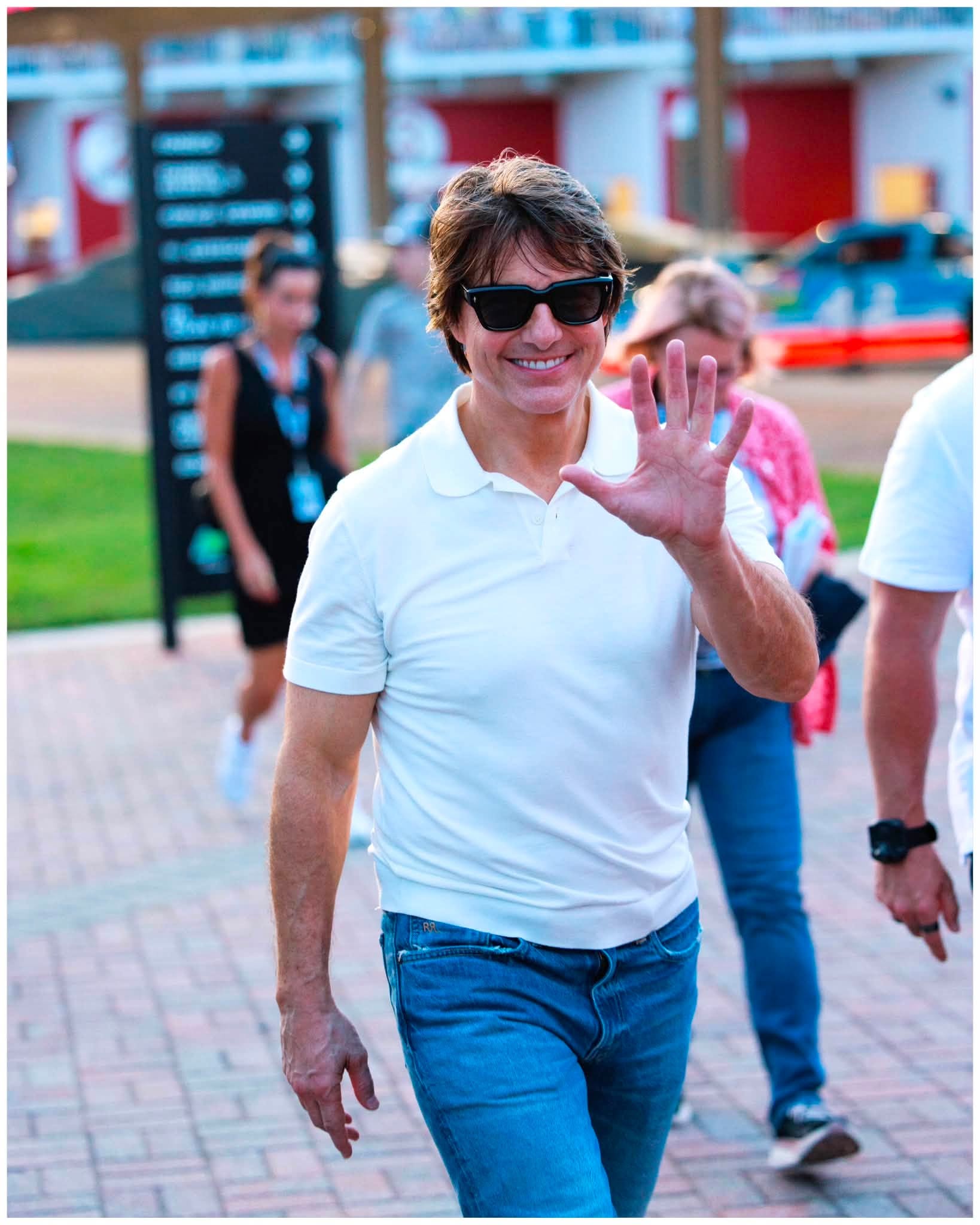
Hollywood superstar Tom Cruise smiles and waves while making an appearance at Daytona International Speedway during NASCAR race weekend. Photo Credit: Arthur Dell Morgan / Florida National News
Cole Trickle Is Coming Back
Cruise first played talented but hotheaded NASCAR driver Cole Trickle in the original “Days of Thunder,” released in 1990.
Now, Cole Trickle is coming back.
Cruise announced the sequel from Daytona on Saturday, Aug. 29, hours before the NASCAR Cup Series regular-season finale.
Cruise will star and produce alongside longtime collaborator Jerry Bruckheimer and Tommy Harper. Bruckheimer also produced the original film.
Jonathan Levine, whose directing credits include “50/50,” “Warm Bodies” and “Long Shot,” is set to direct from a screenplay by Will Staples.
The film is being developed for a major theatrical release, including IMAX and other premium formats.
Paramount’s promotional materials currently call the film simply “Days of Thunder,” although the project is widely being referred to as “Days of Thunder 2.”
Days of Thunder. Summer 2028. pic.twitter.com/rD3QLXfUyi
— Tom Cruise (@TomCruise) August 29, 2026
Anne Hathaway Joins Cruise at Daytona
Cruise won’t return to the NASCAR world alone.
Academy Award-winning actress Anne Hathaway will co-star as a NASCAR team owner and engineer, marking the first major on-screen collaboration between the two Hollywood stars.
Hathaway joined Cruise at Daytona for the announcement, with the two posing beside a green-and-yellow race car carrying Cole Trickle’s name and “Days of Thunder” branding.
Hathaway is known for blockbuster and critically acclaimed films including “The Devil Wears Prada,” “Les Misérables,” “The Dark Knight Rises,” “Interstellar” and “The Princess Diaries.”
Plot details remain under wraps, including where audiences will find Cole Trickle nearly four decades after the original movie.
Cruise Meets NASCAR Drivers
Cruise didn’t simply announce the movie and leave.
He attended the NASCAR Cup Series pre-race drivers’ meeting ahead of the Coke Zero Sugar 400, addressing a room filled with NASCAR drivers and racing industry figures.
Bruckheimer, Harper and Staples also attended.
Cruise reflected on filming the original movie at Daytona, including the risks of shooting racing sequences at high speeds.
He also made clear that the sequel will be about more than cars traveling nearly 200 mph.
Cruise told the NASCAR community that the original “Days of Thunder” sought to capture something special about racers and the culture surrounding them.
For the new film, Cruise said the filmmakers want audiences to understand NASCAR as a team, a community and a culture, while also experiencing the speed, excitement and danger of the sport.
That message could prove central to the sequel as Cruise and the filmmakers attempt to introduce a new generation of moviegoers to NASCAR.
Cruise Honors Late NASCAR Champion Kyle Busch
One of Cruise’s most poignant Daytona moments came during the drivers’ meeting.
Cruise sat beside an empty chair bearing the name of late two-time NASCAR Cup Series champion Kyle Busch, who died in May.
Photos from the gathering showed Cruise reaching over and patting the empty seat before looking down in a quiet gesture of respect.
The moment resonated with NASCAR fans as tributes to Busch have continued throughout the racing community.
It also carried an added connection to Cruise’s racing movie legacy: “Days of Thunder” was reportedly one of Busch’s favorite racing films.
Amid the excitement surrounding a major Hollywood announcement, Cruise’s simple gesture provided a solemn moment of remembrance for one of NASCAR’s biggest stars.
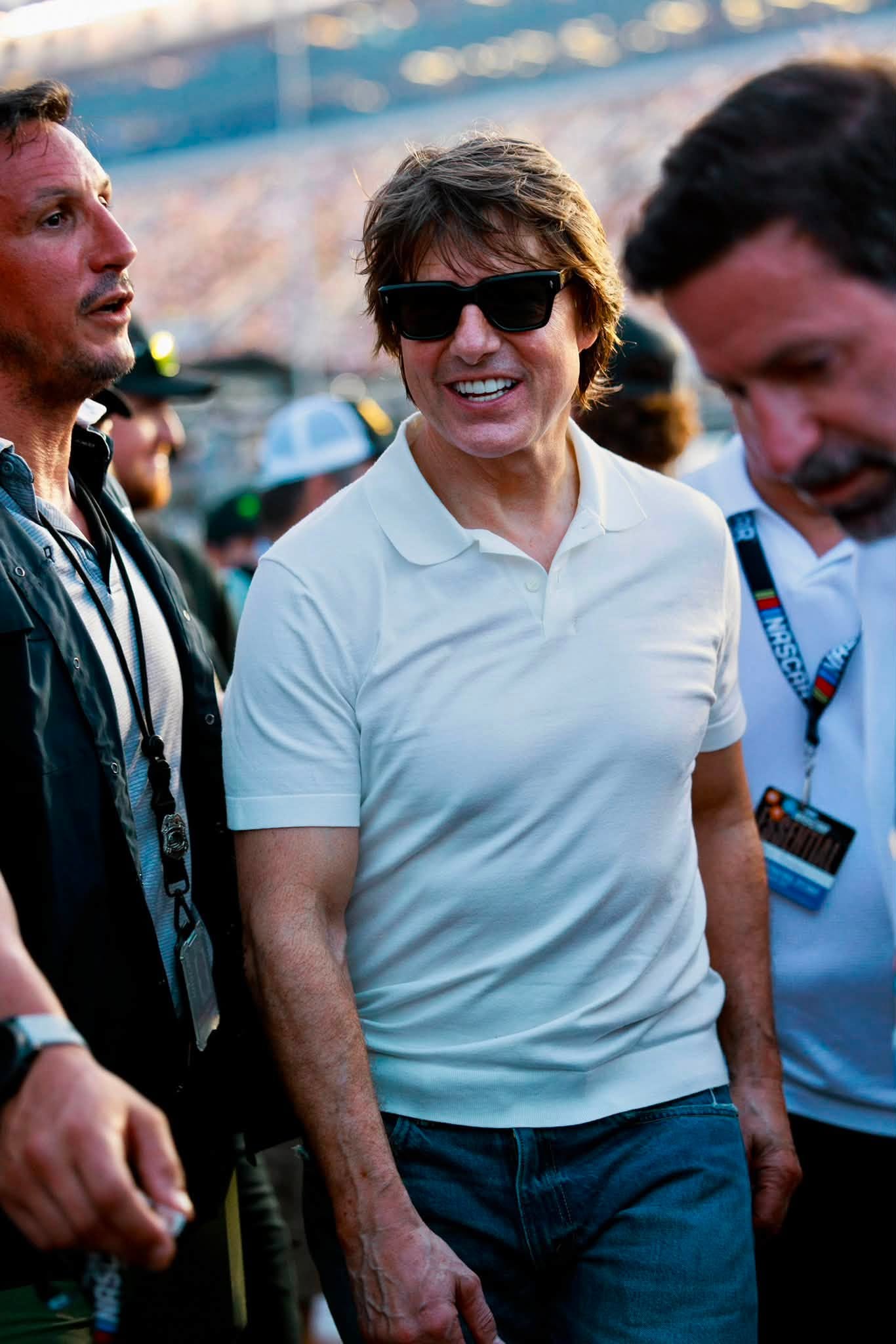
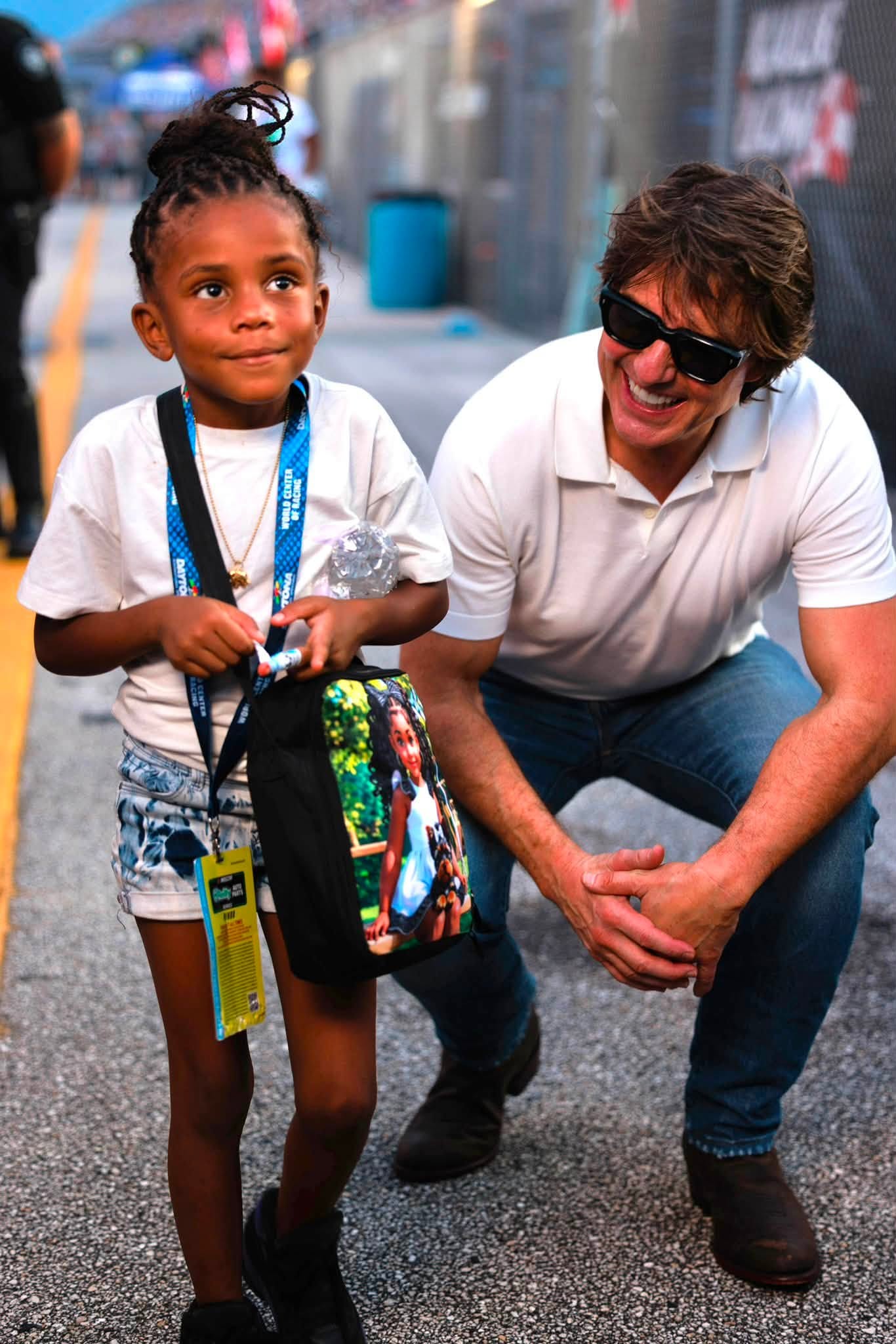
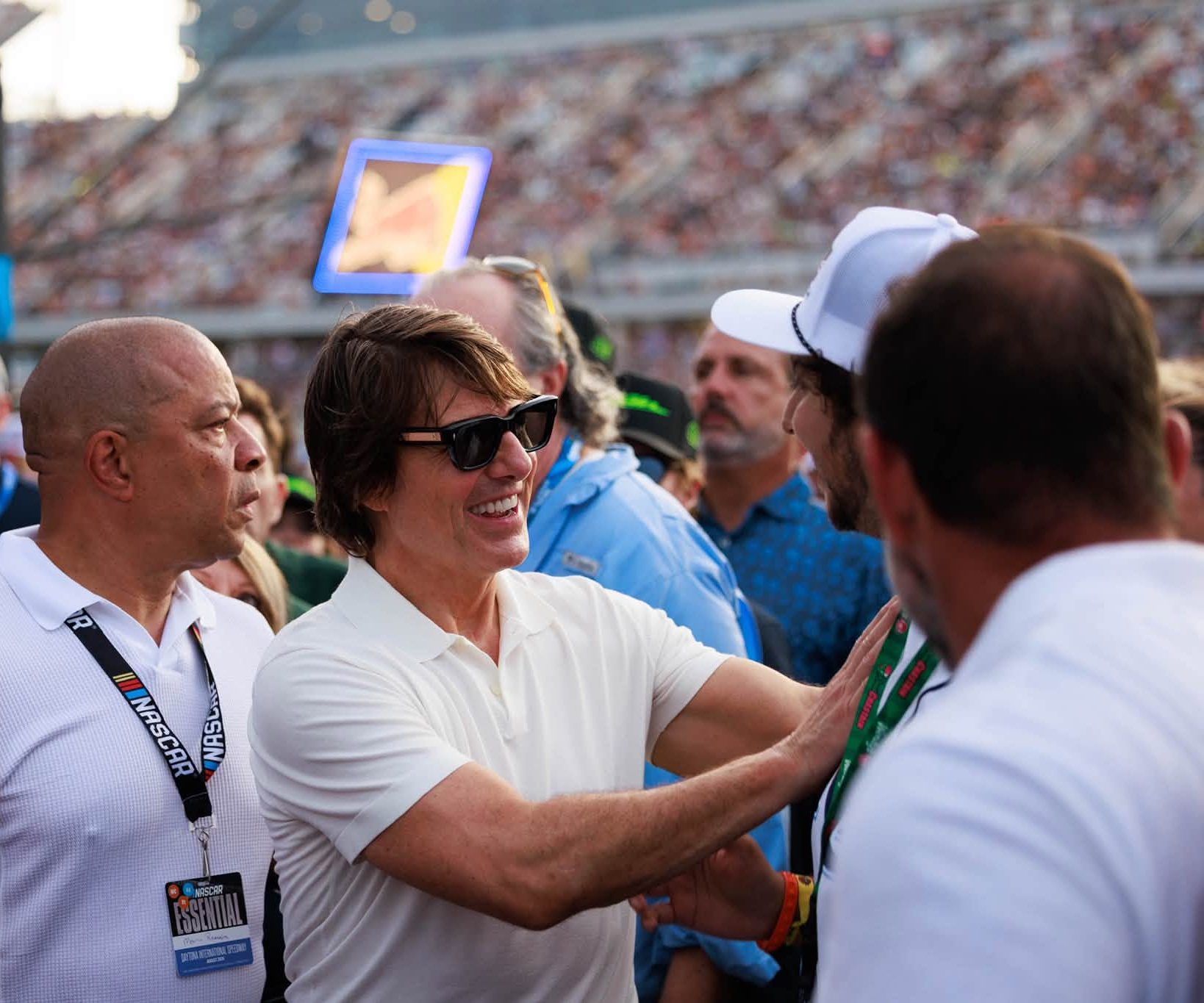
Hollywood superstar Tom Cruise makes an appearance at Daytona International Speedway during the 2026 Coke Zero Sugar 400, embracing NASCAR community and fans. Photo Credit: Arthur Dell Morgan / Florida National News
FNN Captures Cruise Showing NASCAR Fans Love
Outside the drivers’ meeting, Cruise’s interaction with fans became one of the most memorable parts of his Daytona appearance.
Florida National News video and photo coverage captured Cruise up close as he greeted NASCAR fans, stopped for selfies, shared hugs and talked with spectators.
The reaction was immediate.
Phones went up. Fans gathered. Smiles spread through the crowd.
Cruise wasn’t simply a Hollywood celebrity watching the race from a distance. Fans got an opportunity to see one of the world’s most recognizable movie stars up close.
Some got photographs.
Others got a handshake, a hug or a few words with the megastar.
For longtime Cruise fans who have watched him on movie screens for decades, suddenly standing face-to-face with him at Daytona transformed an already memorable NASCAR weekend into something personal.
A selfie. A hug. A handshake. A conversation with Tom Cruise.
For many, it was the kind of dream-of-a-lifetime encounter they never expected when they arrived at Daytona International Speedway.
And FNN cameras were there to capture it.
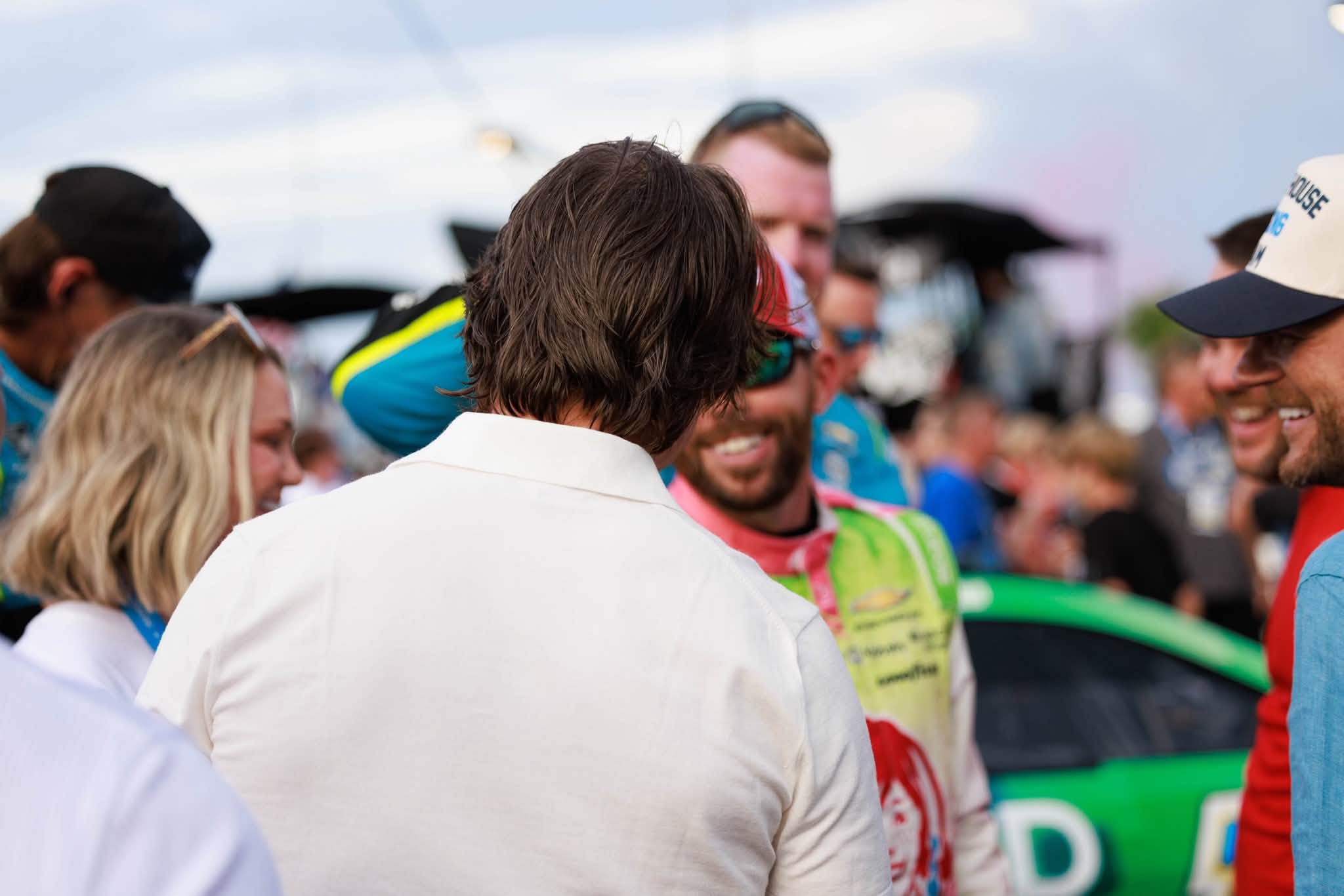
Hollywood superstar Tom Cruise visits with NASCAR drivers and members of the racing community during the 2026 Coke Zero Sugar 400 at Daytona International Speedway.
Photo Credit: Arthur Dell Morgan / Florida National News
Cruise Takes in the NASCAR Experience
Cruise immersed himself in NASCAR’s pre-race atmosphere after addressing the drivers.
He made his way toward the starting grid for pre-race ceremonies, getting an up-close look at the drivers, teams, cars and crews preparing for one of NASCAR’s biggest nights.
The experience offered Cruise and the filmmakers another opportunity to observe modern NASCAR firsthand as they prepare to bring Cole Trickle back to the big screen.
That authenticity could become especially important for a movie Cruise says will focus not only on racing, but also on the people and teamwork behind it.
From ‘Risky Business’ to ‘Top Gun: Maverick’
Cruise’s Daytona appearance brought one of the world’s most successful movie stars directly into the heart of NASCAR.
Over more than four decades, Cruise has starred in some of Hollywood’s most recognizable films, including:
- “Risky Business”
- “Top Gun”
- “Rain Man”
- “A Few Good Men”
- “Jerry Maguire”
- the blockbuster “Mission: Impossible” franchise
- “Top Gun: Maverick”
- and “Days of Thunder.”
His reputation for high-energy action movies and performing ambitious practical stunts makes his return to a racing film particularly intriguing.
Cruise even recalled at Daytona how dangerous filming the original could become, describing an incident in which the race car he was driving caught fire while cameras were rolling.

‘Days of Thunder’ Became a NASCAR Favorite
Directed by the late Tony Scott, the original “Days of Thunder” followed Trickle as he entered NASCAR and learned to harness his raw talent and aggression with the help of veteran crew chief Harry Hogge, played by Robert Duvall.
The movie also starred Nicole Kidman, Randy Quaid, Michael Rooker, Cary Elwes and John C. Reilly.
Although its initial critical reception was mixed, the movie developed an enduring following, particularly among NASCAR fans.
More than three decades later, Cole Trickle, his No. 46 race car and the movie’s depiction of NASCAR remain recognizable pieces of racing pop culture.
Can Cruise Repeat the ‘Top Gun: Maverick’ Magic?
Cruise’s decision to return as Cole Trickle inevitably draws comparisons with another enormously successful return to one of his signature roles.
In 2022, Cruise returned as Capt. Pete “Maverick” Mitchell in “Top Gun: Maverick,” 36 years after the original “Top Gun.”
The sequel became a worldwide blockbuster and the biggest box-office success of Cruise’s career.
Now Cruise and Bruckheimer are returning to another movie from their past.
“Days of Thunder” will arrive nearly 38 years after the original — giving Cruise another opportunity to introduce an iconic character to a new generation while bringing longtime fans back to the theater.
Days of Thunder. Summer 2028. pic.twitter.com/l7tWBQVONm
— Tom Cruise (@TomCruise) August 29, 2026
Daytona Provides the Perfect Stage
Few places could have provided a more fitting backdrop for Cruise’s announcement than Daytona International Speedway.
Daytona played an important role in the original movie, and Cruise filmed racing sequences at the legendary track.
Nearly four decades later, he returned to the “World Center of Racing” to tell NASCAR that Cole Trickle is coming back.
Cruise met drivers, addressed the NASCAR community, honored Kyle Busch and connected personally with race fans before the Coke Zero Sugar 400.
Hours later, the real racing delivered its own Hollywood-style ending as Ryan Preece captured the Coke Zero Sugar 400 in overtime, earning his first points-paying NASCAR Cup Series victory.
From Daytona Back to the Big Screen
Many questions about the new “Days of Thunder” remain unanswered.
The complete cast has not been announced. The storyline remains under wraps. NASCAR’s precise role in the production has not been fully detailed.
But several major pieces are now on the starting grid:
Tom Cruise is returning as Cole Trickle.
Anne Hathaway is joining him as a NASCAR team owner and engineer.
Jerry Bruckheimer is producing.
Jonathan Levine is directing.
And “Days of Thunder” is scheduled to race into theaters June 2, 2028.
For NASCAR fans at Daytona, however, the movie announcement was only part of the story.
They got Tom Cruise in person.
They watched one of Hollywood’s biggest stars step into their racing world, meet NASCAR drivers, honor a fallen champion and show fans some love.
For some, the unexpected opportunity to see, hug, photograph or simply exchange a few words with Cruise became a memory of a lifetime.
And Florida National News was on the scene to capture the excitement, energy and star power as Hollywood met NASCAR at Daytona.
WATCH FNN VIDEO: Hollywood megastar Tom Cruise connects with NASCAR fans at Daytona International Speedway as he announces the highly anticipated return of “Days of Thunder.”
Entertainment
Dr. Phillips Center’s Free Frontyard Holiday Festival Returns to Downtown Orlando Nov. 27


 Florida3 days ago
Democratic Leaders Condemned Susan Valdés’ GOP Switch; Orange Democrats Later Appear Alongside Her
 Entertainment1 day ago
Tom Cruise Announces ‘Days of Thunder’ 2 With Anne Hathaway, Surprises NASCAR Fans at Daytona
 Sports3 days ago
Ryan Preece Captures Checkered Flag in Dramatic Coke Zero Sugar 400 Victory at Daytona
 Sports3 days ago
Jaguars Shut Out Buccaneers 19-0 in Preseason Finale


