Connect with us

Tech

Yearlong Spacemen Embrace Fresh, Frigid Air Back on Earth

Published

on

CAPE CANAVERAL, Fla. (AP) — Ah, there’s nothing like a blast of fresh, frigid air to welcome you back to the planet after nearly a year cooped up in space.

That’s the word from astronaut Scott Kelly, NASA’s space-endurance champ who returned to bitterly cold Kazakhstan on Wednesday, along with his roommate for the past year, Russian cosmonaut Mikhail Kornienko.

In a NASA interview before heading home to Houston, where he arrived early Thursday, Kelly said it was “amazing” to feel the cold air when the hatch of his Soyuz capsule popped open after touchdown.

“I don’t mean to say it’s not fresh on the space station,” he said, “but there’s nothing like new cold air coming into the capsule.”

Both Kelly, 52, and Kornienko, 55, yearned for nature throughout their 340-day mission at the International Space Station, a dry run by NASA for eventual trips to Mars.

“Just like Scott, I wanted to see Earth and I wanted to smell that fresh air. This is an unforgettable feeling,” Kornienko said.

It was the longest an American ever lived in space, although nothing new for the Russians. The world record is 438 days, set back in the mid-1990s at the former Mir space station. Even before that, a pair of Soviet cosmonauts had racked up a full one-year spaceflight.

“Congratulations on your record,” former cosmonaut and Kazak space agency chief Talgat Musabayev said at a welcoming ceremony. He couldn’t resist: “Of course, it was already done 28 years ago.”

President Barack Obama joined the chorus of praise pouring in.

“Welcome back to Earth, @StationCDRKelly! Your year in space is vital to the future of American space travel. Hope gravity isn’t a drag!” Obama said via Twitter.

The White House said Obama spoke with Kelly on Wednesday, thanking him for his service and for sharing his journey through social media. Kelly posted hundreds of photos of Earth.

After landing, the latest one-year space subjects quickly parted company, Kelly flying back to Houston and Kornienko to Star City, Russia, near Moscow. While en route, Kelly tweeted a picture of his first salad back on Earth, noting it will be important to grow fresh food during Mars expeditions, like his space station lettuce crop.

Kelly acknowledged it was bittersweet leaving the space station – his home since last March, currently staffed by three men until the arrival of three more in two weeks.

“I’d been there a long time, so I looked forward to leaving. But at the same time, it’s a magnificent place and I’m going to miss it,” he said.

Neither will be saying goodbye – in Russian, do svidaniya – to medical tests anytime soon.

Minutes after emerging from their capsule, they were whisked in chairs to a medical tent where they did their best to stand, walk, jump, navigate obstacles – everything an astronaut might need to do immediately upon arriving at Mars.

NASA aims to put astronauts on the red planet in the 2030s, but first wants to know how the body – and mind – will fare during the 2½-year expedition. Kelly ranked physical isolation aboard the 250-mile-high platform, from those he loved, as his biggest challenge.

Kelly looked fit as he emerged from the Soyuz capsule on the remote steppes of central Asia, pumping his fist and giving a thumbs-up. He showed no signs of slowing down a few hours later as he waited to board the plane for the long flight back to Houston. He needed little if any assistance in walking and said there seemed to be little difference from his five-month station stint five years ago.

The exams – along with blood, saliva and urine collections – will continue for weeks if not months. In the case of Kelly and his identical twin, retired astronaut Mark Kelly, the testing could last a year if not longer. The brothers served as guinea pigs – one in weightlessness, the other on the ground.

Kelly’s last tweet from orbit Tuesday provided a cliffhanger: “The journey isn’t over. Follow me as I rediscover #Earth!”

The brothers were reunited at Ellington Airport near Johnson Space Center in Houston early Thursday. The welcoming committee included Scott’s two daughters, ages 21 and 12; his girlfriend who’s been chronicling his mission as a NASA public affairs officer at Johnson; and his sister-in-law, former Arizona congresswoman Gabrielle Giffords, Mark’s wife.

“It’s great to be back in Texas on U.S. soil,” Scott Kelly told the crowd. “I missed everyone very much.”

Also joining in the celebration: Vice President Joe Biden’s wife, Jill, and NASA Administrator Charles Bolden.

“I brought you some beer and apple pie – nothing’s more American than that,” Jill Biden said.

As for his space legacy, Kelly said he and Kornienko “were a small part” in setting the stage for Mars.

“Expanding our envelope and our ability to operate in space is something that’s going to take us farther from this planet,” he said.

He stressed that it took thousands working behind the scenes to pull off this mission, noting: “It’s really not about us.”

Maybe so, but their sacrifice was duly noted by grateful well-wishers at NASA and elsewhere. On this flight alone, the pair traveled 144 million miles through space – the average distance between Earth and neighbor Mars – and were exposed to cosmic radiation. They tackled 400 experiments, some of them unpleasant. And like other station residents, Kelly downed recycled urine and sweat – nearly 200 gallons over the year.

Make no mistake, “a year’s a long time,” according to Kelly. He checked into the space station last March and by the six-month mark last September, “I felt like I had been up there my whole life.”

Six months is the typical space station stint; that was the mission length for Russian cosmonaut Sergey Volkov, who piloted Kelly and Kornienko to a safe Soyuz touchdown.

“I’m definitely encouraged on our ability to go even longer,” Kelly said. “I mean, even though I looked forward to coming home and there were things that I missed, I felt like if it was for the right reason, I clearly could have stayed however long it took.”

Continue Reading
Click to comment

Leave a Reply

Your email address will not be published. Required fields are marked *

Tech

NASA Rolls Out Massive SLS Rocket Stage for Artemis III Mission to Kennedy Space Center

Published

on

Pictured above is the top four-fifths of the SLS (Space Launch System) core stage – the section containing the liquid hydrogen tank, liquid oxygen tank, intertank, and forward skirt. NASA will roll the largest section of the agency’s SLS rocket that will launch the second crewed Artemis mission under the Artemis III mission out of NASA’s Michoud Assembly Facility on Monday, April 20. Credit: NASA

NEW ORLEANS (FNN) — NASA will roll out the largest section of its Space Launch System rocket on Monday, April 20, marking a major milestone for the Artemis III mission.

The section, representing the top four-fifths of the SLS core stage, is being moved from NASA’s Michoud Assembly Facility in New Orleans. It includes the liquid hydrogen tank, liquid oxygen tank, intertank and forward skirt. The structure will be loaded onto NASA’s Pegasus barge for transport to Kennedy Space Center in Florida.

CORE STAGE DELIVERY AND INTEGRATION

Once the core stage arrives at Kennedy Space Center, teams will complete final outfitting and vertical integration. The hardware will then be transferred to NASA’s Exploration Ground Systems Program for stacking and launch preparation.

The Artemis III engine section and boat-tail, which protects the engines during launch, were previously moved to the Vehicle Assembly Building in July 2025. The four RS-25 engines are scheduled to arrive from Stennis Space Center in Mississippi no later than July 2026 for integration.

POWERING THE ARTEMIS III MISSION

Equipped with four RS-25 engines, the SLS core stage will generate more than 2 million pounds of thrust, enabling the launch of astronauts aboard the Orion spacecraft.

Artemis III is currently targeted for launch in 2027, following the successful Artemis II mission, which completed a crewed flight around the Moon on April 10.

NASA’S MOON-TO-MARS STRATEGY

The Artemis III mission is part of NASA’s broader Artemis program, aimed at returning astronauts to the Moon and establishing a sustained human presence.

The mission will test critical capabilities, including rendezvous and docking between the Orion spacecraft and commercial systems needed for future lunar landings, currently planned for 2028.

NASA is working in partnership with Boeing, the SLS core stage lead contractor, and L3Harris Technologies, the lead contractor for the RS-25 engines. The core stage remains the backbone of the SLS rocket and is manufactured at the Michoud Assembly Facilit

Continue Reading

Tech

NASA’s Artemis II Astronauts Begin Historic Journey Around the Moon After Key Orion Engine Burn

Published

on

Earth's crescent is seen from a solar array camera on the Orion spacecraft on the first flight day of the Artemis II mission. Credit: NASA

CAPE CANAVERAL, Fla. (FNN) — For the first time in more than 50 years, astronauts on a NASA mission are headed around the Moon after successfully completing a critical burn of the Orion spacecraft’s main engine.

The approximately six-minute firing of Orion’s service module engine Thursday — known as the translunar injection burn — accelerated the spacecraft and its crew beyond Earth’s orbit, placing them on a trajectory toward the Moon.

Aboard the spacecraft are NASA astronauts Reid Wiseman, Victor Glover and Christina Koch, along with Canadian Space Agency astronaut Jeremy Hansen.

“Today, for the first time since Apollo 17 in 1972, humans have departed Earth orbit,” said Dr. Lori Glaze, acting associate administrator for NASA’s Exploration Systems Development Mission Directorate. “Reid, Victor, Christina and Jeremy now are on a precise trajectory toward the Moon. Orion is operating with crew for the first time in space, and we are gathering critical data and learning from each step.”

NASA’s Space Launch System rocket and Orion spacecraft lifted off from Launch Pad 39B at Kennedy Space Center at 6:35 p.m. EDT on April 1, beginning a planned 10-day test mission around the Moon and back.

Successful Launch and Spacecraft Activation

Shortly after reaching space, Orion deployed its four solar array wings, allowing the spacecraft to generate power from the Sun. The crew and mission controllers then began transitioning the spacecraft from launch to normal flight operations while checking critical onboard systems.

About 49 minutes into the flight, the rocket’s upper stage fired to place Orion into an elliptical orbit around Earth. A second burn propelled the spacecraft — named “Integrity” by the crew — into a high Earth orbit extending roughly 46,000 miles above the planet for nearly 24 hours of system testing.

Following the maneuver, Orion separated from the upper stage and began flying independently.

System Tests and Crew Operations in Space

During the early phase of the mission, the astronauts conducted a manual piloting demonstration to evaluate Orion’s handling capabilities using the Interim Cryogenic Propulsion Stage as a docking target.

After the test, Orion executed an automated departure burn to safely move away from the stage. The propulsion stage later performed a disposal burn before re-entering Earth’s atmosphere over a remote area of the Pacific Ocean.

Before its re-entry, four small CubeSats were deployed from the rocket’s Orion stage adapter to conduct separate scientific missions.

Mission teams also transitioned communications to NASA’s Deep Space Network while the crew adjusted to the space environment. Astronauts completed their first rest periods, performed onboard exercise routines, restored the spacecraft’s toilet to normal operations and prepared the spacecraft for the translunar injection burn.

Lunar Flyby and Artemis Program Goals

The crew is scheduled to conduct a lunar flyby Monday, April 6, when astronauts will capture high-resolution images and make observations of the Moon’s surface — including portions of the lunar far side rarely seen directly by humans.

Although the far side will only be partially illuminated during the flyby, the lighting conditions are expected to cast long shadows across the terrain, highlighting ridges, slopes and crater rims that are difficult to observe under full sunlight.

After completing the flyby, the astronauts will return to Earth and splash down in the Pacific Ocean off the coast of San Diego.

The mission marks a major milestone for NASA’s Artemis program, which aims to send astronauts on increasingly ambitious missions to explore the Moon, advance scientific discovery, stimulate economic growth and prepare for the first crewed missions to Mars.

Continue Reading

Florida

VIDEO: NASA Artemis II Mission Sends Astronauts Around the Moon in First Crewed Test Since Apollo

Published

on

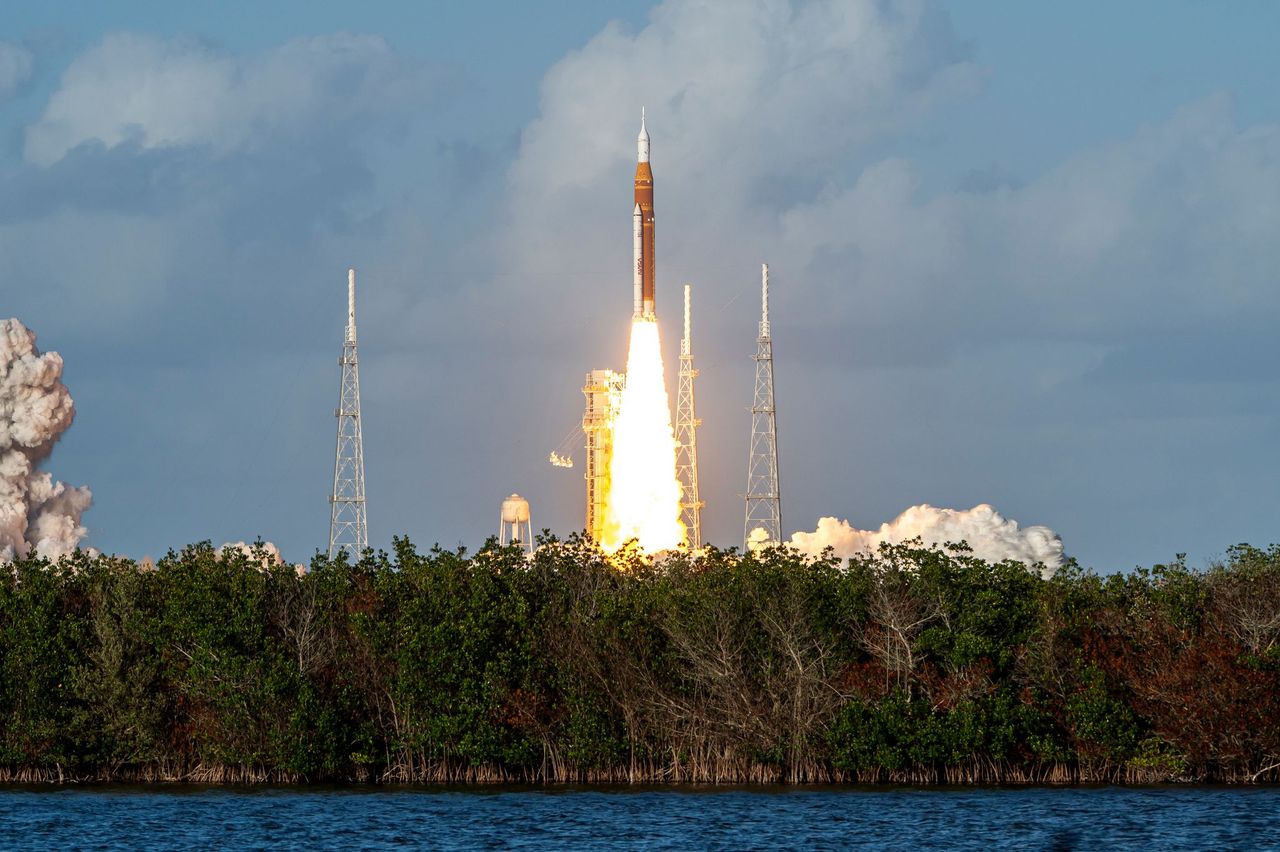
The Artemis II crewed lunar mission launches from Kennedy Space Center on April 1, 2026. Four astronauts blasted off aboard a massive NASA rocket on a long-anticipated journey around the Moon—marking the first crewed lunar flyby in more than 50 years. Photo by Nickolas Wolf / Florida National News.
CAPE CANAVERAL, Fla. (FNN) — NASA is preparing to launch the crew of Artemis II on a historic journey around the Moon, marking the first time astronauts will travel beyond low-Earth orbit since the era of Apollo Program.
The mission will lift off from Kennedy Space Center aboard the Space Launch System, carrying astronauts in the Orion spacecraft on a multi-day flight that will orbit the Moon before returning safely to Earth.

The Artemis II crewed lunar mission launches from Kennedy Space Center on April 1, 2026. Four astronauts blasted off aboard a massive NASA rocket on a long-anticipated journey around the Moon—marking the first crewed lunar flyby in more than 50 years. Photo by Nickolas Wolf / Florida National News.


Historic Return to Deep Space Artemis II is the first crewed mission in NASA’s Artemis program, designed to return humans to the Moon and eventually establish a sustainable presence there. The flight follows the successful uncrewed test mission, Artemis I, which demonstrated the Orion spacecraft’s ability to travel to lunar orbit and return to Earth. The Artemis program represents NASA’s long-term strategy to explore deep space, including preparing astronauts for future missions to Mars. Astronaut Crew to Circle the Moon

The Artemis II crew includes four astronauts selected to test Orion’s life-support systems and navigation capabilities during the mission.

The Artemis II crewed lunar mission launches from Kennedy Space Center on April 1, 2026. Four astronauts blasted off aboard a massive NASA rocket on a long-anticipated journey around the Moon—marking the first crewed lunar flyby in more than 50 years.
Photo by Nickolas Wolf / Florida National News.


Their journey will take them thousands of miles beyond the Moon before returning to Earth. The mission will also demonstrate critical technologies needed for future lunar landings planned under upcoming Artemis missions.

Florida’s Space Coast in the Global Spotlight The launch is expected to draw thousands of spectators to Florida’s Space Coast, including viewers gathering along beaches in Cocoa Beach and nearby communities to witness the historic liftoff.

Local officials and tourism leaders say the Artemis program continues to reinforce Florida’s role as the nation’s gateway to space exploration.


Continue Reading
Advertisement
Advertisement Ticket Time Machine ad
Advertisement Orlando Regional REALTOR Association logo
Advertisement Parts Pass App
Advertisement Hispanic Chamber of Commerce of Metro Orlando
Advertisement
Advertisement African American Chamber of Commerce of Central Florida
Advertisement FNN News en Español
Advertisement Indian American Chamber of Commerce logo
Advertisement Florida Sports Channel

FNN Newsletter

Trending