

Politics
Asian Americans feel particularly targeted by new laws criminalizing those who assist voters


WASHINGTON (AP) — For a century, the League of Women Voters in Florida formed bonds with marginalized residents by helping them register to vote — and, in recent years, those efforts have extended to the growing Asian American and Asian immigrant communities.
But a state law signed by Gov. Ron DeSantis in May would have forced the group to alter its strategy.

The legislation would have imposed a $50,000 fine on third-party voter registration organizations if the staff or volunteers who handle or collect the forms have been convicted of a felony or are not U.S. citizens.
A federal judge blocked the provision this week. But its passage reflects the effort by DeSantis, a Republican presidential candidate, and other GOP leaders to crack down on access to the ballot. Florida is one of at least six states, including Georgia and Texas, where Republicans have enacted voting rules since 2021 that created or boosted criminal penalties and fines for individuals and groups that assist voters. Several of those laws are also facing legal challenges.
In the meantime, voting rights advocates are being forced to quickly adapt to the changing environment. Before the ruling in Florida, for instance, the League of Women Voters started using online links and QR codes for outreach. It removed the personal connection between its workers and communities and replaced it with digital tools that are likely to become a technological barrier.
“If there’s not access, in terms of language, we can’t get to as many people, which particularly affects AAPI voters,” Executive Director Leah Nash said, referring to the state’s Asian American and Pacific Island population, which has grown rapidly and where more than 30% of adults have limited English proficiency. “If we just give someone our website or QR code to go register, we don’t know for sure if they’re doing it and we like to get as many people registered to vote as possible.”
In states where penalties are getting tougher, the developments have sowed fear and confusion among groups that provide translators, voter registration help and assistance with mail-in balloting — roles that voting rights advocates say are vital for Asian communities in particular.
In a number of states, language barriers already hamper access to the ballot for a population that has been growing rapidly. Asian, Native Hawaiian and other Pacific Islander populations grew 35% between 2010 and 2020, according to Census data. The new laws in mostly Republican-led states are seen by many voting groups as another form of voter suppression.

“It’s specifically targeting limited English proficiency voters, and that includes AAPI voters,” said Meredyth Yoon, litigation director at Asian Americans Advancing Justice in Atlanta.
Yoon added that record turnout for the 2020 elections in Georgia influenced the Republican-dominated legislature to pass sweeping voter restrictions: “It’s not a coincidence,” she said.
In Texas, Republican Gov. Greg Abbott signed a bill in June that raises the penalty for illegal voting to a felony, upping it from a misdemeanor charge that was part of a sweeping elections law passed two years earlier.
Alice Yi, who is Chinese American, used to help translate in Austin, Texas, but said the new law isn’t clear about whether good faith mistakes will be criminalized and worries that she could get into trouble by offering assistance.
Yi recalls being approached during a 2022 primary election by a man who was Vietnamese American and asked for help because he hadn’t voted before and didn’t speak English. She said she was immediately worried she could face consequences if she helped him.
“This is the fear I’m facing,” she said.
Now, she said, she will help her father vote, but no one else.
But voting rights supporters like Ashley Cheng — also in Austin — remain committed to reaching Asian voters, despite the threat of jail time.
Cheng, the founding president of Asian Texans for Justice, recalls discovering her mother was not listed in the voter rolls when she tried to help her vote in 2018. They never found out why she wasn’t properly registered. Advocates say this highlights flaws in the system and illustrates how volunteers are essential to overcoming them.
The group’s own research has found that roughly two-thirds of Asian voters in Texas were highly motivated to vote in the 2022 midterm elections. Cheng said that desire amplified her enthusiasm to help the community get its votes counted.
“It’s really easy to feel like, ‘Oh, I would love to just like not try anymore,’” she said. “But, I think about people like my mom and so many others in the Asian diaspora who live in Texas who have that experience of wanting to vote but not being able to, for whatever reason, are not feeling like it’s accessible.”
For instance, some 34% of Asian American adults in Texas have limited English proficiency, according to 2022 data from Asian and Pacific Islander American Vote (APIA Vote), a nonpartisan Asian American and Pacific Islander advocacy group.
Farha Ahmed, an attorney in Texas, said the increased liability in helping these marginalized communities access the ballot box forced her to decide against continuing as an election judge, a position that administers voting procedures and settles disputes concerning election laws.
“There’s not a lot of resources and there’s not a lot of protection,” said Ahmed, who lives in Sugarland, just outside Houston. “Election judges want to help make it easy for people to vote, but with these new laws in place, they’re very unsure of where is their liability when they’re really just trying to do their best to help.”
Before Florida and Texas, Georgia lawmakers overhauled that state’s election laws.
A section of Georgia’s 2021 election bill made it a misdemeanor to offer a voter any money or gifts at polling places, a provision that included passing out water and snacks for those waiting in lines. Attempts to get a court to toss out the ban on snacks and water have so far been unsuccessful.
James Woo, the communications director at Asian Americans Advancing Justice-Atlanta, said he won’t even get his parents a drink of water while helping them with their ballots.
“It’s simple things like that, which would have been like a conversation starter or just like helping them throughout the process, might be viewed as like something illegal I’m doing,” he said.

Florida
Civil Rights Group Honors Nobel Peace Prize Winner Navi Pillay, Highlights Florida’s Trayvon Martin Connection

The Orlando-based civil rights association recalls supporting the former U.N. human rights chief’s 2012 call for an investigation into the teenager’s killing in Sanford.
ORLANDO, Fla. (FNN) — The Florida Civil Rights Association is congratulating 2026 Nobel Peace Prize winner Navanethem “Navi” Pillay, recalling her call for an investigation into Trayvon Martin’s killing and the international attention it brought to questions of racial equality and justice in Florida.
The Norwegian Nobel Committee announced Pillay’s selection Oct. 9 for her efforts to promote peace and international law. The South African jurist served as United Nations high commissioner for human rights from 2008 to 2014 and helped shape landmark international court decisions.
In a press release, FCRA President J. Willie David III said Pillay’s intervention connected a Florida family’s demand for answers to a broader concern for human rights.
“Pillay’s call for an investigation reinforced that a family’s demand for justice in Sanford mattered beyond Florida and the United States,” David said.
“We welcomed her intervention in 2012 because families deserve answers and the law must protect everyone equally.”
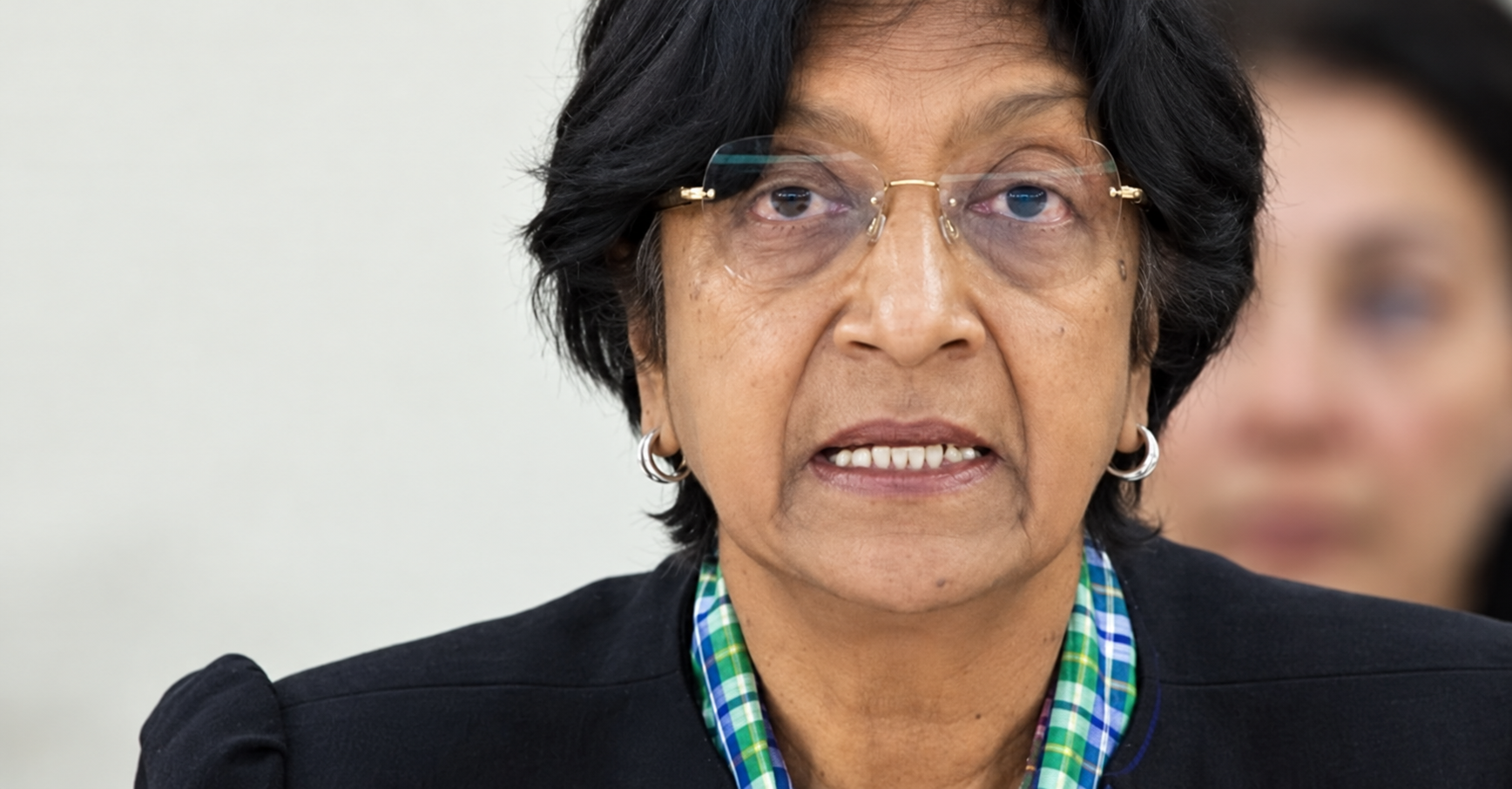
UN Human Rights Commissioner Navi Pillay (Photo credit: UN Photo/Jean-Marc Ferre)
FCRA recalls its response in 2012
Martin, an unarmed Black 17-year-old, was fatally shot by neighborhood watch volunteer George Zimmerman on Feb. 26, 2012, in Sanford, northeast of Orlando.
In April 2012, Pillay called for an immediate investigation into the killing as the case drew international attention and scrutiny of Florida’s Stand Your Ground law.
FCRA welcomed that call. The association’s current release cites an April 7, 2012, West Orlando News report that quoted David discussing the case’s global impact.
“The shooting death of Trayvon Martin and Florida’s Stand Your Ground Law have created a worldwide movement that calls into question how justice is delivered to victims of color,” David said at the time, according to the release.
FCRA describes the activism surrounding Martin’s death as a defining moment that galvanized a new generation of civil rights advocates.
Zimmerman was charged with second-degree murder and acquitted in July 2013. In February 2015, the U.S. Justice Department closed its separate investigation, finding insufficient evidence to pursue federal criminal civil rights charges.
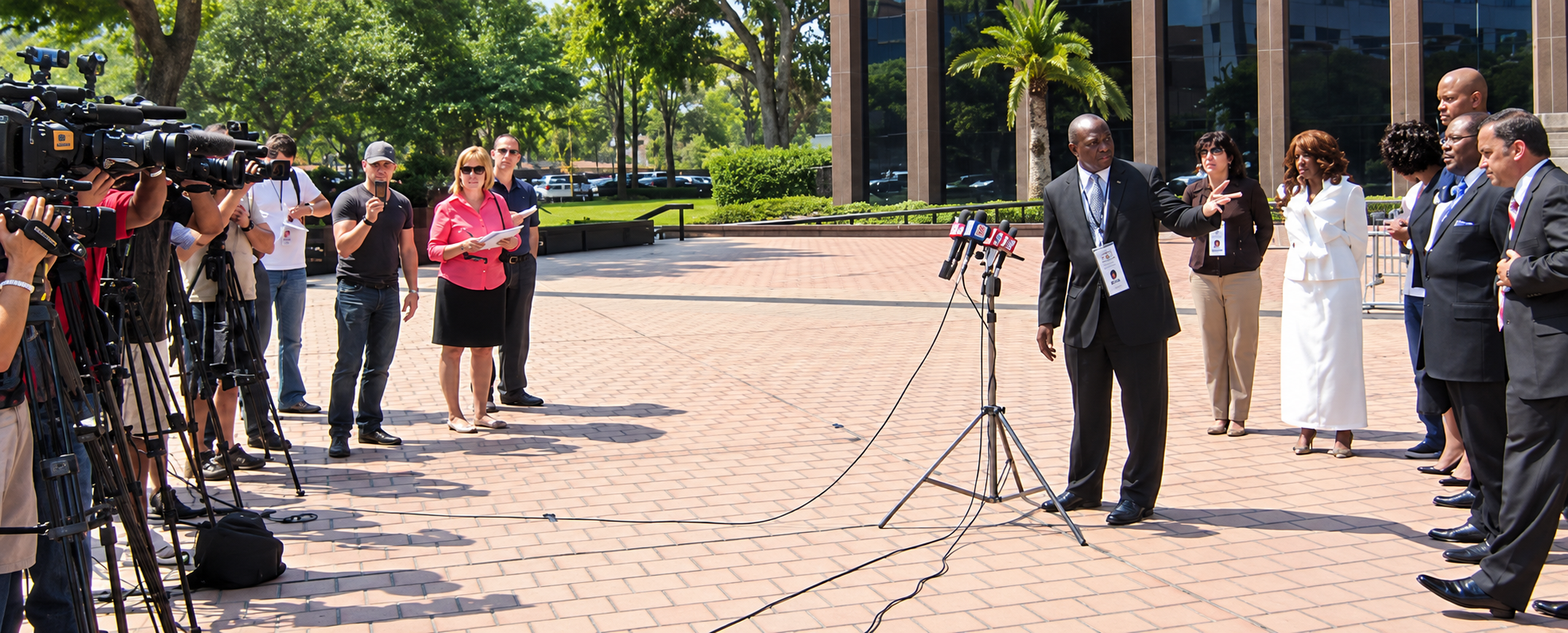
The Florida Civil Rights Association (FCRA) held a press conference outside the State of Florida’s regional offices in Orlando in 2012, calling on then-Gov. Rick Scott to take action following Trayvon Martin’s killing. Photo by FCRA.
Why Florida’s case drew global scrutiny
The Florida connection shows how the handling of a local killing can draw international scrutiny over racial discrimination, access to justice and the protection of human rights.
Pillay’s intervention brought those concerns into the international discussion surrounding Martin’s death. In September 2013, U.N. human rights experts also urged the United States to complete its civil rights investigation and examine concerns about racial profiling.
The significance lies in human rights oversight: how public institutions investigate deaths and provide equal treatment can attract attention beyond national borders. Pillay’s call was an appeal for investigation, rather than an international court judgment about Zimmerman’s guilt or Florida’s compliance with international law.
For FCRA, that connection remains relevant to how Florida leaders evaluate laws and practices affecting the communities they serve.
Pillay’s record in international justice
Pillay challenged discrimination under apartheid before serving on South Africa’s High Court, the International Criminal Tribunal for Rwanda and the International Criminal Court.
At the Rwanda tribunal, she was part of the judicial panel that established that rape and sexual violence can constitute acts of genocide, a landmark development in international criminal law.
David said honoring that career should also encourage accountability at home.
“Her Nobel Peace Prize recognizes a career built on confronting injustice through the rule of law,” he said. “Honoring that work means demanding transparent investigations and equal protection here at home. Rights belong to everyone.”
A renewed call for fairness in Florida
FCRA urged Florida leaders to safeguard impartial investigations, examine whether Stand Your Ground and other laws are applied fairly, and address policies or practices that produce discriminatory outcomes.
Founded in 2005, the association advocates for civil rights, human rights and civil liberties through education, advocacy and accountability. Its statement links Pillay’s international recognition to a continuing demand for fairness and human dignity in Florida.
Florida
Florida Governor Candidates: Donalds Spent Longer as a Democrat; Jolly Reports Longer Republican History

Central Florida News
Commissioner Uribe Announces New Date for Hispanic Heritage Festival Due to Weather

ORLANDO, Fla. (FNN) — Commissioner Uribe announced that the Hispanic Heritage Festival has been rescheduled due to weather conditions. The event will now take place Saturday, Oct. 24, 2026, from 9 a.m. to noon at Cypress Grove Park, 290 Holden Ave., Orlando.
The festival will celebrate the rich history, cultures, traditions and contributions of Hispanic and Latino communities through live music, dance performances, food and community resources.
Scheduled highlights include:
- Live music by youth orchestra The Nucleus Orchestral.
- Dance performances featuring Maria Saavedra of FusionFest with Huellas de Colombia, Unidos for Ecuador and Mexico Dansa.
- Food from Zaza.
- Community resources from 311 and other participants.
Join Commissioner Uribe and the community for a morning celebrating Hispanic and Latino heritage.
NEW DATE: Saturday, Oct. 24, 2026
TIME: 9 a.m. to noon
LOCATION: Cypress Grove Park
ADDRESS: 290 Holden Ave., Orlando, FL 32839



 Florida3 days ago
Florida Governor Candidates: Donalds Spent Longer as a Democrat; Jolly Reports Longer Republican History
 Central Florida News5 days ago
Commissioner Uribe Announces New Date for Hispanic Heritage Festival Due to Weather
 Business5 days ago
Dallas Mayor Eric Johnson Listed as Speaker for Global AI, Supply Chain Summit
 Central Florida News5 days ago
USF Comes Up Short at UTSA as Late Touchdown Seals 31-24 Loss
 Florida13 hours ago
Civil Rights Group Honors Nobel Peace Prize Winner Navi Pillay, Highlights Florida’s Trayvon Martin Connection


