

US NATIONAL NEWS
Biden-Harris Administration Announces New Actions to Empower Workers— Building on the President’s Historic Support for Workers and Unions


Under Bidenomics, America is seeing a historic level of public and private investment in manufacturing and new industries that will create good-paying jobs that Americans can raise a family on and build a community around. The President continues to fight to ensure all Americans get fair pay for a hard day’s work and have a free and fair choice to join a union.
In advance of Labor Day, the Biden-Harris Administration is announcing new actions this week to empower workers by investing in America’s clean energy workforce, establishing pathways into high-paying and union jobs, demonstrating the benefits of unions, and extending critical wage protections. These actions include:
Ensuring Clean Energy Investments Support High-Quality and Union Jobs
- Creating good-paying jobs in clean energy. The Department of the Treasury and the Internal Revenue Service published a historic proposed rule to support good-paying jobs and workforce development made possible by incentives in the Inflation Reduction Act (IRA). Many of the IRA’s clean energy deployment tax incentives are increased by five times if taxpayers pay workers prevailing wages and use Registered Apprentices. The Notice of Proposed Rulemaking (NPRM) provides clarity about how these incentives work, including penalty and correction provisions for those who fail to meet the requirements, and promotes worker-centric practices. The NPRM also encourages the use of qualifying Project Labor Agreements, which guarantee workers good-paying jobs, help construction contractors finish complex projects on time and on budget, and can establish equitable pathways into construction careers.
- Supporting a fair and just electric vehicle transition. The Department of Energy opened applications for the $2 billion Domestic Manufacturing Conversion Grants program, created by the IRA. The program will provide funding for auto manufacturers transitioning from internal combustion engine vehicles and components to electric vehicles and components. In line with the President’s call for a transition that protects workers, this program will prioritize applications from facilities that are at risk of closing or recently closed and reward applicants that retain existing workers, have strong labor partnerships, pay high wages, and convert facilities while remaining in the same community. The Department of Energy Loan Programs Office is also facilitating access to $10 billion in capital for auto factory conversions. The Office plans to prioritize the review of applications for projects in locations with a long history of auto manufacturing and demonstrate strong workforce practices and labor standards.
Demonstrating the Union Advantage
- Conducting analysis on how unions benefit the economy. The Department of the Treasury released a first-of-its-kind report that finds that unions help grow the economy by reducing inequality, raising incomes, increasing savings (including retirement savings), and broadening homeownership. According to the report, which was released as part of the White House Task Force on Worker Organizing and Empowerment chaired by Vice President Kamala Harris, union members make higher wages and are more likely to earn critical benefits like retirement, health care, child care, life insurance, and sick leave. The report also finds that all workers—even non-union workers and workers who have been laid off—experience gains from greater unionization.
- Proposing new rules that would provide millions of workers with overtime protections. The Department of Labor released a proposed rule to increase the overtime salary threshold from under $36,000 per year to roughly $55,000 per year. Under this proposal, more salaried employees making less than $55,000 per year and working more than 40 hours a week would receive at least one and one-half times their regular rates of pay for the overtime hours they work. The proposed rule would extend overtime pay to as many as 3.6 million hardworking Americans.
Increasing Wages
- Raising wages for construction workers. In August, the Department of Labor (DOL) published a final rule updating the Davis-Bacon Act prevailing wage standards for the first time in nearly 40 years. The rule affects more than one million workers constructing $200 billion in federally funded or assisted projects, who will receive higher wages over time. Nearly all of the significant construction programs contained in President Biden’s Bipartisan Infrastructure Law, CHIPS and Science Act, and Inflation Reduction Act require or provide strong incentives for the use of Davis-Bacon prevailing wages—which ensures even more workers will benefit from DOL’s new rule.
- Protecting workers’ pay. The Biden-Harris Administration has recovered more than $690 million for more than 440,000 low-paid workers across the nation. The Administration enforces laws that protect these workers from being victims of wage theft and exploitation when they were not paid minimum wages or hard-earned overtime wages, were denied their tips, or were misclassified as independent contractors.
- Empowering workers through education. Recently, the Department of Labor relaunched the Worker Organizing Resource and Knowledge (WORK) Center. The WORK Center is the federal government’s premiere online resource center providing information about labor unions and their importance to workers and communities. While more than half of non-union workers say they want a union, only about 10 percent of these workers say they know how to form one. The WORK Center meets the needs of workers who are seeking more information about their labor rights and lack experience in organizing.
- Disclosing when federal contractors hire union avoidance advisors. In July, the Department of Labor published a final regulation updating the LM-10 form, a form that employers must file disclosing whether they pay consultants to persuade workers concerning their organizing and collective bargaining rights or to surveil activities of employees and unions involved in labor disputes. The rule newly requires private-sector employers to indicate whether they are federal contractors or subcontractors, promoting transparency for workers and the federal government into whether contractors hire anti-union consultants.
- Making historic investment in Registered Apprenticeships. All Americans should have a pathway to good-paying jobs, which is why the Biden-Harris Administration invested a historic $285 million in Registered Apprenticeships in fiscal year (FY) 2023 and, in July, awarded more than $65 million in grants to 45 states to expand and diversify Registered Apprenticeships in high-demand industries. The Administration also launched the Apprenticeship Ambassadors Initiative to amplify the Registered Apprenticeship model with private- and public-sector employers.
- Launching Investing in America Workforce Hubs. In May, the Biden-Harris Administration launched new initiatives to train and connect more workers to the good-paying jobs—including union jobs—created by the President’s Investing in America investments. Through the Workforce Hubs Initiative, the Administration is partnering with local officials, employers, unions, community colleges, and other stakeholders to ensure a diverse and skilled workforce is ready to meet the demand for labor driven by historic public and private investments in five Hubs—Phoenix, Columbus, Baltimore, Augusta, and Pittsburgh.
- Increasing access to good construction jobs for underrepresented workers. In March, the Department of Labor launched the Mega Construction Project (Megaproject) Program, initially designating as Megaprojects 12 Bipartisan Infrastructure Law-funded projects across the country. The Megaprojects Program provides free, continuous, on-the-ground assistance to help construction project owners, contractors, and unions ensure equal employment opportunities for underrepresented workers. Also in March, the Department of Labor announced a $20 million cooperative agreement with TradesFutures for the Scaling Apprenticeship Readiness Across the Building Trades Initiative, in partnership with the National Urban League. This first-of-its-kind initiative aims to substantially increase the number of participants from underrepresented populations and underserved communities in Registered Apprenticeship programs in the construction industry.
- Expanding access to child care and long-term care. In April, President Biden issued an Executive Order with more than 50 actions to increase access to high-quality care and better support caregivers. The Executive Order directs all cabinet-level agencies with federal job-creation funds—including from his Investing in America agenda—to consider requiring or encouraging grantees to use funds for supportive services, including child care and long-term care, to the maximum extent allowable. This action will help ensure underserved workers can enroll in, remain in, and complete training, and transition to good jobs, including union jobs. This builds on the first-of-its-kind requirement that employers seeking significant federal funds under the CHIPS and Science Act provide a concrete plan to help their employees access affordable child care, enabling more parents from local communities to access good-paying jobs.


Entertainment
Kym Whitley, Yvette Nicole Brown to Headline First Ladies Health Initiative Brain Health Luncheon

Entertainment
Chaka Khan, Q Parker to Lead Living Legends Foundation’s 35th Anniversary Gala in Atlanta

Milestone celebration will recognize the executives, radio personalities, entrepreneurs and cultural leaders who helped shape Black music and entertainment
ATLANTA, Ga. (FNN) — Ten-time Grammy Award winner Chaka Khan will serve as honorary ambassador and Grammy-winning singer and founding 112 member Q Parker as honorary gala chair for the Living Legends Foundation’s 35th Anniversary Awards Dinner & Gala, the organization announced.
The milestone celebration is scheduled for Friday, Oct. 2, in Atlanta and will bring together artists, music executives, radio personalities, creatives, entrepreneurs and cultural leaders to recognize the people whose work has helped shape Black music, media and entertainment.
For Khan, the role marks a return to an organization that recognized her more than three decades ago. She was among the artists honored by the Living Legends Foundation in 1992.
“When you cross a bridge, you don’t think about all the hands that built it. Some of the most important contributions are the ones we never see,” Khan said in the announcement. “Thank you, Living Legends Foundation, for seeing that every story matters and for honoring those hands and hearts that helped build the way for all of us.”
Chaka Khan Returns for Milestone Anniversary
Living Legends Foundation Chairman David C. Linton said Khan’s connection to the organization makes her participation especially significant during its 35th anniversary.
“Having Chaka Khan serve as our Honorary Ambassador during this milestone year is incredibly meaningful,” Linton said. “Chaka’s history with the Foundation reaches back to our earliest years, and her extraordinary career represents the excellence, longevity and cultural impact we have worked to celebrate for 35 years.”
Khan’s appearance also comes as she prepares for another chapter in her recording career. According to the foundation’s announcement, her new album, “Chakzilla,” is scheduled for release Sept. 18. The project, described as her first full-length album in seven years, includes collaborations with Sia, Snoop Dogg and Lenny Kravitz.
The combination of Khan’s new music and her honorary role highlights one of the gala’s central themes: connecting the legacy of Black music with the people continuing to move the industry forward.
Q Parker to Serve as Honorary Gala Chair
Joining Khan is Q Parker, a founding member of Grammy-winning R&B group 112. Parker will serve as honorary gala chair and help promote the foundation’s work recognizing and supporting music industry professionals.
“Black music has given me a career, a community, and an opportunity to use my gifts to impact people around the world, so serving as Honorary Chair for the Living Legends Foundation’s 35th anniversary is truly an honor,” Parker said.
Parker said the industry’s success extends far beyond the artists audiences see on stage.
“This organization understands that our industry is bigger than the names we see on the marquee,” Parker said. “There are countless people behind the scenes who have dedicated their lives to moving our culture forward.”
Parker recently released the single “Stare,” from his forthcoming album, “Evolution of Romance, Volume Two,” expected this fall, according to the announcement.
Honoring the People Behind Black Music and Culture
Founded in 1991, the Living Legends Foundation has built its mission around recognizing professionals whose work has helped bring Black music and culture to audiences around the world.
Beyond its annual honors, the nonprofit provides support to music industry professionals with confirmed needs and invests in future generations through mentorship, scholarships and other assistance.
The anniversary gala will continue that mission by placing executives, broadcasters, advocates, entrepreneurs and other behind-the-scenes leaders alongside some of the most recognizable figures in entertainment.
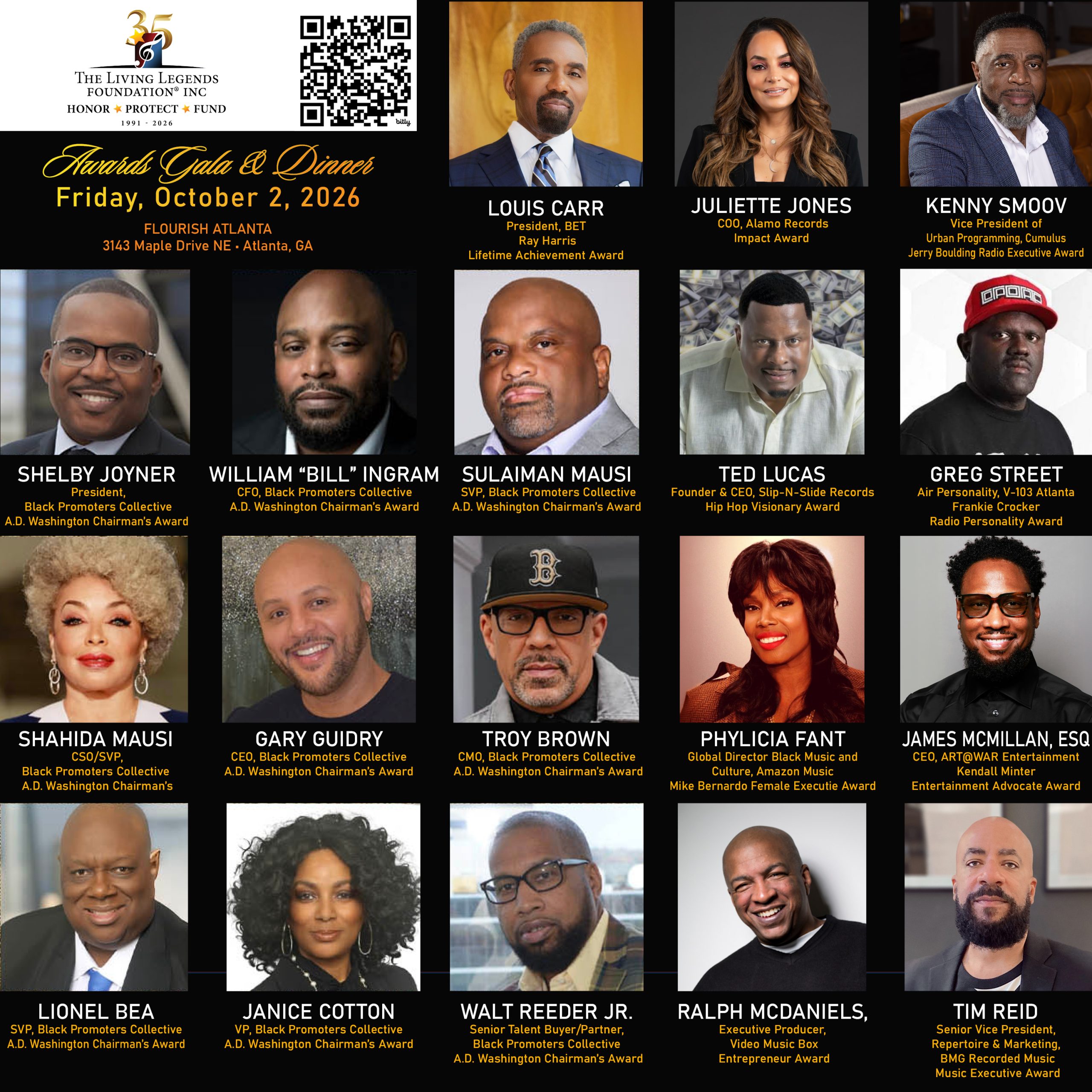
2026 Living Legends Foundation Honorees
This year’s honorees include:
- Ray Harris Lifetime Achievement Award: Louis Carr, president of BET
- A.D. Washington Chairman’s Award: Black Promoters Collective
- Jerry Boulding Radio Executive Award: Kenny Smoov, vice president of urban programming, Cumulus
- Frankie Crocker Radio Personality Award: Greg Street, air personality, V-103 Atlanta
- Impact Player Award: Juliette Jones, COO, Alamo Records
- Music Executive Award: Tim Reid, senior vice president, repertoire and marketing, BMG Recorded Music
- Mike Bernardo Female Executive Award: Phylicia Fant, global director, Black Music + Culture, Amazon Music
- Kendall Minter Entertainment Advocate Award: James McMillan, Esq., CEO, ART@WAR Entertainment
- Hip-Hop Visionary Award: Ted Lucas, founder and CEO, Slip-N-Slide Records
- Entrepreneur Award: Ralph McDaniels, executive producer, “Video Music Box”
Why the 35th Anniversary Matters
The anniversary reflects more than three decades of recognizing people whose contributions to Black music and entertainment have not always received the same public attention as the artists they helped build, promote and sustain.
That history is reflected in Khan’s return. After being recognized by the foundation in its early years, she will now help honor another generation of industry leaders.
The 35th Anniversary Awards Dinner & Gala will continue the Living Legends Foundation’s tradition of celebrating achievement, leadership, innovation and service while preserving the stories of the people who helped build the business and culture surrounding Black music.
Business
DOJ, DOT and DHS Launch Nationwide Crackdown on CDL Fraud, Trucking Schools and Unqualified Drivers


 Jacksonville5 days ago
Jaguars Maul The Patriots 35-6
 Central Florida News1 day ago
Buccaneers’ Todd Bowles Backs Jalon Daniels Ahead of First NFL Start Against Packers
 Business3 days ago
ALDI to Launch Seven Ready-Made Meals in October, With Single-Serve Dishes Under $8
 Central Florida News20 hours ago
Orlando Magic Announce $20 Tickets, $2–$7 Concessions for Home Games
 Business18 hours ago
Hola at the Park Set for Oct. 3 in Altamonte Springs; Admission Free


