Politics
Biden vows abortion legislation as top priority next year
Published
4 years agoon
WASHINGTON (AP) — President Joe Biden promised Tuesday that the first bill he sends to Capitol Hill next year will be one that codifies Roe v. Wade — if Democrats control enough seats in Congress for Biden to sign abortion protections into law — in a speech designed to energize his party’s voters just three weeks ahead of the November midterms.
“If you care about the right to choose, then you gotta vote,” Biden said during remarks at the Howard Theatre in Washington. He urged those in attendance to recall how they felt when the Supreme Court in late June overturned the landmark 1973 ruling legalizing abortion, and repeatedly lambasted Republicans nationwide who have pushed for restrictions on the procedure, often without exceptions.
Biden said “the only sure way to stop these extremist laws that are putting in jeopardy women’s health and rights is for Congress to pass a law.” He acknowledged that right now, “we’re short a handful of votes” to reinstate abortion protections at the federal level, urging voters to send more Democrats to Congress.
“If we do that, here’s the promise I make to you and the American people: The first bill that I will send to the Congress will be to codify Roe v. Wade,” Biden said. “And when Congress passes it, I’ll sign it in January, 50 years after Roe was first decided the law of the land.”
That’s a big if.
Republicans are widely projected to gain control of at least the House. Abortion rights have been a key motivating factor for Democrats this year, although the economy and inflation still rank as chief concern for most voters.
For the White House, it won’t be enough just to keep control of both chambers of Congress, already an uphill battle, to be able to enshrine the protections of Roe into law. The Senate would need to abolish the filibuster, the legislative rule that requires 60 votes for most bills to advance in the chamber, in order to pass an abortion measure with a simple majority of senators.
Long resistant to any revisions to Senate institutional rules, Biden said in the days after the decision by the Supreme Court to overrule Roe in Dobbs v. Jackson that he would support eliminating that supermajority threshold for abortion bills, just as he did on voting rights legislation.
But two moderate Democrats — Sens. Kyrsten Sinema, Ariz., and Joe Manchin, W.Va. — support keeping the filibuster. Sinema has said she wants to retain the filibuster precisely so any abortion restrictions backed by Republicans would face a much higher hurdle to pass in the Senate.
Democratic Senate candidates in Pennsylvania and Wisconsin — the party’s two best chances to flip seats currently held by Republicans — have both said they support eliminating the filibuster in order to pass abortion legislation. Pennsylvania Senate candidate John Fetterman has actively campaigned on being the 51st vote for priorities such as legalizing abortion, codifying same-sex marriage protections, and making it easier for workers to unionize — all measures that would otherwise be blocked by a filibuster in the Senate.
Abortion — and proposals from some Republicans to impose nationwide restrictions on the procedure — have been a regular fixture of Biden’s political rhetoric this election cycle, as Democrats seek to energize voters in a difficult midterm season for the party in power in Washington.
In fundraisers and in political speeches, Biden has vowed to reject any abortion restrictions that may come to his desk in a GOP-controlled Congress. He has also urged voters to boost the Democratic ranks in the Senate so enough senators would not only support reinstating abortion nationwide, but would be willing to change Senate rules to do it.
“If you give me two more Democratic senators in the United States Senate, I promise you, I promise you we’re going to codify Roe,” Biden said at a Democratic National Committee rally in Washington last month. “We’ll once again make Roe the law of the land. And we’ll once again protect a woman’s right to choose.”
On Tuesday, Biden made a pointed appeal to young voters, who traditionally participate in lower rates than other age demographics in midterm elections. Though his remarks were primarily focused on abortion, Biden also mentioned his decisions to forgive billions of dollars in student loan debt and to issue pardons for marijuana possession — moves popular with younger voters.
“What I am saying is, you represent the best of us. Your generation will not be ignored, will not be shunned and will not be silent,” Biden said, adding: “In 2020, you voted to deliver the change you wanted to see in the world. In 2022, you need to exercise your power to vote again for the future of our nation and the future of your generation.”
Court decisions and state legislation have shifted — and sometimes, re-shifted — the status of abortion laws across the country. Currently, bans are in place at all states of pregnancy in 12 states. In another, Wisconsin, clinics have stopped providing abortions though there’s dispute over whether a ban is in effect. In Georgia, abortion is banned at the detection of cardiac activity — generally around six weeks and before women often know they’re pregnant.
Meanwhile, codifying Roe remains a broadly popular position. In a July AP-NORC poll, 60% of U.S. adults said they believe Congress should pass a law guaranteeing access to legal abortion nationwide.
Even with the economy dominating so much of the midterm discourse, abortion has been a touchstone in high-profile contests from Ohio to Arizona, especially as Democrats try to trap Republicans between their most ardent anti-abortion base voters who want absolute or near-total bans and a majority of U.S. adults that wants at least some legal access to elective abortions.
For instance, in Georgia, Republican Senate nominee Herschel Walker went so far in his only debate against Sen. Raphael Warnock, a Democrat, as to deny his previous support for a national abortion ban with no exceptions. Despite Walker’s previous statements captured on video, he insisted Warnock misrepresented his position. Walker said in the debate that he backs a Georgia statute outlawing abortion after six weeks of pregnancy – an effective ban for some women because it’s so early they don’t yet know they’re pregnant. The law includes exceptions for later abortions in cases of rape, incest and involving health risks to a woman.
Warnock, meanwhile, avoided direct questions about whether he’d support any abortion limits, instead turning the question to Walker’s position.
You may like

Trump Calls for “Permanent Pause” on Migration from Poorer Nations After D.C. Shooting

Elon Musk Waves ‘Chainsaw of Bureaucracy’ at Conservative Conference, Vows to Cut Through Federal Government

Honoring the Legacy of Senator Geraldine Thompson: A Champion of Voting Rights, Education, and African American History
Central Florida News
Orlando Commissioner Tony Ortiz Files for Mayor, Could Become City’s First Puerto Rican Mayor
Published
2 hours agoon
May 12, 2026By
Willie DavidORLANDO, Fla. (FNN) — Tony Ortiz, a longtime Orlando city commissioner, former Marine, and former law enforcement officer, has officially filed to run for mayor of Orlando following Mayor Buddy Dyer’s announcement that he will not seek re-election.
Ortiz filed his candidacy ahead of the November 2027 nonpartisan mayoral election. If elected, he would become Orlando’s first Puerto Rican mayor.
GROWING FIELD OF CANDIDATES
Ortiz joins a growing field of candidates that includes State Representative Anna Eskamani, who could become Orlando’s first Iranian American mayor if elected, along with Elliot Kahanna and Abdelnasser Luth.
In his campaign announcement, Ortiz emphasized issues affecting residents across Orlando, including housing affordability, public safety, homelessness, transportation, economic opportunity, and neighborhood stability.
“As the City of Orlando continues to grow and evolve, residents across the city are increasingly focused on the issues that shape everyday life,” Ortiz stated in his campaign announcement.
LAW ENFORCEMENT BACKGROUNDS RESONATE WITH ORANGE COUNTY VOTERS
Political observers note that Orange County voters have historically supported candidates with backgrounds in local, state, and federal law enforcement or public safety roles.
Examples include Orange County Mayor Jerry Demings, former Orange County sheriff; former U.S. Congresswoman Val Demings, former Orlando police chief; former State Senator Victor Torres, a former NYC Transit Police officer; Maitland City Commissioner Keith Givens, a retired FBI agent; former State Representative Daisy Morales, a former HSI official; Apopka City Commissioner Diane Velazquez, a former NYPD officer; and former Orlando City Commissioner Samuel Ings, a former Orlando police officer.
HISTORIC OPPORTUNITY FOR REPRESENTATION
Ortiz’s candidacy highlights the continued growth and political influence of Central Florida’s Puerto Rican community. If successful, his election would mark a historic milestone for Puerto Rican representation in Orlando city government.
Florida
Central Florida Lawmakers Challenge DeSantis Redistricting Map as Lawsuits Mount
Published
6 days agoon
May 6, 2026By
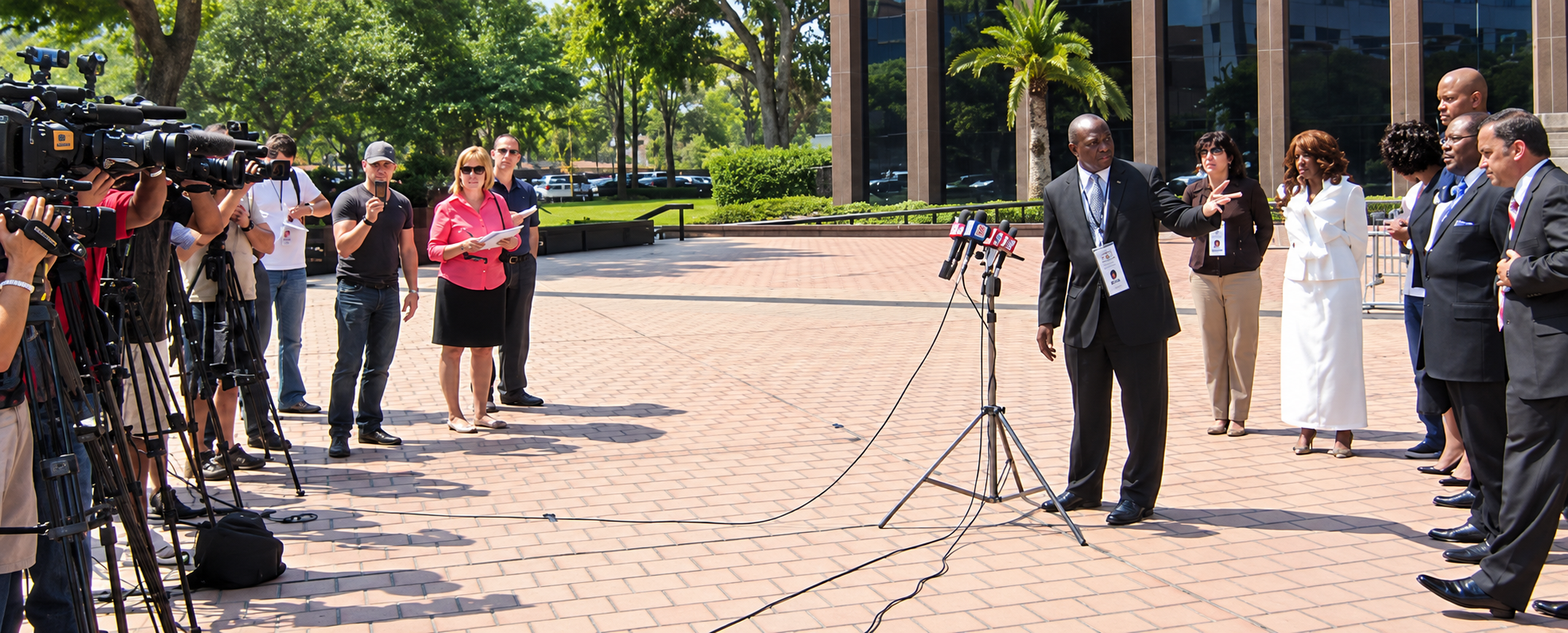
Willie DavidORLANDO, Fla. (FNN) — The Central Florida Black Caucus of Local Elected Officials held a press conference on the steps of Orlando City Hall, criticizing a new congressional map signed into law by Florida Governor Ron DeSantis.
Speakers included U.S. Congressman Maxwell Frost, State Senator Lavon Bracy-Davis, State Representative Bruce Antone, Orange County Clerk of Courts Tiffany Moore Russell, representatives from Equal Ground, and the Central Florida Urban League. Officials argued the map weakens minority representation and follows a recent U.S. Supreme Court ruling that scaled back key protections under the Voting Rights Act.
Florida National News has learned that three lawsuits have been filed seeking to block the newly approved congressional map following the redistricting process. The map is widely viewed as an effort to expand Republican representation in Florida’s congressional delegation ahead of upcoming elections.
IMPACT ON BLACK REPRESENTATION
Leaders warned the redistricting plan could significantly reduce the influence of Black voters in Central Florida and across the state. They argued that dismantling historically minority-access districts undermines decades of progress in equitable representation.
LEGAL CHALLENGES UNDERWAY
At least three lawsuits have been filed challenging the legality of the new map. Civil rights advocates contend the redistricting plan violates federal protections and could further erode voting rights following the Supreme Court’s recent decision.
FUTURE OF BLACK CONGRESSIONAL LEADERSHIP
Elected officials and advocacy groups expressed concern about the long-term effects on Black congressional representation. They emphasized the need for continued legal action and community engagement to protect fair representation in future elections.
Florida
DeSantis’ New Florida Congressional Map Could Spark Lawsuits, Legislative Showdown, and Statewide Protests
Published
2 weeks agoon
April 27, 2026TALLAHASSEE, Fla. (FNN) — Governor Ron DeSantis unveiled a proposed congressional redistricting map that could significantly reshape Florida’s representation in the U.S. House ahead of the 2026 midterm elections.
The proposal, released Monday, outlines districts that could favor Republicans in 24 seats, compared to four Democratic-leaning districts. Currently, Florida’s congressional delegation includes 20 Republicans and seven Democrats, with one vacant seat.
REDISTRICTING PROPOSAL & POLITICAL IMPACT
The governor said the new map reflects Florida’s population changes and fulfills his commitment to mid-decade redistricting. Lawmakers have been called into a special legislative session to consider the proposal.
The map appears to eliminate four Democratic-held seats, including a Tampa-area district represented by U.S. Rep. Kathy Castor, an Osceola County district held by U.S. Rep. Darren Soto—the first Puerto Rican elected to Congress from Florida—and a Palm Beach-Broward district that could displace U.S. Rep. Jared Moskowitz.
The proposal also affects a majority-Black voting district spanning Palm Beach and Broward counties, previously represented by former U.S. Rep. Sheila Cherfilus-McCormick, raising concerns about the future of minority representation.
Supporters, including Evan Power, say the map could better align districts with voter distribution. Critics, including Nikki Fried, have called the proposal unconstitutional gerrymandering. Florida law prohibits partisan gerrymandering, setting up potential legal challenges.
Rep. Tray McCurdy, D-Orlando and Rep. Angie Nixon, D-Jacksonville sit on the Florida Seal in protest as debate stops on Senate Bill 2-C: Establishing the Congressional Districts of the State in the House of Representatives Thursday, April 21, 2022 at the Capitol in Tallahassee, Fla. Rep. Daisy Morales, D-Orlando, joins the protest, holding a sign. The session was halted on the protest. (AP Photo/Phil Sears)
LOOKING BACK: 2022 PROTESTS OVER REDISTRICTING
The current debate mirrors tensions from 2022, when Democratic lawmakers staged a sit-in protest on the Florida House floor in opposition to a previous congressional map backed by DeSantis.
Lawmakers including Yvonne Hinson, Angie Nixon, Travaris McCurdy, Felicia Robinson, and Daisy Morales participated in the protest, temporarily halting legislative proceedings.
Morales, a member of the Congressional Redistricting Subcommittee and the only Hispanic lawmaker involved in the sit-in, strongly criticized the map at the time.
“Our democracy is being attacked. The governor eliminating two Black congressional seats is a power grab and it’s wrong,” Morales said in a written statement. “Stripping seats from Black representation is the same as saying the Black voice—the Black vote—doesn’t matter.”
She also warned about potential impacts on Hispanic representation:
“With this map passing, I’m deeply concerned it could target the only Puerto Rican representing Florida in Congress, Darren Soto, to benefit partisan interests. We don’t want to disenfranchise the 1.2 million Puerto Ricans in Florida.”
WHAT COMES NEXT IN 2026
As lawmakers prepare to debate the new proposal, Democrats are expected to push back through legal challenges, legislative opposition, and public advocacy.
The outcome of Florida’s redistricting battle could play a pivotal role in shaping control of the U.S. House and influence the national political landscape heading into the 2026 midterm elections.