

Politics
Capitol rioters included highly trained ex-military and cops


WASHINGTON (AP) — As President Donald Trump’s supporters massed outside the Capitol last week and sang the national anthem, a line of men wearing olive-drab helmets and body armor trudged purposefully up the marble stairs in a single-file line, each man holding the jacket collar of the one ahead.
The formation, known as “Ranger File,” is standard operating procedure for a combat team that is “stacking up” to breach a building — instantly recognizable to any U.S. soldier or Marine who served in Iraq and Afghanistan. It was a chilling sign that many at the vanguard of the mob that stormed the seat of American democracy either had military training or were trained by those who did.
An Associated Press review of public records, social media posts and videos shows at least 21 current or former members of the U.S. military or law enforcement have been identified as being at or near the Capitol riot, with more than a dozen others under investigation but not yet named. In many cases, those who stormed the Capitol appeared to employ tactics, body armor and technology such as two-way radio headsets that were similar to those of the very police they were confronting.
Experts in homegrown extremism have warned for years about efforts by far-right militants and white-supremacist groups to radicalize and recruit people with military and law enforcement training, and they say the Jan. 6 insurrection that left five people dead saw some of their worst fears realized.

FILE – In this Wednesday, Jan. 6, 2021 file photo, Donald Trump supporters gather outside the Capitol in Washington. (AP Photo/Manuel Balce Ceneta, File)
“ISIS and al-Qaida would drool over having someone with the training and experience of a U.S. military officer,” said Michael German, a former FBI agent and fellow with the Brennan Center for Justice at New York University. “These people have training and capabilities that far exceed what any foreign terrorist group can do. Foreign terrorist groups don’t have any members who have badges.”
Among the most prominent to emerge is a retired Air Force lieutenant colonel and decorated combat veteran from Texas who was arrested after he was photographed wearing a helmet and body armor on the floor of the Senate, holding a pair of zip-tie handcuffs.
Another Air Force veteran from San Diego was shot and killed by a Capitol Police officer as she tried to leap through a barricade near the House chamber. A retired Navy SEAL, among the most elite special warfare operators in the military, posted a Facebook video about traveling from his Ohio home to the rally and seemingly approving of the invasion of “our building, our house.”
Two police officers from a small Virginia town, both of them former infantrymen, were arrested by the FBI after posting a selfie of themselves inside the Capitol, one flashing his middle finger at the camera.

This Jan. 6, 2021 photo made available by the United States Capitol Police in a complaint and arrest warrant shows Rocky Mount Police Department Sgt. Thomas “T.J.” Robertson and officer Jacob Fracker in the Capitol in front of a statute of John Stark, a Revolutionary War officer famous for writing the state motto of New Hampshire, “Live Free or Die.” (Courtesy United States Capitol Police via AP)
Also under scrutiny is an active-duty psychological warfare captain from North Carolina who organized three busloads of people who headed to Washington for the “Save America” rally in support the president’s false claim that the November election was stolen from him.
While the Pentagon declined to provide an estimate for how many other active-duty military personnel are under investigation, the military’s top leaders were concerned enough ahead of President-elect Joe Biden’s inauguration that they issued a highly unusual warning to all service members this week that the right to free speech gives no one the right to commit violence.
The chief of the U.S. Capitol Police was forced to resign following the breach and several officers have been suspended pending the outcome of investigations into their conduct, including one who posed for a selfie with a rioter and another who was seen wearing one of Trump’s red “Make America Great Again” caps.
The AP’s review of hundreds of videos and photos from the insurrectionist riot shows scores of people mixed in the crowd who were wearing military-style gear, including helmets, body armor, rucksacks and two-way radios. Dozens carried canisters of bear spray, baseball bats, hockey sticks and pro-Trump flags attached to stout poles later used to bash police officers.
A close examination of the group marching up the steps to help breach the Capitol shows they wore military-style patches that read “MILITIA” and “OATHKEEPER.” Others were wearing patches and insignias representing far-right militant groups, including the Proud Boys, the Three Percenters and various self-styled state militias.

FILE – In this Sunday, June 25, 2017 file photo, Stewart Rhodes, founder of the citizen militia group known as the Oath Keepers speaks during a rally outside the White House in Washington. Rhodes, an Army veteran who founded the Oath Keepers in 2009 as a reaction to the presidency or Barack Obama, had been saying for weeks before the Jan. 6, 2021 Capitol riot that his group was preparing for a civil war and was “armed, prepared to go in if the president calls us up.” (AP Photo/Susan Walsh, File)
The Oath Keepers, which claims to count thousands of current and former law enforcement officials and military veterans as members, have become fixtures at protests and counter-protests across the country, often heavily armed with semi-automatic carbines and tactical shotguns.
Stewart Rhodes, an Army veteran who founded the Oath Keepers in 2009 as a reaction to the presidency of Barack Obama, had been saying for weeks before the Capitol riot that his group was preparing for a civil war and was “armed, prepared to go in if the president calls us up.”
Adam Newbold, the retired Navy SEAL from Lisbon, Ohio, whose more than two-decade military career includes multiple combat awards for valor, said in a Jan. 5 Facebook video, “We are just very prepared, very capable and very skilled patriots ready for a fight.”
He later posted a since-deleted follow-up video after the riot saying he was “proud” of the assault.
Newbold, 45, did not respond to multiple messages from the AP but in an interview with the Task & Purpose website he denied ever going inside the Capitol. He added that because of the fallout from the videos he has resigned from a program that helps prepare potential SEAL applicants.

This image shows a video by Adam Newbold posted on Facebook on Tuesday, Jan. 5, 2021. The retired U.S. Navy SEAL said he was not going to Washington, D.C., “looking for a fight” and that people should treat police officers and National Guard members with respect. He added: “We are not going down looking for a fight. We are just very prepared, very capable, and very skilled patriots ready for a fight. And we will react without hesitation when called upon to do so.” (Facebook via AP)
Retired Air Force Lt. Col. Larry Rendall Brock Jr. of Texas was released to home confinement Thursday after a prosecutor alleged the former fighter pilot had zip-tie handcuffs on the Senate floor because he planned to take hostages.
“He means to kidnap, restrain, perhaps try, perhaps execute members of the U.S. government,” Assistant U.S. Attorney Jay Weimer said. “His prior experience and training make him all the more dangerous.”

This undated photo provided by the Grapevine, Texas Police Department in January 2021 shows Larry Rendall Brock Jr. During the deadly riot at the U.S. Capitol on Wednesday, Jan. 6, 2021, Brock was photographed on the Senate floor wearing a helmet and heavy vest and carrying zip-tie handcuffs. The retired Air Force officer was arrested in Texas and charged Sunday, Jan. 10 in federal court in the District of Columbia. (Grapevine, Texas Police Department via AP)
Army commanders at Fort Bragg in North Carolina are investigating the possible involvement of Capt. Emily Rainey, the 30-year-old psychological operations officer and Afghanistan war veteran who told the AP she traveled with 100 others to Washington to “stand against election fraud.” She insisted she acted within Army regulations and that no one in her group entered the Capitol or broke the law.
“I was a private citizen and doing everything right and within my rights,” Rainey said.
More than 110 people have been arrested on charges related to the Capitol riot so far, ranging from curfew violations to serious federal felonies related to theft and weapons possession.
Brian Harrell, who served as the assistant secretary for infrastructure protection at the Department of Homeland Security until last year, said it is “obviously problematic” when “extremist bad actors” have military and law enforcement backgrounds.
“Many have specialized training, some have seen combat, and nearly all have been fed disinformation and propaganda from illegitimate sources,” Harrell said. “They are fueled by conspiracy theories, feel as if something is being stolen from them, and they are not interested in debate. This is a powder keg cocktail waiting to blow.”
The FBI is warning of the potential for more bloodshed. In an internal bulletin issued Sunday, the bureau warned of plans for armed protests at all 50 state capitals and in Washington, D.C., in the coming weeks.
Meanwhile, police departments in such major cities as New York, Los Angeles, Las Vegas, Houston and Philadelphia announced they were investigating whether members of their agencies participated in the Capitol riot. The Philadelphia area’s transit authority is also investigating whether seven of its police officers who attended Trump’s rally in Washington broke any laws.
A Texas sheriff announced last week that he had reported one of his lieutenants to the FBI after she posted photos of herself on social media with a crowd outside the Capitol. Bexar County Sheriff Javier Salazar said Lt. Roxanne Mathai, a 46-year-old jailer, had the right to attend the rally but he’s investigating whether she may have broken the law.
One of the posts Mathai shared was a photo that appeared to be taken Jan. 6 from among the mass of Trump supporters outside the Capitol, captioned: “Not gonna lie. … aside from my kids, this was, indeed, the best day of my life. And it’s not over yet.”
A lawyer for Mathai, a mother and longtime San Antonio resident, said she attended the Trump rally but never entered the Capitol.
In Houston, Police Chief Art Acevedo said an 18-year veteran of the department suspected of joining the mob that breached the Capitol was placed on leave and will face a disciplinary hearing.
“There is no excuse for criminal activity, especially from a police officer,” Acevedo said. “I can’t tell you the anger I feel at the thought of a police officer, and other police officers, thinking they get to storm the Capitol.”

Central Florida News
Broadcaster Ray Cruz Santiago Criticizes Samuel Vilchez Santiago With Communist Graphics, Puerto Rican Identity Claims

The commentator’s video pairs the Democrat’s image with Soviet-style imagery and references his grandfather’s communist beliefs; Vilchez Santiago has publicly rejected socialism.
ORLANDO, Fla. (FNN) — Hispanic broadcaster Ray Cruz Santiago is targeting Florida House Democratic nominee Samuel Vilchez Santiago in a video that depicts the candidate in a Soviet-style military uniform and pairs his name with a hammer-and-sickle graphic.
The approximately two-minute video invokes Vilchez Santiago’s description of his grandfather as a communist while presenting images of the candidate, former Venezuelan President Hugo Chávez and Republican opponent Jorge Malavet.
In separate Facebook posts, Cruz Santiago also accuses the Venezuelan-born Democrat of misleading Puerto Rican voters about his heritage. The material reviewed does not substantiate that allegation, and Vilchez Santiago has publicly rejected the socialist label.
Video visually links candidate to communism
The uploaded video shows an apparent composite depicting Vilchez Santiago in a military uniform and peaked cap. Another graphic places the name “Samuel Vilchez” beneath a red flag bearing a hammer and sickle.
An on-screen caption describes him, translated from Spanish, as a “Democratic candidate in District 43 with a communist grandfather.”
The sequence also juxtaposes footage of Chávez with an image of Vilchez Santiago draped in a Venezuelan flag. Later frames display Malavet and Vilchez Santiago alongside Puerto Rican and Venezuelan flag symbols, respectively.
Together, those visual choices suggest an association between the Democratic candidate and communism. They do not independently establish his political beliefs, affiliations or support for Venezuela’s government. The uniform depiction should be understood as an apparent composite, rather than documentary evidence that he wore such a uniform.
Grandfather’s statement includes family opposition to Chavismo
The reference to Vilchez Santiago’s grandfather has a documented source.
“My grandfather was a communist,” Vilchez Santiago said in a 2019 Princeton University profile. In the same discussion, he described his parents as politically active opponents of Venezuela’s Chavista government and discussed his family’s departure because of political persecution. pace.princeton.edu
That account describes an ideological divide within his family. His grandfather’s beliefs do not establish the candidate’s own ideology.
Candidate has rejected socialist label
Cruz Santiago’s supplied posts describe Vilchez Santiago as a socialist or democratic socialist, a characterization the candidate has disputed.
“I am not a socialist. I have never been a socialist,” Vilchez Santiago said in Spanish in an interview published Sept. 29 by La Prensa Florida.
He argued that proposals involving health care, Social Security and lower household expenses should not automatically be labeled socialist. His stated priorities included easing property tax increases for first-time homebuyers, reducing toll expenses and simplifying small-business registration. laprensafl.com

Separate posts question Puerto Rican campaign imagery
Cruz Santiago’s heritage criticism appears in separate Facebook posts alleging that Vilchez Santiago is presenting himself as Puerto Rican to attract voters. www.facebook.com
A screenshot of a campaign advertisement supplied to FNN shows a photograph of Vilchez Santiago holding a Puerto Rican flag alongside two women, with his campaign branding displayed over the image.
The photograph places a recognizable symbol of Puerto Rican identity within the campaign’s presentation of his personal story. Viewers unfamiliar with his Venezuelan background could interpret it as suggesting Puerto Rican heritage. The materials reviewed do not establish whether viewers reached that conclusion or whether the campaign intended it.
The screenshot contains no explicit claim of Puerto Rican ancestry. Vilchez Santiago’s Venezuelan background is publicly documented in the Princeton profile and a Venezuelan-American Caucus biography. pace.princeton.edu
Why the presentation matters to voters
The criticism combines two distinct subjects: the candidate’s heritage and his political beliefs.
For voters evaluating the material, the central distinction is between documented statements and associations created through editing. The grandfather’s communist beliefs are supported by the candidate’s published account. The uniform, hammer-and-sickle graphic and Chávez juxtaposition are elements of the video’s presentation, rather than proof of the candidate’s ideology.
Likewise, the Puerto Rican flag photograph documents the campaign’s use of cultural imagery without establishing a false claim of ancestry.
Broadcaster brings criticism into District 43 contest
Cruz Santiago hosts El Escándalo del Día on Miami’s Radio Mambí 710 AM, according to his professional profile. Salsoul’s official website also lists him among its personalities. www.linkedin.com
Readers can review his commentary on Facebook and visit his website.
Vilchez Santiago and Malavet are the Democratic and Republican candidates, respectively, in the Nov. 3 election for Florida House District 43, according to state election records. dos.elections.myflorida.com

Florida
Donalds, Jolly Court Black Voters In Governor’s Race. How Much Are They Spending With Black-Owned Media?

Endorsements and community visits highlight the competition for Black support, while advertising purchases remain an unanswered question.
ORLANDO, Fla. (FNN) — Republican Byron Donalds and Democrat David Jolly are courting Black voters through endorsements, community appearances and organizing efforts, but how much their political operations are spending with Black-owned media remains unverified in the reporting reviewed for this article.
Donalds has secured support from Eatonville Vice Mayor Angela Thomas and Gainesville City Commissioner Cynthia Moore Chestnut, a longtime Democrat. Jolly has assembled a statewide coalition of Black elected officials, religious leaders and policy advisers ahead of the Nov. 3 election.
The endorsements show how individual leaders are approaching the governor’s race. Advertising records would help answer a separate question: How much business are the political operations seeking Black votes directing to Black-owned publishers and broadcasters?

Donalds Gains Endorsements
Thomas endorsed Donalds on Oct. 19, the same day Jolly visited Eatonville for a get-out-the-vote event, according to News 6.
“I am honored to have Vice Mayor Angela Thomas’s support,” Donalds wrote in the Facebook statement announcing her endorsement.
“Eatonville’s story of self-governance is one of the proudest in Florida’s history, and her leadership carries that legacy forward today.”
Donalds connected her support to his message about individual freedom and local decision-making.
“That’s the kind of trust in communities I’ll bring to Tallahassee — letting Floridians run their own lives, not Tallahassee,” he wrote.
Chestnut’s endorsement brought a prominent Black Democratic voice into Donalds’ camp. In a statement published by WCJB, she acknowledged policy disagreements with him while defending her decision to cross party lines.
“I want to see a Black governor of Florida in my lifetime,” Chestnut said.
She also encouraged voters to question Donalds directly about public education, property taxes, voting rights and economic opportunity.
Donalds would become Florida’s first Black governor if elected. Support from individual officials, however, does not establish a statewide shift among Black voters.
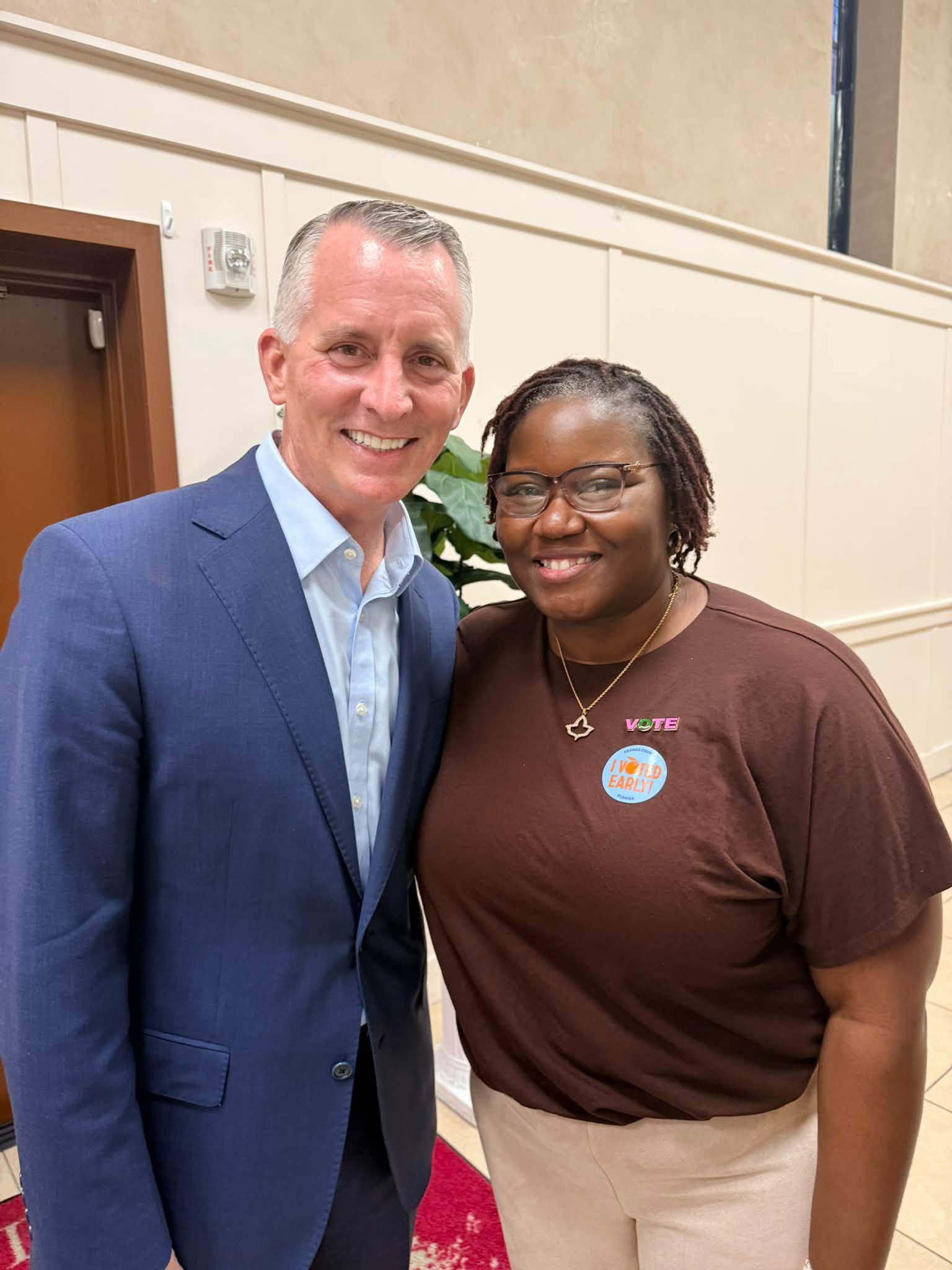
Jolly Builds a Black Leadership Coalition
Jolly’s campaign announced a Black leadership coalition Sept. 10 that includes former Jacksonville Mayor Alvin Brown, state Sens. Shevrin Jones and Tracie Davis, former state Sen. Arthenia Joyner and Pinellas County Commissioner Rene Flowers.
The campaign said the group would organize voters, help develop policy and expand community engagement. Jolly’s announced commitments include establishing an office of civil rights, supporting voting rights legislation and opposing restrictions targeting the teaching of Black history.
During his Eatonville visit, Jolly emphasized his responsibility to reach communities throughout Florida.
“Part of running for governor is representing every community across the state,” he told News 6.
A former Republican congressman who later became an independent before joining the Democratic Party, Jolly has made homeowners insurance reform, access to primary health care and public education central campaign issues.
Following the Advertising Dollars
Both political operations have announced substantial advertising efforts.
Florida Politics reported that Friends of Byron Donalds announced a $20 million statewide advertising buy ahead of the August primary. The publication separately reported that Jolly launched a multimillion-dollar statewide advertising effort in September. The announcements cover different periods and political entities and cannot be treated as equivalent spending totals.
Those announcements do not provide a complete accounting of purchases from Black-owned media.
Advertisements aimed at Black voters can run through companies with different ownership structures. Reaching a Black audience does not necessarily mean a campaign purchased advertising from a Black-owned business.
A comparable accounting would identify which Black-owned outlets received payments, how much they received and when. It would include purchases placed through agencies and separate candidate spending from political committee spending.
Without those figures, the available reporting does not establish whether either operation’s investment falls short of a stated commitment or other defined benchmark.
Florida’s Black Media Network
Florida’s established Black press includes The Miami Times in South Florida, the statewide Florida Courier, Daytona Times, The Florida Star in Jacksonville, Florida Sentinel Bulletin in Tampa and The Weekly Challenger in St. Petersburg and Pinellas County.
These publications illustrate the geographic reach of the state’s Black press. Their inclusion is not an audience ranking or a finding that they received advertising from either political operation.
The National Newspaper Publishers Association describes the Black press as a source of community news, information and commentary delivered through print and digital platforms.
Why the Spending Question Matters
For voters, the governor’s race involves representation and decisions affecting insurance costs, schools, health care and civil rights. Endorsements provide one perspective on the candidates; their records and proposals provide another.
Advertising disclosure would add a financial measure of outreach. It would show which Black-owned media businesses received campaign purchases and allow readers to compare those payments with each operation’s overall advertising budget.
As Donalds and Jolly compete for Black support, that accounting would help the public evaluate how their spending decisions align with their community engagement.
Florida National News calls on the Donalds and Jolly campaigns and their affiliated political committees to publicly announce their advertising spending with Black-owned media.
The disclosure should identify outlets, amounts paid, spending periods and purchases placed through agencies. Planned purchases should be listed separately from completed payments.
The same disclosure standard should apply to Democratic and Republican political operations seeking Black voters’ support. Advertising purchases must remain independent of editorial coverage and endorsements.


 Florida5 days ago
Donalds, Jolly Court Black Voters In Governor’s Race. How Much Are They Spending With Black-Owned Media?
 Central Florida News4 days ago
Broadcaster Ray Cruz Santiago Criticizes Samuel Vilchez Santiago With Communist Graphics, Puerto Rican Identity Claims
 Central Florida News4 days ago
Festival of Trees Marks 40 Years With Holiday Displays, Santa Breakfasts and Parties
 Entertainment4 days ago
“4000 Days,” “Frampton” Set for Naples International Film Festival Oct. 24–25
 Business4 days ago
GOAA Highlights Airport Improvements, Approves New Small Business Policies


