Politics
Florida lawmakers hope to aid ailing home insurance market
Published
3 years agoon
TALLAHASSEE, Fla. (AP) — Florida lawmakers on Monday advanced sweeping GOP legislation intended to shore up the state’s struggling home insurance market in the year’s second special session devoted to the topic.
The proposal would create a $1 billion reinsurance fund, reduce litigation costs and compel some customers to leave the state-created insurer of last resort and rejoin the private market. It also would force insurers to respond to claims more promptly and boost state oversight of insurers’ conduct following hurricanes.
The bill cleared a Senate banking committee and is expected to sail though the Republican-dominated Legislature this week.
“We will continue to focus our efforts on fair costs and strong protections for consumers while adding reasonable guardrails for insurance companies against frivolous litigation and fraudulent claims that drive up rates for everyone,” Republican Senate President Kathleen Passidomo told lawmakers.
The 123-page bill on home insurance was filed late Friday. During the special session, which is expected to last three to five days, lawmakers also will consider property tax relief for Hurricane Ian victims and highway toll reductions for frequent commuters.
Florida has struggled for years to curb surging home insurance premiums and hold on to private insurers in a market where devastating hurricanes weigh heavily on the cost of business. Six insurers have left the state this year.
Hurricane Ian, which slammed into the southwest coast in late September and inflicted widespread damage to homes and businesses across the state, caused an estimated $40 billion to $70 billion in insured losses.
The GOP insurance bill seeks to build on legislation passed during a special session in May, but legislative leaders have warned residents not to expect swift reductions in rates from either package of reforms.
Democrats said they were not included in the drafting of the Republican proposals. On Monday, Democrats reiterated concerns that the market was becoming too expensive for some homeowners and that the GOP proposal did not do enough to immediately lower rates.
“Property insurance in Florida is becoming unaffordable, so much so that some folks are not able to move forward with their American dream of purchasing a home. Because while they could afford the home, they couldn’t afford property insurance,” said House Democratic Leader Fentrice Driskell.
Lawmakers will vote on speeding up the claims process and eliminating the state’s assignment of benefits laws, in which property owners sign over their claims to contractors who then handle proceedings with insurance companies.
The Republican proposal also would force people with state-created Citizens Property Insurance policies to pay for flood insurance and require moves to private insurers if they offer a policy up to 20% more expensive than Citizens.
“There’s things in this bill that I think are good, but I don’t know if the good outweighs the bad,” Sen. Bobby Powell, a Democrat, said, noting the Citizens provision.
The legislation would remove “one-way” attorney fees for property insurance, which require property insurers to pay attorney fees of policyholders who successfully file lawsuits over claims while shielding policyholders from paying such fees of insurers when they lose.
It would also provide $1 billion in taxpayer funds for a program to provide carriers with hurricane reinsurance — coverage bought to help ensure they can pay out claims. It would offer “reasonable” rates in a market where companies have complained of rising costs.
Republican Sen. Danny Burgess said the market is in crisis and desperately needs major changes.
“Although maybe we’re going to put some measures in place that we’ve attempted to avoid in the past, recognize that we’re here today because it’s the only thing we haven’t tried and nothing else has worked enough to the point of fixing this,” he said.
Lawmakers are also considering another bill to provide property tax relief for people whose homes and business were made uninhabitable by the storm and a proposal to give 50% refunds for commuters who pay more than 35 highway tolls in a month with a transponder. Both measures are expected to pass.
You may like

VIDEO: Florida House Democratic Leader Driskell, Democratic Caucus Leader Book Blast DeSantis, State of the State Address

Governor Ron DeSantis Announces Award of $100 Million for Beach Recovery Following Hurricanes Ian and Nicole

Governor Ron DeSantis and the Florida Department of Economic Opportunity Highlight Private Sector Partners Supporting Recovery Efforts
Central Florida News
Orlando Commissioner Tony Ortiz Files for Mayor, Could Become City’s First Puerto Rican Mayor
Published
2 hours agoon
May 12, 2026By
Willie DavidORLANDO, Fla. (FNN) — Tony Ortiz, a longtime Orlando city commissioner, former Marine, and former law enforcement officer, has officially filed to run for mayor of Orlando following Mayor Buddy Dyer’s announcement that he will not seek re-election.
Ortiz filed his candidacy ahead of the November 2027 nonpartisan mayoral election. If elected, he would become Orlando’s first Puerto Rican mayor.
GROWING FIELD OF CANDIDATES
Ortiz joins a growing field of candidates that includes State Representative Anna Eskamani, who could become Orlando’s first Iranian American mayor if elected, along with Elliot Kahanna and Abdelnasser Luth.
In his campaign announcement, Ortiz emphasized issues affecting residents across Orlando, including housing affordability, public safety, homelessness, transportation, economic opportunity, and neighborhood stability.
“As the City of Orlando continues to grow and evolve, residents across the city are increasingly focused on the issues that shape everyday life,” Ortiz stated in his campaign announcement.
LAW ENFORCEMENT BACKGROUNDS RESONATE WITH ORANGE COUNTY VOTERS
Political observers note that Orange County voters have historically supported candidates with backgrounds in local, state, and federal law enforcement or public safety roles.
Examples include Orange County Mayor Jerry Demings, former Orange County sheriff; former U.S. Congresswoman Val Demings, former Orlando police chief; former State Senator Victor Torres, a former NYC Transit Police officer; Maitland City Commissioner Keith Givens, a retired FBI agent; former State Representative Daisy Morales, a former HSI official; Apopka City Commissioner Diane Velazquez, a former NYPD officer; and former Orlando City Commissioner Samuel Ings, a former Orlando police officer.
HISTORIC OPPORTUNITY FOR REPRESENTATION
Ortiz’s candidacy highlights the continued growth and political influence of Central Florida’s Puerto Rican community. If successful, his election would mark a historic milestone for Puerto Rican representation in Orlando city government.
Florida
Central Florida Lawmakers Challenge DeSantis Redistricting Map as Lawsuits Mount
Published
6 days agoon
May 6, 2026By
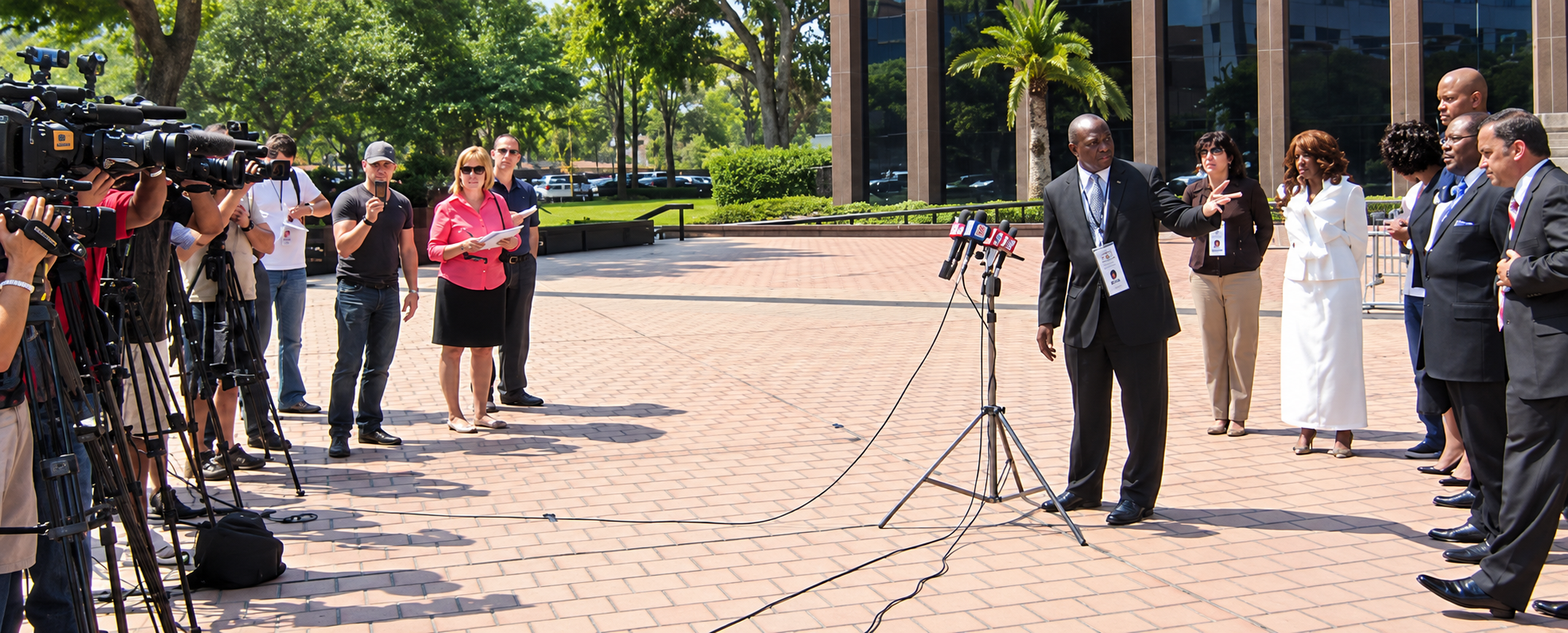
Willie DavidORLANDO, Fla. (FNN) — The Central Florida Black Caucus of Local Elected Officials held a press conference on the steps of Orlando City Hall, criticizing a new congressional map signed into law by Florida Governor Ron DeSantis.
Speakers included U.S. Congressman Maxwell Frost, State Senator Lavon Bracy-Davis, State Representative Bruce Antone, Orange County Clerk of Courts Tiffany Moore Russell, representatives from Equal Ground, and the Central Florida Urban League. Officials argued the map weakens minority representation and follows a recent U.S. Supreme Court ruling that scaled back key protections under the Voting Rights Act.
Florida National News has learned that three lawsuits have been filed seeking to block the newly approved congressional map following the redistricting process. The map is widely viewed as an effort to expand Republican representation in Florida’s congressional delegation ahead of upcoming elections.
IMPACT ON BLACK REPRESENTATION
Leaders warned the redistricting plan could significantly reduce the influence of Black voters in Central Florida and across the state. They argued that dismantling historically minority-access districts undermines decades of progress in equitable representation.
LEGAL CHALLENGES UNDERWAY
At least three lawsuits have been filed challenging the legality of the new map. Civil rights advocates contend the redistricting plan violates federal protections and could further erode voting rights following the Supreme Court’s recent decision.
FUTURE OF BLACK CONGRESSIONAL LEADERSHIP
Elected officials and advocacy groups expressed concern about the long-term effects on Black congressional representation. They emphasized the need for continued legal action and community engagement to protect fair representation in future elections.
Florida
DeSantis’ New Florida Congressional Map Could Spark Lawsuits, Legislative Showdown, and Statewide Protests
Published
2 weeks agoon
April 27, 2026TALLAHASSEE, Fla. (FNN) — Governor Ron DeSantis unveiled a proposed congressional redistricting map that could significantly reshape Florida’s representation in the U.S. House ahead of the 2026 midterm elections.
The proposal, released Monday, outlines districts that could favor Republicans in 24 seats, compared to four Democratic-leaning districts. Currently, Florida’s congressional delegation includes 20 Republicans and seven Democrats, with one vacant seat.
REDISTRICTING PROPOSAL & POLITICAL IMPACT
The governor said the new map reflects Florida’s population changes and fulfills his commitment to mid-decade redistricting. Lawmakers have been called into a special legislative session to consider the proposal.
The map appears to eliminate four Democratic-held seats, including a Tampa-area district represented by U.S. Rep. Kathy Castor, an Osceola County district held by U.S. Rep. Darren Soto—the first Puerto Rican elected to Congress from Florida—and a Palm Beach-Broward district that could displace U.S. Rep. Jared Moskowitz.
The proposal also affects a majority-Black voting district spanning Palm Beach and Broward counties, previously represented by former U.S. Rep. Sheila Cherfilus-McCormick, raising concerns about the future of minority representation.
Supporters, including Evan Power, say the map could better align districts with voter distribution. Critics, including Nikki Fried, have called the proposal unconstitutional gerrymandering. Florida law prohibits partisan gerrymandering, setting up potential legal challenges.
Rep. Tray McCurdy, D-Orlando and Rep. Angie Nixon, D-Jacksonville sit on the Florida Seal in protest as debate stops on Senate Bill 2-C: Establishing the Congressional Districts of the State in the House of Representatives Thursday, April 21, 2022 at the Capitol in Tallahassee, Fla. Rep. Daisy Morales, D-Orlando, joins the protest, holding a sign. The session was halted on the protest. (AP Photo/Phil Sears)
LOOKING BACK: 2022 PROTESTS OVER REDISTRICTING
The current debate mirrors tensions from 2022, when Democratic lawmakers staged a sit-in protest on the Florida House floor in opposition to a previous congressional map backed by DeSantis.
Lawmakers including Yvonne Hinson, Angie Nixon, Travaris McCurdy, Felicia Robinson, and Daisy Morales participated in the protest, temporarily halting legislative proceedings.
Morales, a member of the Congressional Redistricting Subcommittee and the only Hispanic lawmaker involved in the sit-in, strongly criticized the map at the time.
“Our democracy is being attacked. The governor eliminating two Black congressional seats is a power grab and it’s wrong,” Morales said in a written statement. “Stripping seats from Black representation is the same as saying the Black voice—the Black vote—doesn’t matter.”
She also warned about potential impacts on Hispanic representation:
“With this map passing, I’m deeply concerned it could target the only Puerto Rican representing Florida in Congress, Darren Soto, to benefit partisan interests. We don’t want to disenfranchise the 1.2 million Puerto Ricans in Florida.”
WHAT COMES NEXT IN 2026
As lawmakers prepare to debate the new proposal, Democrats are expected to push back through legal challenges, legislative opposition, and public advocacy.
The outcome of Florida’s redistricting battle could play a pivotal role in shaping control of the U.S. House and influence the national political landscape heading into the 2026 midterm elections.