Connect with us

Tech

Judge rules against Google, allows antitrust case to proceed

Published

on

ALEXANDRIA, Va. — A federal judge on Friday rejected a motion from Google to toss out the government’s antitrust case against it.

U.S. District Judge Leonie Brinkema ruled the lawsuit alleging Google wields monopolistic power in the world of online advertising can proceed in its entirety.

Her ruling is the second setback for Google at the federal court in Alexandria. Google had earlier tried to get the case consolidated with a similar lawsuit that’s been ongoing for several years in New York. But Brinkema ruled last month that the case can proceed in the Alexandria courthouse, which is known as the “Rocket Docket” for its reputation of adjudicating disputes swiftly.

The lawsuit alleges that Google holds a virtual monopoly in online advertising that works to the detriment of consumers. The complaint alleged that Google “corrupted legitimate competition in the ad tech industry by engaging in a systematic campaign to seize control of the wide swath of high-tech tools used by publishers, advertisers, and brokers, to facilitate digital advertising.”

Google argued that the case should be tossed out, in part because the government defines Google’s alleged monopoly too narrowly. Google’s lawyers contend the lawsuit does not account for advertisers’ ability, for example, to advertise on huge social media platforms like Facebook and TikTok that run their own advertising platforms independent of Google.

In court papers, Google made an analogy to an unsuccessful antitrust lawsuit against Live Nation, a concert promoter that owns and operates a large number of outdoor amphitheaters.

The lawsuit alleged Live Nation held a monopoly on amphitheaters, but a judge ruled that the plaintiffs failed to prove a monopoly in part because they did not take into account reasonable alternatives to amphitheater venues, like indoor concert halls and arenas.

Brinkema said the question of how to define the market in which Google allegedly holds a monopoly will be a key issue in the case, But she said at this preliminary stage, the government’s allegations are plausible enough for the case to move forward. The government’s burden of proof, though, will increase at trial.

After the hearing, Google issued a statement from Dan Taylor, its vice president of global ads, saying the lawsuit “ignores the reality of today’s dynamic digital advertising space, where we compete against hundreds of companies like Amazon, Apple, Meta, Microsoft and TikTok.”

The statement said the lawsuit “would slow innovation, raise advertising fees, and make it harder for thousands of small businesses and publishers to grow.”

A number of states, including Virginia, California, Colorado, Connecticut, New Jersey, New York, Rhode Island and Tennessee, have joined in the case as plaintiffs against Google.

Continue Reading
Click to comment

Leave a Reply

Your email address will not be published. Required fields are marked *

Tech

NASA’s Artemis II Astronauts Begin Historic Journey Around the Moon After Key Orion Engine Burn

Published

on

Earth's crescent is seen from a solar array camera on the Orion spacecraft on the first flight day of the Artemis II mission. Credit: NASA

CAPE CANAVERAL, Fla. (FNN) — For the first time in more than 50 years, astronauts on a NASA mission are headed around the Moon after successfully completing a critical burn of the Orion spacecraft’s main engine.

The approximately six-minute firing of Orion’s service module engine Thursday — known as the translunar injection burn — accelerated the spacecraft and its crew beyond Earth’s orbit, placing them on a trajectory toward the Moon.

Aboard the spacecraft are NASA astronauts Reid Wiseman, Victor Glover and Christina Koch, along with Canadian Space Agency astronaut Jeremy Hansen.

“Today, for the first time since Apollo 17 in 1972, humans have departed Earth orbit,” said Dr. Lori Glaze, acting associate administrator for NASA’s Exploration Systems Development Mission Directorate. “Reid, Victor, Christina and Jeremy now are on a precise trajectory toward the Moon. Orion is operating with crew for the first time in space, and we are gathering critical data and learning from each step.”

NASA’s Space Launch System rocket and Orion spacecraft lifted off from Launch Pad 39B at Kennedy Space Center at 6:35 p.m. EDT on April 1, beginning a planned 10-day test mission around the Moon and back.

Successful Launch and Spacecraft Activation

Shortly after reaching space, Orion deployed its four solar array wings, allowing the spacecraft to generate power from the Sun. The crew and mission controllers then began transitioning the spacecraft from launch to normal flight operations while checking critical onboard systems.

About 49 minutes into the flight, the rocket’s upper stage fired to place Orion into an elliptical orbit around Earth. A second burn propelled the spacecraft — named “Integrity” by the crew — into a high Earth orbit extending roughly 46,000 miles above the planet for nearly 24 hours of system testing.

Following the maneuver, Orion separated from the upper stage and began flying independently.

System Tests and Crew Operations in Space

During the early phase of the mission, the astronauts conducted a manual piloting demonstration to evaluate Orion’s handling capabilities using the Interim Cryogenic Propulsion Stage as a docking target.

After the test, Orion executed an automated departure burn to safely move away from the stage. The propulsion stage later performed a disposal burn before re-entering Earth’s atmosphere over a remote area of the Pacific Ocean.

Before its re-entry, four small CubeSats were deployed from the rocket’s Orion stage adapter to conduct separate scientific missions.

Mission teams also transitioned communications to NASA’s Deep Space Network while the crew adjusted to the space environment. Astronauts completed their first rest periods, performed onboard exercise routines, restored the spacecraft’s toilet to normal operations and prepared the spacecraft for the translunar injection burn.

Lunar Flyby and Artemis Program Goals

The crew is scheduled to conduct a lunar flyby Monday, April 6, when astronauts will capture high-resolution images and make observations of the Moon’s surface — including portions of the lunar far side rarely seen directly by humans.

Although the far side will only be partially illuminated during the flyby, the lighting conditions are expected to cast long shadows across the terrain, highlighting ridges, slopes and crater rims that are difficult to observe under full sunlight.

After completing the flyby, the astronauts will return to Earth and splash down in the Pacific Ocean off the coast of San Diego.

The mission marks a major milestone for NASA’s Artemis program, which aims to send astronauts on increasingly ambitious missions to explore the Moon, advance scientific discovery, stimulate economic growth and prepare for the first crewed missions to Mars.

Continue Reading

Florida

VIDEO: NASA Artemis II Mission Sends Astronauts Around the Moon in First Crewed Test Since Apollo

Published

on

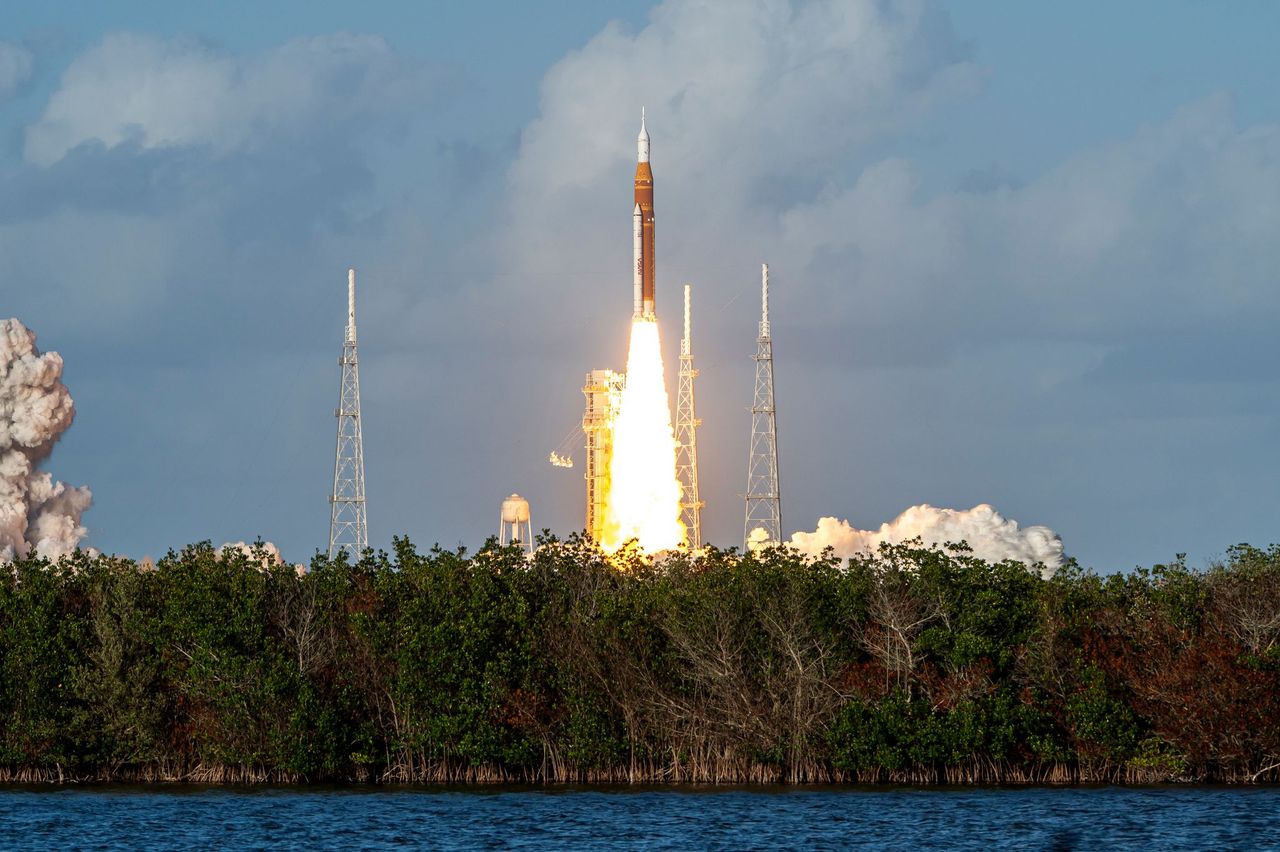
The Artemis II crewed lunar mission launches from Kennedy Space Center on April 1, 2026. Four astronauts blasted off aboard a massive NASA rocket on a long-anticipated journey around the Moon—marking the first crewed lunar flyby in more than 50 years. Photo by Nickolas Wolf / Florida National News.
CAPE CANAVERAL, Fla. (FNN) — NASA is preparing to launch the crew of Artemis II on a historic journey around the Moon, marking the first time astronauts will travel beyond low-Earth orbit since the era of Apollo Program.
The mission will lift off from Kennedy Space Center aboard the Space Launch System, carrying astronauts in the Orion spacecraft on a multi-day flight that will orbit the Moon before returning safely to Earth.

The Artemis II crewed lunar mission launches from Kennedy Space Center on April 1, 2026. Four astronauts blasted off aboard a massive NASA rocket on a long-anticipated journey around the Moon—marking the first crewed lunar flyby in more than 50 years. Photo by Nickolas Wolf / Florida National News.


Historic Return to Deep Space Artemis II is the first crewed mission in NASA’s Artemis program, designed to return humans to the Moon and eventually establish a sustainable presence there. The flight follows the successful uncrewed test mission, Artemis I, which demonstrated the Orion spacecraft’s ability to travel to lunar orbit and return to Earth. The Artemis program represents NASA’s long-term strategy to explore deep space, including preparing astronauts for future missions to Mars. Astronaut Crew to Circle the Moon

The Artemis II crew includes four astronauts selected to test Orion’s life-support systems and navigation capabilities during the mission.
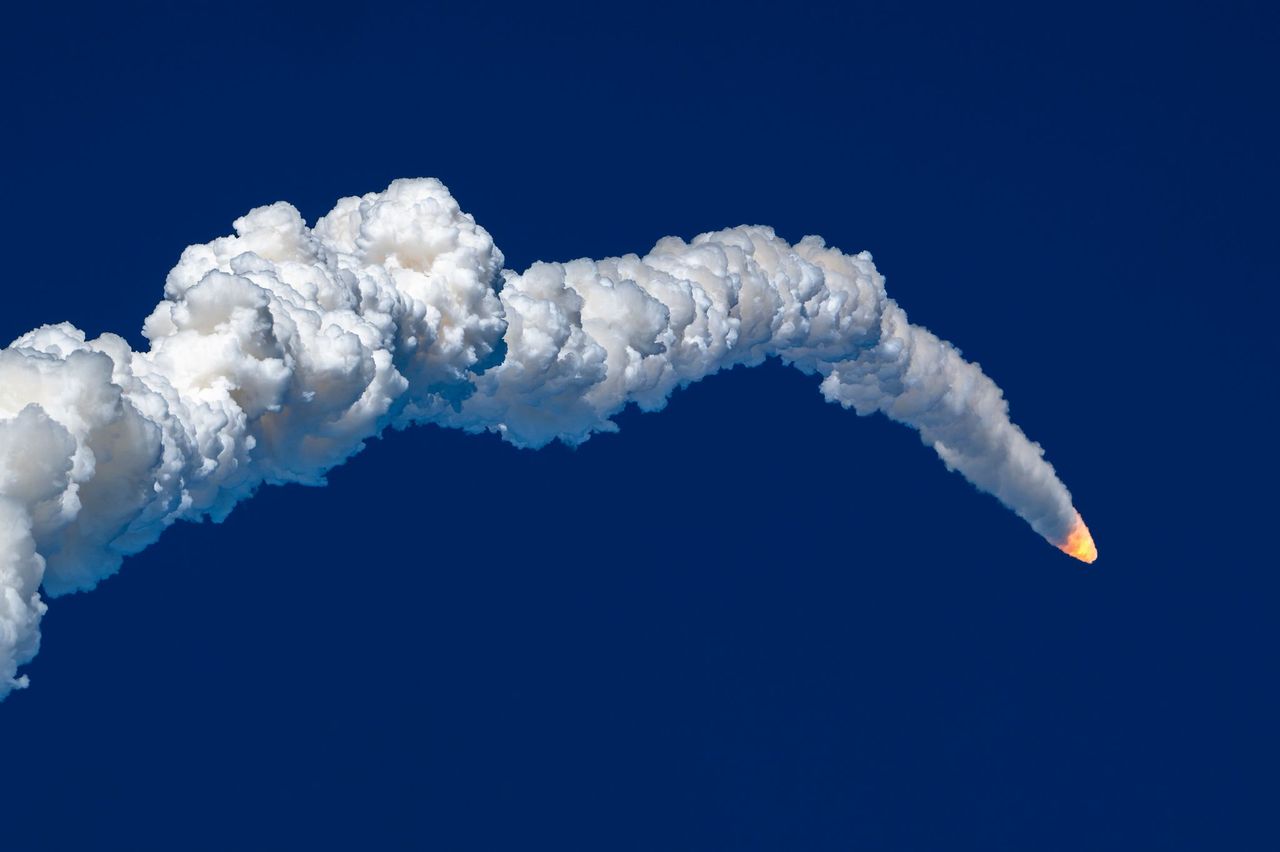
The Artemis II crewed lunar mission launches from Kennedy Space Center on April 1, 2026. Four astronauts blasted off aboard a massive NASA rocket on a long-anticipated journey around the Moon—marking the first crewed lunar flyby in more than 50 years.
Photo by Nickolas Wolf / Florida National News.


Their journey will take them thousands of miles beyond the Moon before returning to Earth. The mission will also demonstrate critical technologies needed for future lunar landings planned under upcoming Artemis missions.

Florida’s Space Coast in the Global Spotlight The launch is expected to draw thousands of spectators to Florida’s Space Coast, including viewers gathering along beaches in Cocoa Beach and nearby communities to witness the historic liftoff.

Local officials and tourism leaders say the Artemis program continues to reinforce Florida’s role as the nation’s gateway to space exploration.


Continue Reading

Tech

NASA Astronaut Jonny Kim Returns to Earth After 245-Day ISS Mission

Published

on

WASHINGTON, D.C. (FNN) — NASA astronaut Jonny Kim returned to Earth early Tuesday alongside Roscosmos cosmonauts Sergey Ryzhikov and Alexey Zubritsky, concluding an eight-month science mission aboard the International Space Station focused on advancing life on Earth and preparing for future deep space exploration.

The trio landed safely under parachute at 12:03 a.m. EST (10:03 a.m. local time) southeast of Dzhezkazgan, Kazakhstan, aboard the Soyuz MS-27 spacecraft. Their departure from the station occurred at 8:41 p.m. EST on Dec. 8.

Record-Breaking Mission and First-Time Flyers

Across 245 days in orbit, the crew circled Earth 3,920 times and traveled nearly 104 million miles. Kim and Zubritsky completed their first spaceflights, while Ryzhikov—on his third mission—now holds 603 cumulative days in space.

The crew launched to the ISS on April 8 as part of a mission that contributed to NASA’s long-running efforts to advance scientific discovery and human spaceflight capabilities.

Scientific Research to Benefit Earth and Future Missions

While aboard the ISS, Kim supported numerous experiments and technology demonstrations. His work included studying the behavior of bioprinted tissues with blood vessels in microgravity—research that could accelerate space-based tissue production and improve medical treatments on Earth.

Kim also tested multi-robot remote command capabilities for the Surface Avatar investigation, a study that could inform the development of robotic assistants for future lunar and Martian missions. In addition, he contributed to research on in-space manufacturing of DNA-mimicking nanomaterials, which may enhance drug delivery systems and support emerging fields in regenerative medicine.

Return to Houston and the Future of Exploration

After routine medical checks in Kazakhstan, the crew will travel to the recovery staging area in Karaganda. Kim will then return to NASA’s Johnson Space Center in Houston.

For more than 25 years, astronauts have lived and worked continuously aboard the International Space Station, enabling scientific breakthroughs not achievable on Earth. As commercial partners expand human spaceflight services and develop new low Earth orbit destinations, NASA is directing its focus toward deep space exploration through the Artemis program and preparing for eventual human missions to Mars.

Continue Reading
Advertisement
Advertisement Ticket Time Machine ad
Advertisement Orlando Regional REALTOR Association logo
Advertisement Parts Pass App
Advertisement Hispanic Chamber of Commerce of Metro Orlando
Advertisement
Advertisement African American Chamber of Commerce of Central Florida
Advertisement FNN News en Español
Advertisement Indian American Chamber of Commerce logo
Advertisement Florida Sports Channel

FNN Newsletter

Trending