Opinion
[OPINION] Orange County Republicans Must Adapt, or They’ll Lose Every Time!
Published
7 years agoon
By
Randy RossORLANDO, Fla. (FNN NEWS) – In the 2018 midterm elections almost none of the Orange County Republican candidates running for office were successful. The County Commission seat 2 a shadow glimmer of hope. Only a few candidates who had districts that spanned into other counties did manage a win. As we search for answers and point fingers, there’s really no one to blame but ourselves. It’s not that there isn’t a desire to win, but the desire is muddied in leadership which concerns itself more with holding power than actually rolling up its sleeves. This is difficult work which must be done to ensure that the future looks less like the past and more reflective of the demographic makeup with the market today and trends for the future. If this last cycle has proven anything, it has proven that doing things the way we always have will produce failure.
WHY REPUBLICANS DIDN’T HAVE A CHANCE IN ORANGE COUNTY RACES: The obvious answer is that the sheer numbers of registered Democrats outshine Republicans by 120,000 at the time this article was submitted. Voter registration must remain a top priority if we really want to give Republicans a fighting chance in Orange County.
Additionally, consider the Super Bowl or College Football Championships. Losers don’t win, winners do. Does anyone believe winning just happens overnight? Recruiters and coaches identify the best players nationwide to develop a winning team years in advance. Once the team is recruited, years of practice and nurturing go into putting the right players forward to play the games of their lives. We simply didn’t have years to prepare our team this cycle. Some of those running for office this cycle, our Republican political players, were chosen based on perceived ability to win or name recognition while others were chosen in hopes of capturing a win from years gone by. Not only was the approach lazy, it was flawed and became the Titanic of the 2018 local election process in Orange County. While 2020 is a great launching pad for a new approach to local Republican politics, it could, and most likely would, be 2022 or 2024 before we’d see a successful impact from a strategic approach to winning races. Let that sink in.
ORANGE COUNTY REPUBLICAN POLITICS MUST STOP BEING COLOR BLIND: The idea that anyone thought that continuing to identify “old white men” in a market with people more reflective of the local populations is simply flawed and destined to fail. Suggesting a need for minority outreach is a great start, but that’s not work. It’s lip service. Minority outreach means hosting events and recruiting in communities where minorities live. Thinking that black and brown people in our diverse community are going to gravitate to a senior center in a downtown white community is simply not realistic. The ideal meeting space must feel comfortable for all and the greeting committee reflective of various cultures and races. The Orange County Republican Executive Committee (OCREC) needs a minority outreach team comprised of minorities. Not white people who don’t give minorities a seat at the table with resources to actually engage the communities they represent. It is only then that the local party will start mirroring the county it represents.
REASSESS THE VOTING DEMOGRAPHICS: I can recall, after a large number of Puerto Ricans relocated to Central Florida last year following Hurricane Maria, a politician mentioning to me, “We don’t need to be concerned. Most are registering Independent or not registering at all.” I remember pausing and thinking that made absolutely no sense with absolutely no support, other than hearsay, to make it reality. I mean, was an Orange County Republican census completed and I was unaware of it? Market trends and evaluations, in our case, who is registered to vote and is living in Orange County Florida, should be a constant part of any organizational structure, including a political group. Is the messaging relevant and appropriate? Is the messaging and engagement tailored? Are we touching people with what matters to them: their lives, communities and pocketbooks? Do we have people on our election teams to guide us and advise what is necessary to attract new and different sectors of our population? Are we willing to do what is necessary to be inclusive of those factors in our marketing efforts? Do we even know how to attract minorities or is it simply a talking point? Or are people with little to no experience making decisions because of their role, not because the decisions are solid and rooted in fact?
SPEND TIME BUILDING BRIDGES AND MENDING FENCES: Not all is lost in our market on white male Republicans in Republican groups or candidates running for office, but they too must spend time building bridges with the communities they will be looking to represent. The days of “assuming” black and brown people minorities don’t or won’t vote are long behind us. In the early part of my career I worked for a consultant who helped fitness center owners enhance their business model. I share her philosophy because it really hits home as to what must occur for Republican groups and candidates to widen their net. In a nutshell, she’d walk into a failing health club and she’d share with the facility owner, “You know what your problem is? You focus on people who are committed to get fit. The bodybuilders, the aerobic queens. The electricity could be off and those people will still not miss a workout. What you should be doing is focusing on the deconditioned market. Average people who know fitness and wellness are important, but simply are unmotivated or don’t even know where to begin.” Imagine if Republican groups and politicians focused more on those they need to educate or motivate to engage or vote versus on the loyal base that comes to every election to vote red? Meaning — and back to my point–we must reach outside our comfort zones if what we seek is engagement from people that might not fit the political status quo. It’s in those spaces and times where candidates will build bridges with people and races who may not look like them.
THE REPUBLICAN PARTY OF ORANGE COUNTY NEEDS TO BE REBRANDED STAT: If you ask most what they think of when they describe a Republican you’ll often hear “old white men” in the description. If you walk into an OCREC meeting most of this description would be a fair assessment. Somewhere the local party decided that redirecting its outreach to what was comfortable was more appealing than going through the learning curve of what appeals to minorities and people that are, well, different from the stereotype. I’ve often heard, “That’s not true, we welcome everyone into our membership.” Well, that’s been proven time and time again to be untrue. In fact, a recent movement to bring the leaders of multiple women’s clubs into the membership was met with immediate and deliberate pushback. Instead of extending the welcome mat, there was a revolt to keep those leaders and their members from gaining access to what in recent years has resembled more of a secret society than a direct reflection of the demographic makeup of the county.
SOLUTIONS
I’m not one to produce concerns without recommending solutions and suggestions.
REACH OUT TO POTENTIAL VOTERS WHERE THEY LOOK FOR INFORMATION AND WHERE THEY LIVE: One thing the Democratic Party does very well is to go into neighborhoods and host events to recruit and educate new voters. We know Hispanics, for example, are more event-oriented and prefer print and radio over receiving mailers. We Republicans spend time at gun shows. While certainly a captive audience, again, remember we’re looking to grow the audience of potential recruits and voters. That cannot be accomplished without going outside the box.
TRANSLATE ALL COLLATERAL FROM ENGLISH TO SPANISH: A key thing I’ve learned from my experience over the past few years in working with the Hispanic population is it’s not that they can’t speak or read English, it’s that the they simply “prefer” seeing things in their language. So rather than crying foul and saying, “If they can’t read or speak English, they shouldn’t vote,” pay attention. It’s a preference. A preference that may help build a bridge between the party and a sector of the population.
Finally, realize everything suggested here is a cultural shift in Orange County Republican groups and politicians that will not occur overnight. It will take years of adjusting and fine tuning a constantly evolving strategic mindset to ensure that the wheel never rolls in the wrong direction again. I’m not suggesting we become focused on social issues…far from it. Conservative values are far more in line with all minority groups and cultures than most Republican politicians and organizations are prepared to acknowledge and work to engage.
So sure, it takes hard work to educate and motivate and build an army. But if our 2018 midterm election losses have taught us anything, it’s that doing things the same way we have for decades results in losses. Orange County Republicans were out=worked, out-recruited, out-strategized, and out-coached. But there is hope. It all starts with honest dialogue and genuine brainstorming. Let this be the first step! We must assume there will be a Cinderella story.
________________________________________
Randy Ross is a political contributor for Florida National News. | social@floridanationalnews.com
Opinion
Commentary: Civility as Moral Power: What Gandhi Gave King — and What King Gave America and the World
Published
4 weeks agoon
January 19, 2026Dr. Martin Luther King Jr. did not merely change laws. He changed the moral tone of a nation.
At a time when America was convulsed by racism, violence, and injustice, Dr. King chose a path many dismissed as weak or naïve: civility, nonviolence, and disciplined love. History proved otherwise. In King’s hands, civility was neither politeness nor passivity. It was moral power.
That power did not arise in isolation. King drew deeply from the life and philosophy of Mahatma Gandhi. While studying theology and social ethics, he encountered Gandhi’s doctrine of satyagraha — the “force of truth.” What struck King most was Gandhi’s insistence that injustice must be resisted, but never with methods that corrupt the soul or mirror the cruelty of the oppressor. King later called Gandhi “the guiding light of our technique of nonviolent social change.”
From India’s struggle against British colonialism to America’s fight against segregation, the moral logic was the same: suffering willingly endured, without hatred or retaliation, can awaken the conscience of a nation. Nonviolence was not weakness; it was moral jiu-jitsu — exposing injustice by refusing to cooperate with it, while refusing to become it.
For King, civility did not mean silence in the face of injustice. In his Letter from Birmingham Jail, he made clear that unjust laws must be broken — openly, lovingly, and with a willingness to accept the penalty. Like Gandhi, King rejected both cowardly submission and violent revolt. His method of nonviolent civil disobedience was precise and intentional: it disrupted injustice while preserving the moral legitimacy of the movement.
This moral lineage from Gandhi to King remains one of the most remarkable transmissions of ethical philosophy in modern history. Different cultures. Different continents. One moral grammar. Both men believed that love is a social force, not merely a private virtue; that hatred multiplies hatred; and that the means we use to pursue justice shape the society we ultimately create.
When children were attacked by fire hoses in Birmingham and peaceful marchers were beaten on the Edmund Pettus Bridge, it was not rage that moved the conscience of the nation. It was the devastating contrast between the dignity of the protesters and the brutality of their oppressors. Civility gave the movement credibility. Nonviolence gave it legitimacy. Moral discipline gave it victory.
Neither Gandhi nor King was “nice” in the shallow sense. Both condemned injustice relentlessly. Both disrupted the comfort of the powerful. Yet neither surrendered to cruelty or dehumanization. They understood a hard truth: a movement that loses its soul cannot save a society.
Today, in an age of outrage, humiliation, and political tribalism, their shared example speaks with renewed urgency. We cancel rather than persuade. We humiliate rather than debate. We dehumanize rather than disagree — and we call it authenticity.
Gandhi and King would have rejected this moral downgrade.
They would remind us:
That cruelty is not courage.
That rage is not righteousness.
That humiliation is not justice.
Gandhi lit the torch. King carried it across an ocean. Now it rests in our hands.
To honor them is not merely to quote them once a year. It is to practice what they practiced: to resist injustice without surrendering our humanity, to speak with moral clarity without moral cruelty, and to pursue change without poisoning the future with hatred.
Their revolution was not only political.
It was moral.
And it remains ours.
Hon. Rick Singh is a former Orange County property appraiser and a civic leader in Central Florida. He writes on ethics, public service, and democratic culture.
Opinion
OPINION: Puerto Rican Political Power in Florida Faces Decline Post-2024 Losses
Published
1 year agoon
January 10, 2025By
Willie DavidThe 2024 elections marked a troubling turning point for Puerto Rican political representation in Florida. What was once a growing force of influence in state and national politics now faces a steep decline, raising alarms about the future of Puerto Rican voices in government.
In 2016, our community achieved historic milestones: Darren Soto became the first Puerto Rican from Florida elected to the U.S. Congress, Victor Torres won a seat in the Florida Senate, and four Puerto Ricans—John Cortes, Amy Mercado, René Plasencia, and Bob Cortes—held seats in the Florida State House. This wave of representation was a proud moment for Puerto Ricans, a sign that our voices were finally being heard at the highest levels.
2016 Representation Snapshot:
- 1 U.S. Representative Seat
- 1 Florida State Senate Seat
- 4 Florida State House Seats
Fast forward to 2025, and the numbers tell a much different story:
- 1 U.S. Representative Seat (Darren Soto)
- 0 Florida State Senate Seats
- 2 Florida State House Seats (Johanna López and Susan Plasencia)
The losses in 2024 have decimated our influence in state government. The Florida State Senate, once home to a Puerto Rican voice, is now silent. The reduction in House seats has further diminished our ability to shape policy and advocate for our community.
This is a moment for reflection and action. As a former Puerto Rican Florida State Representative, I understand the hard work it takes to elevate our community’s concerns and ensure they are heard. But these latest setbacks demonstrate that we cannot afford complacency.
We must:
- Prioritize leadership development by identifying and mentoring the next generation of Puerto Rican leaders.
- Strengthen voter engagement efforts to increase turnout and political awareness within our community.
- Build coalitions across Florida to amplify our collective voice and work toward shared goals.
- Focus on unity, setting aside partisan divides to protect and grow Puerto Rican representation.
Puerto Ricans in Florida contribute significantly to the state’s economy, culture, and community development. Yet, without strong political representation, our ability to advocate for critical issues—such as disaster recovery, housing, healthcare, and education—is severely hampered.
The time to act is now. If we fail to address this decline, the consequences for Puerto Rican communities across Florida could be dire. Let us remember that our representation is not just about holding titles but about driving meaningful change for the people we serve. Together, we can rebuild and ensure that Puerto Rican political power not only survives but thrives for future generations.
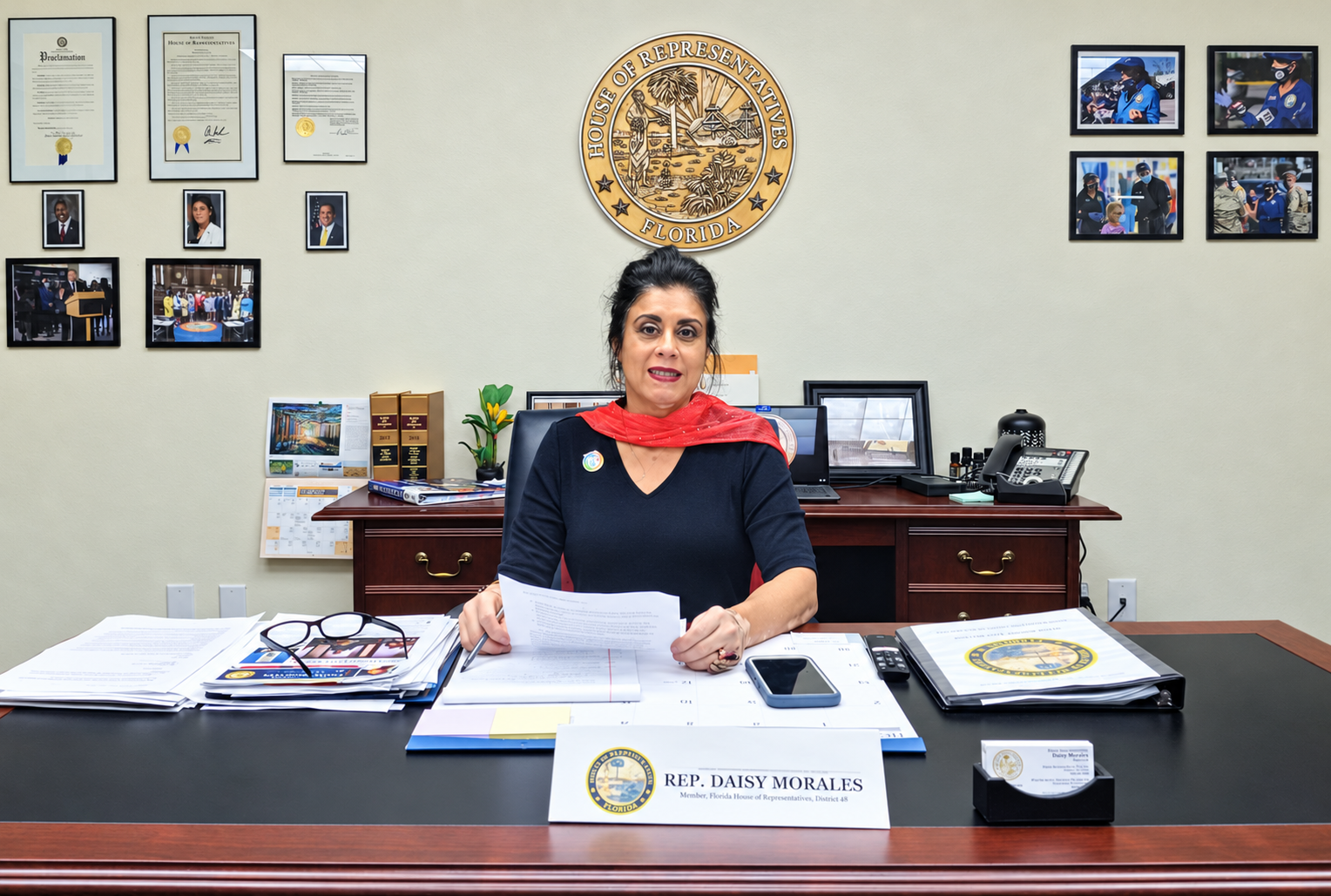
Daisy Morales
Former Florida State Representative
Advocate for Puerto Rican Leadership and Progress
_______________________________________________________________
To contribute to Florida National News, you can submit Letters to the Editor (up to 200 words) or My Voice columns (approximately 500 words) by emailing them to letters@FloridaNationalNews.com. Please include your address for verification purposes only. If submitting a My Voice column, also attach a photo and a 1-2 line bio about yourself.
Submissions are considered for publication based on space availability. All contributions may be edited for content, clarity, and length and may also be republished across any platform within the FNN News Network.
We value your voice and look forward to hearing from you!
Opinion
OPINION: Why Kamala Harris Should Run for President in 2028
Published
1 year agoon
November 9, 2024As one of the most powerful Democrat in America, Vice President Kamala Harris has redefined the Democratic Party’s vision and laid a foundation that resonates across generations. Her recent race may not have led to victory, but it achieved historic milestones and undeniable progress, positioning her as a strong candidate for a presidential run in 2028. Harris’s journey is more than a campaign story—it’s a testament to resilience, vision, and the power of representation.
Key Campaign Successes:
Kamala Harris’s 2024 campaign set records and defined new standards, underscoring her influence and appeal as the Democratic Party’s future:
- Unmatched Fundraising Power: Harris shattered expectations by raising a staggering $1 billion in just 107 days, mobilizing grassroots supporters and influential donors alike. This financial prowess is a rare asset, proving Harris has the power to energize her base and secure the resources for a robust campaign in 2028.
- A Historic First: Harris became the first nominee for the Democratic Party who is both a woman and Black — and South Asian, opening doors for diverse leadership and setting a historic milestone that inspired millions. Her groundbreaking nomination broadened the party’s reach, engaging a new generation of voters and energizing communities that may prove even more impactful in 2028.
- Electrifying Rallies: Harris’s campaign rallies drew some of the largest and most energized crowds, uniting diverse demographics and proving her ability to mobilize on a massive scale. This enthusiasm and reach will be invaluable as Democrats seek to connect with younger voters and maintain turnout momentum in future elections.
- Debate Dominance: Known for her sharp debating skills, Harris outperformed Donald Trump on the debate stage, refocusing on critical issues and strengthening her policy appeal. Her clear stances on healthcare, climate action, and reproductive rights won over progressives and independents alike, highlighting her capability as a skilled and effective communicator.
Notable Endorsements and Widespread Support
During her campaign, Harris garnered endorsements from leading Democratic voices, including former President Barack Obama, major labor unions, and key progressive organizations. These endorsements amplified her message, validated her leadership, and set the stage for her continued influence in Democratic circles. These alliances could be a solid foundation for another potential run, ensuring she has strong backing in 2028.
U.S. Vice President Kamala Harris gives remarks in the Statuary Hall of the U.S. Capitol during a ceremony on the first anniversary of the January 6, 2021 attack on the U.S. Capitol by supporters of former President Donald Trump in Washington, D.C., U.S., January 6, 2022. Greg Nash/Pool via REUTERS
Takeaways and Implications for 2028
While the 2024 outcome wasn’t in her favor, Harris’s campaign was a transformative experience, positioning her as the Democratic Party’s top hope to retake the White House in 2028:
- A Diverse Coalition: Harris has built a powerful coalition of young voters, women, people of color, and progressives. If she can retain and expand this base, she has the potential to bridge party divides and strengthen Democratic appeal in a way few others can.
- The Absence of Trump: With Donald Trump out of the 2028 race, Republicans may lack the singular, polarizing figure who drove voter turnout in 2024. This void could open the door for Harris to expand her base and draw in moderates looking for fresh, inclusive leadership.
A Campaign Beyond Politics
Harris’s 2024 bid wasn’t just a run for office; it was a bold vision of the Democratic Party’s future. Her achievements, historic firsts, and groundbreaking influence reflect a leader whose determination and resilience are unmatched. She has shown that every setback is an opportunity to regroup, rethink, and rise stronger. Success doesn’t come solely from victories but from the courage to persist, the flexibility to adapt, and the unyielding drive to try again.
Harris’s journey represents not only the thrill of competition but also the profound growth that emerges from the challenges. In politics, as in sports (the Super Bowl, the World Series), resilience fuels the comeback, and Harris’s experience has crafted her into a contender ready to lead in 2028. Her return to the national stage would embody the resilience and strength that the Democratic Party—and America—needs.
_________________________________________________
Florida National News
opinion@FloridaNationalNews.com