

US NATIONAL NEWS
President Biden Announces Key Appointments to Boards and Commissions

Published
2 years agoon

WASHINGTON – Today, President Joe Biden announced his intent to appoint the following individuals to serve in key roles:
- Troy Coronado, to be a Member of the Board of Visitors to the U.S. Military Academy
- Manuel A. Chinea, to be a Member of the Community Development Advisory Board
- Janie Simms Hipp, to be a Member of the Community Development Advisory Board
- Mark Alan Kaufman, to be a Member of the Community Development Advisory Board
- Susan Chapman Plumb, to be a Member of the Community Development Advisory Board
- Damon Y. Smith, to be a Member of the Council of the Administrative Conference of the United States
- Justin Driver, to be a Member of the Permanent Committee for the Oliver Wendell Holmes Devise
- Kamana‘opono M. Crabbe, to be a Commissioner of the President’s Advisory Commission on Asian Americans, Native Hawaiians, and Pacific Islanders
- Sameera Fazili, to be a Commissioner of the President’s Advisory Commission on Asian Americans, Native Hawaiians, and Pacific Islanders
- Krystal Ka‘ai, to be a Commissioner of the President’s Advisory Commission on Asian Americans, Native Hawaiians, and Pacific Islanders
- Vida Lin, to be a Commissioner of the President’s Advisory Commission on Asian Americans, Native Hawaiians, and Pacific Islanders
- Emmanuel Jenkins, to be a Member of the President’s Committee for People with Intellectual Disabilities
- Charles P. Riley, to be a Member of the Route 66 Centennial Commission
- Edgar Gluck, to be a Member of the Commission for the Preservation of America’s Heritage Abroad
- Andrew G. Biggs, to be a Member of the Financial Oversight and Management Board for Puerto Rico
- Cameron McKenzie, to be a Member of the Financial Oversight and Management Board for Puerto Rico
- John Earl Nixon, to be a Member of the Financial Oversight and Management Board for Puerto Rico
The Board of Visitors to the U.S. Military Academy
The Board of Visitors to the U.S. Military Academy provides independent advice and recommendations to the President on matters related to morale, discipline, curriculum, instruction, physical equipment, fiscal affairs, academic methods, and any other matters relating to the Academy that the Board decides to consider. The Board consists of six members appointed by the President for terms of three years.
Troy Coronado, to be a Member of the Board of Visitors to the U.S. Military Academy
Troy Coronado, rising from the rank of private to colonel, has 30 years of distinguished military service in the U.S. Army. In 1987, he enlisted in the Infantry at Fort Benning, Georgia. While working as a drill corporal, he was selected to attend the Officer Candidate School, and upon graduation, was commissioned a second lieutenant in the Armor Branch. His first assignment was platoon leader in Schweinfurt, Germany.
In 2006, Coronado completed a combat tour in Afghanistan, working as an embedded team trainer, as part of Operation Enduring Freedom. Following his return to the U.S., his assignments included the Pentagon, Fort Knox, Kentucky, and the National Guard Bureau Joint Staff. In 2014, he returned to Afghanistan as the Joint Command Inspector General. From there he was assigned to the Warrior Transition Brigade at the Walter Reed National Military Medical Center in Maryland until his retirement in 2017.
Coronado’s military awards include the Legion of Merit, Bronze Star Medal, Defense Meritorious Service Medal, Joint Service Commendation, Army Commendation, Army Achievement, Good Conduct Medal, National Defense Service Medal, Global War on Terrorism Medal, Armed Forces Reserve Medal, NATO Medal, and the Combat Action Badge. He is a member of the Army Infantry Officer Candidate School Hall of Fame and a recipient of the American Latino Veterans Association Valor Award. Coronado and his wife, Lisa, have been married for 35 years and have three daughters and two grandchildren. He now lives back in his hometown of San Antonio, Texas.
Community Development Advisory Board, Department of the Treasury
The Community Development Advisory Board serves to advise the Community Development Financial Institutions (CDFI) Fund within the Department of the Treasury. The Community Development Advisory Board’s mission is to promote access to capital to underserved communities. The CDFI Fund, in partnership with the Board, partners with and invests in local lenders and financial service providers around the country. Since inception, the CDFI Fund has awarded more than $5.2 billion dollars to its partners.
Manuel A. Chinea, to be a Member of the Community Development Advisory Board
Manuel Chinea is the Chief Operating Officer of Popular Bank, a leading financial institution with operations in Puerto Rico, the mainland U.S. and the Virgin Islands. Prior to joining Popular Bank, Chinea served as Executive Vice President and Chief for Retail Operations at Certus Bank. For over two decades, Chinea has been an active member and officer of several marketing, credit, treasury management and nonprofit organizations. Chinea has been an active leader in the treasury management and nonprofit space, as he currently serves as a board member of Junior Achievement of New York and is a current Treasurer and former board Chair of the Hispanic Federation. Chinea holds a B.S. in finance from the University of Maryland’s Robert H. Smith School of Business and an MBA from the University of Michigan’s Stephen M. Ross School of Business.
Janie Simms Hipp, to be a Member of the Community Development Advisory Board
Janie Hipp is the President and CEO of Native Agriculture Financial Services, a lending institution focused on economic development for tribal communities. Prior to this, Hipp was nominated by President Biden and confirmed by the Senate to serve as the General Counsel of the Department of Agriculture. She is the first enrolled tribal citizen to hold that role, as a member of the Chickasaw Nation. Hipp has worked in agricultural law and economic development for nearly 40 years, including serving as the CEO of the Native American Agriculture Fund and as a senior advisor to USDA Secretary Tom Vilsack and Director of the USDA Office of Tribal Relations. Hipp holds a Bachelor of Arts degree in social work from the University of Oklahoma, a J.D. from Oklahoma City University’s School of Law and a LLM in agricultural law from the University of Arkansas School of Law.
Mark Alan Kaufman, to be a Member of the Community Development Advisory Board
Mark Kaufman is the President of the Neighborhood Impact Investment Fund, a community development financial institution dedicated to investing in inclusive growth for historically undercapitalized areas of Baltimore, MD. Kaufman has nearly 40 years of experience in government and the private sector working on community finance and development. His public service includes his tenure as Counselor to Treasury Deputy Secretary Sarah Bloom Raskin in the Obama-Biden Administration and as Commissioner of the Maryland Division of Financial Regulation. In the private sector, he served as the President of City First Bank, a DC-based community development financial institution, and as Managing Director of Investment Banking at CIBC World Markets. Kaufman holds a B.A. in Political Science and Economics from Brown University, as well as a MPA and MBA from Columbia University.
Susan Chapman Plumb, to be a Member of the Community Development Advisory Board
Susan Chapman Plumb is the CEO and board chair of Local Bank and is a board member of the Federal Reserve Bank of Kansas City. Local Bank, previously known as the Bank of Cherokee County, was one of the first Native-owned CDFIs certified by the Treasury Department. Plumb began her career as an attorney, and has since worked in banking in Cherokee County for the last 20 years. Plumb is active in her community, serving on the boards of the Tahlequah Hospital Foundation and the Oklahoma Hall of Fame. She holds a B.A. in journalism from the University of Oklahoma and a J.D. from the University of Tulsa.
Council of the Administrative Conference of the United States
The Administrative Conference of the United States (ACUS) is an independent federal agency charged with convening expert representatives from the public and private sectors to recommend improvements to administrative process and procedure. ACUS initiatives promote efficiency, participation, and fairness in the promulgation of federal regulations and in the administration of federal programs. The 10-member ACUS Council is composed of government officials and private citizens.
Damon Y. Smith, to be a Member of the Council of the Administrative Conference of the United States
Damon Y. Smith serves as the General Counsel at the U.S. Department of Housing and Urban Development (HUD). As General Counsel, Smith is responsible for leading the agency’s litigation and enforcement efforts, serving as the Designated Agency Ethics Official, and assisting the Secretary in the development of HUD programs and policies. Smith joined the Biden-Harris Administration as Principal Deputy General Counsel. Prior to that, he was Senior Director of Advocacy and Counsel at the Credit Union National Association and a Partner at Jenner and Block LLP in Washington, D.C. where he provided counsel to companies facing complex compliance, government regulation, and enforcement matters.
Smith previously served as Principal Deputy and Acting General Counsel at HUD during the Obama-Biden Administration. Before his government service, he taught property and local government law as an Associate Professor at Rutgers-Camden Law School and a Visiting Professor at the American University Washington College of Law. He began his legal career as a real estate Associate at Arnold & Porter in Washington, D.C. and worked prior to law school as an urban planner in East St. Louis, Illinois and St. Louis, Missouri. Smith is a graduate of Harvard Law School and holds a B.A. in English and a master’s degree in urban planning from the University of Illinois at Urbana-Champaign.
Permanent Committee for the Oliver Wendell Holmes Devise
The Permanent Committee for the Oliver Wendell Holmes Devise was established by Congress in 1955 after the late Associate Justice of the Supreme Court Oliver Wendell Holmes Jr. bequeathed a portion of his estate to the United States in 1935. Congress used the gift to establish the Committee, which is charged with documenting and disseminating the history of the United States Supreme Court. The Committee’s principal purpose is to continue to publish the multi-volume work documenting the history of the Court. The Committee is composed of the Librarian of Congress and four additional members appointed by the President.
Justin Driver, to be a Member of the Permanent Committee for the Oliver Wendell Holmes Devise
Justin Driver is the Robert R. Slaughter Professor of Law at Yale Law School, where he primarily teaches and writes in the fields of constitutional law, constitutional theory, and education law. He is the author of The Schoolhouse Gate: Public Education, the Supreme Court, and the Battle for the American Mind, which was selected as a Washington Post Notable Book of the Year and an Editors’ Choice of The New York Times Book Review. The Schoolhouse Gate also received the Steven S. Goldberg Award for Distinguished Scholarship in Education Law, and was a finalist for the American Bar Association’s Silver Gavel Award and Phi Beta Kappa’s Ralph Waldo Emerson Book Award. A recipient of the American Society for Legal History’s William Nelson Cromwell Article Prize, Driver is an elected member of the American Law Institute and of the American Academy of Arts & Sciences. In 2021, President Biden appointed Driver to serve on the Presidential Commission on the Supreme Court of the United States. He is a graduate of Brown, Oxford, Duke, and Harvard Law School. After graduating from Harvard, Driver clerked for Justice Sandra Day O’Connor (Ret.) and Justice Stephen Breyer (Ret.).
President’s Advisory Commission on Asian Americans, Native Hawaiians, and Pacific Islanders
The President’s Advisory Commission on Asian Americans, Native Hawaiians, and Pacific Islanders advises the President on ways the public, private, and non-profit sectors can work together to advance equity and opportunity for every Asian American, Native Hawaiian, and Pacific Islander (AANHPI) community. The Commission is also charged with advising the President on policies to address anti-Asian xenophobia and violence, ways to build capacity in AANHPI communities through federal grantmaking, and policies to address the intersectional barriers that AANHPI women, LGBTQ+ people, and people with disabilities face. The Commission includes civic leaders from across the country and reflects the rich diversity of AANHPI communities across the United States. The Commission consists of 25 members appointed by the President.
Kamana‘opono M. Crabbe, to be a Commissioner of the President’s Advisory Commission on Asian Americans, Native Hawaiians, and Pacific Islanders
Dr. Kamana‘opono M. Crabbe serves as a seasoned spokesperson and representative for the Native Hawaiian community on Native Hawaiian rights, social inequities, community health and resilience, and current social, cultural, educational, economic, and political issues affecting Native Hawaiians, Hawai‘i, and the Pacific. He sits on several high-level policy and governing boards, including the Hawai‘i Executive Collaborative Leadership Committee and the Asian American Foundation Advisory Council.
In 2010, he joined the Office of Hawaiian Affairs (OHA) as its Research Director, and was appointed as Chief Executive Officer in March 2012. As OHA’s Ka Pouhana, the main post of the hale, he grounded the organization in Kūkulu Hou – his vision to reestablish and rebuild the mana of kānaka maoli, Native Hawaiians. He later served as the Ka Pouhana-CEO for the Kohala Institute at ‘Iole, where he led the organization on a new vision to “be a world leader in sustainable thinking through a model 21st century ahupua‘a, where land is chief, and man is steward.”
Currently, Crabbe serves as the Executive Counselor for the Asian Pacific Islander Health Forum, a national health policy advocacy organization based out of Washington, D.C. and San Francisco, California. He also serves as a Senior Executive for the Hawai‘i Executive Collaborative and is the Project Lead-Executive for the Rediscovering Hawai‘i’s Soul initiative.
Crabbe has received numerous cultural distinctions and formal awards recognizing his executive leadership and accomplishments. He serves his community as a ho‘oponopono practitioner, skilled chanter and orator, and ‘aha ‘awa ceremony and protocol expert. In 2006, he established the non-profit organization, ‘Aha Kāne: Foundation for the Advancement of Native Hawaiian Males. He earned his doctorate in clinical psychology from the University of Hawai‘i at Mānoa and served countless families, youth, and communities as a licensed clinical psychologist for over 12 years.
Sameera Fazili, to be a Commissioner of the President’s Advisory Commission on Asian Americans, Native Hawaiians, and Pacific Islanders
Sameera Fazili is an economic policy expert with over 20 years of leadership experience across the public, private, and non-profit sectors. She previously served as Deputy Assistant to President Biden and Deputy Director of the White House’s National Economic Council. In that role, she led the Administration’s work on industrial policy, supply chains, and regional economic development, including the response to numerous supply chain crises. She currently runs her own advisory business, focused on clean energy transition, global supply chain resilience, and economic equity issues, and is a senior fellow in industrial policy and trade at the Roosevelt Institute. She serves on the boards of Asian Americans Advancing Justice Atlanta, the Paideia School, and the Washington Center for Equitable Growth, and was previously a board member with the Inner-City Muslim Action Network, helping launch their Atlanta, Georgia office. Her career has included work at the Federal Reserve Bank of Atlanta, the U.S. Department of the Treasury, and Yale Law School, where she helped launch Connecticut’s first community development bank. A graduate of Yale Law School and Harvard College, she lives in Atlanta, Georgia.
Krystal Ka‘ai, to be a Commissioner of the President’s Advisory Commission on Asian Americans, Native Hawaiians, and Pacific Islanders
Krystal Ka‘ai is a dedicated public servant with over 14 years of experience working to advance equity for underserved communities. In 2021, she was appointed by President Biden as the first Native Hawaiian in history to serve as the Executive Director of the White House Initiative and the President’s Advisory Commission on Asian Americans, Native Hawaiians, and Pacific Islanders. In this role, she oversees the Biden-Harris Administration’s whole-of-government strategy to advance equity, justice, and opportunity for Asian American, Native Hawaiian, and Pacific Islander (AA and NHPI) communities, including coordinating interagency policy development and external outreach to local, state, and federal stakeholders across the country. Prior to joining the Administration, she served as the Executive Director of the Congressional Asian Pacific American Caucus (CAPAC), a bicameral caucus comprised of over 80 Members of Congress who advocate for the needs and concerns of AA and NHPI communities at the federal level. Her public service career also includes prior roles with the U.S. Senate Committee on Indian Affairs, the State of Hawai‘i Office of Hawaiian Affairs, and the National Japanese American Memorial Foundation.
Vida Lin, to be a Commissioner of the President’s Advisory Commission on Asian Americans, Native Hawaiians, and Pacific Islanders
Vida Lin has dedicated 30 years to empowering Nevada’s Asian American, Native Hawaiian, and Pacific Islander community by taking decisive action where she saw the greatest need. As the Founder and President of the Asian Community Development Council, Lin transformed her vision into reality by establishing Nevada’s first Asian food pantry, hosting vaccination clinics, offering free citizenship assistance, and opening the Healthy Asians and Pacific Islanders (HAPI) Medical Center in Las Vegas, Nevada.
Lin’s journey began in San Francisco, California where she ran a small family business and later transitioned to the insurance industry to protect families after a personal tragedy. During her successful 20-year career as an insurance broker, Lin’s passion for helping the underserved drove her to advise and serve as a board member for numerous charities and causes. Her unwavering commitment to civic engagement and advocacy was recognized with the Bank of America “Neighborhood Builders: Racial Equality Award” in 2022, and the City of Las Vegas honored her with “Vida Lin Day” on January 18, 2023. Lin’s legacy is defined by her relentless pursuit of uplifting and empowering the next generation of leaders.
President’s Committee for People with Intellectual Disabilities
The President’s Committee on People with Intellectual Disabilities serves as a federal advisor to the President and the Secretary of Health and Human Services on matters relating to persons with intellectual disabilities. The Committee has 21 members who serve two-year terms. Individuals appointed to this Committee reflect the diversity of America and include people with intellectual disabilities and their family members, researchers, service providers and other professionals, community and business representatives, and systems advocates.
Emmanuel Jenkins, to be a Member of the President’s Committee for People with Intellectual Disabilities
Emmanuel Jenkins, the driving force behind the non-profit We Stand 4 Something, is a beacon of support for individuals with disabilities and their families, spreading positivity and hope. In Delaware, he serves as the Community Relations Officer for the Delaware Developmental Disabilities Council and serves as the Chair of the Delaware Employment First Oversight Commission and Vice Chair of the Delaware Developmental Disabilities Services Advisory Committee. An alumnus of the Partners in Policymaking program since 2014, Jenkins’ unwavering dedication to advocacy is further evidenced by his recent roles on the Advisory Committee for the Self-Advocacy Resource and Technical Assistance Center and as Chair of the National Association of Councils on Developmental Disabilities (NACDD) Self-Advocacy Committee. He also serves on the NACDD Board and chairs its communications working group. In academia, Jenkins is a distinguished Leadership Education in Neurodevelopmental and Related Disabilities (LEND) Faculty Member at the University of Delaware. Jenkins has been married since 2009 and is father to an 18-year-old. With over two decades as a motivational speaker, Emmanuel envisions a future where his tireless advocacy can reach new heights, embodying resilience, determination, and the belief in standing for something greater.
Route 66 Centennial Commission
The Route 66 Centennial Commission was established by Congress in 2020 to study and make recommendations on activities that would be fitting and proper to celebrate the centennial anniversary of the Mother Road of the United States, Route 66, in 2026. The Commission studies activities including potential ceremonies and celebrations, the production and publication of media or other materials, and the issuance of commemorative items.
Charles P. Riley, to be a Member of the Route 66 Centennial Commission
Charles P. Riley is a citizen of the Pueblo of Acoma, New Mexico and has a made public service his career. He served the Pueblo as a Tribal Council member for 13 years and as a Tribal Sheriff for one year. Riley holds a Bachelor’s Degree in Civil Engineering from the University of New Mexico and worked for private engineering and surveying firms for 10 years, before joining the Bureau of Indian Affairs. At the Bureau of Indian Affairs, he held the positions of Regional Road Engineer, Designated Engineer, and Mescalero Agency Superintendent. Riley ended his government career working for the Bureau of Indian Education. He retired from public service after 25 years and is currently working for the Pueblo as the Director of Community Development.
As the Director of Community Development, Riley oversees the planning, design, and construction of roads on Pueblo of Acoma lands. His office has been awarded grants to plan and design 13 miles of roads and three bridges. His office is currently helping other departments with the development of a new Education Resource Center and Senior Center complex. The Pueblo’s future projects include a reservation-wide pedestrian/bike trail system, and the designation of a Tribal Scenic Byway that will lead to the historic Acoma village known as “Sky City,” that will begin and end on historic Route 66.
Riley has been married for 39 years, and has three daughters and four grandchildren
Commission for the Preservation of America’s Heritage Abroad
The Commission for the Preservation of America’s Heritage Abroad was established in 1985 to ensure that sites important to populations impacted by Nazism, communism, and the Cold War would be preserved for future generations. The Commission’s mission is to identify, protect, and preserve cemeteries, monuments, and historic buildings in Eastern and Central Europe that are associated with U.S. heritage. The work recognizes that the population of the United States is mostly comprised of immigrants and their descendants, and that the United States has an interest in the preservation of sites in other countries related to the heritage of these Americans.
Edgar Gluck, to be a Member of the Commission for the Preservation of America’s Heritage Abroad
Rabbi Edgar Gluck was born in Hamburg, Germany on June 14th, 1936. A Holocaust survivor, he immigrated to the U.S. at the age of two. He attended the Chasan Sofer Rabbinical Academy and Beth Medrash Elyon Academy of higher studies and research where he earned an Advanced Rabbinical Degree of “Rabbi and Judge.” One of his areas of post-rabbinical specialization has been the identity and dignity of the dead, and he has worked tirelessly to identify and restore grave sites and reclaim cemeteries and areas of mass graves worldwide for the last six decades. Gluck has also been active with the Office of the Chief Medical Examiner in the city of New York, where he currently holds the position of Chaplain to the Chief Medical Examiner.
In 1971, he co-founded Hatzoloh, the largest volunteer ambulance corps in the country. Gluck is Chairman of the in-patient Board of Maimonides Medical Center, one of the largest metropolitan hospitals in New York City, and has been appointed as Chief Rabbi of Galicia, Poland. In 1984, President Ronald Reagan awarded him with a Commendation for his Exemplary Community Service and he continues to serve the needs of the community, both in the U.S. and abroad.
Financial Oversight and Management Board for Puerto Rico
The Financial Oversight and Management Board for Puerto Rico was created under the Puerto Rico Oversight, Management and Economic Stability Act of 2016. The Board consists of seven members appointed by the President and one ex officio member designated by the Governor of Puerto Rico. The Board is tasked with working with the people and Government of Puerto Rico to create the necessary foundation for economic growth and to restore opportunity to the people of Puerto Rico.
Andrew G. Biggs, to be a Member of the Financial Oversight and Management Board for Puerto Rico
Andrew G. Biggs is a Senior Fellow at the American Enterprise Institute. Biggs previously was the Principal Deputy Commissioner of the Social Security Administration and in 2005 served as an Associate Director of the White House National Economic Council. In 2013, the Society of Actuaries appointed Biggs Co-Vice Chair of its Blue Ribbon Panel on Public Pension Funding. In 2016, Biggs was appointed by President Obama to the Financial Oversight and Management Board for Puerto Rico, to which he was reappointed by President Trump in 2020. Biggs holds a B.A. from Queen’s University Belfast in Northern Ireland, an MSc from Cambridge University and the University of London, and a PhD from the London School of Economics.
Cameron McKenzie, to be a Member of the Financial Oversight and Management Board for Puerto Rico
Cameron McKenzie is an accomplished investment banker, investor, and entrepreneur with a strong background in mergers and acquisitions, capital raises, business valuation, management consulting, restructuring, and corporate financial advisory services. Over his career, he has worked on numerous transactions across industries such as energy, healthcare, and real estate.
After working for the consulting firm of former U.S. Ambassador Hans H. Hertell, McKenzie founded McKenzie & Associates in 2015. His firm provides investment banking and corporate advisory services to small and middle-market companies throughout the Americas. In addition, he is an investor in several small businesses that collectively employ over 200 people.
McKenzie’s impact extends beyond business; he served as President and Chairman of the Puerto Rico Chamber of Commerce from 2022 to 2023 and was appointed Honorary Consul of Japan in Puerto Rico that same year. In 2023, McKenzie became the first Puerto Rican to join the International Chamber of Commerce executive board in Paris, France. Additionally, he serves on the board of the Baldwin School of Puerto Rico and as an executive board member of Grupo 21.
McKenzie holds an MBA and a B.S. from Babson College and numerous financial certifications and regulatory licenses. Recognized as a leader in the financial sector, McKenzie has received several accolades, including being named among the “40 under 40” by the National Association of Certified Valuators and Analysts in 2019. McKenzie and his wife, Stephania Gonzalez, are blessed with three children: Annabel, Leonardo, and Nicholas.
John Earl Nixon, to be a Member of the Financial Oversight and Management Board for Puerto Rico
John Earl Nixon serves as a Senior Vice President at Acentra Health, an innovative healthcare technology company. In his role, he is focused on government relations, corporate strategy, and client management.
Nixon was Chief Administrative and Financial Officer of the University of Utah from 2014 to 2019. He served as Michigan’s Budget Director from 2011 to 2014 in Governor Rick Snyder’s Administration, where he led a department of 2,700 employees overseeing the state’s $52 billion budget, and statewide government technology and administrative functions. During his tenure, Michigan eliminated a perpetual $1.5 billion deficit, reduced the state’s long-term liabilities by $20 billion, and received a credit rating upgrade. Nixon is also the former state budget director for Utah, having served for Governors Jon Huntsman and Gary Herbert.
He is a Certified Public Accountant and holds a B.S. in Corporate Finance from Brigham Young University and an MBA with an emphasis in Information Technology from the University of Utah. Nixon was named Public Official of the Year in 2012 by Governing magazine, which cited his role in Michigan’s economic turnaround. He was also one of Government Technology Magazine’s Top 25 Doers, Dreamers, and Drivers in 2012. In 2010, he served as President of the National Association of State Budget Officers. In 2008, he was named Chief Financial Officer of the Year for the public sector by Utah Business Magazine. He lives in Bountiful, Utah with his wife, DeAnn. They have six children, two of whom are married.

You may like
Florida
Trump Plans Fort Myers Rally as Byron Donalds Seeks to Become Florida’s First Black Governor
Published
6 days agoon
October 17, 2026
FORT MYERS, Fla. (FNN) — President Donald Trump is scheduled to hold a midterm rally in Fort Myers on Friday, Oct. 23, bringing his campaign efforts to the congressional district represented by his endorsed candidate for Florida governor, U.S. Rep. Byron Donalds.
Donalds, the Republican nominee, faces Democrat David Jolly in the Nov. 3 election. If elected, Donalds would become Florida’s first Black governor, succeeding term-limited Republican Gov. Ron DeSantis.
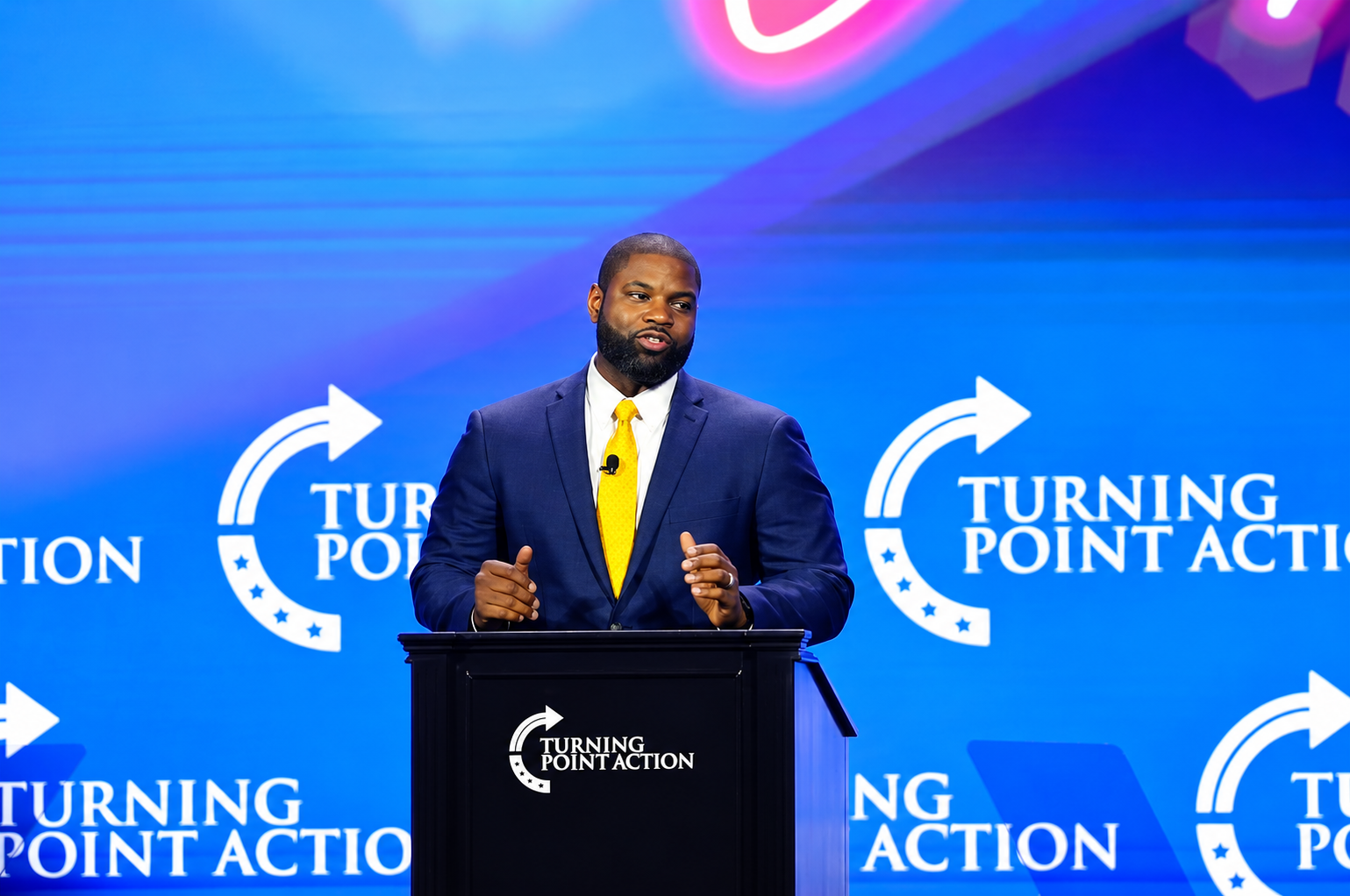
U.S. Rep. Byron Donalds speaks at a Turning Point Action event in Florida. Photo by Roman Garay / Florida National News.
Rally Set for Oct. 23
Trump’s remarks are scheduled to begin at 2 p.m., with doors opening at 10:30 a.m., according to the Republican Party’s event registration page. All times are Eastern.
Gulf Coast News reports that the rally will take place at Alico Arena at Florida Gulf Coast University. However, the official GOP registration page still lists the venue as “To Be Announced.” Attendees should check that page for confirmation and updates.
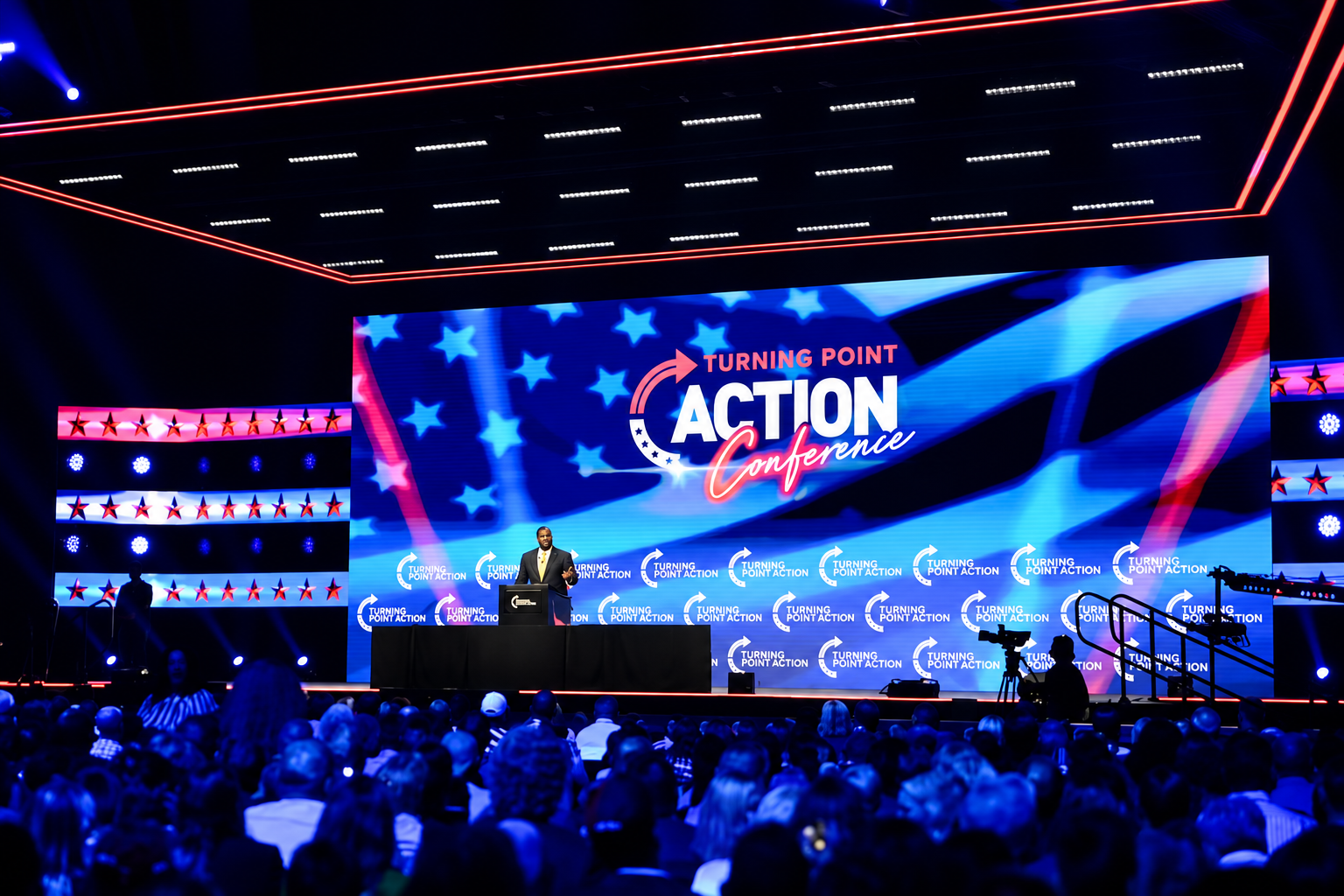
Prominent conservative figures, including Tucker Carlson, then-former President Donald Trump, U.S. Rep. Byron Donalds and Megyn Kelly, rallied Republican voters during the Turning Point Action Conference at the Palm Beach County Convention Center, July 15-16, 2023.
Photo by Roman D. Garay / Florida National News.
Trump’s Endorsement Connects President to Historic Bid
Trump has endorsed Donalds, whose campaign lists the president among its prominent Republican supporters. The Fort Myers visit places Trump in Donalds’ Southwest Florida political base during the closing weeks of the election.
Following his primary victory, Donalds acknowledged Trump’s influence among Republican voters.
“Obviously, he has the strongest following of anybody in our party,” Donalds said, according to Associated Press reporting.
A Donalds victory would give Florida its first Black governor and extend Republican leadership in the governor’s office. Trump’s endorsement connects the president to that potentially historic outcome, although the rally announcement does not identify the event as exclusively supporting Donalds.
Republican Unity and Voter Turnout
Donalds called for Republicans to unite after the primary, telling supporters, “Tonight we are one united Republican Party,” according to the AP.
The Fort Myers rally will provide Trump another platform to address supporters ahead of the Nov. 3 midterm elections. The published event announcement confirms his appearance but does not list additional speakers.
Politics
RNC Chairman Joe Gruters Calls Trump an ‘Absolute Machine’ Ahead of Midterm Elections
Published
6 days agoon
October 17, 2026
WASHINGTON (FNN) — Republican National Committee Chairman Joe Gruters is urging Republicans to focus on voter turnout ahead of the Nov. 3 midterm elections, praising President Donald Trump’s campaign appearances and arguing that the party’s success depends on getting supporters to the polls.
In a Fox News appearance highlighted in an RNC news release, Gruters described Trump as an “absolute machine” and pointed to the president’s rallies as a central part of Republicans’ election strategy.
Gruters: ‘It’s All About Turnout Now’
Gruters expressed confidence in Republican candidates while sharply criticizing their Democratic opponents.
“We have strong candidates; [Democrats] have incredibly weak candidates. It’s all about turnout now. That’s why the president’s going to all these rallies. He’s an absolute machine, getting the job done,” Gruters said, according to the release.
His remarks emphasized voter mobilization as Republicans seek to protect and expand their congressional majorities.
RNC Chairman Highlights Trump’s Policies
Gruters also praised the administration’s policies, particularly its approach to the southern border, presenting those efforts as reasons voters should support Republican candidates.
“This president deserves a lot of credit. He deserves a lot of praise for all these great things that he has done,” he said.
The release included broader claims about border enforcement and drug trafficking but did not provide supporting data. Those statements represent Gruters’ assessment of the administration’s record.
Florida Connection to National GOP Leadership
Gruters, a former chairman of the Republican Party of Florida, now leads the national party’s effort to rally Republican voters. The Florida GOP described him as a longtime Trump ally when announcing his election as RNC chairman.
His national role places a political leader with Florida party experience at the forefront of Republicans’ midterm turnout campaign.
Closing Message: Get Supporters to the Polls
“This race all comes down to turnout,” Gruters said.
He framed the election as a choice about the country’s direction and urged voters to continue supporting Trump and conservative leadership.
“If you believe in the American dream, and you still have hope that you or your children could achieve it, then you’ve got to continue the leadership of the conservative party and this president, Donald J. Trump.”
Business
Dallas Mayor Eric Johnson Listed as Speaker for Global AI, Supply Chain Summit
Published
2 weeks agoon
October 9, 2026
Organizers say the Oct. 26–27 conference will bring together business leaders, policymakers and technology professionals for discussions on global commerce, digital transformation and industry innovation.
DALLAS, TX (FNN) — Dallas Mayor Eric L. Johnson is listed as an invited speaker for the Global Procurement, Supply Chain, AI & Logistics Summit and Global Recognition Awards 2026, scheduled for Oct. 26–27 in Dallas, according to an announcement from the event’s organizer.
The American Association of Procurement, Supply Chain and Tourism Management, known as AAPSCM, said the two-day summit will take place at the AC Hotel & Residence Inn Dallas by the Galleria, 5460 James Temple Drive.
The conference will focus on artificial intelligence, supply chain resilience, innovation and the future of global commerce.
Mayor listed among international speakers
Organizers identified Johnson among the invited speakers joining executives, policymakers, academics, consultants and professionals in procurement, supply chain management, technology and logistics.
The announcement describes participants as coming “from the United States and around the world.”
According to the release, Johnson is listed among speakers participating in the Oct. 27 program. The announcement does not specify the subject or time of his remarks.
AI, forecasting and digital transformation
The second day’s agenda includes a session on artificial intelligence and machine learning in inventory management, forecasting, and sales and operations planning.
An executive leadership session titled “Driving Innovation & Digital Transformation” is scheduled to follow.
The program will examine technology’s role in procurement, logistics and supply chain operations, with an emphasis on how leaders respond to changing business conditions.
Awards to recognize industry achievement
The summit will also include procurement and supply chain awards, followed by Global Excellence Awards recognizing individuals, organizations and industry leaders.
Organizers said the awards program includes more than 35 categories spanning procurement, supply chain management, artificial intelligence and logistics.
The announcement describes the awards as recognizing “achievement, innovation and leadership.”
Executives and decision-makers expected
AAPSCM said it expects attendees to include chief executives, chief procurement officers, chief supply chain officers, chief operating officers and technology leaders.
The anticipated audience also includes procurement directors, logistics professionals, government representatives and specialists in AI and digital transformation.
About the organizer
AAPSCM describes itself as a U.S.-based nonprofit professional organization that supports professional development through certification, education, training, membership, conferences and international collaboration.
Event and registration information
- Event: 2nd Global Procurement, Supply Chain, AI & Logistics Summit & Global Recognition Awards 2026
- Dates: Oct. 26–27, 2026
- Venue: AC Hotel & Residence Inn Dallas by the Galleria
- Address: 5460 James Temple Drive, Dallas, Texas 75240
- Organizer: American Association of Procurement, Supply Chain and Tourism Management
- Registration: aapscm-conferences.org
- Organization: aapscm.org


FNN Newsletter
Trending


 Florida1 day ago
Donalds, Jolly Court Black Voters In Governor’s Race. How Much Are They Spending With Black-Owned Media?
 Central Florida News19 hours ago
Festival of Trees Marks 40 Years With Holiday Displays, Santa Breakfasts and Parties
 Business17 hours ago
GOAA Highlights Airport Improvements, Approves New Small Business Policies
 Entertainment18 hours ago
“4000 Days,” “Frampton” Set for Naples International Film Festival Oct. 24–25
 Florida16 hours ago
Nikki Fried to Challenge Trump’s Economic Record Ahead of Florida Visit


