

Politics
Soto, Escobar, Woodall Introduce Legislation to Keep Families Together in the United States

Published
6 years agoon
By
Willie David
WASHINGTON, D.C. – Congresswoman Veronica Escobar (TX-16), Congressman Rob Woodall (GA-7) and Congressman Darren Soto (FL-9) introduced H.R. 8708, the American Families United Act. This bipartisan legislation is designed to preserve and promote family unity by amending the Immigration and Nationality Act to help millions of U.S. citizens reunite with their loved ones.
The American Families United Act would protect the rights and interests of U.S. citizens in our immigration system, and provide the Attorney General and the Department of Homeland Security Secretary discretion to allow certain individuals to be reunited in the United States. This legislation could help Alejandra Juarez, a Polk County resident of over 20 years, who was deported from the United States to her home country of Mexico. Alejandra’s husband, Sgt. Temo Juarez is an Iraq combat veteran who served in the Marines and the Infantry Regiment of the Army National Guard. Together, they raised their two U.S.-born daughters Pamela, 19, and Estela, 11, in Davenport, Florida.
“I was at the Orlando International Airport when my constituent, Alejandra Juárez, a mother and wife, boarded a plane and headed for Mexico, a country to which she was born but did not call home,” said Congressman Soto. “She left behind her two American-born daughters, Pamela and Estela, and her husband, Temo, a veteran of both the U.S. Marines and Army. Since that day, I made a promise never to give up fighting to reunite them. The American Families United Act is key to fixing the broken immigration system that tears families apart and threatens the social fabric of thousands of communities across the country. We will reunite the families impacted by the Administration’s cruel immigration policies!”
The legislation, introduced by former Congressman Beto O’Rourke, was inspired by Edgar Falcon, an El Pasoan and constituent of Texas’ 16thCongressional District. Edgar married his wife Maricruz on the U.S.-Mexico border in 2013 after Maricruz was refused a visa. Since then, Edgar has traveled between his family’s home in Ciudad Juarez and his job in El Paso, but his ability to commute has been strained by the coronavirus pandemic.
“For decades, families like Edgar’s across the U.S.-Mexico border have been forced to live apart from one another due to outdated immigration laws,” said Congresswoman Escobar. “Thousands of innocent children and families have been separated by a border between them, and we cannot stop fighting until every single family is reunited. The American Families United Act is a critical step in the right direction and will help bring loved ones together. Much more work remains in the 117th Congress and I look forward to achieving broader, bolder, and more comprehensive changes to our immigration system in the new year.”
“Families belong together,” said Congressman Woodall. “In many cases today, immigration policy provides U.S. citizens with absolutely no pathway for citizenship—or even a legal status—for their spouse. These policies either keep families apart or encourage families to stay in the shadows. We can do and must do better. We should be encouraging people to get right by the law. This bill keeps the families of American citizens together while undocumented spouses and some parents wait in line for their chance to become an American citizen.”
“I thank Congresswoman Escobar, who’s courageously supporting this bipartisan bill,” said Edgar Falcon, American Families United President and El Pasoan. “Our members are extremely grateful for her leadership, as well as the leadership of Congressman Woodall and Congressman Soto. We call on their Congressional colleagues to pass this bill because Americans have the right to marry for love without being forced to choose between marriage and our country.”
“This legislation recognizes that family unity is at the core of our values as a nation. The American Families United Act is an important step in aligning the law of our land with the compassion and common-sense citizens expect from the world’s humanitarian leader,” said Krish O’Mara Vignarajah, president and CEO of Lutheran Immigration and Refugee Service. “We are grateful to Representatives Escobar, Woodall and Soto for their commitment to enshrining in law the universal truth that families belong together.”
“As a coalition of business leaders, we recognize that a pro-business environment requires an immigration system that creates jobs, grows the economy, and keeps families together,” said Juan Carlos Cerda, Texas Dreamer and Business Outreach Manager, American Business Immigration Coalition. “We support the American Families United Act because it provides a pathway to legal status for more than 17% of Dreamers who have earned a degree and 1.7 million mixed-status families who are working and contributing to our country. We applaud Rep. Escobar for her bipartisan efforts to provide a solution for these essential workers, and we look forward to working with her on additional solutions that address our broken immigration system.”
To view the bill text, click here and to view a section-by-section of the bill, click here.

You may like
Politics
Eight Black Major-Party Gubernatorial Nominees Head to November Ballot in Historic 2026 Election

Published
24 hours agoon
September 6, 2026
Five Democrats and three Republicans are competing across eight states, a remarkable milestone in a nation that has elected only three Black governors
WASHINGTON (FNN) — Eight Black major-party nominees are running for governor across the United States in the 2026 general election, creating an unprecedented moment in American gubernatorial politics.
The field spans both major parties and eight states: Florida, Georgia, Maryland, Michigan, Minnesota, Nevada, South Carolina and Wisconsin. Five nominees are Democrats and three are Republicans. Seven are seeking to become the first Black governor elected in their respective states, while Maryland Gov. Wes Moore is seeking reelection.
The number is particularly striking because only three Black Americans have ever been elected governor: Douglas Wilder of Virginia, Deval Patrick of Massachusetts and Moore of Maryland. All three are Democrats and men.
That means more than twice as many Black major-party gubernatorial nominees are competing in 2026 alone as the total number of Black Americans ever elected governor.
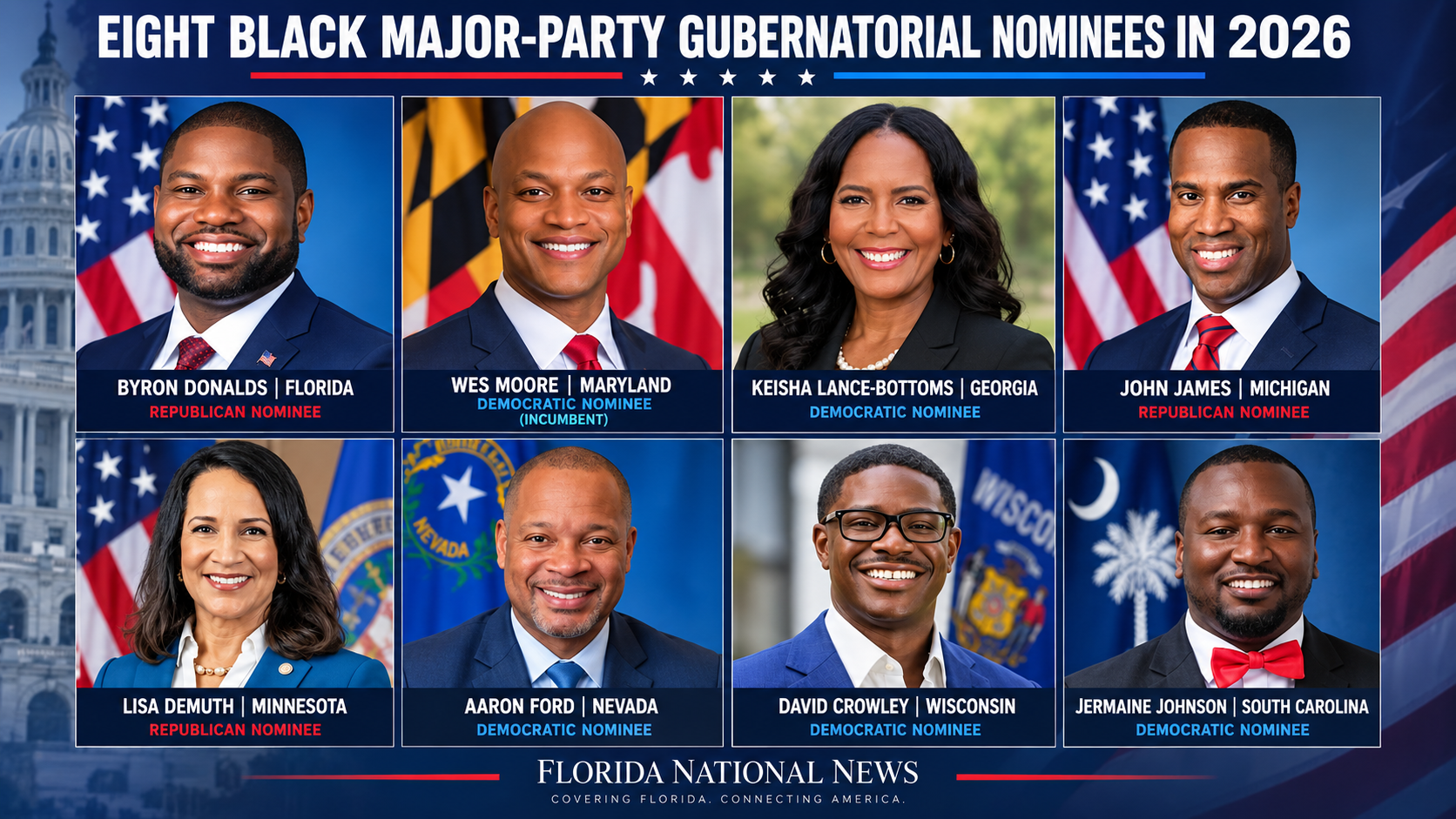
Eight Black major-party nominees are running for governor across eight states in the November 2026 general election: Keisha Lance Bottoms (D-Georgia), David Crowley (D-Wisconsin), Byron Donalds (R-Florida), Lisa Demuth (R-Minnesota), Aaron Ford (D-Nevada), John James (R-Michigan), Jermaine Johnson (D-South Carolina) and Wes Moore (D-Maryland). Moore is seeking reelection, while the other seven could become the first Black governors elected in their respective states. Source Florida National News (FNN)
Why It Matters: Eight Nominees, Only Three Black Governors Elected
Governors occupy some of the most powerful elected positions in American government, overseeing state agencies and budgets while exercising authority over legislation, appointments and executive policy.
Yet Black representation in governors’ mansions has remained exceptionally rare.
Wilder became the nation’s first elected Black governor when Virginia voters elected him in 1989. Patrick followed in Massachusetts in 2006. Moore became the third with his Maryland victory in 2022. Moore is currently the nation’s only Black governor.
The 2026 field could significantly expand that history — and potentially establish several additional firsts.
Either Keisha Lance Bottoms or Lisa Demuth could become the first Black woman elected governor in U.S. history. Republican nominees Byron Donalds, John James and Demuth also represent the possibility of another gubernatorial milestone.
But the candidates do not represent a single political movement. Their backgrounds, ideologies and policy positions differ substantially.
That distinction is central to understanding the significance of 2026: Black representation at the gubernatorial level is appearing across party and ideological lines.
Meet the Eight Black Major-Party Nominees
Byron Donalds — Florida — Republican
Former U.S. Rep. Byron Donalds won Florida’s Republican gubernatorial nomination Aug. 18 and is seeking to succeed term-limited Gov. Ron DeSantis.
Donalds previously served in the Florida House before his election to Congress representing Southwest Florida. A prominent conservative and ally of President Donald Trump, Donalds faces Democratic nominee and former Republican U.S. Rep. David Jolly in November. Florida election records confirm the Donalds-Jolly general-election matchup.
If elected, Donalds would become Florida’s first Black governor.
Wes Moore — Maryland — Democrat
Wes Moore is the only incumbent governor among the eight nominees.
An Army veteran, Rhodes Scholar, author and former nonprofit executive, Moore was elected in 2022, becoming Maryland’s first Black governor and only the third Black American elected governor of any state.
He is seeking a second term.
Keisha Lance Bottoms — Georgia — Democrat
Former Atlanta Mayor Keisha Lance Bottoms is the Democratic nominee in Georgia.
Bottoms served as Atlanta mayor from 2018 to 2022 and later served in President Joe Biden’s administration. She faces Republican Rick Jackson in November.
A Bottoms victory would make her Georgia’s first Black governor and could make her the nation’s first Black woman elected governor.
John James — Michigan — Republican
John James, a businessman, Army veteran and former member of Congress, is Michigan’s Republican gubernatorial nominee.
James previously mounted two campaigns for the U.S. Senate before winning election to the U.S. House in 2022. He faces Democratic nominee Jocelyn Benson in November.
A James victory would make him Michigan’s first Black governor.
Lisa Demuth — Minnesota — Republican
Minnesota Republican Lisa Demuth entered the 2026 campaign with a history of breaking political barriers in her state.
Demuth, a business owner and state lawmaker, became Minnesota’s first Black House speaker. She defeated a Republican primary field that included MyPillow founder Mike Lindell and now faces Democratic U.S. Sen. Amy Klobuchar in the general election.
If elected, Demuth would become Minnesota’s first Black governor and could become the first Black woman elected governor in U.S. history.
Aaron Ford — Nevada — Democrat
Nevada Attorney General Aaron Ford is the Democratic nominee for governor.
Ford previously served as majority leader of the Nevada Senate and became Nevada’s first Black attorney general. He is challenging incumbent Republican Gov. Joe Lombardo.
A victory would make Ford Nevada’s first Black governor.
David Crowley — Wisconsin — Democrat
David Crowley, the Milwaukee County executive and a former Wisconsin state representative, won the Democratic gubernatorial nomination after a closely contested primary.
Crowley became the first Black person elected Milwaukee County executive in 2020. He faces Republican Tom Tiffany in November.
If elected, Crowley would become Wisconsin’s first Black governor.
Jermaine Johnson — South Carolina — Democrat
South Carolina state Rep. Jermaine Johnson is the Democratic nominee for governor.
Johnson has served in the South Carolina House since 2020 and is seeking the state’s highest executive office.
If elected, Johnson would become South Carolina’s first Black elected governor.
Five Democrats, Three Republicans — And Different Political Visions
The historic nature of the field should not obscure its political diversity.
Democrats: Wes Moore, Keisha Lance Bottoms, Aaron Ford, David Crowley and Jermaine Johnson.
Republicans: Byron Donalds, John James and Lisa Demuth.
The candidates differ on major questions of taxation, abortion, education, voting laws, health care, economic policy and the role of state government.
AP reported that many of the candidates have not made race the centerpiece of their campaigns, instead emphasizing their qualifications, policies and governing priorities.
Their shared place in history therefore should not be interpreted as shared politics.
Florida’s History: Andrew Gillum Came Close in 2018
Florida has faced the possibility of electing its first Black governor before.
In 2018, Tallahassee Mayor Andrew Gillum, a Democrat, faced Republican Ron DeSantis in the general election.
Gillum came remarkably close to making history. DeSantis ultimately prevailed by roughly 32,000 votes out of more than 8 million cast, a margin of less than half a percentage point.
Gillum’s defeat left Florida without a Black governor.
Eight years later, the possibility has returned from the opposite side of the political aisle.
Donalds won the Republican nomination with 811,131 votes, or 47.79%, in the Aug. 18 primary, according to official Florida election results. Jolly captured 60.95% of the Democratic primary vote.
The historical connection between Gillum and Donalds is narrow but significant: they represent different parties, political philosophies and eras, but both became major-party nominees with an opportunity to become Florida’s first Black governor.
2026 Could Produce Several Historic Firsts
The November elections could substantially rewrite the history of Black gubernatorial representation.
Seven nominees could become the first Black governor elected in their states. Bottoms or Demuth could become America’s first Black woman elected governor. Moore could win another term as Maryland’s first Black governor.
The outcomes will ultimately depend on voters evaluating each candidate individually — their records, policies, qualifications and visions for their states.
Historical significance does not determine an election result.
A National Milestone Before November Votes Are Counted
Whatever voters decide, 2026 has already established a milestone.
Eight Black major-party nominees are competing for governor across eight states in the same general-election cycle — more than twice the number of Black Americans who have ever been elected governor.
They are Democrats and Republicans, incumbents and challengers, veterans, lawmakers, executives and attorneys. Their political philosophies differ, sometimes dramatically.
What connects them historically is much narrower — but consequential.
For the first time, American voters in eight states will simultaneously consider Black major-party nominees for governor, putting the possibility of several new chapters in American political history directly in the hands of voters this November.
Florida
Byron Donalds to Speak at Trump’s Midterm Convention as Florida Democrats Target Their Political Alliance
Published
1 day agoon
September 6, 2026
Florida Democrats seize on Donalds’ Dallas appearance as the Republican gubernatorial nominee heads into the general election
TALLAHASSEE, Fla. (FNN) — Republican gubernatorial nominee Byron Donalds will join President Donald Trump and other prominent Republicans at the GOP Midterm Convention in Dallas next week, prompting Florida Democrats to renew attacks on Donalds’ close political alliance with the president.
Donalds is scheduled to speak at the Sept. 9-10 gathering, according to Florida Politics. Republican National Committee Chair Joe Gruters and U.S. Rep. Anna Paulina Luna are among other Florida Republicans scheduled to participate.
The appearance comes as Trump takes an increasingly visible role in Republican efforts ahead of the November midterms. AP reports Trump has promised to campaign extensively for Republican candidates and is urging the party to run on his administration’s record despite political concerns surrounding the economy and other issues.
Florida Democrats Target Donalds’ Trump Ties
The Florida Democratic Party responded to Donalds’ scheduled appearance by seeking to make his relationship with Trump an issue in Florida’s gubernatorial campaign.
“Despite Floridians’ growing disdain for Donald Trump and the pain caused by the Byron-Trump economy, Byron Donalds is ready to remind the state of their close connection by sharing the spotlight with Trump next week,” Florida Democratic Party spokesperson Evan Ecklund said in a party news release.
Ecklund also criticized Donalds over tax and data-center policies and called him Trump’s “most-trusted puppet.”
Those descriptions are partisan characterizations from the Florida Democratic Party. They should not be read as independent findings by FNN.
Trump-Donalds Alliance Has Been Central to the Governor’s Race
Donalds and Trump have maintained a highly visible political alliance.
Trump repeatedly endorsed Donalds during Florida’s Republican gubernatorial primary, and Donalds has consistently aligned himself with Trump’s political agenda. Donalds’ appearance in Dallas extends that relationship into the general election campaign.
For Democrats, the convention provides another opportunity to connect Donalds directly to Trump.
For Republicans, the event is an opportunity to mobilize their voters and emphasize their policy agenda ahead of November.
Gruters framed the election around taxes, border security, government regulation and the economy while sharply criticizing Democratic policies.
Trump Takes a Larger Midterm Role
The Dallas gathering also comes as Trump increases his involvement in Republican midterm campaigning.
Trump has pledged to campaign for Republican candidates in competitive races around the country. AP reports that he has encouraged Republican lawmakers to emphasize his administration’s record even as the party confronts voter concerns over the economy and other national issues.
For Donalds, the convention puts Florida’s Republican nominee on a national stage alongside one of his most prominent political supporters.
For Florida Democrats, it provides another opening to argue that Trump’s record should also be part of voters’ assessment of Donalds.
That competing message — Republicans embracing Trump’s record and Democrats seeking to make that association a liability — is likely to remain part of the political debate heading toward November.
Florida
FNN Perspective: Cynthia Moore Chestnut’s Byron Donalds Endorsement Spotlights Nearly Four Decades of Public Service and Cross-Party Politics
Published
1 day agoon
September 6, 2026
Gainesville Democrat’s support for the Republican nominee renews debate over Black representation, party loyalty, political choice and the freedom to disagree
FNN PERSPECTIVE — Gainesville City Commissioner Cynthia Moore Chestnut’s endorsement of Republican gubernatorial nominee Byron Donalds has generated criticism from fellow Democrats and opened a broader discussion about party loyalty, Black political representation and an American political tradition that allows voters and public figures to cross party lines for many different reasons.
This perspective examines Chestnut’s decision in the context of her nearly four decades of public service, her stated reasons for supporting Donalds, historical examples of cross-party endorsements and the freedom of Americans to support — and criticize — political candidates.

Cynthia Moore Chestnut’s Nearly Four Decades of Public Service
Chestnut’s endorsement represents one decision in a public-service career extending back nearly four decades.
A Tallahassee native, Chestnut earned a bachelor’s degree in speech pathology from Florida A&M University, a master’s degree in speech pathology from Florida State University and a doctorate in public administration from Nova Southeastern University.
She became the first Black woman elected to the Gainesville City Commission, then broke additional barriers in state and county government. She became the first woman and first Black person elected to represent Florida House District 23 and later the first Black woman elected to the Alachua County Commission and the first to chair it, according to her official city biography.
Chestnut also became deeply involved in Democratic Party leadership, including service in county and state party organizations.
That history helps explain why her decision to support a Republican for governor has attracted attention beyond an ordinary political endorsement.
Why Cynthia Moore Chestnut Endorsed Byron Donalds
Chestnut has made clear that she remains a Democrat.
She initially emphasized political independence, her belief that Black voters should not be considered the property of either party and her desire to see Florida elect its first Black governor.
But Chestnut has since provided additional context.
In a Sept. 5 interview, she said Democratic nominee David Jolly’s selection of Gwen Graham as his running mate significantly influenced her decision. Chestnut criticized what she called an “all-white ticket” and said she believed Jolly missed an opportunity to select a Black or Hispanic running mate who could broaden the ticket’s representation and appeal.
Chestnut also said she spoke with Donalds and came away impressed that he listened to her. She told the interviewer that supporting Donalds does not mean she is becoming a Republican and said she does not support President Donald Trump.
Those additional details are important because they demonstrate that Chestnut’s endorsement cannot accurately be reduced to a single consideration.

LaVon Bracy Davis Strongly Disagrees With Chestnut
Democratic state Sen. LaVon Bracy Davis has offered a sharply different assessment.
Bracy Davis criticized the endorsement and questioned how Chestnut could reconcile her history of Democratic and Black political leadership with Donalds’ political record.
Her objections have included Donalds’ positions on voting rights and his relationship with the MAGA movement. Bracy Davis also rejected the idea that the possibility of electing Florida’s first Black governor should outweigh her concerns about Donalds’ policies.
The disagreement illustrates an important feature of political expression: Chestnut is free to explain why she crossed party lines, while Bracy Davis and others are equally free to challenge the reasoning behind that decision.
Cross-Party Endorsements Happen for Many Different Reasons
There is no single explanation for crossing party lines.
Voters and political leaders may support someone from another party because of policy, qualifications, leadership, personal relationships, representation, dissatisfaction with their own party, a particular issue or their individual assessment of the candidates in a particular election.
American political history contains numerous examples.
Some Democrats have supported Republicans. Some Republicans have supported Democrats. Others have left one party entirely or changed their registration.
Those decisions should be examined individually rather than treated as politically equivalent.

Gen. Colin Powell and Other Republicans Crossed Party Lines for Barack Obama
One prominent example occurred during the historic 2008 presidential election.
Republican former Secretary of State and retired Gen. Colin Powell endorsed Democratic nominee Barack Obama over Republican nominee John McCain, despite Powell’s longstanding friendship with McCain.
Powell cited several considerations, including leadership, economic issues, foreign policy, the direction of the Republican campaign and McCain’s selection of Sarah Palin. He described Obama as a “transformational figure” and said that although he recognized the racial significance of the election, race was not the dominant reason for his endorsement.
Powell was not alone.
Obama’s campaign organized a Republicans for Obama effort that included former Republican Rep. Jim Leach of Iowa, former Republican Sen. Lincoln Chafee of Rhode Island and former Bush foreign-policy adviser Rita Hauser. Republican Fairbanks Mayor Jim Whitaker also endorsed Obama.
Leach cited foreign policy and the national interest in explaining his decision. The various Republicans who supported Obama therefore did not necessarily cross party lines for precisely the same reason.
Obama went on to become the first Black president of the United States.
Obama and Donalds Are Different — The Comparison Is Cross-Party Choice
The historical comparison should have clear limits.
Barack Obama and Byron Donalds are different candidates, from different political eras, with different records, constituencies and policy positions. Likewise, Powell’s reasons for endorsing Obama were his own and should not be equated with Chestnut’s reasons for endorsing Donalds.
The relevant historical connection is narrower: prominent political figures have crossed party lines for different reasons throughout American political history.
Powell made one decision based on his assessment of the 2008 candidates. Chestnut has made another based on her stated considerations in Florida’s 2026 governor’s race.
Neither example establishes how someone else should vote.
John McCain Demonstrated That Opposition Does Not Require Misinformation
The 2008 campaign provides another relevant lesson — this time about political disagreement rather than endorsement.
McCain was trying to defeat Obama.
Yet during an October 2008 campaign event, McCain corrected supporters who expressed fear about Obama and rejected a woman’s false characterization of Obama as an Arab.
McCain described Obama as a “decent family man” and citizen with whom he had serious disagreements on fundamental issues. He also urged his supporters to remain respectful.
McCain did not stop opposing Obama. He continued campaigning against him.
The episode demonstrated that vigorous political opposition and respect for factual accuracy do not have to be mutually exclusive.
Political Expression Includes Endorsement and Criticism
That principle brings the discussion back to Chestnut.
Political speech and association receive substantial protection from government infringement under the First Amendment, subject to established legal limitations.
Americans can advocate for candidates, criticize public officials, associate politically, change parties or decline to follow a party’s preferred candidate.
But freedom of expression does not insulate a political decision from criticism.
Chestnut can explain why she believes Donalds deserves her support. Bracy Davis and others can argue that Donalds’ record should disqualify him from receiving that support.
Political freedom does not require everyone to reach the same conclusion.

David Jolly’s Political Journey Adds Another Dimension
The 2026 governor’s race itself demonstrates that political affiliations can change.
Democratic nominee David Jolly previously represented Florida in Congress as a Republican. He subsequently left the Republican Party, became unaffiliated and registered as a Democrat in 2025 before seeking the Democratic nomination for governor.
His situation is different from Chestnut’s.
Jolly changed parties. Chestnut says she remains a Democrat while supporting the Republican nominee.
But the two circumstances reinforce a broader point: party affiliation can be important without determining every political decision an individual makes.
One Endorsement, Nearly Four Decades of Public Service
Chestnut’s Donalds endorsement may become one of the most debated decisions of her long political career.
Critics can consider it significant. They can examine Donalds’ record, Chestnut’s stated reasons and her history in Democratic politics and reach their own conclusions.
Her broader record is also part of the story.
For nearly four decades, Chestnut has served in municipal, state and county government, broken racial and gender barriers, participated in Democratic Party leadership and remained active in Gainesville and Alachua County civic life.
One endorsement does not require the public to disregard that history. And nearly four decades of public service do not place one endorsement beyond public scrutiny.
Both can be examined together.
Florida Voters Will Make Their Own Choice
Ultimately, an endorsement does not cast anyone else’s ballot.
Chestnut has made her choice and explained her reasons. Her critics have exercised their freedom to challenge that choice. Donalds and Jolly will make their cases to voters.
Floridians will make the final decision for themselves.
That may be the larger lesson of the controversy surrounding Chestnut.
Cross-party endorsements happen for different reasons. Political affiliations can change. People who share a party affiliation can reach very different conclusions about candidates.
The ability to support, oppose, endorse, criticize, organize and vote reflects political freedoms that generations of Americans fought to expand — including Black Americans who confronted Jim Crow disenfranchisement and discrimination in the struggle for full political participation.
Chestnut’s nearly four decades of public service form part of that broader history.
Her endorsement of Donalds is now another chapter — one Floridians remain free to support, oppose, question or debate.


FNN Newsletter
Trending


 Entertainment2 days ago
Miss Texas, Miss Utah and Miss New Jersey Win 2026 Miss America Preliminary Talent Awards
 Florida2 days ago
Byron Donalds Secures Endorsement From Gainesville Democrat Cynthia Moore Chestnut, Spotlighting Cross-Party Politics
 Entertainment3 days ago
Lee Brice, Kane Brown, Brantley Gilbert, Brandon Lake and Stephen Wilson Jr. to Headline Audacy’s Stars and Strings in South Florida
 Florida1 day ago
FNN Perspective: Cynthia Moore Chestnut’s Byron Donalds Endorsement Spotlights Nearly Four Decades of Public Service and Cross-Party Politics
 Florida1 day ago
Byron Donalds to Speak at Trump’s Midterm Convention as Florida Democrats Target Their Political Alliance


