Politics
Trump ally Roger Stone sentenced to over 3 years in prison
Published
6 years agoon
WASHINGTON (AP) — Trump loyalist Roger Stone was sentenced Thursday to more than three years in federal prison, following an extraordinary move by Attorney General William Barr to back off his Justice Department’s original sentencing recommendation.
U.S. District Court Judge Amy Berman Jackson said Stone’s crimes demanded a significant time behind bars, but she said the seven to nine years originally recommended by the Justice Department were excessive.
Stone’s lawyers had asked for a sentence of probation, citing his age of 67 years, his health and his lack of criminal history. Instead, he drew 40 months. Jackson also sentenced Stone to two years of probation after his prison time and fined him $20,000.
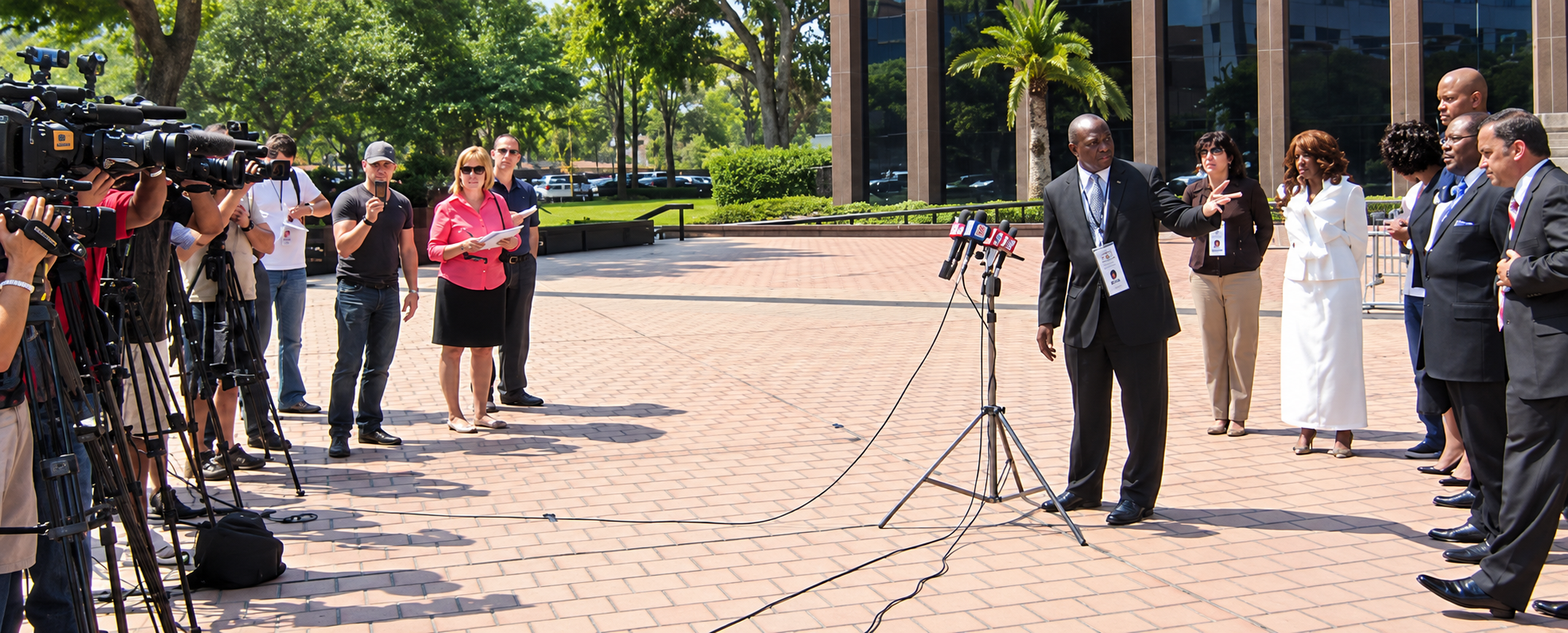
Stone had no immediate reaction in court when Jackson announced his sentence. Later, he emerged from the courthouse to a crowd exchanging back and forth chants of “Lock him up” and “Pardon Roger Stone.” Stone got into a black SUV without speaking to reporters.
His attorney Bruce Rogow said Stone and his team would “have no comment.” The judge delayed execution of his sentence while she considers Stone’s motion for a new trial.
The sentencing set off a parlor game of speculation in Washington, with many wondering when — not if — President Donald Trump would grant Stone a pardon. But Trump, who issued 11 high-profile pardons earlier this week, said he was holding off for now.
“I’m not going to do anything in terms of the great powers bestowed upon a president of the United States,” he said during an appearance in Las Vegas. “I want the process to play out. I think that’s the best thing to do because I would love to see Roger exonerated.”
But even the prospect that Trump might someday pardon Stone prompted a preemptive rebuke Thursday from critics like Democratic House Intelligence Chairman Adam Schiff of California, who tweeted after the sentencing that, “to pardon Stone when his crimes were committed to protect Trump would be a breathtaking act of corruption.”
But Sen. Lindsey Graham, R-S.C., a staunch Trump ally, signaled early support for such a move, tweeting that Trump has “all the legal authority in the world” to pardon Stone if he chooses.
Stone was convicted in November on all seven counts of an indictment that accused him of lying to Congress, tampering with a witness and obstructing the House investigation into whether the Trump campaign coordinated with Russia to tip the 2016 election.
The sentence came amid Trump’s unrelenting defense of his longtime confidant that has led to a mini-revolt inside the Justice Department and allegations the president has interfered in the case.
Trump took to Twitter to denounce as a “miscarriage of justice” the initial recommendation by Justice Department prosecutors that Stone receive at least seven years in prison. Attorney General William Barr then backed off that recommendation, prompting four prosecutors to quit Stone’s case.
Jackson angrily denied that Stone was being punished for his politics or his allies. “He was not prosecuted, as some have claimed, for standing up for the president. He was prosecuted for covering up for the president,” she said.
She said Stone’s use of social media to stoke public sentiment against the prosecution and the court was intended to reach a wide audience, including using a photo of Jackson with crosshairs superimposed.
“This is intolerable to the administration of justice,” Jackson said. She also had stern words for the new prosecution team.
“Why are you the one who is standing here today?” Jackson asked federal prosecutor John Crabb, who took over the case after the original trial team quit.
Crabb said there had been a “miscommunication” between Barr and Timothy Shea, the former Barr aide who now serves as the acting U.S. Attorney in the nation’s capital. Crabb asked the judge to impose “a substantial period of incarceration.”
After Stone’s attorney, Seth Ginsberg, repeated the defense team’s plea that Stone get no prison time, Stone declined to address the court.
Stone was the sixth Trump aide or adviser to be convicted of charges brought as part of special counsel Robert Mueller’s Russia investigation.
Any jail sentence seems likely to draw a public rebuke from Trump, who maintains that Stone’s entire case is just an aspect of the ongoing “witch hunt” against him and his allies by bitter Democrats and the “deep state” inside the FBI and the Justice Department.
Overnight Thursday, Trump retweeted a conservative cable host’s comment that what happened to Stone “should never happen again.”
In Stone’s initial sentencing memorandum filed Feb. 10, prosecutors said Stone deserved a prison term lasting seven to nine years, in accordance with federal sentencing guidelines. Such a sentence would send a message to deter others who might consider lying or obstructing a congressional probe or tampering with witnesses, the prosecutors said.
Stone has denied wrongdoing and consistently criticized the case against him as politically motivated. He did not take the stand during his trial and his lawyers did not call any witnesses in his defense.
Prosecutors had charged in the filing that Stone “decided to double- and triple-down on his criminal conduct by tampering with a witness for months in order to make sure his obstruction would be successful.”
“Stone’s actions were not a one-off mistake in judgment. Nor were his false statements made in the heat of the moment. They were nowhere close to that,” prosecutors wrote in the court papers.
But Justice Department officials said they were caught off guard by the recommendation, even though Shea, the acting U.S. Attorney in Washington, D.C., is a former top aide to Barr. The attorney general ordered a new memorandum with a less harsh punishment, though it left provided no specifics and left the details to the judge.
Barr’s decision became public just hours after Trump, in an overnight tweet, called the situation “horrible and very unfair.” He added: “Cannot allow this miscarriage of justice!”
Barr later said in an ABC News interview that he had not been asked by Trump to look into the case. In a stunning public rebuke, he said the president’s tweets were making it “impossible” for him to do his job. Meanwhile, Barr’s actions on the sentencing for Stone prompted the entire trial team to quit.
The public debacle also prompted a rare statement from the Chief Judge of the D.C. District Court, Beryl A. Howell, who said “public criticism or pressure is not a factor” in judges’ sentencing decisions.
The evidence presented at Stone’s trial didn’t directly address Mueller’s conclusion that there was insufficient evidence to prove a criminal conspiracy between the Trump campaign and Russia to tip the outcome of the 2016 presidential election in Trump’s favor. But it provided new insight into the scramble inside the Trump campaign when it was revealed in July 2016 that the anti-secrecy site WikiLeaks was in possession of more than 19,000 emails hacked from the servers of the Democratic National Committee.
Witnesses testified that Trump’s campaign viewed Stone as an “access point” to WikiLeaks and tried to use him to get advance word about hacked emails damaging to Hillary Clinton.
Prosecutors argued that Stone had lied to Congress about his conversations about WikiLeaks with New York radio host and comedian Randy Credico.
During the 2016 campaign, Stone mentioned in interviews and public appearances that he was in contact with founder Julian Assange through a trusted intermediary and hinted at inside knowledge of WikiLeaks’ plans.
Testimony revealed that Stone, while appearing before the House Intelligence Committee, named Credico as his intermediary to Assange and pressured Credico not to contradict him.
After Credico was contacted by Congress, he reached out to Stone, who told him he should “stonewall it” and “plead the fifth,” he testified. Credico also testified during Stone’s trial that Stone repeatedly told him to “do a ‘Frank Pentangeli,’” a reference to a character in “The Godfather: Part II” who lies before Congress.
Prosecutors also charged that Stone had threatened Credico’s therapy dog, Bianca, saying he was “going to take that dog away from you.”
You may like
Florida
DeSantis’ New Florida Congressional Map Could Spark Lawsuits, Legislative Showdown, and Statewide Protests
Published
2 days agoon
April 27, 2026TALLAHASSEE, Fla. (FNN) — Governor Ron DeSantis unveiled a proposed congressional redistricting map that could significantly reshape Florida’s representation in the U.S. House ahead of the 2026 midterm elections.
The proposal, released Monday, outlines districts that could favor Republicans in 24 seats, compared to four Democratic-leaning districts. Currently, Florida’s congressional delegation includes 20 Republicans and seven Democrats, with one vacant seat.
REDISTRICTING PROPOSAL & POLITICAL IMPACT
The governor said the new map reflects Florida’s population changes and fulfills his commitment to mid-decade redistricting. Lawmakers have been called into a special legislative session to consider the proposal.
The map appears to eliminate four Democratic-held seats, including a Tampa-area district represented by U.S. Rep. Kathy Castor, an Osceola County district held by U.S. Rep. Darren Soto—the first Puerto Rican elected to Congress from Florida—and a Palm Beach-Broward district that could displace U.S. Rep. Jared Moskowitz.
The proposal also affects a majority-Black voting district spanning Palm Beach and Broward counties, previously represented by former U.S. Rep. Sheila Cherfilus-McCormick, raising concerns about the future of minority representation.
Supporters, including Evan Power, say the map could better align districts with voter distribution. Critics, including Nikki Fried, have called the proposal unconstitutional gerrymandering. Florida law prohibits partisan gerrymandering, setting up potential legal challenges.
Rep. Tray McCurdy, D-Orlando and Rep. Angie Nixon, D-Jacksonville sit on the Florida Seal in protest as debate stops on Senate Bill 2-C: Establishing the Congressional Districts of the State in the House of Representatives Thursday, April 21, 2022 at the Capitol in Tallahassee, Fla. Rep. Daisy Morales, D-Orlando, joins the protest, holding a sign. The session was halted on the protest. (AP Photo/Phil Sears)
LOOKING BACK: 2022 PROTESTS OVER REDISTRICTING
The current debate mirrors tensions from 2022, when Democratic lawmakers staged a sit-in protest on the Florida House floor in opposition to a previous congressional map backed by DeSantis.
Lawmakers including Yvonne Hinson, Angie Nixon, Travaris McCurdy, Felicia Robinson, and Daisy Morales participated in the protest, temporarily halting legislative proceedings.
Morales, a member of the Congressional Redistricting Subcommittee and the only Hispanic lawmaker involved in the sit-in, strongly criticized the map at the time.
“Our democracy is being attacked. The governor eliminating two Black congressional seats is a power grab and it’s wrong,” Morales said in a written statement. “Stripping seats from Black representation is the same as saying the Black voice—the Black vote—doesn’t matter.”
She also warned about potential impacts on Hispanic representation:
“With this map passing, I’m deeply concerned it could target the only Puerto Rican representing Florida in Congress, Darren Soto, to benefit partisan interests. We don’t want to disenfranchise the 1.2 million Puerto Ricans in Florida.”
WHAT COMES NEXT IN 2026
As lawmakers prepare to debate the new proposal, Democrats are expected to push back through legal challenges, legislative opposition, and public advocacy.
The outcome of Florida’s redistricting battle could play a pivotal role in shaping control of the U.S. House and influence the national political landscape heading into the 2026 midterm elections.
Politics
Gov. Ron DeSantis Orders Flags at Half-Staff for Slain Coral Springs Vice Mayor Nancy M. Metayer Bowen
Published
2 weeks agoon
April 16, 2026TALLAHASSEE, Fla. (FNN) — Gov. Ron DeSantis has ordered flags to be flown at half-staff in honor of Coral Springs Vice Mayor Nancy M. Metayer Bowen, who was killed April 1 in what authorities describe as a domestic violence incident.
The directive calls for U.S. and Florida state flags to be lowered from sunrise to sunset Friday, April 17, 2026, at the State Capitol in Tallahassee and at all local and state buildings, installations and grounds throughout Coral Springs.
According to Coral Springs Police, officers conducted a wellness check at Metayer Bowen’s home after city staff raised concerns when she missed scheduled meetings and could not be reached. Responding officers found her deceased inside the residence.
Investigators said the killing appears to be a domestic violence incident. Her husband, Stephen Bowen, was later taken into custody and faces charges of premeditated murder and tampering with evidence. The case remains under active investigation.
State and local leaders say the half-staff order honors Metayer Bowen’s service and legacy in the Coral Springs community, where she was recognized for her leadership and commitment to public service.
What We Know About Her Death
Police say Metayer Bowen was killed April 1 at her Coral Springs home. Officers discovered her body during a wellness check prompted by her unexplained absence from official duties and lack of communication.
Husband Arrested, Faces Charges
Authorities arrested her husband, Stephen Bowen, who now faces premeditated murder and evidence-tampering charges. Investigators have identified the case as an apparent domestic violence incident.
State Honors Her Legacy
Gov. DeSantis ordered flags lowered across key government buildings in Tallahassee and Coral Springs, recognizing Metayer Bowen’s public service and the impact of her loss on the community.
Crimes and Courts
Florida Creates Public Assistance Fraud Task Force, Appoints Special Prosecutor to Crack Down on Fraud
Published
2 weeks agoon
April 15, 2026TALLAHASSEE, Fla. (FNN) — James Uthmeier announced the launch of the Public Assistance Fraud Task Force, a multi-agency initiative aimed at strengthening investigations and prosecutions of fraud involving taxpayer-funded benefit programs.
As part of the effort, Assistant Statewide Prosecutor Scott Strauss has been appointed as special prosecutor to oversee complex, multi-circuit fraud cases and coordinate legal strategies across agencies.
TASK FORCE TO TARGET FRAUD
The task force is designed to provide legal counsel and streamline criminal prosecutions for state agencies and law enforcement, enhancing Florida’s ability to build strong cases against individuals accused of fraud.
“We are launching this task force to bring accountability and prosecute those who are stealing from Floridians,” Uthmeier said. “Florida is not Minnesota or California, and we will safeguard the taxpayers’ investment in the services meant for the vulnerable.”
MULTI-AGENCY COLLABORATION
State leaders emphasized the importance of coordination across agencies to combat increasingly sophisticated fraud schemes.
“Under the leadership of Governor Ron DeSantis and Attorney General Uthmeier, Florida has continued to identify, address, and prevent fraud,” said Shevaun L. Harris, secretary of the Agency for Health Care Administration. “This multi-agency initiative creates an opportunity to collectively reaffirm that commitment.”
Brad McVay added that protecting taxpayer-funded programs is essential to maintaining public trust.
“Floridians deserve a government that safeguards their taxpayer dollars from fraudsters,” McVay said.
Florida Department of Law Enforcement Commissioner Mark Glass also stressed enforcement.
“If you commit fraud against public assistance programs, you will be held accountable,” Glass said.
ROLE OF SPECIAL PROSECUTOR
The special prosecutor will evaluate and oversee ongoing multi-circuit investigations, assist in developing cases for prosecution, and support law enforcement with legal tools such as warrants and affidavits.
Kathleen Von Hoene said the initiative will strengthen protections for vulnerable populations.
“Our goal is to protect the public, preserve the integrity of the Medicaid program, and safeguard the populations it serves,” she said.
PROGRAMS AND ENFORCEMENT
Florida’s public assistance programs include Medicaid, SNAP, WIC, housing assistance and reemployment services. Fraud involving these programs can result in criminal charges ranging from misdemeanors to felonies, with penalties including fines, restitution and incarceration.
Law enforcement agencies interested in participating in the task force can contact the Office of Statewide Prosecution for more information.