

Politics
Trump says he’s the nation’s top cop, a debatable claim


Central Florida News
Broadcaster Ray Cruz Santiago Criticizes Samuel Vilchez Santiago With Communist Graphics, Puerto Rican Identity Claims

The commentator’s video pairs the Democrat’s image with Soviet-style imagery and references his grandfather’s communist beliefs; Vilchez Santiago has publicly rejected socialism.
ORLANDO, Fla. (FNN) — Hispanic broadcaster Ray Cruz Santiago is targeting Florida House Democratic nominee Samuel Vilchez Santiago in a video that depicts the candidate in a Soviet-style military uniform and pairs his name with a hammer-and-sickle graphic.
The approximately two-minute video invokes Vilchez Santiago’s description of his grandfather as a communist while presenting images of the candidate, former Venezuelan President Hugo Chávez and Republican opponent Jorge Malavet.
In separate Facebook posts, Cruz Santiago also accuses the Venezuelan-born Democrat of misleading Puerto Rican voters about his heritage. The material reviewed does not substantiate that allegation, and Vilchez Santiago has publicly rejected the socialist label.
Video visually links candidate to communism
The uploaded video shows an apparent composite depicting Vilchez Santiago in a military uniform and peaked cap. Another graphic places the name “Samuel Vilchez” beneath a red flag bearing a hammer and sickle.
An on-screen caption describes him, translated from Spanish, as a “Democratic candidate in District 43 with a communist grandfather.”
The sequence also juxtaposes footage of Chávez with an image of Vilchez Santiago draped in a Venezuelan flag. Later frames display Malavet and Vilchez Santiago alongside Puerto Rican and Venezuelan flag symbols, respectively.
Together, those visual choices suggest an association between the Democratic candidate and communism. They do not independently establish his political beliefs, affiliations or support for Venezuela’s government. The uniform depiction should be understood as an apparent composite, rather than documentary evidence that he wore such a uniform.
Grandfather’s statement includes family opposition to Chavismo
The reference to Vilchez Santiago’s grandfather has a documented source.
“My grandfather was a communist,” Vilchez Santiago said in a 2019 Princeton University profile. In the same discussion, he described his parents as politically active opponents of Venezuela’s Chavista government and discussed his family’s departure because of political persecution. pace.princeton.edu
That account describes an ideological divide within his family. His grandfather’s beliefs do not establish the candidate’s own ideology.
Candidate has rejected socialist label
Cruz Santiago’s supplied posts describe Vilchez Santiago as a socialist or democratic socialist, a characterization the candidate has disputed.
“I am not a socialist. I have never been a socialist,” Vilchez Santiago said in Spanish in an interview published Sept. 29 by La Prensa Florida.
He argued that proposals involving health care, Social Security and lower household expenses should not automatically be labeled socialist. His stated priorities included easing property tax increases for first-time homebuyers, reducing toll expenses and simplifying small-business registration. laprensafl.com

Separate posts question Puerto Rican campaign imagery
Cruz Santiago’s heritage criticism appears in separate Facebook posts alleging that Vilchez Santiago is presenting himself as Puerto Rican to attract voters. www.facebook.com
A screenshot of a campaign advertisement supplied to FNN shows a photograph of Vilchez Santiago holding a Puerto Rican flag alongside two women, with his campaign branding displayed over the image.
The photograph places a recognizable symbol of Puerto Rican identity within the campaign’s presentation of his personal story. Viewers unfamiliar with his Venezuelan background could interpret it as suggesting Puerto Rican heritage. The materials reviewed do not establish whether viewers reached that conclusion or whether the campaign intended it.
The screenshot contains no explicit claim of Puerto Rican ancestry. Vilchez Santiago’s Venezuelan background is publicly documented in the Princeton profile and a Venezuelan-American Caucus biography. pace.princeton.edu
Why the presentation matters to voters
The criticism combines two distinct subjects: the candidate’s heritage and his political beliefs.
For voters evaluating the material, the central distinction is between documented statements and associations created through editing. The grandfather’s communist beliefs are supported by the candidate’s published account. The uniform, hammer-and-sickle graphic and Chávez juxtaposition are elements of the video’s presentation, rather than proof of the candidate’s ideology.
Likewise, the Puerto Rican flag photograph documents the campaign’s use of cultural imagery without establishing a false claim of ancestry.
Broadcaster brings criticism into District 43 contest
Cruz Santiago hosts El Escándalo del Día on Miami’s Radio Mambí 710 AM, according to his professional profile. Salsoul’s official website also lists him among its personalities. www.linkedin.com
Readers can review his commentary on Facebook and visit his website.
Vilchez Santiago and Malavet are the Democratic and Republican candidates, respectively, in the Nov. 3 election for Florida House District 43, according to state election records. dos.elections.myflorida.com

Florida
Donalds, Jolly Court Black Voters In Governor’s Race. How Much Are They Spending With Black-Owned Media?

Endorsements and community visits highlight the competition for Black support, while advertising purchases remain an unanswered question.
ORLANDO, Fla. (FNN) — Republican Byron Donalds and Democrat David Jolly are courting Black voters through endorsements, community appearances and organizing efforts, but how much their political operations are spending with Black-owned media remains unverified in the reporting reviewed for this article.
Donalds has secured support from Eatonville Vice Mayor Angela Thomas and Gainesville City Commissioner Cynthia Moore Chestnut, a longtime Democrat. Jolly has assembled a statewide coalition of Black elected officials, religious leaders and policy advisers ahead of the Nov. 3 election.
The endorsements show how individual leaders are approaching the governor’s race. Advertising records would help answer a separate question: How much business are the political operations seeking Black votes directing to Black-owned publishers and broadcasters?

Donalds Gains Endorsements
Thomas endorsed Donalds on Oct. 19, the same day Jolly visited Eatonville for a get-out-the-vote event, according to News 6.
“I am honored to have Vice Mayor Angela Thomas’s support,” Donalds wrote in the Facebook statement announcing her endorsement.
“Eatonville’s story of self-governance is one of the proudest in Florida’s history, and her leadership carries that legacy forward today.”
Donalds connected her support to his message about individual freedom and local decision-making.
“That’s the kind of trust in communities I’ll bring to Tallahassee — letting Floridians run their own lives, not Tallahassee,” he wrote.
Chestnut’s endorsement brought a prominent Black Democratic voice into Donalds’ camp. In a statement published by WCJB, she acknowledged policy disagreements with him while defending her decision to cross party lines.
“I want to see a Black governor of Florida in my lifetime,” Chestnut said.
She also encouraged voters to question Donalds directly about public education, property taxes, voting rights and economic opportunity.
Donalds would become Florida’s first Black governor if elected. Support from individual officials, however, does not establish a statewide shift among Black voters.
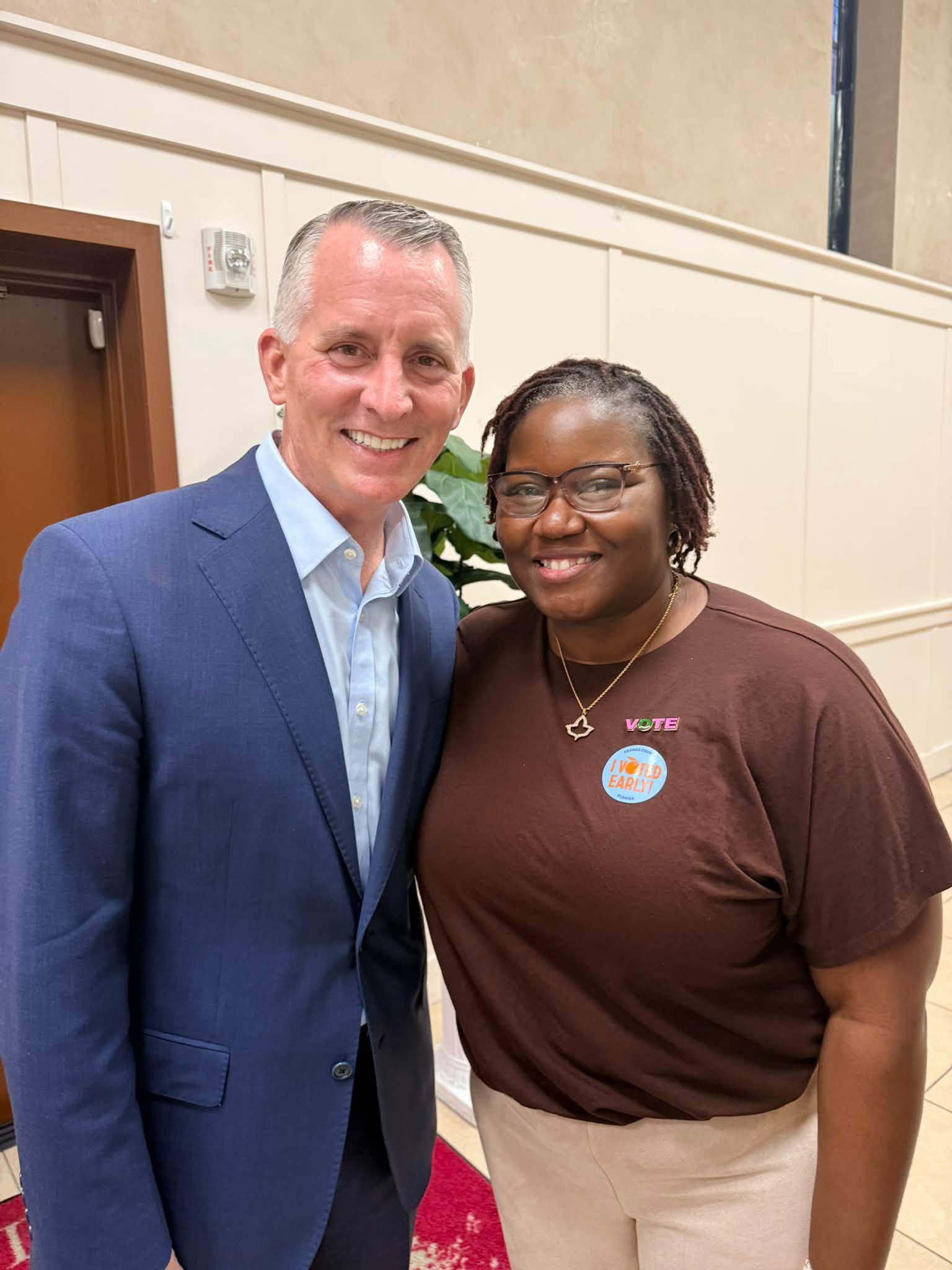
Jolly Builds a Black Leadership Coalition
Jolly’s campaign announced a Black leadership coalition Sept. 10 that includes former Jacksonville Mayor Alvin Brown, state Sens. Shevrin Jones and Tracie Davis, former state Sen. Arthenia Joyner and Pinellas County Commissioner Rene Flowers.
The campaign said the group would organize voters, help develop policy and expand community engagement. Jolly’s announced commitments include establishing an office of civil rights, supporting voting rights legislation and opposing restrictions targeting the teaching of Black history.
During his Eatonville visit, Jolly emphasized his responsibility to reach communities throughout Florida.
“Part of running for governor is representing every community across the state,” he told News 6.
A former Republican congressman who later became an independent before joining the Democratic Party, Jolly has made homeowners insurance reform, access to primary health care and public education central campaign issues.
Following the Advertising Dollars
Both political operations have announced substantial advertising efforts.
Florida Politics reported that Friends of Byron Donalds announced a $20 million statewide advertising buy ahead of the August primary. The publication separately reported that Jolly launched a multimillion-dollar statewide advertising effort in September. The announcements cover different periods and political entities and cannot be treated as equivalent spending totals.
Those announcements do not provide a complete accounting of purchases from Black-owned media.
Advertisements aimed at Black voters can run through companies with different ownership structures. Reaching a Black audience does not necessarily mean a campaign purchased advertising from a Black-owned business.
A comparable accounting would identify which Black-owned outlets received payments, how much they received and when. It would include purchases placed through agencies and separate candidate spending from political committee spending.
Without those figures, the available reporting does not establish whether either operation’s investment falls short of a stated commitment or other defined benchmark.
Florida’s Black Media Network
Florida’s established Black press includes The Miami Times in South Florida, the statewide Florida Courier, Daytona Times, The Florida Star in Jacksonville, Florida Sentinel Bulletin in Tampa and The Weekly Challenger in St. Petersburg and Pinellas County.
These publications illustrate the geographic reach of the state’s Black press. Their inclusion is not an audience ranking or a finding that they received advertising from either political operation.
The National Newspaper Publishers Association describes the Black press as a source of community news, information and commentary delivered through print and digital platforms.
Why the Spending Question Matters
For voters, the governor’s race involves representation and decisions affecting insurance costs, schools, health care and civil rights. Endorsements provide one perspective on the candidates; their records and proposals provide another.
Advertising disclosure would add a financial measure of outreach. It would show which Black-owned media businesses received campaign purchases and allow readers to compare those payments with each operation’s overall advertising budget.
As Donalds and Jolly compete for Black support, that accounting would help the public evaluate how their spending decisions align with their community engagement.
Florida National News calls on the Donalds and Jolly campaigns and their affiliated political committees to publicly announce their advertising spending with Black-owned media.
The disclosure should identify outlets, amounts paid, spending periods and purchases placed through agencies. Planned purchases should be listed separately from completed payments.
The same disclosure standard should apply to Democratic and Republican political operations seeking Black voters’ support. Advertising purchases must remain independent of editorial coverage and endorsements.


 Central Florida News5 days ago
Broadcaster Ray Cruz Santiago Criticizes Samuel Vilchez Santiago With Communist Graphics, Puerto Rican Identity Claims
 Central Florida News3 days ago
Orlando Magic Fall to 0-2 Under Sean Sweeney After 115-93 Loss to Timberwolves
 Central Florida News2 days ago
Global Police Leaders Gather in Orlando for IACP 2026 Conference


