

Politics
Trump ‘strongly looking’ at releasing migrants in Dem cities


WASHINGTON (AP) — President Donald Trump said Friday he is strongly considering releasing “Illegal Immigrants” into Democratic strongholds to punish congressional foes for inaction on the border— just hours after White House and Homeland Security officials insisted the idea had been rejected as fast as it had been proposed.
“Due to the fact that Democrats are unwilling to change our very dangerous immigration laws, we are indeed, as reported, giving strong considerations to placing Illegal Immigrants in Sanctuary Cities only,” Trump tweeted. He added that, “The Radical Left always seems to have an Open Borders, Open Arms policy – so this should make them very happy!”
The reversal, which appeared to catch officials at the Department of Homeland Security off guard, came as critics were blasting Trump for the supposedly-rejected idea, accusing him of turning migrants into pawns to go after his political opponents. It comes as Trump has grown increasingly exasperated by a surge of Central American migrant families crossing the southern border and is looking for new ways to pressure congressional Democrats to change laws that he insists are making the problem worse.
Indeed, last week Trump urged his soon-to-be acting Homeland Security Secretary Kevin McAleenan to seal the southern border and told McAleenan he would pardon him if he were to find himself in trouble for blocking legal asylum-seekers, according to two people familiar with the conversation who spoke on condition of anonymity to describe a private exchange.
It was not clear whether the president was joking, and a Homeland Security spokesman said in a statement: “At no time has the president indicated, asked, directed or pressured the acting secretary to do anything illegal. ” The reported conversation came during the president’s trip last week to Calexico, California, a day after he announced he was delaying his threat to close the border because Mexico appeared to be stepping up its enforcement efforts.
Before Trump’s tweets on Friday, both the Department of Homeland Security and a White House official had insisted in nearly identical statements that the sanctuary-cities plan had been floated but then flatly rejected.
But not, apparently, by the president, who emphatically revived the idea.
Asked about it by reporters, he said he was “strongly looking at” releasing migrant families into those communities.
“They’re always saying they have open arms. Let’s see if they have open arms,” he said.
There were no indications, however, that officials were taking any steps to move forward with the idea or considered the president’s words anything more than bluster.
“Sanctuary cities” are places where local authorities do not cooperate with Immigration and Customs Enforcement officials, denying information or resources that would help ICE round up for deportation people living in the country illegally.
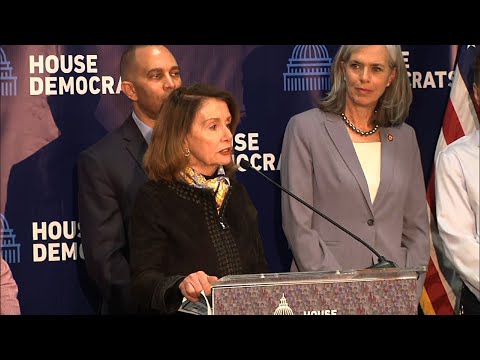
House Speaker Nancy Pelosit was asked about reports that the White House considered sending immigrants to sanctuary cities. (April 12)
They include New York City and San Francisco, home city of House Speaker Nancy Pelosi, who on Friday called the idea “unworthy of the presidency of the United States and disrespectful of the challenges that we face as a country, as a people, to address who we are — a nation of immigrants.”
Rep. Bennie Thompson of Mississippi, who chairs the House Homeland Security committee, said it “serves as a reminder that the Trump administration’s reckless immigration agenda is not about keeping the country safe, but about partisan politics and wantonly inflicting cruelty. ”
The idea of pressing immigration authorities to embrace the plan was discussed in November and then again in February as the Trump administration struggled with a surge of migrants at the border, according to three people who spoke on condition of anonymity to outline private conversations. Homeland Security and ICE lawyers quickly rejected the proposal, according to the people, on the grounds that it was complicated, too expensive and a misuse of funds, two of the people said.
The plan, which was first reported by The Washington Post, is one of a litany of ideas being tossed around by an increasingly anxious White House in recent months. Officials say they are running out of options, and have proposed and recycled numerous ideas that have never come to fruition. Trump in recent weeks, for instance, has discussed the idea of renewing his administration’s controversial family separation policy — even as he’s publicly declared he won’t do that — and has threatened to completely seal the border despite opposition from many in his administration.
There have been at least two versions of the sanctuary city plan discussed: One to move people who have already been detained to places with Democratic opponents of the president, the other to transport migrants apprehended at the border directly to San Francisco, New York City, Chicago and other spots.
ICE arrests people in the U.S. illegally and also manages migrants who present themselves at border crossings and ask for asylum.
The surge of migrant families at the border has been taxing the system, and ICE says it no longer has the resourced to handle immigrants processed by the Border Patrol. As a result, more than 125,000 people have been released as they await court hearings — a practice Trump has derided as “catch and release.”
With immigrant processing and holding centers overwhelmed, the administration has already been busing people hundreds of miles inland and releasing them at Greyhound stations and churches in cities such as Albuquerque, San Antonio and Phoenix.
Transporting large groups of immigrants to distant cities would be even more expensive for an agency already strapped for cash. Flights chartered by ICE cost about $7,785 per flight hour, according to the agency, and require multiple staffers, including an in-flight medical professional. The agency also uses commercial flights but requires that migrants to pay for those.
At the same time, many “sanctuary” communities would likely welcome the immigrants in question. Some of these cities have robust networks of nonprofit legal groups that could help them strengthen their legal cases to stay.
The Department of Health and Human Services said this week it had started scouting vacant properties that could be turned into facilities for holding migrant children in several cities, including Atlanta, Dallas, Houston, Phoenix, and San Antonio.
Those facilities would be licensed by each state and likely take several months to be approved and opened, separating them from the rapidly expanding emergency shelter at Homestead, Florida, and the now-closed tent facility at Tornillo, Texas.
The Defense Department has also been reviewing a number of military bases to find a location that can house up to 5,000 unaccompanied migrant children as the U.S. braces for a surge of people crossing the U.S.-Mexico border this spring.
Under the Trump administration, ICE has significantly stepped up arrests, including of people who have no U.S. criminal records. In response, some cities have banished ICE from jails where agents could easily pick up immigration violators. Police in New York, Baltimore and Seattle rarely, if ever, disclose information about when suspected criminals in the U.S. illegally will be released from custody.
Democrats have said they will tackle immigration bills, possibly as soon as they return from their spring recess, and Senate Republican leader Mitch McConnell has indicated an interest.

Central Florida News
Broadcaster Ray Cruz Santiago Criticizes Samuel Vilchez Santiago With Communist Graphics, Puerto Rican Identity Claims

The commentator’s video pairs the Democrat’s image with Soviet-style imagery and references his grandfather’s communist beliefs; Vilchez Santiago has publicly rejected socialism.
ORLANDO, Fla. (FNN) — Hispanic broadcaster Ray Cruz Santiago is targeting Florida House Democratic nominee Samuel Vilchez Santiago in a video that depicts the candidate in a Soviet-style military uniform and pairs his name with a hammer-and-sickle graphic.
The approximately two-minute video invokes Vilchez Santiago’s description of his grandfather as a communist while presenting images of the candidate, former Venezuelan President Hugo Chávez and Republican opponent Jorge Malavet.
In separate Facebook posts, Cruz Santiago also accuses the Venezuelan-born Democrat of misleading Puerto Rican voters about his heritage. The material reviewed does not substantiate that allegation, and Vilchez Santiago has publicly rejected the socialist label.
Video visually links candidate to communism
The uploaded video shows an apparent composite depicting Vilchez Santiago in a military uniform and peaked cap. Another graphic places the name “Samuel Vilchez” beneath a red flag bearing a hammer and sickle.
An on-screen caption describes him, translated from Spanish, as a “Democratic candidate in District 43 with a communist grandfather.”
The sequence also juxtaposes footage of Chávez with an image of Vilchez Santiago draped in a Venezuelan flag. Later frames display Malavet and Vilchez Santiago alongside Puerto Rican and Venezuelan flag symbols, respectively.
Together, those visual choices suggest an association between the Democratic candidate and communism. They do not independently establish his political beliefs, affiliations or support for Venezuela’s government. The uniform depiction should be understood as an apparent composite, rather than documentary evidence that he wore such a uniform.
Grandfather’s statement includes family opposition to Chavismo
The reference to Vilchez Santiago’s grandfather has a documented source.
“My grandfather was a communist,” Vilchez Santiago said in a 2019 Princeton University profile. In the same discussion, he described his parents as politically active opponents of Venezuela’s Chavista government and discussed his family’s departure because of political persecution. pace.princeton.edu
That account describes an ideological divide within his family. His grandfather’s beliefs do not establish the candidate’s own ideology.
Candidate has rejected socialist label
Cruz Santiago’s supplied posts describe Vilchez Santiago as a socialist or democratic socialist, a characterization the candidate has disputed.
“I am not a socialist. I have never been a socialist,” Vilchez Santiago said in Spanish in an interview published Sept. 29 by La Prensa Florida.
He argued that proposals involving health care, Social Security and lower household expenses should not automatically be labeled socialist. His stated priorities included easing property tax increases for first-time homebuyers, reducing toll expenses and simplifying small-business registration. laprensafl.com

Separate posts question Puerto Rican campaign imagery
Cruz Santiago’s heritage criticism appears in separate Facebook posts alleging that Vilchez Santiago is presenting himself as Puerto Rican to attract voters. www.facebook.com
A screenshot of a campaign advertisement supplied to FNN shows a photograph of Vilchez Santiago holding a Puerto Rican flag alongside two women, with his campaign branding displayed over the image.
The photograph places a recognizable symbol of Puerto Rican identity within the campaign’s presentation of his personal story. Viewers unfamiliar with his Venezuelan background could interpret it as suggesting Puerto Rican heritage. The materials reviewed do not establish whether viewers reached that conclusion or whether the campaign intended it.
The screenshot contains no explicit claim of Puerto Rican ancestry. Vilchez Santiago’s Venezuelan background is publicly documented in the Princeton profile and a Venezuelan-American Caucus biography. pace.princeton.edu
Why the presentation matters to voters
The criticism combines two distinct subjects: the candidate’s heritage and his political beliefs.
For voters evaluating the material, the central distinction is between documented statements and associations created through editing. The grandfather’s communist beliefs are supported by the candidate’s published account. The uniform, hammer-and-sickle graphic and Chávez juxtaposition are elements of the video’s presentation, rather than proof of the candidate’s ideology.
Likewise, the Puerto Rican flag photograph documents the campaign’s use of cultural imagery without establishing a false claim of ancestry.
Broadcaster brings criticism into District 43 contest
Cruz Santiago hosts El Escándalo del Día on Miami’s Radio Mambí 710 AM, according to his professional profile. Salsoul’s official website also lists him among its personalities. www.linkedin.com
Readers can review his commentary on Facebook and visit his website.
Vilchez Santiago and Malavet are the Democratic and Republican candidates, respectively, in the Nov. 3 election for Florida House District 43, according to state election records. dos.elections.myflorida.com

Florida
Donalds, Jolly Court Black Voters In Governor’s Race. How Much Are They Spending With Black-Owned Media?

Endorsements and community visits highlight the competition for Black support, while advertising purchases remain an unanswered question.
ORLANDO, Fla. (FNN) — Republican Byron Donalds and Democrat David Jolly are courting Black voters through endorsements, community appearances and organizing efforts, but how much their political operations are spending with Black-owned media remains unverified in the reporting reviewed for this article.
Donalds has secured support from Eatonville Vice Mayor Angela Thomas and Gainesville City Commissioner Cynthia Moore Chestnut, a longtime Democrat. Jolly has assembled a statewide coalition of Black elected officials, religious leaders and policy advisers ahead of the Nov. 3 election.
The endorsements show how individual leaders are approaching the governor’s race. Advertising records would help answer a separate question: How much business are the political operations seeking Black votes directing to Black-owned publishers and broadcasters?

Donalds Gains Endorsements
Thomas endorsed Donalds on Oct. 19, the same day Jolly visited Eatonville for a get-out-the-vote event, according to News 6.
“I am honored to have Vice Mayor Angela Thomas’s support,” Donalds wrote in the Facebook statement announcing her endorsement.
“Eatonville’s story of self-governance is one of the proudest in Florida’s history, and her leadership carries that legacy forward today.”
Donalds connected her support to his message about individual freedom and local decision-making.
“That’s the kind of trust in communities I’ll bring to Tallahassee — letting Floridians run their own lives, not Tallahassee,” he wrote.
Chestnut’s endorsement brought a prominent Black Democratic voice into Donalds’ camp. In a statement published by WCJB, she acknowledged policy disagreements with him while defending her decision to cross party lines.
“I want to see a Black governor of Florida in my lifetime,” Chestnut said.
She also encouraged voters to question Donalds directly about public education, property taxes, voting rights and economic opportunity.
Donalds would become Florida’s first Black governor if elected. Support from individual officials, however, does not establish a statewide shift among Black voters.
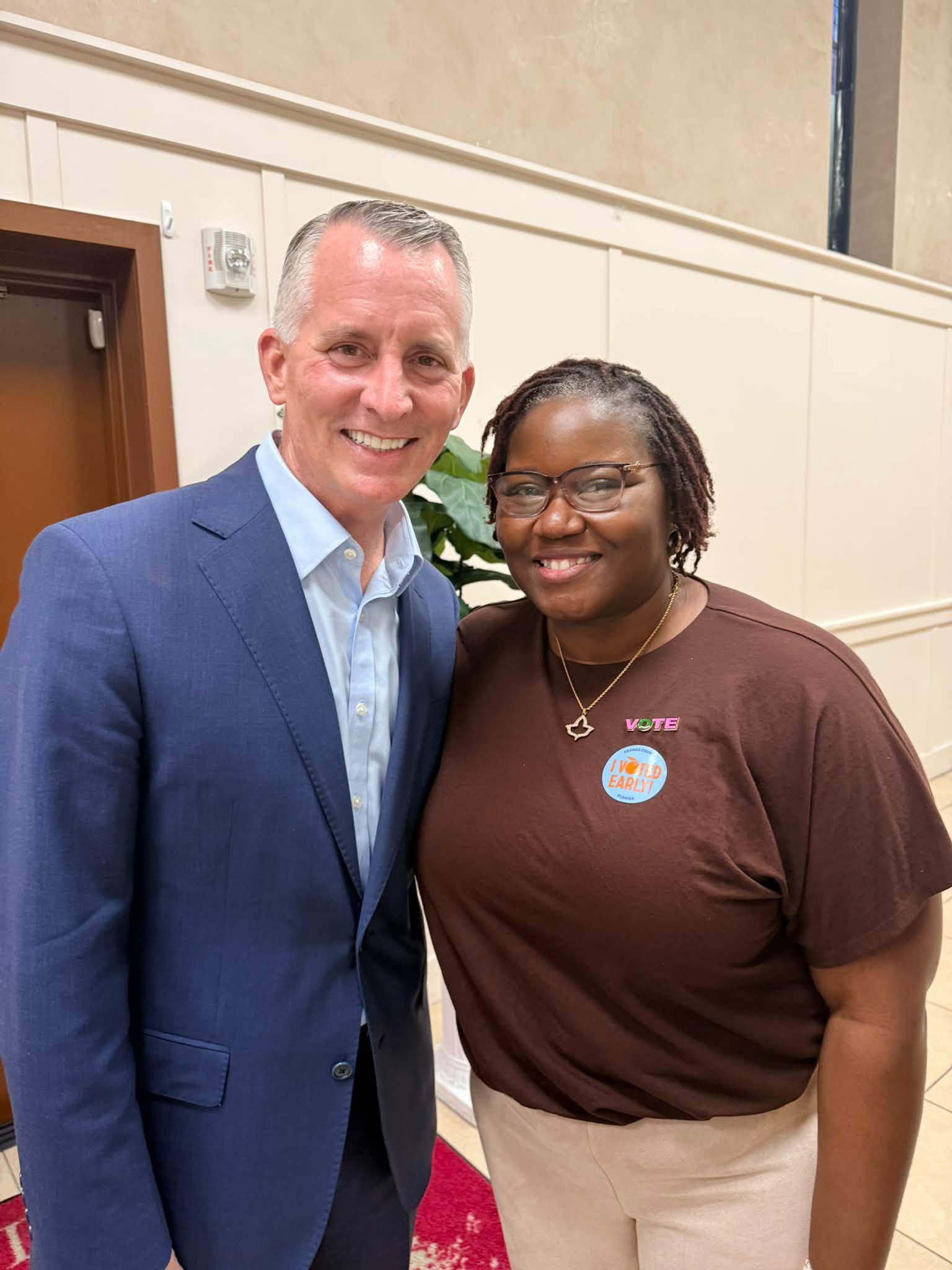
Jolly Builds a Black Leadership Coalition
Jolly’s campaign announced a Black leadership coalition Sept. 10 that includes former Jacksonville Mayor Alvin Brown, state Sens. Shevrin Jones and Tracie Davis, former state Sen. Arthenia Joyner and Pinellas County Commissioner Rene Flowers.
The campaign said the group would organize voters, help develop policy and expand community engagement. Jolly’s announced commitments include establishing an office of civil rights, supporting voting rights legislation and opposing restrictions targeting the teaching of Black history.
During his Eatonville visit, Jolly emphasized his responsibility to reach communities throughout Florida.
“Part of running for governor is representing every community across the state,” he told News 6.
A former Republican congressman who later became an independent before joining the Democratic Party, Jolly has made homeowners insurance reform, access to primary health care and public education central campaign issues.
Following the Advertising Dollars
Both political operations have announced substantial advertising efforts.
Florida Politics reported that Friends of Byron Donalds announced a $20 million statewide advertising buy ahead of the August primary. The publication separately reported that Jolly launched a multimillion-dollar statewide advertising effort in September. The announcements cover different periods and political entities and cannot be treated as equivalent spending totals.
Those announcements do not provide a complete accounting of purchases from Black-owned media.
Advertisements aimed at Black voters can run through companies with different ownership structures. Reaching a Black audience does not necessarily mean a campaign purchased advertising from a Black-owned business.
A comparable accounting would identify which Black-owned outlets received payments, how much they received and when. It would include purchases placed through agencies and separate candidate spending from political committee spending.
Without those figures, the available reporting does not establish whether either operation’s investment falls short of a stated commitment or other defined benchmark.
Florida’s Black Media Network
Florida’s established Black press includes The Miami Times in South Florida, the statewide Florida Courier, Daytona Times, The Florida Star in Jacksonville, Florida Sentinel Bulletin in Tampa and The Weekly Challenger in St. Petersburg and Pinellas County.
These publications illustrate the geographic reach of the state’s Black press. Their inclusion is not an audience ranking or a finding that they received advertising from either political operation.
The National Newspaper Publishers Association describes the Black press as a source of community news, information and commentary delivered through print and digital platforms.
Why the Spending Question Matters
For voters, the governor’s race involves representation and decisions affecting insurance costs, schools, health care and civil rights. Endorsements provide one perspective on the candidates; their records and proposals provide another.
Advertising disclosure would add a financial measure of outreach. It would show which Black-owned media businesses received campaign purchases and allow readers to compare those payments with each operation’s overall advertising budget.
As Donalds and Jolly compete for Black support, that accounting would help the public evaluate how their spending decisions align with their community engagement.
Florida National News calls on the Donalds and Jolly campaigns and their affiliated political committees to publicly announce their advertising spending with Black-owned media.
The disclosure should identify outlets, amounts paid, spending periods and purchases placed through agencies. Planned purchases should be listed separately from completed payments.
The same disclosure standard should apply to Democratic and Republican political operations seeking Black voters’ support. Advertising purchases must remain independent of editorial coverage and endorsements.


