Connect with us

Politics

Turning outrage into power: How far right is changing GOP

Published

on

WASHINGTON (AP) — House Minority Leader Kevin McCarthy appears to have settled on a strategy to deal with a handful of Republican lawmakers who have stirred outrage with violent, racist and sometimes Islamophobic comments.

If you can’t police them, promote them.

The path to power for Republicans in Congress is now rooted in the capacity to generate outrage. The alarming language, and the fundraising haul it increasingly produces, is another example of how Donald Trump, the former president, has left his mark on politics, changing the way Republicans rise to influence and authority.

Success in Congress, once measured by bills passed and constituents reached, is now gauged in many ways by the ability to attract attention, even if it is negative as the GOP looks to reclaim a House majority next year by firing up Trump’s most ardent supporters.

That has helped elevate a group of far-right lawmakers — including Reps. Lauren Boebert of Colorado, Marjorie Taylor Greene of Georgia and Paul Gosar of Arizona — whose inflammatory comments once would have made them pariahs.

Rather than face punishment for personal attacks that violate longstanding norms of Congress, they’ve been celebrated by conservatives, who have showered Boebert and Greene with campaign cash.

“We are not the fringe. We are the base of the party,” Greene, who has previously endorsed calls to assassinate prominent Democrats, said last week on a podcast hosted by former Trump adviser Steve Bannon.

The hands-off approach by Republican leadership gives them license to spread hate speech, conspiracy theories and misinformation that can have real world consequences, while testing the resolve of Democrats, who already removed Gosar and Greene from their committees.

It’s also a different tack from the one McCarthy took in 2019 when he stripped then-Rep. Steve King of Iowa of his committee assignments for lamenting that white supremacy and white nationalism had become offensive terms.

Boebert offers the latest example.

In two videos that surfaced recently she likened Rep. Ilhan Omar, a Minnesota Democrat who is one of three Muslims in Congress, to a terrorist concealing a bomb in a backpack. Boebert has also repeatedly referred to Omar as belonging to a “jihad squad,” as well as “black-hearted” and “evil.”

Her comments drew widespread condemnation and led to calls for Boebert to become the third GOP lawmaker this year to be removed from congressional committees. But instead of publicly apologizing to Omar, a defiant Boebert insisted that Omar should be the one to issue a public apology “to the American people” for her “anti-American” rhetoric, as well as past “anti-Semitic” comments, which Democrats condemned at the time.

In the uproar that followed, Omar received death threats, including a voicemail left by a man who called her a “traitor” and suggested she would be soon be taken “off the face of the (expletive) earth.”

“We cannot pretend this hate speech from leading politicians doesn’t have real consequences,” Omar said Tuesday while calling on the Republican Party to “actually do something to confront anti-Muslim hatred in its ranks.”

Boebert, meanwhile, burnished her image through an appearance on Fox News where she blamed Democrats who “want to cancel me” for the controversy. She has raked in $2.7 million so far this year, making her one of the top Republican fundraisers, according to campaign finance disclosures.

McCarthy, who is in line to become speaker if Republicans retake the majority in the 2022 midterm elections, downplayed the controversy Friday. He credited Boebert for attempting to privately apologize in a phone call with Omar, while breezing past Boebert’s refusal to do so publicly.

“In America, that’s what we do,” he said. “And then we move on.”

But McCarthy has also indicated that there will be little consequence for personal attacks. Just last month he said those punished by Democrats could be in line for a promotion if he becomes speaker, floating the possibility that Gosar and Greene “may have better committee assignments” than before.

That also poses a vexing issue for Democrats. During a Wednesday caucus meeting House Speaker Nancy Pelosi condemned Boebert’s behavior, but cautioned that restraint was needed.

“This is hard because these people are doing it for the publicity,” Pelosi said, according to a person in the room, who insisted on anonymity to discuss private deliberations. “There’s a judgment that has to be made about how we contribute to their fundraising and their publicity on how obnoxious and disgusting they can be.”

In many cases, the incentive to outrage can outweigh the consequences.

Greene arrived in Congress this year with a well documented history of making inflammatory comments. A former adherent of the QAnon conspiracy theories, she once mused that a wealthy Jewish family may have used space lasers to spark California wildfires.

She’s also harassed survivors of school shootings, accused Pelosi of committing crimes punishable by death and appeared in a 2019 video at the Capitol in which she argued Omar and another Muslim representative weren’t “really official” members of Congress because they didn’t take the oath of office on the Bible.

Since her election she’s used her nonstop attacks and viral online moments to reap a $6.3 million fundraising windfall — more than three times the cost of the average congressional campaign — while proving to be a speaking draw at Republican fundraisers around the country.

“If you say something bats—— crazy, if you say something extreme, you are going to raise money,” said Rep. Nancy Mace, R-S.C., who is one of the few Republicans to publicly criticize the rhetoric of her colleagues. Mace, who publicly feuded with Greene last week, said the Georgia lawmaker was a “grifter of the first order” who takes advantage of “vulnerable conservatives.”

Gosar, who was censured last month after posting an animated video of himself killing Democratic Rep. Alexandria Ocasio-Cortez of New York, is nowhere near as prolific of a fundraiser. But he has become a celebrated figure for white nationalists and has made appearances at fringe right-wing events, including a gathering in Florida last February hosted by Nick Fuentes, an internet personality who has promoted white supremacist beliefs.

Still, some Republicans say just because the three have achieved a measure of fame doesn’t mean they have accumulated real influence or staying power.

“There’s always some gifted communicator who comes in,” said Rep. Tom Cole, a 10-term Oklahoma Republican, who used the GOP class of 1994, when Republicans took over the House for the first time in decades, as an example. “We’re a long way of knowing how long they’ll stay. A lot of the brightest stars of the 1994 class were gone within eight years.”

Besides he added: “The reality is the first six years, the only thing you are going to do is what they let you.”


Continue Reading
Click to comment

Leave a Reply

Your email address will not be published. Required fields are marked *

Central Florida News

Orlando Commissioner Tony Ortiz Files for Mayor, Could Become City’s First Puerto Rican Mayor

Published

on

ORLANDO, Fla. (FNN) — Tony Ortiz, a longtime Orlando city commissioner, former Marine, and former law enforcement officer, has officially filed to run for mayor of Orlando following Mayor Buddy Dyer’s announcement that he will not seek re-election.

Ortiz filed his candidacy ahead of the November 2027 nonpartisan mayoral election. If elected, he would become Orlando’s first Puerto Rican mayor.

GROWING FIELD OF CANDIDATES
Ortiz joins a growing field of candidates that includes State Representative Anna Eskamani, who could become Orlando’s first Iranian American mayor if elected, along with Elliot Kahanna and Abdelnasser Luth.

In his campaign announcement, Ortiz emphasized issues affecting residents across Orlando, including housing affordability, public safety, homelessness, transportation, economic opportunity, and neighborhood stability.

“As the City of Orlando continues to grow and evolve, residents across the city are increasingly focused on the issues that shape everyday life,” Ortiz stated in his campaign announcement.

LAW ENFORCEMENT BACKGROUNDS RESONATE WITH ORANGE COUNTY VOTERS
Political observers note that Orange County voters have historically supported candidates with backgrounds in local, state, and federal law enforcement or public safety roles.

Examples include Orange County Mayor Jerry Demings, former Orange County sheriff; former U.S. Congresswoman Val Demings, former Orlando police chief; former State Senator Victor Torres, a former NYC Transit Police officer; Maitland City Commissioner Keith Givens, a retired FBI agent; former State Representative Daisy Morales, a former HSI official; Apopka City Commissioner Diane Velazquez, a former NYPD officer; and former Orlando City Commissioner Samuel Ings, a former Orlando police officer.

Florida National News Photo

HISTORIC OPPORTUNITY FOR REPRESENTATION
Ortiz’s candidacy highlights the continued growth and political influence of Central Florida’s Puerto Rican community. If successful, his election would mark a historic milestone for Puerto Rican representation in Orlando city government.

Continue Reading

Florida

Central Florida Lawmakers Challenge DeSantis Redistricting Map as Lawsuits Mount

Published

on

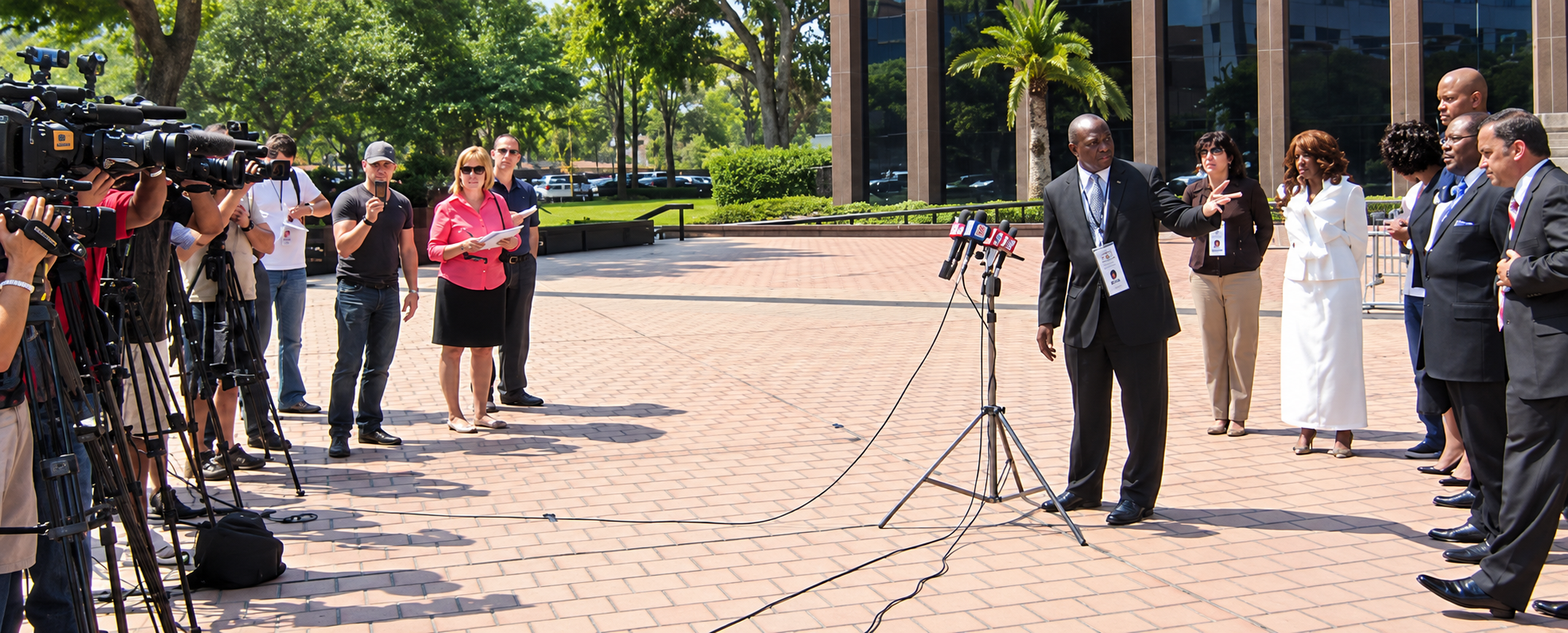
ORLANDO, Fla. (FNN) — The Central Florida Black Caucus of Local Elected Officials held a press conference on the steps of Orlando City Hall, criticizing a new congressional map signed into law by Florida Governor Ron DeSantis.

Speakers included U.S. Congressman Maxwell Frost, State Senator Lavon Bracy-Davis, State Representative Bruce Antone, Orange County Clerk of Courts Tiffany Moore Russell, representatives from Equal Ground, and the Central Florida Urban League. Officials argued the map weakens minority representation and follows a recent U.S. Supreme Court ruling that scaled back key protections under the Voting Rights Act.

Florida National News has learned that three lawsuits have been filed seeking to block the newly approved congressional map following the redistricting process. The map is widely viewed as an effort to expand Republican representation in Florida’s congressional delegation ahead of upcoming elections.

IMPACT ON BLACK REPRESENTATION
Leaders warned the redistricting plan could significantly reduce the influence of Black voters in Central Florida and across the state. They argued that dismantling historically minority-access districts undermines decades of progress in equitable representation.

LEGAL CHALLENGES UNDERWAY
At least three lawsuits have been filed challenging the legality of the new map. Civil rights advocates contend the redistricting plan violates federal protections and could further erode voting rights following the Supreme Court’s recent decision.

FUTURE OF BLACK CONGRESSIONAL LEADERSHIP
Elected officials and advocacy groups expressed concern about the long-term effects on Black congressional representation. They emphasized the need for continued legal action and community engagement to protect fair representation in future elections.

Continue Reading

Florida

DeSantis’ New Florida Congressional Map Could Spark Lawsuits, Legislative Showdown, and Statewide Protests

Published

on

TALLAHASSEE, Fla. (FNN) — Governor Ron DeSantis unveiled a proposed congressional redistricting map that could significantly reshape Florida’s representation in the U.S. House ahead of the 2026 midterm elections.

The proposal, released Monday, outlines districts that could favor Republicans in 24 seats, compared to four Democratic-leaning districts. Currently, Florida’s congressional delegation includes 20 Republicans and seven Democrats, with one vacant seat.

REDISTRICTING PROPOSAL & POLITICAL IMPACT
The governor said the new map reflects Florida’s population changes and fulfills his commitment to mid-decade redistricting. Lawmakers have been called into a special legislative session to consider the proposal.

The map appears to eliminate four Democratic-held seats, including a Tampa-area district represented by U.S. Rep. Kathy Castor, an Osceola County district held by U.S. Rep. Darren Soto—the first Puerto Rican elected to Congress from Florida—and a Palm Beach-Broward district that could displace U.S. Rep. Jared Moskowitz.

The proposal also affects a majority-Black voting district spanning Palm Beach and Broward counties, previously represented by former U.S. Rep. Sheila Cherfilus-McCormick, raising concerns about the future of minority representation.

Supporters, including Evan Power, say the map could better align districts with voter distribution. Critics, including Nikki Fried, have called the proposal unconstitutional gerrymandering. Florida law prohibits partisan gerrymandering, setting up potential legal challenges.

Rep. Tray McCurdy, D-Orlando and Rep. Angie Nixon, D-Jacksonville sit on the Florida Seal in protest as debate stops on Senate Bill 2-C: Establishing the Congressional Districts of the State in the House of Representatives Thursday, April 21, 2022 at the Capitol in Tallahassee, Fla. Rep. Daisy Morales, D-Orlando, joins the protest, holding a sign. The session was halted on the protest. (AP Photo/Phil Sears)


LOOKING BACK: 2022 PROTESTS OVER REDISTRICTING

The current debate mirrors tensions from 2022, when Democratic lawmakers staged a sit-in protest on the Florida House floor in opposition to a previous congressional map backed by DeSantis.

Lawmakers including Yvonne Hinson, Angie Nixon, Travaris McCurdy, Felicia Robinson, and Daisy Morales participated in the protest, temporarily halting legislative proceedings.

Morales, a member of the Congressional Redistricting Subcommittee and the only Hispanic lawmaker involved in the sit-in, strongly criticized the map at the time.

“Our democracy is being attacked. The governor eliminating two Black congressional seats is a power grab and it’s wrong,” Morales said in a written statement. “Stripping seats from Black representation is the same as saying the Black voice—the Black vote—doesn’t matter.”

She also warned about potential impacts on Hispanic representation:

“With this map passing, I’m deeply concerned it could target the only Puerto Rican representing Florida in Congress, Darren Soto, to benefit partisan interests. We don’t want to disenfranchise the 1.2 million Puerto Ricans in Florida.”

WHAT COMES NEXT IN 2026
As lawmakers prepare to debate the new proposal, Democrats are expected to push back through legal challenges, legislative opposition, and public advocacy.

The outcome of Florida’s redistricting battle could play a pivotal role in shaping control of the U.S. House and influence the national political landscape heading into the 2026 midterm elections.

Continue Reading
Advertisement
Advertisement Ticket Time Machine ad
Advertisement Orlando Regional REALTOR Association logo
Advertisement Parts Pass App
Advertisement Hispanic Chamber of Commerce of Metro Orlando
Advertisement
Advertisement African American Chamber of Commerce of Central Florida
Advertisement FNN News en Español
Advertisement Indian American Chamber of Commerce logo
Advertisement Florida Sports Channel

FNN Newsletter

Trending