Connect with us

Politics

Words and consequences: A look at the Omar and Trump feud

Published

on

WASHINGTON (AP) — President Donald Trump isn’t backing down from his tweets about Democratic Rep. Ilhan Omar, one of the first Muslim women to serve in Congress.

In fact, he spoke at an event in Omar’s home state of Minnesota on Monday amid a ferocious fight over her comments about the Sept. 11 terrorist attacks.

Omar, a Somali-American, says it’s more than a rhetorical squabble, and that lives, including hers, are at stake. Trump says national security is at issue and Omar is “ungrateful.”

A look at the latest rhetorical battle between the pair that’s more broadly about race and whether leaders and their words should be blamed for violence.

___

THE AFTERSHOCKS

Omar says she’s faced increased death threats since Trump spread around a video that purports to show her being dismissive of the 2001 terrorist attacks. “This is endangering lives,” she said, accusing Trump of fomenting extremism. “It has to stop.”

Her statement late Sunday followed an announcement by House Speaker Nancy Pelosi that she has taken steps to ensure the safety of the Minnesota Democrat. Pelosi also urged Trump to take down the video.

The video soon disappeared as a pinned tweet at the top of Trump’s Twitter feed, but it was not deleted.

Trump further escalated his rhetoric Monday morning, tweeting that, “Before Nancy, who has lost all control of Congress and is getting nothing done, decides to defend her leader, Rep. Omar, she should look at the anti-Semitic, anti-Israel and ungrateful U.S. HATE statements Omar has made.”
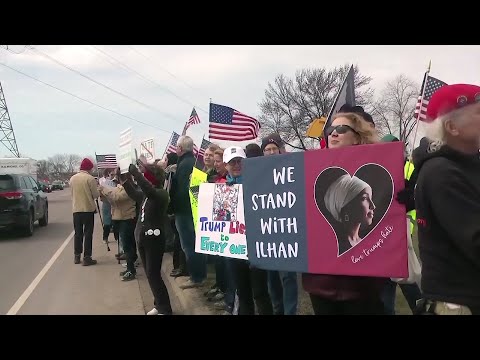
Supporters and opponents of President Donald Trump squared off before the president spoke at a Tax Day rally in Burnsville, Minn. Trump used a tweet to escalate his feud with Rep. Omar Ilhan, a Minnesota Democrat. (April 15)

Tap to unmute

Later Monday, Trump announced he was heading to “the Great State of Minnesota!” Omar responded by retweeting that post with the comment, “The Great State of Minnesota, where we don’t only welcome immigrants, we send them to Washington.”

Minnesota has the largest concentration of Somalis in the nation, and most of those are in the Minneapolis area.

On Monday at the London School of Economics and Political Science, Pelosi said: “I don’t think any president of the United States should use the tragedy of 9/11 as a political tool. I think that is wrong, I think it’s beneath the dignity of the office.”

___

WHAT OMAR SAID

Omar told a Los Angeles gathering of the Council on American-Islamic Relations on March 23 that many Muslims saw their civil liberties eroded after the Sept. 11 attacks.

“For far too long we have lived with the discomfort of being a second-class citizen and, frankly, I’m tired of it, and every single Muslim in this country should be tired of it,” she said in the speech, according to video posted online. “CAIR was founded after 9/11, because they recognized that some people did something and that all of us were starting to lose access to our civil liberties.”

CAIR was founded in 1994, according to its website, but its membership skyrocketed after the attacks.

___

HOW TRUMP REACTED

The president on Friday retweeted a video that pulled “some people did something” from Omar’s speech and included news footage of the hijacked planes hitting the Twin Towers. Trump also tweeted, “WE WILL NEVER FORGET!”

The president elevated criticism largely from Omar’s political opponents and conservatives who say Omar’s phrasing offered a flippant description of the assailants and the attacks that killed nearly 3,000 people.

Neither Trump’s tweet nor the video included Omar’s full quote or the context of her comments.

In Minnesota, Trump kept his remarks at a trucking company in Burnsville mostly focused on the 2017 GOP-passed tax cut.

___

WHO ECHOED TRUMP

Other prominent GOP voices joined Trump in criticizing Omar.

“First Member of Congress to ever describe terrorists who killed thousands of Americans on 9/11 as ‘some people who did something,’” tweeted Rep. Dan Crenshaw, R-Texas. The retired Navy SEAL lost his right eye in 2012 in an explosion in Afghanistan.

“Here’s your something,” the New York Post blared on a cover beneath a photograph of the flaming towers.

Fox News Channel host Brian Kilmeade said on a “Fox & Friends” segment on Omar, “You have to wonder if she’s an American first.”

___

LIFE AND DEATH…

Omar has been the target of threats in the past. She tweeted back at Kilmeade and Crenshaw: “This is dangerous incitement, given the death threats I face.”

“My love and commitment to our country and that of my colleagues should never be in question. We are ALL Americans!”

An upstate New York man was charged recently with making death threats against her.

___

SAFETY

Members of the Congressional Black Caucus said in a conference call Monday they are concerned for Omar’s safety, especially as Trump campaigned in Minnesota. Chairwoman Karen Bass said whipping up “outrage” over Omar “further puts her life in danger.”

Added House Homeland Security Chairman Bennie Thompson: “Members of Congress should be free to give their opinions on subjects without fear of threat of bodily harm.”

“I’m concerned about it and the notion that, if your thinking is different from the president’s, you become a target.”

Continue Reading
Click to comment

Leave a Reply

Your email address will not be published. Required fields are marked *

Florida

FIU Becomes First Florida University to Launch CORE Emergency Management Partnership

Published

on

MIAMI, Fla. (FNN) — Florida officials announced the launch of the Coalition for Operational Readiness in Education, or CORE, Program at Florida International University, beginning an initiative designed to strengthen the state’s emergency management workforce through partnerships with colleges, universities and technical and trade schools.

The program will connect higher education institutions with the Florida Division of Emergency Management and other state agencies to provide students with specialized education and training in emergency management.

CORE is also expected to provide opportunities for students to earn industry-recognized certificates and establish pathways to jobs with emergency management offices and private-sector industry partners across Florida.

FIU First to Launch CORE

Florida International University in Miami is the first institution where CORE is being rolled out.

State officials said 11 institutions have committed to participating, with the long-term goal of expanding the initiative to every college, university, technical school and trade school in Florida.

The statewide expansion would create a pipeline of students trained for careers involving disaster preparedness, emergency response and recovery.

Building Florida’s Emergency Management Workforce

Florida’s exposure to hurricanes and other natural disasters has made emergency preparedness and response a major state priority.

Officials said maintaining Florida’s emergency management capabilities requires developing the next generation of professionals who will work before, during and after disasters and other emergencies.

The CORE partnerships are designed to connect classroom education with professional training, certifications and employment opportunities.

Education-to-Employment Pipeline

The program is intended to create a more direct pathway from education to careers in emergency management.

Through partnerships involving state agencies, educational institutions and industry organizations, students could gain specialized training while developing credentials recognized by employers.

The initiative could also help state and local emergency management agencies develop a larger pool of trained candidates as Florida’s population and emergency-response needs continue to grow.

Statewide Expansion Planned

While the program begins at FIU, officials said the broader objective is statewide.

The goal is to eventually establish CORE partnerships throughout Florida’s higher education and workforce-training system, including universities, colleges, technical schools and trade schools.

Florida officials also envision CORE becoming a workforce-development model that other states could replicate.

Key Takeaways

  • Program: Coalition for Operational Readiness in Education (CORE)
  • Initial launch: Florida International University in Miami
  • State partner: Florida Division of Emergency Management and other state agencies
  • Participating institutions: 11 institutions have committed so far
  • Training: Specialized emergency management education and workforce preparation
  • Credentials: Industry-recognized certificates
  • Career component: Pathways to emergency management agencies and industry employers
  • Long-term goal: Expand CORE to colleges, universities, technical schools and trade schools throughout Florida
  • National objective: Develop a Florida workforce model that could be replicated in other states

Continue Reading

Florida

Byron Donalds Selects Miami-Dade Sen. Bryan Avila as Running Mate in Florida Governor’s Race

Published

on

MIAMI, Fla. (FNN) — Republican gubernatorial nominee Byron Donalds selected Florida state Sen. Bryan Avila of Miami-Dade County as his running mate for lieutenant governor, adding a South Florida lawmaker to the GOP ticket for the 2026 general election.

Donalds announced Avila as his choice Tuesday, Aug. 25, at Miami’s historic Freedom Tower, a location closely associated with South Florida’s Cuban exile community.

The selection puts Avila alongside Donalds as Republicans turn their attention to the general election and the race to succeed Gov. Ron DeSantis.

Who Is Bryan Avila?

Avila is a Republican state senator from Miami-Dade County and previously served in the Florida House of Representatives.

His selection gives the Donalds ticket a prominent South Florida presence and adds a lawmaker with experience in both chambers of the Florida Legislature.

The Miami announcement also places immigration, communism, economic opportunity and Florida’s relationship with Latin American communities near the center of the Republican ticket’s general-election messaging.

Road to the General Election

With Avila joining the ticket, Donalds now moves toward the November general election with the Republican nominees for governor and lieutenant governor in place.

The lieutenant governor selection is one of Donalds’ most consequential decisions since securing the Republican nomination, helping define the geographic, political and demographic strategy of his statewide campaign.

Continue Reading

Florida

Florida House Democratic Campaign Committee Chair Christine Hunschofsky Faces Lawsuits, Election Complaints

Published

on

Who is next? Lawsuits and Florida election complaints put the incoming House Democratic leader’s oversight of political attacks, campaign spending and tactics against former Democratic lawmakers under scrutiny

ORLANDO, Fla. (FNN) — Incoming Florida House Democratic Leader Christine Hunschofsky, a former Parkland mayor is facing growing scrutiny over campaign tactics by the Florida House Democratic Campaign Committee, the party-affiliated committee she chairs, as former Democratic lawmakers challenge political attacks through lawsuits and Florida election complaints.

The disputes are placing increased scrutiny on Christine Hunschofsky, chair of the Florida House Democratic Campaign Committee, and Cassidy Whitaker, the committee’s caucus director for the 2026 election cycle.

The controversy goes beyond ordinary party infighting, with former Democratic lawmakers alleging that FHDCC used opposition research and campaign communications containing false or misleading information to attack members of its own party.

Those allegations raise questions about the committee’s research, approval process and campaign tactics — and whether House Democratic leaders can rebuild trust with lawmakers targeted by the same political organization they are expected to help lead.

Former Democratic lawmakers are now turning to the courts and Florida’s election complaint process to challenge FHDCC-linked campaign tactics, intensifying scrutiny of the committee’s leadership, spending, opposition research and oversight.

The lawsuits and complaints remain allegations. They do not establish that Hunschofsky, FHDCC or others violated the law.

But the controversy is no longer simply an internal Democratic campaign fight.

FHDCC Faces Real Legal Challenges

State Representative-Elect and former Democratic state Rep. James Bush III sued FHDCC and other defendants in Miami-Dade County over allegedly defamatory election communications.

Former Democratic state Rep. Daisy Morales has separately challenged campaign communications involving FHDCC through litigation in Orange County and Florida’s election complaint process.

The cases involve separate elections and allegations and must be decided on their individual evidence.

State Rep.-elect Daphne Campbell, a former state senator and former state representative, told Florida National News in a phone interview that she is considering filing a defamation lawsuit as well.

Together, however, they place FHDCC’s campaign practices under greater scrutiny and create a leadership test for Hunschofsky as she prepares to lead Florida House Democrats.

Hunschofsky’s Leadership Under Scrutiny

Hunschofsky’s position as chair does not automatically make her personally liable for every communication, expenditure or decision made by FHDCC.

But leadership brings accountability for how an organization operates.

Political attack campaigns require research, writing, production, vendors, financing and distribution. FHDCC’s internal structure determines how those activities are authorized and supervised.

That makes Hunschofsky’s authority, knowledge and oversight relevant as the committee responds to legal challenges involving its campaign activity.

The central issue is straightforward: What happened under the FHDCC banner, and what responsibility did its leadership have for it?.

Party Establishment vs. Voters’ Choice

The controversy also exposes a deeper tension between party leadership and voters who expect to choose representatives based on the priorities of their communities.

Political parties can recruit, endorse and financially support candidates.

Voters make the final choice.

Heavy intervention by a party organization in a Democratic primary can create the perception that party leaders are trying to make that choice for voters.

That can damage trust when voters believe local experience, constituent service and understanding of their community matter more than the preferences of party leadership.

Democrats Spending Money Fighting Democrats

The internal battles come as Florida Democrats face a larger electoral challenge.

Republicans hold substantial power in Tallahassee, while Democrats need financial resources to compete for legislative seats and statewide offices.

Money spent attacking Democrats in expensive Democratic primaries cannot simultaneously be spent challenging Republicans.

FHDCC has the right to participate in elections within the law. But intraparty battles followed by lawsuits and election complaints create a political question about whether those resources are advancing the committee’s broader mission of electing Democrats.

Minority Democrats and Party Trust

The disputes also involve former minority Democratic lawmakers.

Bush and Campbell are Black. Morales is Puerto Rican, Hispanic.

That does not establish racial or ethnic discrimination by Hunschofsky or FHDCC.

But former minority Democratic lawmakers turning to courts and election regulators over tactics associated with their own party creates a political challenge for Democrats, who depend heavily on Black and Hispanic voters.

Those voters have the same interest as every Florida voter in accurate campaign information, fair elections and political organizations that follow the rules.

A Political Standard That Should Apply to Both Parties

The controversy also creates an uncomfortable comparison for Democrats who have criticized President Donald Trump’s aggressive treatment of political opponents.

The lawsuits and election complaints do not establish that FHDCC copied Trump’s strategy or adopted a “Trump playbook.”

But they raise a broader question of consistency.

Democrats who demand accountability when Republicans exercise political power aggressively should be prepared to apply the same standards to organizations within their own party.

Republicans should do the same when allegations involve their side.

Fairness cannot depend on which party benefits.

From Political Fight to Legal Process

Negative campaigning and opposition research are legal and receive substantial First Amendment protection.

Political committees, however, remain subject to election laws, campaign-finance requirements and civil law.

A lawsuit does not prove defamation.

FHDCC’s separate argument that it cannot be sued.

An election complaint does not prove an election-law violation.

Neither automatically creates a criminal investigation.

If evidence ultimately supports potential criminal conduct, the appropriate law-enforcement agency or prosecutor — not political parties, candidates or news organizations — determines whether an investigation is warranted.

The principle protects everyone: allegations must be proven, due process must be respected and political influence should not shield proven violations.

Who Is Next?

The growing legal disputes leave FHDCC with a political problem extending beyond Bush, Morales and Campbell.

Who is next on the Florida House Democratic Campaign Committee’s target list?

No Democrat is entitled to immunity from legitimate political criticism simply because that candidate belongs to the party.

But candidates should be able to expect political organizations to play by the rules.

The same principle applies to Republicans.

Political organizations can fight hard, expose legitimate weaknesses and spend money advocating for their candidates.

They still have to follow the law.

Hunschofsky Faces a Leadership Test

Hunschofsky is not watching the controversy from outside the organization.

She chairs the Florida House Democratic Campaign Committee while preparing to lead Florida House Democrats, including minority Democratic lawmakers who were targeted by the committee’s campaign attacks.

The lawsuits and election complaints therefore put FHDCC’s governance, campaign strategy and financial oversight directly within the public debate surrounding her leadership.

The courts will determine the civil allegations before them. Election regulators will determine matters within their jurisdiction. If evidence independently supports potential criminal violations, law-enforcement authorities can determine whether an investigation is warranted.

For Hunschofsky, the leadership test is whether the committee she chairs can defend its campaign practices, account for its spending and maintain the trust of Democratic voters while the allegations move through Florida’s courts and election-enforcement system.

The lawsuits and election complaints remain allegations. They are not findings that Hunschofsky or FHDCC violated the law.

For Florida voters, the standard should be simple:

Play by the rules. Follow the evidence. Apply the law equally.

Florida National News is seeking comment from Hunschofsky and FHDCC regarding the lawsuits, election complaints, campaign spending and committee oversight. FNN will update this report with responses and significant developments.

Continue Reading
Advertisement
Advertisement Ticket Time Machine ad
Advertisement Orlando Regional REALTOR Association logo
Advertisement Parts Pass App
Advertisement Hispanic Chamber of Commerce of Metro Orlando
Advertisement
Advertisement African American Chamber of Commerce of Central Florida
Advertisement FNN News en Español
Advertisement Indian American Chamber of Commerce logo
Advertisement Florida Sports Channel

FNN Newsletter

Trending