Politics
AP source: Pelosi attacker carried zip ties, in Jan. 6 echo
Published
4 years agoon
WASHINGTON (AP) — The man accused of attacking House Speaker Nancy Pelosi’s husband carried zip ties with him when he broke into the couple’s San Francisco home, according to a person briefed on the investigation, in what is the latest parallel to the Capitol riot of Jan. 6, 2021.
The person was not authorized to publicly discuss the Pelosi case and spoke to The Associated Press on condition of anonymity Sunday.
The attack on Democratic leader’s 82-year-old husband, Paul Pelosi, less than two weeks before before the Nov. 8 election that will determine control of Congress as well as key statewide and local offices, was an unsettling reminder of the nation’s toxic political climate. With threats to public officials at an all-time high, members of Congress were being urged to reach out for additional security resources, including increased police patrols of their neighborhoods.
U.S. Capitol Police Chief J. Thomas Manger said in a weekend memo to lawmakers that the attack “is a somber reminder of the threats elected officials and families face in 2022.”
Police in San Francisco said the assault of Paul Pelosi was intentional. Authorities said the suspect, identified as David DePape, 42, confronted Paul Pelosi in the family’s Pacific Heights home early Friday and, the AP has reported, demanded to know, “Where is Nancy?”
The two men struggled over a hammer before officers responding to a 911 call to the home saw DePape strike Paul Pelosi at least once, police said. DePape was arrested on suspicion of attempted murder, elder abuse and burglary. Prosecutors plan to announce the charges on Monday during a new conference and expect his arraignment on Tuesday.
Eerie echoes of the Jan. 6 riot were apparent in the incident at the Pelosi home.
Rioters who swarmed the Capitol trying to overturn Joe Biden’s election victory over Donald Trump roamed the halls and shouted menacingly, demanding “Where’s Nancy?” Some in the siege were seen inside the Capitol carrying zip ties. The presence of the zip ties on the suspect in Paul Pelosi’s assault was first reported by CNN.
Nancy Pelosi was in Washington when her husband was attacked at home. She soon returned to San Francisco, where her husband was hospitalized. He had surgery for a skull fracture, and suffered other injuries to his arms and hands, her office said.
“Our children, our grandchildren and I are heartbroken and traumatized by the life-threatening attack on our Pop,” she said in a letter late Saturday to colleagues. “We are grateful for the quick response of law enforcement and emergency services, and for the life-saving medical care he is receiving.”
Paul Pelosi remains hospitalized and “continues to improve,” she told colleagues.
With Election Day nearing and Trump relentlessly promoting claims he did not lose to Biden in 2020, federal agencies warned on Friday that domestic extremists fueled by election falsehoods “pose a heightened threat” to the midterms. The Department of Homeland Security and other federal agencies said the greatest danger was “posed by lone offenders who leverage election-related issues to justify violence.”
Biden and other officials, Democrats and Republicans, condemned the attack on Paul Pelosi and said violence has no home in American politics.
“Enough is enough is enough,” Biden said while campaigning in Pennsylvania on Friday night.
Trump, in an interview taped Friday with Americano Media, a conservative Spanish-language network, called the attack on Paul Pelosi a “terrible thing,” but the former president also tried to link it to crime in U.S. cities.
For years, Republicans have tried to make Pelosi a campaign boogeyman, using the 82-year-old’s image as a recurring caricature in countless ads against Democrats, including many now airing in races nationwide during a hostile election season.
The head of the Republican National Committee, Ronna McDaniel, said Sunday it was “unfair” to blame the GOP for creating a political climate that could have laid the ground for such an attack.
“You can’t say people saying, ‘Let’s fire Pelosi’ or ’Let’s take back the House” is saying go do violence,” she told “Fox News Sunday.”
The House GOP’s campaign chief, Minnesota Rep. Tom Emmer, was asked during a Sunday interview about a tweet promoting his own video, which shows him shooting a gun at an indoor target.
“Enjoyed exercising my Second Amendment rights,” Emmer tweeted, mentioning he was with two House GOP candidates. The video includes the imagery and sounds of the rifle being fired. The tweet was posted Wednesday, before Paul Pelosi was assaulted, and said: “13 days to make history. Let’s #FirePelosi.”
Emmer said on CBS’ “Face the Nation” that he was just “exercising our Second Amendment rights, having fun.”
Both McDaniel and House Republican leader Kevin McCarthy of California said Paul Pelosi’s assailant was “deranged.”
McCarthy said on Fox News Channel’s “Sunday Morning Futures” that violence or the threat of violence “has no place in our society.”
Five years ago, a left-wing activist opened fire on Republicans as they practiced for an annual charity baseball game. Rep. Steve Scalise of Louisiana was critically wounded. In 2011, then-Rep. Gabrielle Giffords, D-Ariz., was shot in the head at an event outside a Tucson grocery store.
Elon Musk jumped into the debate Sunday tweeting, then deleting, a link to a fringe website with an unfounded rumor about the attack on Speaker Pelosi’s husband. Sent to his millions of followers, Musk’s tweet came just days after his purchase of Twitter fueled concerns that the social media platform would no longer seek to limit misinformation and hate speech.
Sen. Amy Klobuchar, who leads the Senate committee overseeing security at the Capitol, said lawmakers are considering new measures, including taking their private information off the internet.
Klobuchar, D-Minn., noted, however that Nancy Pelosi “has been villainized for years and, big surprise, it’s gone viral, and it went violent.”
“I think it is really important that people realize that it is not just this moment of this horrific attack, but that we have seen violence perpetrated throughout our political system,” Klobuchar told NBC’s “Meet the Press.”
You may like
Central Florida News
Orlando Commissioner Tony Ortiz Files for Mayor, Could Become City’s First Puerto Rican Mayor
Published
2 hours agoon
May 12, 2026By
Willie DavidORLANDO, Fla. (FNN) — Tony Ortiz, a longtime Orlando city commissioner, former Marine, and former law enforcement officer, has officially filed to run for mayor of Orlando following Mayor Buddy Dyer’s announcement that he will not seek re-election.
Ortiz filed his candidacy ahead of the November 2027 nonpartisan mayoral election. If elected, he would become Orlando’s first Puerto Rican mayor.
GROWING FIELD OF CANDIDATES
Ortiz joins a growing field of candidates that includes State Representative Anna Eskamani, who could become Orlando’s first Iranian American mayor if elected, along with Elliot Kahanna and Abdelnasser Luth.
In his campaign announcement, Ortiz emphasized issues affecting residents across Orlando, including housing affordability, public safety, homelessness, transportation, economic opportunity, and neighborhood stability.
“As the City of Orlando continues to grow and evolve, residents across the city are increasingly focused on the issues that shape everyday life,” Ortiz stated in his campaign announcement.
LAW ENFORCEMENT BACKGROUNDS RESONATE WITH ORANGE COUNTY VOTERS
Political observers note that Orange County voters have historically supported candidates with backgrounds in local, state, and federal law enforcement or public safety roles.
Examples include Orange County Mayor Jerry Demings, former Orange County sheriff; former U.S. Congresswoman Val Demings, former Orlando police chief; former State Senator Victor Torres, a former NYC Transit Police officer; Maitland City Commissioner Keith Givens, a retired FBI agent; former State Representative Daisy Morales, a former HSI official; Apopka City Commissioner Diane Velazquez, a former NYPD officer; and former Orlando City Commissioner Samuel Ings, a former Orlando police officer.
HISTORIC OPPORTUNITY FOR REPRESENTATION
Ortiz’s candidacy highlights the continued growth and political influence of Central Florida’s Puerto Rican community. If successful, his election would mark a historic milestone for Puerto Rican representation in Orlando city government.
Florida
Central Florida Lawmakers Challenge DeSantis Redistricting Map as Lawsuits Mount
Published
6 days agoon
May 6, 2026By
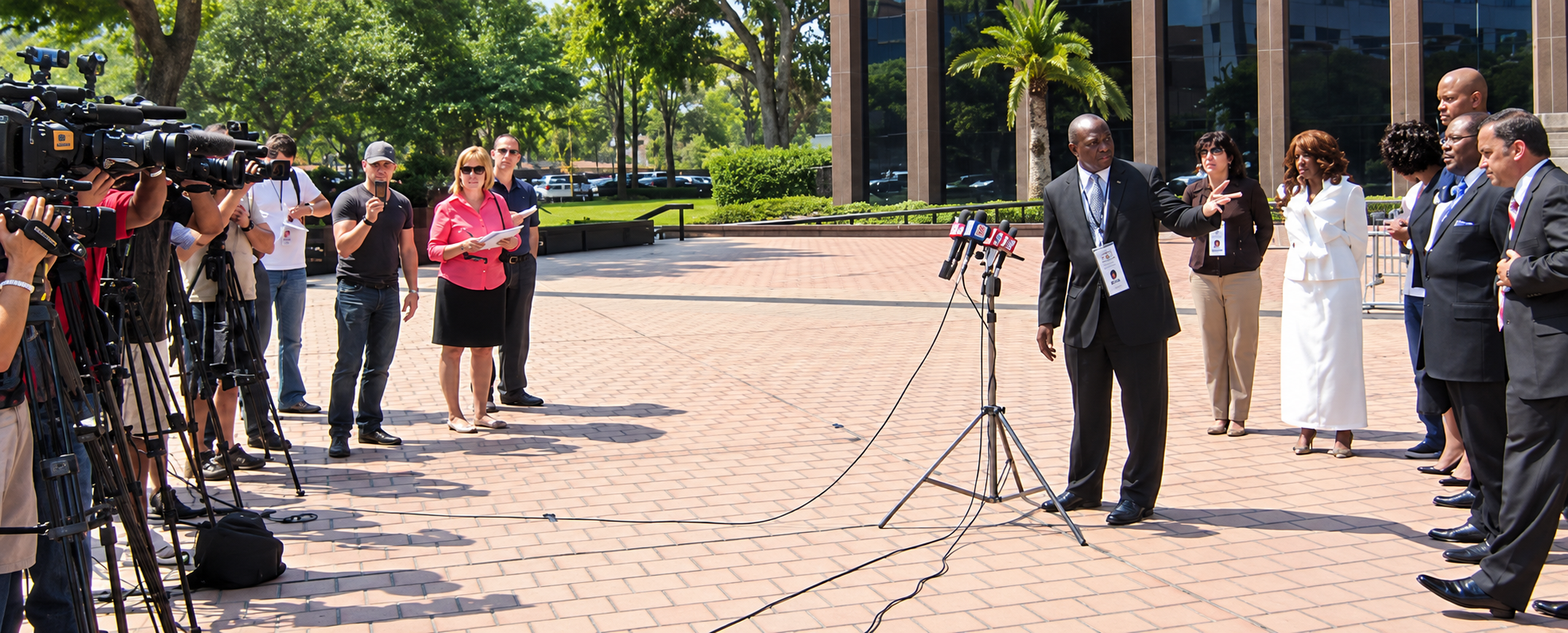
Willie DavidORLANDO, Fla. (FNN) — The Central Florida Black Caucus of Local Elected Officials held a press conference on the steps of Orlando City Hall, criticizing a new congressional map signed into law by Florida Governor Ron DeSantis.
Speakers included U.S. Congressman Maxwell Frost, State Senator Lavon Bracy-Davis, State Representative Bruce Antone, Orange County Clerk of Courts Tiffany Moore Russell, representatives from Equal Ground, and the Central Florida Urban League. Officials argued the map weakens minority representation and follows a recent U.S. Supreme Court ruling that scaled back key protections under the Voting Rights Act.
Florida National News has learned that three lawsuits have been filed seeking to block the newly approved congressional map following the redistricting process. The map is widely viewed as an effort to expand Republican representation in Florida’s congressional delegation ahead of upcoming elections.
IMPACT ON BLACK REPRESENTATION
Leaders warned the redistricting plan could significantly reduce the influence of Black voters in Central Florida and across the state. They argued that dismantling historically minority-access districts undermines decades of progress in equitable representation.
LEGAL CHALLENGES UNDERWAY
At least three lawsuits have been filed challenging the legality of the new map. Civil rights advocates contend the redistricting plan violates federal protections and could further erode voting rights following the Supreme Court’s recent decision.
FUTURE OF BLACK CONGRESSIONAL LEADERSHIP
Elected officials and advocacy groups expressed concern about the long-term effects on Black congressional representation. They emphasized the need for continued legal action and community engagement to protect fair representation in future elections.
Florida
DeSantis’ New Florida Congressional Map Could Spark Lawsuits, Legislative Showdown, and Statewide Protests
Published
2 weeks agoon
April 27, 2026TALLAHASSEE, Fla. (FNN) — Governor Ron DeSantis unveiled a proposed congressional redistricting map that could significantly reshape Florida’s representation in the U.S. House ahead of the 2026 midterm elections.
The proposal, released Monday, outlines districts that could favor Republicans in 24 seats, compared to four Democratic-leaning districts. Currently, Florida’s congressional delegation includes 20 Republicans and seven Democrats, with one vacant seat.
REDISTRICTING PROPOSAL & POLITICAL IMPACT
The governor said the new map reflects Florida’s population changes and fulfills his commitment to mid-decade redistricting. Lawmakers have been called into a special legislative session to consider the proposal.
The map appears to eliminate four Democratic-held seats, including a Tampa-area district represented by U.S. Rep. Kathy Castor, an Osceola County district held by U.S. Rep. Darren Soto—the first Puerto Rican elected to Congress from Florida—and a Palm Beach-Broward district that could displace U.S. Rep. Jared Moskowitz.
The proposal also affects a majority-Black voting district spanning Palm Beach and Broward counties, previously represented by former U.S. Rep. Sheila Cherfilus-McCormick, raising concerns about the future of minority representation.
Supporters, including Evan Power, say the map could better align districts with voter distribution. Critics, including Nikki Fried, have called the proposal unconstitutional gerrymandering. Florida law prohibits partisan gerrymandering, setting up potential legal challenges.
Rep. Tray McCurdy, D-Orlando and Rep. Angie Nixon, D-Jacksonville sit on the Florida Seal in protest as debate stops on Senate Bill 2-C: Establishing the Congressional Districts of the State in the House of Representatives Thursday, April 21, 2022 at the Capitol in Tallahassee, Fla. Rep. Daisy Morales, D-Orlando, joins the protest, holding a sign. The session was halted on the protest. (AP Photo/Phil Sears)
LOOKING BACK: 2022 PROTESTS OVER REDISTRICTING
The current debate mirrors tensions from 2022, when Democratic lawmakers staged a sit-in protest on the Florida House floor in opposition to a previous congressional map backed by DeSantis.
Lawmakers including Yvonne Hinson, Angie Nixon, Travaris McCurdy, Felicia Robinson, and Daisy Morales participated in the protest, temporarily halting legislative proceedings.
Morales, a member of the Congressional Redistricting Subcommittee and the only Hispanic lawmaker involved in the sit-in, strongly criticized the map at the time.
“Our democracy is being attacked. The governor eliminating two Black congressional seats is a power grab and it’s wrong,” Morales said in a written statement. “Stripping seats from Black representation is the same as saying the Black voice—the Black vote—doesn’t matter.”
She also warned about potential impacts on Hispanic representation:
“With this map passing, I’m deeply concerned it could target the only Puerto Rican representing Florida in Congress, Darren Soto, to benefit partisan interests. We don’t want to disenfranchise the 1.2 million Puerto Ricans in Florida.”
WHAT COMES NEXT IN 2026
As lawmakers prepare to debate the new proposal, Democrats are expected to push back through legal challenges, legislative opposition, and public advocacy.
The outcome of Florida’s redistricting battle could play a pivotal role in shaping control of the U.S. House and influence the national political landscape heading into the 2026 midterm elections.