Politics
Leavitt, 25, cites youth in bid to be youngest congresswoman
Published
4 years agoon
MANCHESTER, N.H. (AP) — Karoline Leavitt recalls being in her New Hampshire college dining hall in 2018, filling out an application for a White House intern job while her friends were tailgating at a football game.
“I remember thinking, ‘If I made this opportunity, it’s worth missing any football game in the world,’” she told The Associated Press in an interview.
She got the job. That eventually led to a position in President Donald Trump’s White House press office, then another as communications director for Rep. Elise Stefanik, R-N.Y.
Inspired by Stefanik, the youngest woman elected to Congress when she won in 2014 at age 30, Leavitt is now running for a House seat of her own. At age 25, she could make history on Election Day, Nov. 8: Rep. Alexandria Ocasio-Cortez, D-N.Y., won at 29 in 2018.
Leavitt, an unabashed pro-Trump Republican, would also be the youngest person in the next session of Congress if she were to defeat two-term Democratic Rep. Chris Pappas in one of the most competitive races this year. Leavitt is seven months younger then fellow Gen Z candidate Maxwell Alejandro Frost, a Florida Democrat favored in his race.
The New Hampshire contest will test the appeal of a far-right candidate in a Democratic-leaning state in a midterm election that historically has served as a referendum on the current president.
The 1st Congressional District has a history of switching between parties. It flipped five times in seven elections before Pappas, now 42, won the open seat in 2018. The district includes Manchester, the state’s most populous city, Portsmouth on the Seacoast and rural communities farther north.
Leavitt won her 10-way Republican primary in September in part by going to the right of the other candidates, including Matt Mowers, the party’s 2020 nominee. Mowers also worked in the Trump administration and has said he believed there were voting irregularities in the 2020 presidential election won by Democrat Joe Biden.
“I consistently continue to be the only candidate in this race who says that I believe the 2020 election was undoubtedly stolen from President Trump,” Leavitt said during a debate a week before the primary.
Numerous federal and local election officials of both parties, a long list of courts, top former campaign staffers and even Trump’s own attorney general have said there is no evidence of that. Trump recently endorsed Leavitt, calling her “fantastic.”
“Matt Mowers had solid Trump credentials,” said Dante Scala, a University of New Hampshire professor of political science. “And yet she managed to out-Trump him … and that meant also expressing a lie about a stolen election without reservation.”
Pappas called Leavitt extreme and said her claims about the 2020 election “are not based in truth or reality” and are “dangerous.” Leavitt contends that Pappas and House Speaker Nancy Pelosi, D-Calif., “are the real extremists,” citing their support for a federal elections bill named after the late Rep. John Lewis, D-Ga., that would have created national automatic voter registration, allowed all voters to cast ballots by mail and weakened voter ID laws, among other things.
“Washington is broken, and it won’t get fixed if we keep sending the same people back there,” said Sununu, who lives in the 1st District. “Karoline Leavitt is the new voice and principled vote New Hampshire needs in Congress.”
Pappas and Leavitt have little in common beyond backgrounds in family small businesses — his at a restaurant known for its ice cream, hers working at an ice cream stand and at a used truck and car dealership.
The two have sparred over inflation, the future of Social Security and abortion.
Leavitt contends that the Inflation Reduction Act, which Pappas voted for, will actually increase inflation at a time when families are struggling.
Pappas notes that the new law has capped out-of-pocket costs for older adults on Medicare and provides energy rebates for businesses and families. He said it is fully paid for, will lower energy and health costs costs, and will reduce the deficit by $1.9 trillion over 20 years.
On Social Security, Pappas has accused Leavitt of wanting to privatize it “and gamble it on the stock market.” Leavitt said she would work to protect the benefits of anyone who has paid into the system and is open to “alternative solutions that will ensure a better future for your children and grandchildren.” She said Pappas wants to raise taxes on high earners to continue supporting Social Security.
On abortion, Pappas said he would support the Women’s Health Protection Act, which would protect the right to access abortion care nationwide after the overturning of Roe v. Wade.
Leavitt pledged on her campaign website to be a “fearless pro-life advocate” if elected to Congress. She said she supports having state legislatures make decisions on abortion regulations and would oppose a federal abortion ban.
As a contrast to Leavitt, who has never held elected office, Pappas notes his bipartisan record in Congress and his “People Over Party” coalition of supporters that include Republicans, former Republicans and independents.
“Her professional background is as Donald Trump’s spin doctor in the White House,” Pappas said. “She’s never worked with Democrats on anything.”
Kathleen Sullivan, former chair of the New Hampshire Democratic Party, wrote in a column in the New Hampshire Union Leader that “it is difficult to see Leavitt working with Democrats in the way that Pappas has worked with Republicans.” She cited Leavitt’s references to Democrats as “radical, power-hungry socialists” and previous comments that climate change is “a manufactured crisis” created by the Democrats.
Leavitt says her experience working in the White House prepared her well for Congress, with the West Wing “perhaps one of the most fast paced, high pressure work environments there is.”
She says her youth would be an advantage in Congress.
“There’s people on both sides of the aisle that have been down there literally twice as long as I have been alive,” said Leavitt, who campaigned at college campuses, including her alma mater, Saint Anselm College in Manchester. “That’s a problem for our republic. That’s a problem for your young voters who really want a voice.”
Stefanik, now the third-ranking Republican in the House, endorsed Leavitt early on, calling her a “rising star in the Republican Party who will carry the torch of conservative values for generations to come.” Leavitt credits Stefanik with encouraging her to mount a campaign.
“Nobody told her she was going to win, but she believed in herself,” Leavitt said. “That was very inspiring to me. And I thought, ‘Why can’t I do that from my own home district?’”
You may like
Central Florida News
Orlando Commissioner Tony Ortiz Files for Mayor, Could Become City’s First Puerto Rican Mayor
Published
2 hours agoon
May 12, 2026By
Willie DavidORLANDO, Fla. (FNN) — Tony Ortiz, a longtime Orlando city commissioner, former Marine, and former law enforcement officer, has officially filed to run for mayor of Orlando following Mayor Buddy Dyer’s announcement that he will not seek re-election.
Ortiz filed his candidacy ahead of the November 2027 nonpartisan mayoral election. If elected, he would become Orlando’s first Puerto Rican mayor.
GROWING FIELD OF CANDIDATES
Ortiz joins a growing field of candidates that includes State Representative Anna Eskamani, who could become Orlando’s first Iranian American mayor if elected, along with Elliot Kahanna and Abdelnasser Luth.
In his campaign announcement, Ortiz emphasized issues affecting residents across Orlando, including housing affordability, public safety, homelessness, transportation, economic opportunity, and neighborhood stability.
“As the City of Orlando continues to grow and evolve, residents across the city are increasingly focused on the issues that shape everyday life,” Ortiz stated in his campaign announcement.
LAW ENFORCEMENT BACKGROUNDS RESONATE WITH ORANGE COUNTY VOTERS
Political observers note that Orange County voters have historically supported candidates with backgrounds in local, state, and federal law enforcement or public safety roles.
Examples include Orange County Mayor Jerry Demings, former Orange County sheriff; former U.S. Congresswoman Val Demings, former Orlando police chief; former State Senator Victor Torres, a former NYC Transit Police officer; Maitland City Commissioner Keith Givens, a retired FBI agent; former State Representative Daisy Morales, a former HSI official; Apopka City Commissioner Diane Velazquez, a former NYPD officer; and former Orlando City Commissioner Samuel Ings, a former Orlando police officer.
HISTORIC OPPORTUNITY FOR REPRESENTATION
Ortiz’s candidacy highlights the continued growth and political influence of Central Florida’s Puerto Rican community. If successful, his election would mark a historic milestone for Puerto Rican representation in Orlando city government.
Florida
Central Florida Lawmakers Challenge DeSantis Redistricting Map as Lawsuits Mount
Published
6 days agoon
May 6, 2026By
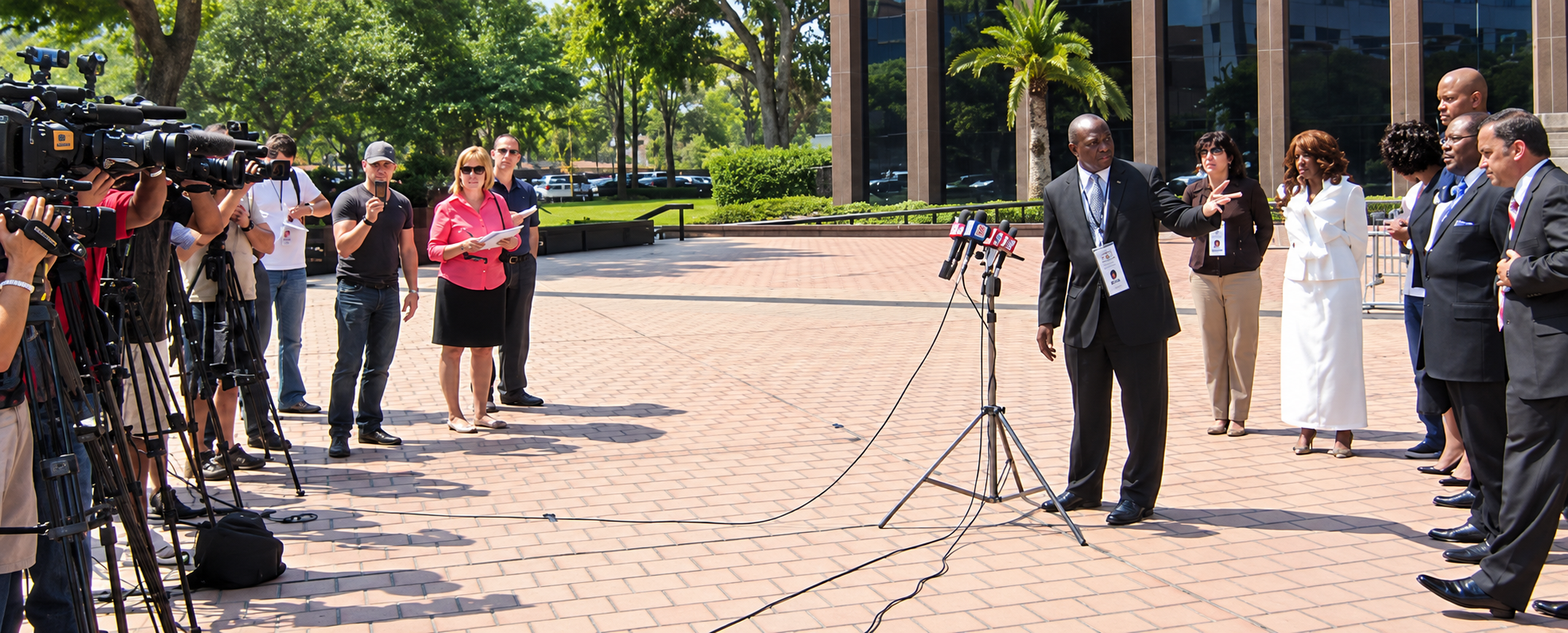
Willie DavidORLANDO, Fla. (FNN) — The Central Florida Black Caucus of Local Elected Officials held a press conference on the steps of Orlando City Hall, criticizing a new congressional map signed into law by Florida Governor Ron DeSantis.
Speakers included U.S. Congressman Maxwell Frost, State Senator Lavon Bracy-Davis, State Representative Bruce Antone, Orange County Clerk of Courts Tiffany Moore Russell, representatives from Equal Ground, and the Central Florida Urban League. Officials argued the map weakens minority representation and follows a recent U.S. Supreme Court ruling that scaled back key protections under the Voting Rights Act.
Florida National News has learned that three lawsuits have been filed seeking to block the newly approved congressional map following the redistricting process. The map is widely viewed as an effort to expand Republican representation in Florida’s congressional delegation ahead of upcoming elections.
IMPACT ON BLACK REPRESENTATION
Leaders warned the redistricting plan could significantly reduce the influence of Black voters in Central Florida and across the state. They argued that dismantling historically minority-access districts undermines decades of progress in equitable representation.
LEGAL CHALLENGES UNDERWAY
At least three lawsuits have been filed challenging the legality of the new map. Civil rights advocates contend the redistricting plan violates federal protections and could further erode voting rights following the Supreme Court’s recent decision.
FUTURE OF BLACK CONGRESSIONAL LEADERSHIP
Elected officials and advocacy groups expressed concern about the long-term effects on Black congressional representation. They emphasized the need for continued legal action and community engagement to protect fair representation in future elections.
Florida
DeSantis’ New Florida Congressional Map Could Spark Lawsuits, Legislative Showdown, and Statewide Protests
Published
2 weeks agoon
April 27, 2026TALLAHASSEE, Fla. (FNN) — Governor Ron DeSantis unveiled a proposed congressional redistricting map that could significantly reshape Florida’s representation in the U.S. House ahead of the 2026 midterm elections.
The proposal, released Monday, outlines districts that could favor Republicans in 24 seats, compared to four Democratic-leaning districts. Currently, Florida’s congressional delegation includes 20 Republicans and seven Democrats, with one vacant seat.
REDISTRICTING PROPOSAL & POLITICAL IMPACT
The governor said the new map reflects Florida’s population changes and fulfills his commitment to mid-decade redistricting. Lawmakers have been called into a special legislative session to consider the proposal.
The map appears to eliminate four Democratic-held seats, including a Tampa-area district represented by U.S. Rep. Kathy Castor, an Osceola County district held by U.S. Rep. Darren Soto—the first Puerto Rican elected to Congress from Florida—and a Palm Beach-Broward district that could displace U.S. Rep. Jared Moskowitz.
The proposal also affects a majority-Black voting district spanning Palm Beach and Broward counties, previously represented by former U.S. Rep. Sheila Cherfilus-McCormick, raising concerns about the future of minority representation.
Supporters, including Evan Power, say the map could better align districts with voter distribution. Critics, including Nikki Fried, have called the proposal unconstitutional gerrymandering. Florida law prohibits partisan gerrymandering, setting up potential legal challenges.
Rep. Tray McCurdy, D-Orlando and Rep. Angie Nixon, D-Jacksonville sit on the Florida Seal in protest as debate stops on Senate Bill 2-C: Establishing the Congressional Districts of the State in the House of Representatives Thursday, April 21, 2022 at the Capitol in Tallahassee, Fla. Rep. Daisy Morales, D-Orlando, joins the protest, holding a sign. The session was halted on the protest. (AP Photo/Phil Sears)
LOOKING BACK: 2022 PROTESTS OVER REDISTRICTING
The current debate mirrors tensions from 2022, when Democratic lawmakers staged a sit-in protest on the Florida House floor in opposition to a previous congressional map backed by DeSantis.
Lawmakers including Yvonne Hinson, Angie Nixon, Travaris McCurdy, Felicia Robinson, and Daisy Morales participated in the protest, temporarily halting legislative proceedings.
Morales, a member of the Congressional Redistricting Subcommittee and the only Hispanic lawmaker involved in the sit-in, strongly criticized the map at the time.
“Our democracy is being attacked. The governor eliminating two Black congressional seats is a power grab and it’s wrong,” Morales said in a written statement. “Stripping seats from Black representation is the same as saying the Black voice—the Black vote—doesn’t matter.”
She also warned about potential impacts on Hispanic representation:
“With this map passing, I’m deeply concerned it could target the only Puerto Rican representing Florida in Congress, Darren Soto, to benefit partisan interests. We don’t want to disenfranchise the 1.2 million Puerto Ricans in Florida.”
WHAT COMES NEXT IN 2026
As lawmakers prepare to debate the new proposal, Democrats are expected to push back through legal challenges, legislative opposition, and public advocacy.
The outcome of Florida’s redistricting battle could play a pivotal role in shaping control of the U.S. House and influence the national political landscape heading into the 2026 midterm elections.