Politics
‘NewsHour’ host and debate moderator Jim Lehrer dies at 85
Published
6 years agoon
NEW YORK (AP) — Jim Lehrer, longtime host of the nightly PBS “NewsHour” whose serious, sober demeanor made him the choice to moderate 11 presidential debates between 1988 and 2012, has died, PBS said Thursday. He was 85.
Lehrer died “peacefully in his sleep,” according to PBS. He had suffered a heart attack in 1983 and more recently, had undergone heart valve surgery in April 2008.
For Lehrer, and for his friend and longtime partner Robert MacNeil, broadcast journalism was a service, with public understanding of events and issues its primary goal.
“We both believed the American people were not as stupid as some of the folks publishing and programming for them believed,” Lehrer wrote in his 1992 memoir, “A Bus of My Own.”
“We were convinced they cared about the significant matters of human events. … And we were certain they could and would hang in there more than 35 seconds for information about those subjects if given a chance.”
Tributes poured in from colleagues and watchers alike, including from Fox News’ Bret Baier, who called Lehrer “an inspiration to a whole generation of political journalists— including this one.” Dan Rather said “few approached their work with more equanimity and integrity than Jim Lehrer.” And Jake Tapper of CNN called Lehrer “a wonderful man and a superb journalist.” House Speaker Nancy Pelosi called him a “champion for truth and transparency.”
Many Americans knew him best for his role as debate moderator. For seven straight presidential elections, he was the sole journalist sitting across from the candidates for the first debate of the general election campaign. In 1996 and 2000, he moderated all of the debates — five of them — and a vice presidential contest to boot.
He told The Associated Press in 2011 that his goal was to probe the candidates’ thinking and avoid “gotcha” questions. He felt his best debate performance was in 2004, with George W. Bush and John Kerry, not because of anything he did, but because the candidates were able to state their positions clearly.
“I didn’t get in the way,” said Lehrer, whose book “Tension City: Inside the Presidential Debates” told stories of his experiences. “Nobody was talking about what I did as a moderator. I didn’t become part of the story.”
He was lured out of retirement for his last debate in 2012 and it may have been a mistake; he received criticism that year for having too light a touch on the proceedings.
The half-hour “Robert MacNeil Report” began on PBS in 1975 with Lehrer as Washington correspondent. The two had already made names for themselves at the then-fledgling network through their work with the National Public Affairs Center for Television and its coverage of the Watergate hearings in 1973.
The nightly news broadcast, later retitled the “MacNeil-Lehrer Report,” became the nation’s first one-hour TV news broadcast in 1983 and was then known as the “MacNeil-Lehrer NewsHour.” After MacNeil bowed out in 1995, it became “The NewsHour with Jim Lehrer.”
“I’m heartbroken at the loss of someone who was central to my professional life, a mentor to me and someone whose friendship I’ve cherished for decades,” said Judy Woodruff, anchor and managing editor of the PBS NewsHour, in a statement.
Politics, international relations, economics, science, even developments in the arts were all given lengthy, detailed coverage in their show.
“When we expanded to the hour, it changed from being a supplement to an alternative,” Lehrer said in 1990. “Now we take the position that if you’re looking for a place to go every 24 hours and find out what’s happened and get some in-depth treatment, we’re the place.”
Lehrer moderated his first presidential debate in 1988 and was a frequent consensus choice for the task in subsequent presidential contests. He likened the job to “walking down the blade of a knife.”
“Anybody who would say it’s just another TV show is a liar or a fool,” he once said. “I know how important it is, but it’s not about me. It’s what the candidates say that matters.”
He also anchored PBS coverage of inaugurations and conventions, dismissing criticism from other TV news organizations that the latter had become too scripted to yield much in the way of real news.
“I think when the major political parties of this country gather together their people and resources in one place to nominate their candidates, that’s important,” he told The Associated Press in 2000. “To me, it’s a non-argument. I don’t see why someone would argue that it wasn’t important.”
Naturally, Lehrer came in for some knocks for being so low-key in the big televised events. After a matchup between George W. Bush and Al Gore in 2000, David Letterman cracked, “Last night was probably the first and only that time Jim Lehrer (was) the most exciting person in the room.”
But the real-life Lehrer — who had a tradition of buying a new tie for good luck before each debate — was more colorful than he might have seemed on PBS.
On the side, he was also a novelist and sometime playwright. His debut novel “Viva Max!” was made into a movie starring Peter Ustinov. He did a whole series of novels about the adventures of an Oklahoma politician known as The One-Eyed Mack.
“Hemingway said this, too: If you paid attention as a reporter, then when the time came to write fiction you’d have something to write about,” Lehrer told The Associated Press in 1991.
“And it turned out I did. And I’ve got all these stories stored up after 30 years in the news business. And they’re just flowing out of me.”
As Lehrer turned 75 in spring 2009, PBS announced that the show would be retitled as “PBS NewsHour” later in the year, with Lehrer pairing up on anchor duties with other show regulars.
He said he approved of the changes, telling The New York Times that having a pair of anchors would “shake things up a bit,” even as all sectors of the news business struggled to meet changing reader and viewer demands.
Lehrer was born in Wichita, Kansas, in 1934, the son of parents who ran a bus line. In addition to titling his memoir “A Bus of My Own,” he collected bus memorabilia — from station signs to a real 1946 Flxible Clipper bus.
After graduation from college in 1956, he served three years in the Marines, later calling the experience so valuable that he thought all young people should take part in national service.
“I had no close calls, no rendezvous with danger, no skirted destinies with death,” he wrote. “What I had was a chance to discover and test myself, physically and emotionally and spiritually, in important, lasting ways.”
He went to work from 1959 to 1970 at The Dallas Morning News and the now-defunct Dallas Times-Herald. Lehrer jumped to television for a Dallas nightly newscast.
Lehrer wrote that it was ironic that the Watergate hearings helped establish the importance of public TV, since President Richard Nixon hated public broadcasting. He also recalled that the lengthy hearings gave him the chance to practice his new craft, and MacNeil, already a veteran, gave him valuable pointers on how to speak on camera clearly and conversationally.
He is survived by his wife, Kate; three daughters: Jamie, Lucy, and Amanda; and six grandchildren.
You may like
Florida
Central Florida Lawmakers Challenge DeSantis Redistricting Map as Lawsuits Mount
Published
6 days agoon
May 6, 2026By
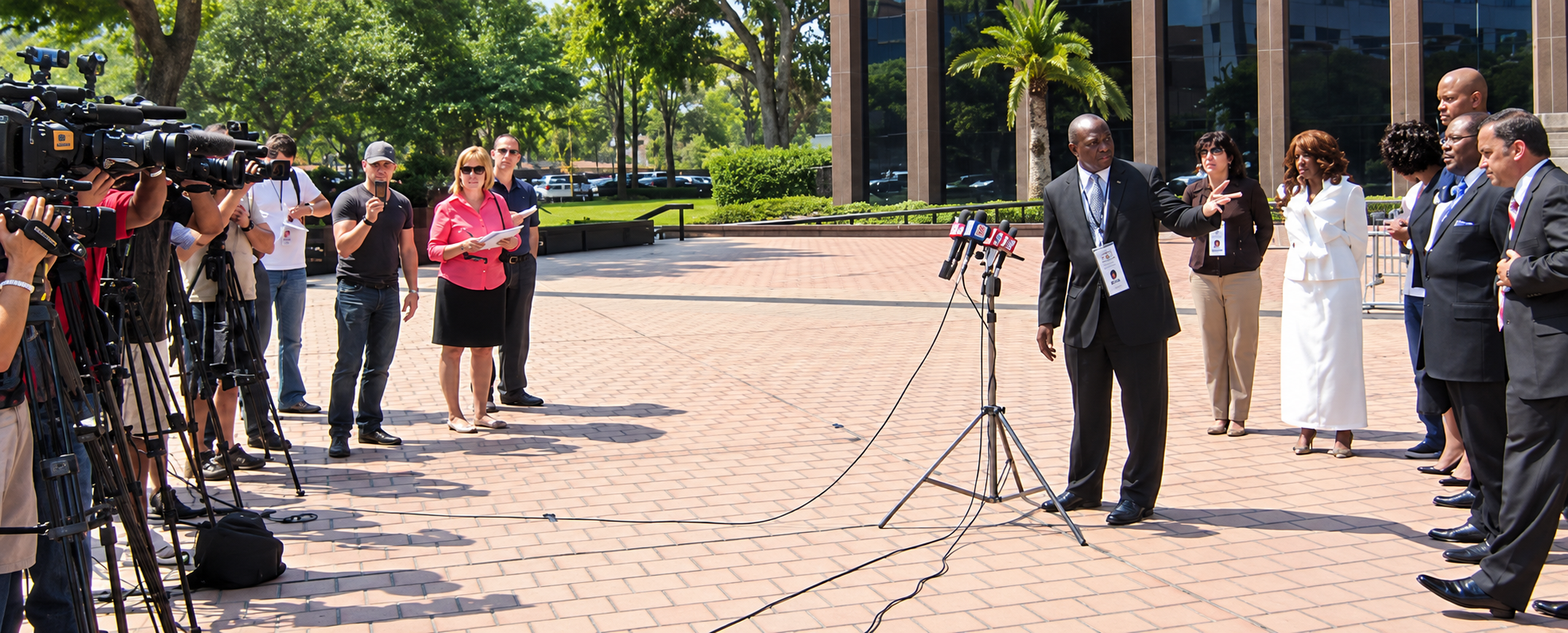
Willie DavidORLANDO, Fla. (FNN) — The Central Florida Black Caucus of Local Elected Officials held a press conference on the steps of Orlando City Hall, criticizing a new congressional map signed into law by Florida Governor Ron DeSantis.
Speakers included U.S. Congressman Maxwell Frost, State Senator Lavon Bracy-Davis, State Representative Bruce Antone, Orange County Clerk of Courts Tiffany Moore Russell, representatives from Equal Ground, and the Central Florida Urban League. Officials argued the map weakens minority representation and follows a recent U.S. Supreme Court ruling that scaled back key protections under the Voting Rights Act.
Florida National News has learned that three lawsuits have been filed seeking to block the newly approved congressional map following the redistricting process. The map is widely viewed as an effort to expand Republican representation in Florida’s congressional delegation ahead of upcoming elections.
IMPACT ON BLACK REPRESENTATION
Leaders warned the redistricting plan could significantly reduce the influence of Black voters in Central Florida and across the state. They argued that dismantling historically minority-access districts undermines decades of progress in equitable representation.
LEGAL CHALLENGES UNDERWAY
At least three lawsuits have been filed challenging the legality of the new map. Civil rights advocates contend the redistricting plan violates federal protections and could further erode voting rights following the Supreme Court’s recent decision.
FUTURE OF BLACK CONGRESSIONAL LEADERSHIP
Elected officials and advocacy groups expressed concern about the long-term effects on Black congressional representation. They emphasized the need for continued legal action and community engagement to protect fair representation in future elections.
Florida
DeSantis’ New Florida Congressional Map Could Spark Lawsuits, Legislative Showdown, and Statewide Protests
Published
2 weeks agoon
April 27, 2026TALLAHASSEE, Fla. (FNN) — Governor Ron DeSantis unveiled a proposed congressional redistricting map that could significantly reshape Florida’s representation in the U.S. House ahead of the 2026 midterm elections.
The proposal, released Monday, outlines districts that could favor Republicans in 24 seats, compared to four Democratic-leaning districts. Currently, Florida’s congressional delegation includes 20 Republicans and seven Democrats, with one vacant seat.
REDISTRICTING PROPOSAL & POLITICAL IMPACT
The governor said the new map reflects Florida’s population changes and fulfills his commitment to mid-decade redistricting. Lawmakers have been called into a special legislative session to consider the proposal.
The map appears to eliminate four Democratic-held seats, including a Tampa-area district represented by U.S. Rep. Kathy Castor, an Osceola County district held by U.S. Rep. Darren Soto—the first Puerto Rican elected to Congress from Florida—and a Palm Beach-Broward district that could displace U.S. Rep. Jared Moskowitz.
The proposal also affects a majority-Black voting district spanning Palm Beach and Broward counties, previously represented by former U.S. Rep. Sheila Cherfilus-McCormick, raising concerns about the future of minority representation.
Supporters, including Evan Power, say the map could better align districts with voter distribution. Critics, including Nikki Fried, have called the proposal unconstitutional gerrymandering. Florida law prohibits partisan gerrymandering, setting up potential legal challenges.
Rep. Tray McCurdy, D-Orlando and Rep. Angie Nixon, D-Jacksonville sit on the Florida Seal in protest as debate stops on Senate Bill 2-C: Establishing the Congressional Districts of the State in the House of Representatives Thursday, April 21, 2022 at the Capitol in Tallahassee, Fla. Rep. Daisy Morales, D-Orlando, joins the protest, holding a sign. The session was halted on the protest. (AP Photo/Phil Sears)
LOOKING BACK: 2022 PROTESTS OVER REDISTRICTING
The current debate mirrors tensions from 2022, when Democratic lawmakers staged a sit-in protest on the Florida House floor in opposition to a previous congressional map backed by DeSantis.
Lawmakers including Yvonne Hinson, Angie Nixon, Travaris McCurdy, Felicia Robinson, and Daisy Morales participated in the protest, temporarily halting legislative proceedings.
Morales, a member of the Congressional Redistricting Subcommittee and the only Hispanic lawmaker involved in the sit-in, strongly criticized the map at the time.
“Our democracy is being attacked. The governor eliminating two Black congressional seats is a power grab and it’s wrong,” Morales said in a written statement. “Stripping seats from Black representation is the same as saying the Black voice—the Black vote—doesn’t matter.”
She also warned about potential impacts on Hispanic representation:
“With this map passing, I’m deeply concerned it could target the only Puerto Rican representing Florida in Congress, Darren Soto, to benefit partisan interests. We don’t want to disenfranchise the 1.2 million Puerto Ricans in Florida.”
WHAT COMES NEXT IN 2026
As lawmakers prepare to debate the new proposal, Democrats are expected to push back through legal challenges, legislative opposition, and public advocacy.
The outcome of Florida’s redistricting battle could play a pivotal role in shaping control of the U.S. House and influence the national political landscape heading into the 2026 midterm elections.
Politics
Gov. Ron DeSantis Orders Flags at Half-Staff for Slain Coral Springs Vice Mayor Nancy M. Metayer Bowen
Published
4 weeks agoon
April 16, 2026TALLAHASSEE, Fla. (FNN) — Gov. Ron DeSantis has ordered flags to be flown at half-staff in honor of Coral Springs Vice Mayor Nancy M. Metayer Bowen, who was killed April 1 in what authorities describe as a domestic violence incident.
The directive calls for U.S. and Florida state flags to be lowered from sunrise to sunset Friday, April 17, 2026, at the State Capitol in Tallahassee and at all local and state buildings, installations and grounds throughout Coral Springs.
According to Coral Springs Police, officers conducted a wellness check at Metayer Bowen’s home after city staff raised concerns when she missed scheduled meetings and could not be reached. Responding officers found her deceased inside the residence.
Investigators said the killing appears to be a domestic violence incident. Her husband, Stephen Bowen, was later taken into custody and faces charges of premeditated murder and tampering with evidence. The case remains under active investigation.
State and local leaders say the half-staff order honors Metayer Bowen’s service and legacy in the Coral Springs community, where she was recognized for her leadership and commitment to public service.
What We Know About Her Death
Police say Metayer Bowen was killed April 1 at her Coral Springs home. Officers discovered her body during a wellness check prompted by her unexplained absence from official duties and lack of communication.
Husband Arrested, Faces Charges
Authorities arrested her husband, Stephen Bowen, who now faces premeditated murder and evidence-tampering charges. Investigators have identified the case as an apparent domestic violence incident.
State Honors Her Legacy
Gov. DeSantis ordered flags lowered across key government buildings in Tallahassee and Coral Springs, recognizing Metayer Bowen’s public service and the impact of her loss on the community.