

Florida
STUDY: These States Are the Best for Single Parents to Raise Children


Florida
Venezuelan Candidate Samuel Vilchez Santiago Leads Florida House Race with Nearly $200,000 Raised as Cross-Party Endorsement Scandal Continues


ORLANDO, Fla. (FNN NEWS) — Democratic Florida House District 43 candidate Samuel Vilchez Santiago has emerged as the fundraising and endorsement leader in the 2026 Democratic primary while continued questions surrounding the Orange County Democratic Executive Committee’s handling of internal party discipline have become an issue in the closely watched legislative race.

According to his campaign website, Samuel Vilchez Santiago serves as a Senior Nonprofit Manager at ActBlue, where he helps thousands of nonprofits and grassroots organizations across the country build people-powered fundraising programs aimed at shifting political influence away from corporations and toward communities.
According to publicly available campaign finance reports and his campaign website, Vilchez Santiago has secured endorsements from numerous Democratic elected officials, labor organizations, and party-affiliated political committees. His campaign biography states that he serves as a Senior Nonprofit Manager at ActBlue, one of the nation’s largest Democratic fundraising platforms.
Vilchez Santiago has also publicly discussed his family’s political history, including fleeing Venezuela and seeking asylum in the United States as political refugees.
“I grew up with politics in my house. My grandfather was a communist and my parents were very politically involved against the Chavista regime.”
— Samuel Vilchez Santiago, quoted in a 2019 Princeton University profile
The statement has become part of his publicly available political biography and has resurfaced during the 2026 campaign as voters examine candidates’ personal backgrounds and political histories.
The statement has received renewed attention amid heightened national political debate over socialism and communism. President Donald Trump and other Republican leaders have frequently criticized segments of the Democratic Party by arguing that some Democratic candidates and democratic socialist movements reflect increasingly left-wing political ideologies. Although Vilchez Santiago has not publicly identified himself as a communist, his own description of his family’s political history has become part of the broader political discussion surrounding his candidacy.
Campaign finance reports show that Central Floridians for Change PAC, affiliated with Samuel Vilchez Santiago’s political operation, contributed $40,000 to the Florida House Democratic Campaign Committee ahead of the August 18, 2026, Democratic primary.
Fundraising and Endorsement Advantage
The Democratic primary for Florida House District 43 has developed into one of Central Florida’s most competitive legislative contests, with a significant disparity in campaign fundraising between the two Democratic candidates.
According to campaign finance reports, Vilchez Santiago‘s campaign raised more than $139,000 and spent more than $114,000 during the election cycle.
A political committee affiliated with Vilchez Santiago’s political operation, Central Floridians for Change PAC, reported raising more than $55,000 and spending approximately $43,000. The PAC’s chair and treasurer is José Gamboa, who also serves as treasurer for Vilchez Santiago’s campaign. Gamboa is also an Account Management Specialist with the Democratic fundraising platform ActBlue.
Campaign finance reports show one of the PAC’s largest expenditures was a $40,000 contribution to the Florida House Democratic Campaign Committee, the political committee responsible for supporting Democratic candidates seeking election to the Florida House of Representatives. The contribution represents a substantial portion of the PAC’s reported expenditures and has become a point of discussion during the Democratic primary.
Combined, the campaign and PAC reported raising approximately $200,000, giving Vilchez Santiago a significant financial advantage over former State Representative Daisy Morales, whose campaign finance reports show approximately $8,400 raised and about $6,500 spent during the same reporting period.
Campaign finance reports show that Johanna López, then a candidate for Florida House District 43, raised approximately $58,000 during the 2022 election cycle. As the incumbent seeking reelection in 2024, her campaign finance reports show she raised approximately $68,000 for the same Florida House District 43 seat now being contested by Samuel Vilchez Santiago and Daisy Morales.
Vilchez Santiago has also secured endorsement from current Florida House Democratic Leader Fentrice Driskell, numerous Democratic elected officials, organized labor unions, and party-affiliated organizations.
Despite the fundraising disparity, history suggests campaign spending alone does not determine election outcomes. During the 2020 Democratic primary for Florida House District 48, Vilchez Santiago also enjoyed a fundraising and endorsement advantage. Morales nevertheless defeated him by approximately ten percentage points before winning the general election and serving in the Florida House.
Political observers noted Morales’ countywide name recognition, earned during her service as an elected Orange County Soil and Water Conservation District Supervisor, may have contributed to that victory.
While fundraising and endorsements often increase campaign visibility, advertising, and voter outreach, Morales has argued that legislative experience, constituent service, and a demonstrated record of passing legislation are more important measures of a candidate’s preparedness to serve in the Florida House.


Former Rivals Meet Again
The 2026 Democratic primary represents a rematch between Vilchez Santiago and Morales, whose political rivalry dates back to the 2020 election.
During Vilchez Santiago’s 2020 campaign, current State Representative Johanna López served as his campaign manager, while José Gamboa served as deputy campaign for Vilchez Santiago’s campain.
Morales has argued that these longstanding political relationships warrant public examination because several individuals connected to Vilchez Santiago’s earlier campaigns later assumed influential roles within Democratic Party organizations or campaign operations.
Florida National News has not independently concluded that these relationships affected any party disciplinary decisions. However, Morales has cited them as part of her request for an independent review by the Florida Democratic Party.
Morales continues to emphasize her legislative accomplishments, constituent services, appropriations secured for Central Florida, and previous electoral victories as evidence that she is prepared to return to Tallahassee.

Local Democratic Party Dispute Continues
Beyond traditional campaign issues, the House District 43 race has become intertwined with an ongoing dispute involving the Orange County Democratic Executive Committee.

According to campaign records, Angie Gallo endorsed and served as campaign manager for Republican candidate Joel Montilla’s campaign
Morales contends the committee selectively enforced party rules following the 2024 Orange County Commission District 5 election, ultimately resulting in her removal from the local Democratic Party.
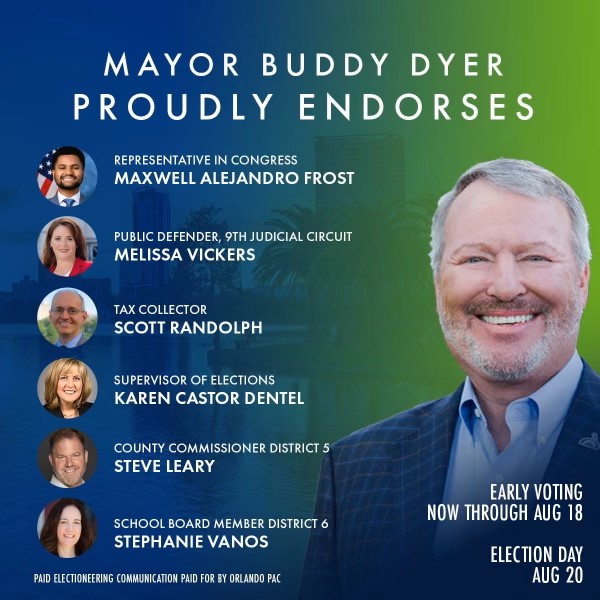
According to several news reports, Orlando Mayor Buddy Dyer endorsed Republican former Winter Park Mayor and Orange County Commission District 5 candidate Steve Leary. Mayor Dyer has endorsed Republican candidates in previous elections as well. Florida National News is not aware of any public disciplinary action taken by the Orange County Democratic Executive Committee regarding those cross-party endorsements.
According to Morales, other Democrats who participated in the same election and allegedly engaged in similar cross-party political activity were not subjected to comparable disciplinary proceedings.
Morales said her removal, combined with the absence of publicly known disciplinary action against other Democrats in similar circumstances, raises questions about whether party rules were enforced consistently, whether preferential treatment was given, and whether adequate oversight existed throughout the disciplinary process.
Morales has requested that the Florida Democratic Party conduct an independent review to determine whether party rules were applied consistently, whether due process requirements were followed, and whether conflicts of interest existed during the disciplinary process.
Florida National News has not independently verified those allegations, and the Florida Democratic Party has not publicly announced the results of any review concerning the matter.
Why the Records Matter
Morales has stated that both she and the Orlando Sentinel requested records concerning the disciplinary process, including meeting minutes, resolutions, voting records, notices of alleged violations, correspondence, investigative materials, and documentation supporting the committee’s actions.
According to Morales, those records are necessary to determine whether party bylaws were followed and whether disciplinary procedures were applied equally to similarly situated Democrats.
Florida National News will also request the same records from both the Orange County Democratic Executive Committee and the Florida Democratic Party and will publish any responsive documents or official statements received.
Questions That Remain
Several questions remain unanswered as the Democratic primary approaches, including:
- Were identical party rules applied consistently to every Democrat involved in the 2024 Orange County Commission District 5 race?
- What official findings, if any, supported the committee’s disciplinary action?
- Will the Florida Democratic Party conduct or publish an independent review?
- Will the requested records be released to the public?
Florida National News will continue reporting on campaign finance filings, public records, candidate responses, and any official actions related to this matter as additional information becomes available.
Business
Essence Magazine Co-Founder Jonathan Blount Dies at 84, Leaving Enduring Legacy in Civil Rights and Black Media


 Florida3 days ago
Venezuelan Candidate Samuel Vilchez Santiago Leads Florida House Race with Nearly $200,000 Raised as Cross-Party Endorsement Scandal Continues
 Central Florida News3 days ago
Orange County Sheriff’s Office: Teen Arrested on Evidence Tampering Charge in Deadly Old Cheney Highway Shooting


 Central Florida News3 days ago
City of Orlando Earns Top-Tier ISO Building Code Effectiveness Rating, Reinforcing Commitment to Safety and Resilience
 Florida3 days ago
Alex Vindman Calls on Ashley Moody to Support Release of Hope Florida Grand Jury Report
 Central Florida News3 days ago
Orlando Magic Earn NBA Team International Strategy Award for Second Consecutive Year


